Want Your Content to Get Cited By ChatGPT, Gemini and AI Models?
Choose LLM content optimisation at DWS to ensure your content is crisp, credible and addresses user queries directly, increasing your brand visibility.
Top Brands Who Believe in Us for AI Citable Content


















What is LLM Content Optimisation?
By offering an immediate boost to your brand, it improves brand visibility and reputation, and eventually generates more revenue. We, at DWS, refine existing content on your website and develop human-led content strategies which help AI systems understand your brand message, target audience, and which user queries it can answer.
Effective LLM optimisation not only strengthens your brand’s discoverability, but also supports topical authority. So, whenever there is a relevant query, your content is referenced in AI-generated responses.
-
Understand user intent
Identify queries asked by a user and what kind of information they are looking for to make decisions.
-
Strengthen content structure
Organise information with descriptive headings, concise explanations, relevant examples and direct answers.
-
Build topical depth
Cover important subjects and related questions consistently to demonstrate the breadth of your expertise.
-
Improve credibility
Review facts, support important claims with reliable sources and demonstrate relevant experience and expertise.
Why Does LLM Content Optimisation Matter?
Since user behaviour has changed over time, the significance of generative search and conversational search has increased. Users now prefer direct answers instead of clicking blue links to get more information.
LLM optimisation immediately boosts brand awareness, protects and improves the brand’s reputation, which eventually leads to higher revenue.

Better Content Understanding
Clear headings, concise explanations and a logical content structure help AI systems interpret your content and identify relevant information. This makes it easier to connect your expertise with user queries.

Higher Brand Discoverability
LLM content optimisation helps present your brand’s expertise, products and services in a clear, accessible format. This can improve your chances of being discovered when users explore relevant topics through AI-powered search tools.

Increased Citation Chances
AI systems may reference content that provides relevant answers, credible evidence and useful insights. By improving content quality, accuracy and structure, you can strengthen your opportunities to be cited in AI-generated responses.

Better Search Intent Alignment
Understanding what users want to know helps you create content that addresses their questions directly. LLM optimisation prioritises relevant answers, practical examples and useful context to meet user needs more effectively.

Stronger Topical Authority
Comprehensive topic coverage, original insights and reliable supporting information help demonstrate your expertise. By connecting relevant pages and addressing related questions, you can build a stronger topical foundation for your brand.
Traditional SEO vs LLM Content Optimisation

Traditional SEO
-
Targets SERP rankings Brings website content in 1st to 3rd position
-
Emphasises Keyword Placement Ensures keyword relevance, readability and comprehensive topic coverage
-
Easy to Scan Content Looks for optimised headings, metadata, internal links and scannable content
-
Considers Website Authority Prioritises backlinks and domain authority as ranking factors
-
Success Through Website Discovery Organic rankings, impressions, clicks, click-through rates and organic traffic
-
Better Organic Search Visibility Provides opportunities to attract relevant website traffic


LLM Content Optimisation
-
Improves Brand Visibility Content gets cited in AI-generated responses
-
Highlights Clear Answers Checks whether content has contextual relevance and credible information
-
Seeks Direct Answers Ensures logical content flow, descriptive headings and meaningful context
-
Looks for Demonstrated Expertise Checks accuracy of information, credible sources and relevant authority signals
-
Success Through AI Citation AI citations, brand mentions, share of AI visibility and referral traffic
-
Brand Citation Across AI Platforms Greater opportunities for brand representation and citation


Our LLM Content Optimisation Process

Prompt and Intent Research
We research relevant user prompts, search intent and conversational queries to align with what the content audience is looking for.

Competitor Analysis
After analysing LLM citations, topical coverage, and competitor websites, we identify strategies that work to improve AI visibility.

Content Gap Analysis
Check for missing information, unexplored topics and unanswered queries to strengthen the topical authority of our clients.

LLM-Friendly Content Outline
For easy AI comprehension, we design content with clear descriptive headings, logical flows and direct answers.

Add Expertise and Original Insights
Incorporate expert knowledge, original research, credible data, and unique perspectives to build trust.

Content Quality Check
Review content for originality, readability, accuracy and structure so content meets quality standards and has the potential to get cited.

We Don’t Generate Content with AI for AI Optimisation

Expert Writers
We have in-house expert writers with industry knowledge and brand understanding. They emphasise original insights, information accuracy and meaningful answers that serve the users.

Manual Quality Checks
Content generated at DWS undergoes manual quality checks to confirm originality, accuracy and relevance. Focussing on brand alignment, our editors look beyond keyword placement.

Audit Before You Scale
Scaling content before quality assessment leads to duplication, thin content or keyword cannibalisation. Our AI content audit identifies AI-generated patterns and content gaps.

Human-Led Strategy
We follow human expertise and not AI-generated recommendations alone. We analyse search intent, audience behaviour, industry trends and brand positioning before generating content.
Frequently Asked Questions
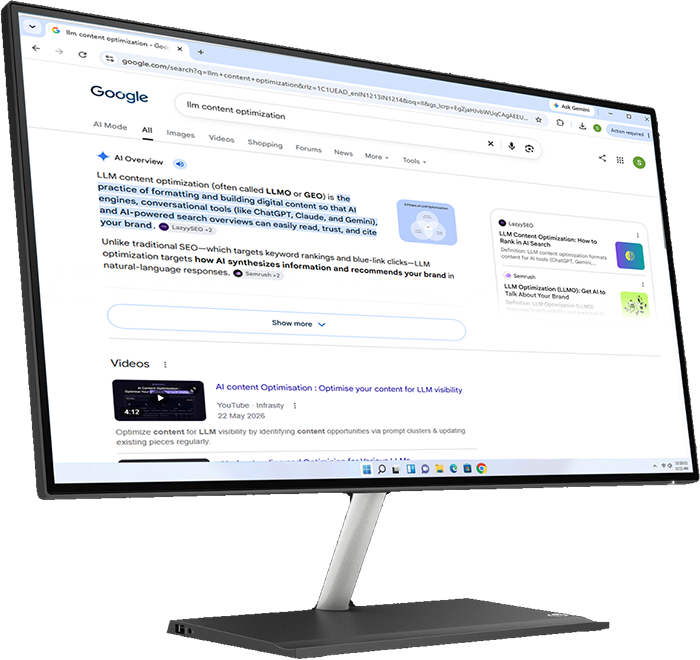
Large Language Model Optimisation (LLMO) or Generative Engine Optimisation (GEO) refers to refining and restructuring website content so that AI tools such as ChatGPT, Google Gemini and Claude can trust, comprehend, and cite it.
Human editorial review is crucial alongside automated tools because, whereas AI tools can accelerate drafting and structuring of content, human editors have a better perception of audience, context, intent, tone and nuance. They can verify facts, guarantee brand trust and judge the true context.
It is difficult to state a standard timeframe since the timeline to see LLM optimisation results depends on factors such as existing content quality, competitive landscape, domain authority, and implementation approach.
Some of the best practices involved in LLM content optimisation include understanding your target audience and intent, using clear and concise language, examples that make the content easy to digest, and incorporating an FAQ section so that the direct answers come up in the AI-powered snippets.
LLMs start by looking at content chunks and then apply numerical values to words using natural language processing (NLP). Then they run sub-searches that offer detailed responses. This way, LLMs personalise content output for users.
Whereas LLM optimisation aims to mention your brand name, content, and product details as a direct answer in AI tools such as ChatGPT and Gemini, SEO optimisation helps with webpage ranking in the SERPs. So, LLM optimisation makes your brand chosen, and SEO optimisation increases visibility.
LLMs are changing content operations by not only accelerating workflows but also transforming how content is structured. Furthermore, they introduce automated governance. They use rules, software, and machine-driven controls that consistently monitor, enforce and audit AI models without completely depending on manual reviews.
Yes, LLMs are great at assisting with basic SEO tasks and optimising content suitable for AI-driven search. However, LLMs can cite inaccurate data and struggle to separate generic internet noise from high-level information. That is why active human intervention is necessary.

Get Your Content Ready to Cite in AI Platforms
Make Your Content LLM Optimised Today
Choose Large Language Model (LLM) content optimisation at DWS to adapt seamlessly to conversational search. So your brand, content and product get mentioned in AI-generated responses and build domain authority.
