
Get Free Content Sample

 Add as preferred on Google →
Google I/O 202 6 unveiled Google’s most ambitious AI innovations yet, showcasing how artificial intelligence is becoming deeply integrated into everyday products and workflows. The event highlighted Google’s vision of making AI more capable, proactive, and useful.
According to Google, the conference featured more than 100 product announcements, while Gemini has now grown to serve over 900 million users across 230 countries, reflecting the rapid adoption of Google’s AI ecosystem. These updates are set to reshape how individuals, businesses, and developers interact with technology in the years ahead.
What is Google I/O 2026?
Google I/O 2026 is Google’s annual developer conference where the company introduced its latest innovations across artificial intelligence, Android, cloud computing, developer tools, and consumer products. Held on 19 and 20 May 2026 at the Shoreline Amphitheatre in California, this year’s event centred almost entirely on AI. It demonstrates Google’s shift from building AI assistants to developing intelligent systems.
Unlike previous editions that balanced hardware launches with software updates, Google I/O 2026 placed Gemini at the centre of nearly every announcement.
The conference also reflected the increasing pace of AI innovation across the industry. Google introduced new multimodal models, smarter search experiences, AI agents, enhanced coding assistants, and powerful tools that allow developers to build AI-native applications more efficiently.
These announcements not only strengthen Google’s competitive position but also indicate how businesses will need to adapt their digital strategies in an AI-first world.
Biggest Google I/O 2026 Announcements
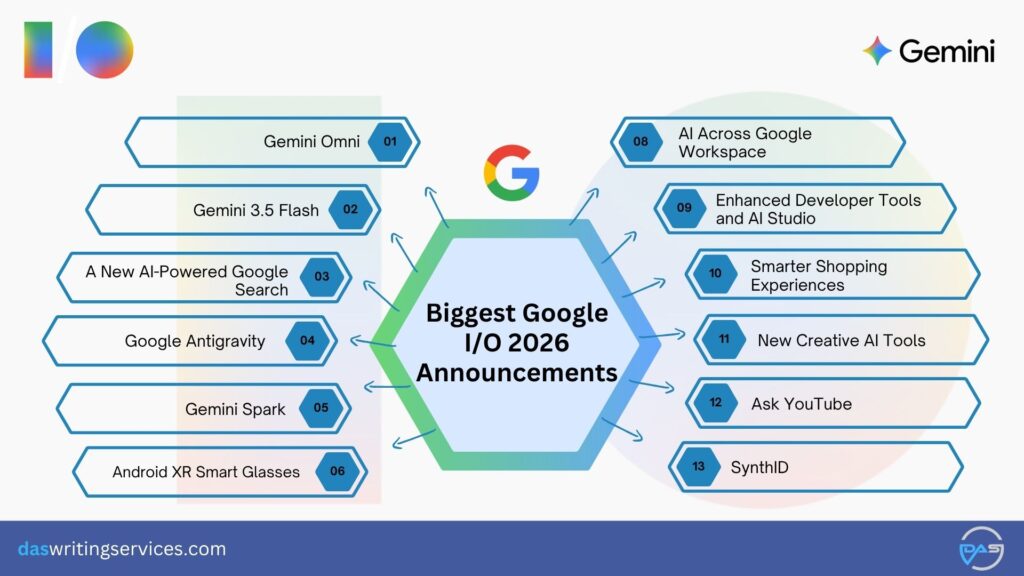
The Google I/O 2026 announcements covered everything from next-generation Gemini models and AI-powered Search to Android XR. With well over 100 product launches, this year’s conference was one of Google’s most comprehensive technology showcases. Here is a detailed overview of what are the major announcements of Google I/O 2026:
- Gemini Omni
One of the biggest highlights of Google I/O 2026 was the introduction of Gemini Omni, Google’s most advanced multimodal AI model. Designed to understand and generate text, images, audio, video, and code within a single workflow, Gemini Omni represents a significant leap beyond traditional AI models that process each format separately.
- Gemini 3.5 Flash
The company introduced Gemini 3.5 Flash, a faster and more efficient AI model built for reasoning, coding, and real-time interactions. Designed for developers and enterprises, it delivers lower latency while maintaining strong performance across complex tasks.
- A New AI-Powered Google Search
Google reimagined Search with a new intelligent search box powered by Gemini. Users can now search using text, images, videos, files, and even Chrome tabs. Search also provides interactive visuals and AI-generated responses that help users complete tasks instead of simply displaying links.
- Google Antigravity
Google unveiled significant upgrades to Google Antigravity. They position the platform as a comprehensive environment for building intelligent AI agents. Rather than focusing solely on conversational AI, Antigravity enables developers to create applications capable of reasoning through complex tasks, interacting with external tools, and completing multi-step workflows.
- Gemini Spark
Google introduced Gemini Spark, a proactive AI companion that helps users organise tasks, manage schedules, conduct research, and provide timely suggestions 24/7. Instead of waiting for prompts, Gemini Spark is designed to anticipate user needs while maintaining user control and privacy.
- Android XR Smart Glasses
Google showcased significant progress with Android XR, which demonstrates lightweight smart glasses powered by Gemini. The glasses support live translation, navigation, messaging, contextual information, and hands-free AI assistance. It brings Google’s vision of ambient computing closer to reality.
- AI Across Google Workspace
Google expanded Gemini’s capabilities across Workspace applications, including Gmail, Docs, Sheets, Meet, and Slides. New AI features help users draft emails, analyse spreadsheets, generate presentations, summarise meetings, and automate repetitive tasks. It improves workplace productivity.
- Enhanced Developer Tools and AI Studio
Developers received major upgrades through Google AI Studio, improved Gemini APIs, and enhanced Android Studio integrations. These Google I/O 2026 updates simplify the process of building, testing, and deploying AI-powered applications while supporting more advanced agentic workflows.
- Smarter Shopping Experiences
Google also introduced Universal Cart, a new AI-powered shopping hub that brings together everything users want to buy across Google’s ecosystem. Whether you are browsing products in Google Search, chatting with Gemini, watching YouTube, or even checking Gmail, you can add items to a single cart without interrupting your experience.
- New Creative AI Tools
Google introduced several creative AI capabilities for generating and editing images, videos, music, and other digital content. These tools are designed to help creators, marketers, and businesses produce high-quality content faster while maintaining creative control through conversational AI interactions.
- Ask YouTube
Google unveiled Ask YouTube, a new AI-powered conversational search feature that makes discovering videos faster and more intuitive. Instead of relying on simple keywords, users can ask detailed, natural-language questions. The feature understands the context behind these queries and delivers more relevant results.
- SynthID
Google announced a major expansion of SynthID, its AI watermarking technology designed to help people identify AI-generated content online. Introduced three years ago, SynthID embeds invisible digital watermarks into AI-generated images, videos, audio, and text.
At Google I/O 2026, the company revealed that users can now verify AI-generated images, videos, and audio directly within the Gemini app, which makes it easier to understand the origin of digital content.
What do The Google I/O 2026 Updates Mean for Businesses?
Google I/O 2026 signals that AI is no longer an emerging technology but a core part of how businesses create, market, and deliver digital experiences. The latest announcements make it clear that organisations must adapt their strategies to remain competitive as Google’s AI ecosystem continues to evolve.
For businesses, one of the biggest changes is the transformation of Google Search. AI-powered search experiences increasingly prioritise content that demonstrates expertise, answers user intent comprehensively, and provides genuine value.
This means simply targeting keywords will no longer be enough. Instead, businesses need to focus on producing authoritative, well-structured content that addresses real user questions and showcases first-hand knowledge.
For organisations looking to strengthen their digital presence, partnering with experienced professionals can make a significant difference. Das Writing Services helps businesses create high-quality content that aligns with Google’s evolving search standards while maintaining authenticity and authority.
How Google I/O 2026 Impacts Developers
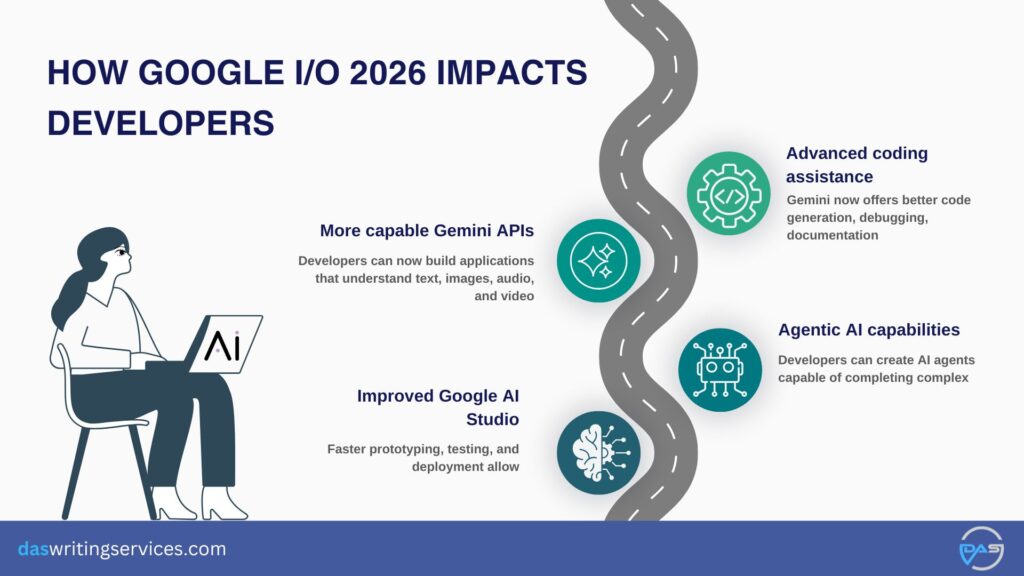
Google I/O 2026 introduced several improvements that make AI development faster, more efficient, and easier to scale. Google is giving developers the tools to build AI-native applications instead of simply integrating AI features. Here are some of the most significant improvements announced during the event:
- More capable Gemini APIs: Developers can now build applications that understand text, images, audio, and video with greater accuracy.
- Improved Google AI Studio: Faster prototyping, testing, and deployment allow developers to move from concept to production more efficiently.
- Advanced coding assistance: Gemini now offers better code generation, debugging, documentation, and optimisation across multiple programming languages.
- Agentic AI capabilities: Developers can create AI agents capable of completing complex, multi-step tasks with minimal user input.
These Google I/O 2026 updates reduce development time while enabling businesses to create more intelligent digital experiences. As Google’s AI ecosystem continues to evolve, developers who adopt these tools early will be better positioned to build next-generation applications.
Final Word
This Google I/O 2026 summary shows that artificial intelligence is no longer a standalone technology. It is becoming the foundation of Google’s products, developer ecosystem, and future vision.
Businesses, marketers, and developers should closely monitor these developments, as they will continue to influence how people discover information and interact with digital content. Keeping pace with these rapid changes requires both technical understanding and well-researched communication.
Want your brand to publish authoritative content on fast-moving technology topics? Das Writing Services combines in-depth industry knowledge with strategic SEO writing to create blogs that rank and establish your business as a trusted source of information.
Frequently Asked Questions
What was the main focus of Google I/O 2026?
Google I/O 2026 focused primarily on artificial intelligence. The event introduced new Gemini models, AI-powered Search experiences, Android XR advancements, developer tools, Workspace enhancements, and agentic AI technologies.
What is Gemini Omni?
Gemini Omni is Google’s latest multimodal AI model that can understand and generate text, images, audio, video, and code within a single workflow. It is designed to support more natural interactions.
How will Google I/O 2026 affect SEO?
Google’s AI-powered Search places greater emphasis on content quality, topical authority, expertise, and user intent. Businesses should focus on publishing original, trustworthy, and well-structured content instead of relying solely on traditional keyword optimisation.

Subhodip Das is the founder and CEO of Das Writing Services Pvt. Ltd. He has an experience of 12 years in the field of Digital Marketing and specialises in Content Writing and Marketing Strategies. He has worked with well-established organisations and startups helping them achieve increased Search Engine Rank visibility. If you want to grow your business online, you can reach out to him here.


