

Get Your Website Content Audit

 Add as preferred on Google →
A call to action (CTA) in digital marketing is a visual prompt or message that encourages users to take action after viewing an ad, website, social media post, or email. It serves as a guide for users to become paying customers. According to Neil Patel, conversion optimisation revolves around the CTA; if the CTA does not match the audience’s intent, it can have serious consequences.
To learn more about the meaning of call to action, how it works, and ways to create an effective CTA, read this blog.
What is Call to Action Meaning in Digital Marketing?
A call to Action in digital marketing is a message or a visual prompt encouraging users to get a desired response in return. For example, while navigating through a financial services website, you see that at the top right corner of the website there is a prompt where “Buy Now” is written. Clicking on this button will lead to a product purchase.
Why Is Call to Action In Digital Marketing Important?
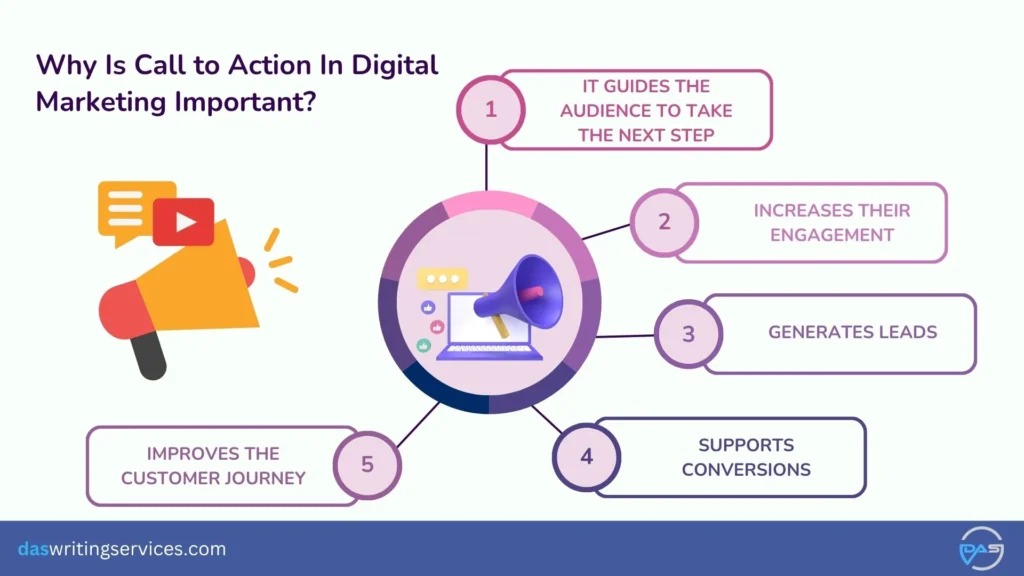
CTA is crucial for the following reasons:
- It guides the audience to take the next step
- Increases their engagement
- Generates leads
- Supports conversions
- Improves the customer journey
However, it is important to ensure that it is placed properly in the content. For example, placing a CTA on the Contact Us page will not help with gathering leads. In contrast, fitting it strategically at the top, middle or end of the content will definitely bear results.
How Does a Call to Action in Digital Marketing Work?
A call to action functions as a bridge between a business goal and a user’s interest. Without an impactful CTA, a user may leave your page without conversion. Meaning you miss out on an opportunity for conversion. Furthermore, in the absence of a CTA, users may feel unsure or lost about what to do next.

If you are wondering, “How does a call to action work in digital marketing?” Here is your answer:
- A strategic keyword eliminates guesswork, so users are sure about what to do next.
- It helps with exact conversion, where a casual visitor becomes a paying customer or a subscriber.
- Soft CTAs such as “Read Blog” or “Learn More” help users with further research.
- Hard CTAs such as “Buy Now” help to make a purchase decision.
Types of CTA in Digital Marketing
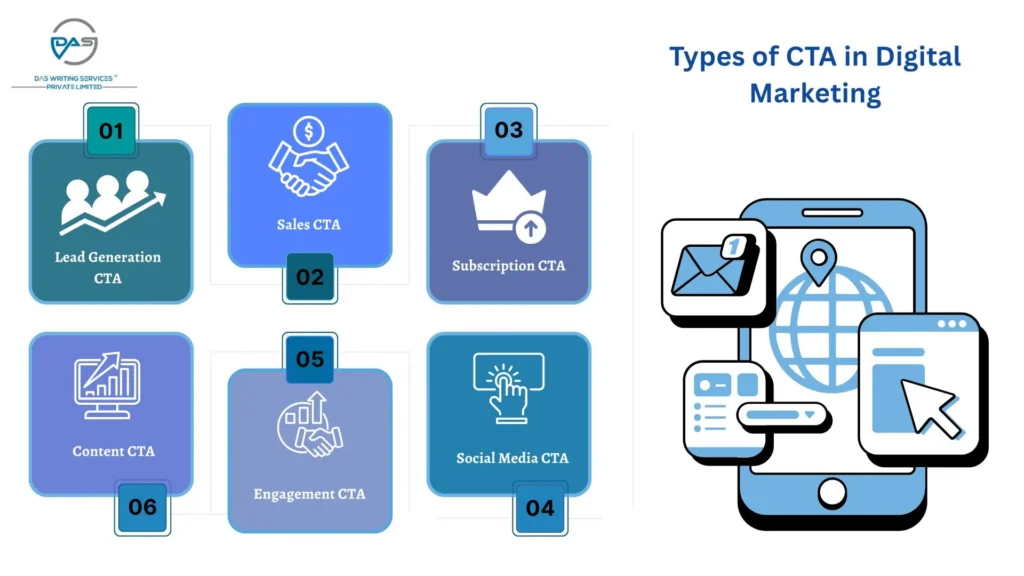
There are six types of CTAs in digital marketing. They are as follows:
- Lead Generation CTA: These CTAs help in starting a conversation, for example, “Book a Demo” or “Get a Free Quote”.
- Sales CTA: To encourage users to purchase a product, these types of CTAs are helpful. For example, “Order Today” or “Buy Now”.
- Subscription CTA: CTAs such as “Join Our Newsletter” or “Subscribe Now” guide audiences to get a subscription for services and newsletters.
- Content CTA: These types of CTAs provide access to additional resources, including reports, guides, and articles. For example, “Download the Guide”.
- Engagement CTA: When it comes to encouraging users to interact with your content, these are helpful. Examples include “Read More”, and “Explore Now,” which can make the content experience more engaging and encourage users.
- Social Media CTA: These guide users to follow a specific account or engage with the content. For example, “Follow Us” or “Learn More”.

Talk to an expert at Das Writing Services today if you are looking for a relevant digital marketing solution for your business.
How to Create an Effective Call to Action?
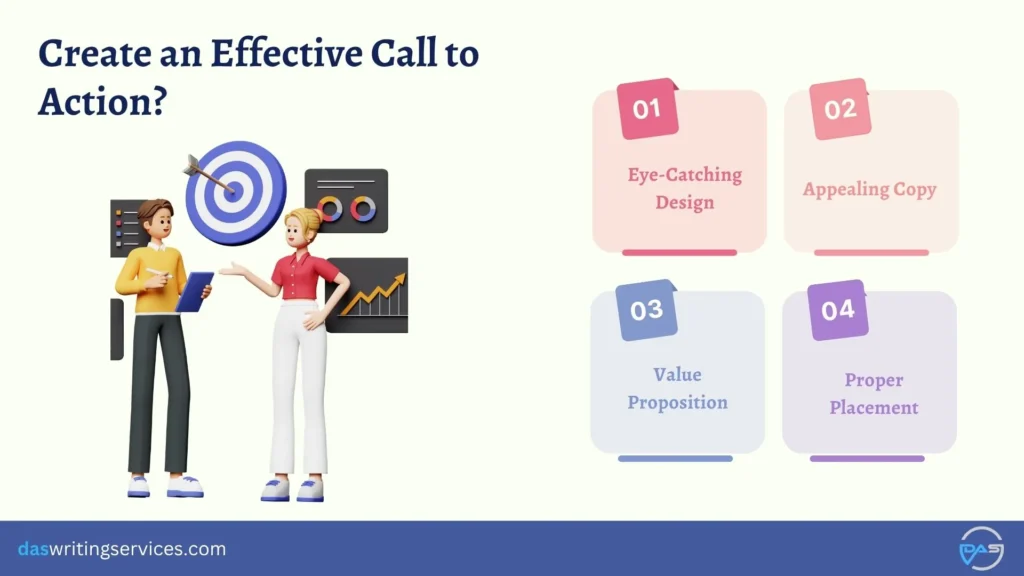
Focusing on the little details while drafting a CTA is essential since the primary objective is to convert a passive user. The following are some of the most common CTA components:
- Eye-Catching Design
To ensure the user can see the CTA, it is mandatory to craft an eye-catching one. Using colours and fonts that are in contrast with the rest of the content can improve visibility, engagement, and overall content performance.
- Appealing Copy
Instead of asking users to “click” or “submit”, an effective CTA must have power words and actionable verbs. Personalise your CTA with words such as “you”, “my”, and “your” for maximum impact.
- Value Proposition
Ensure that your CTA is explicit, so the audience knows what they will get once they click on it. This level of value proposition shows clear benefit, reduces hesitation and boosts conversion rates.
- Proper Placement
Appropriately placing your CTA is another crucial component. For example, fitting your CTA at the top of the sales funnel indicates generating awareness. Placing it in the middle indicates a solution to their problem. Finally, placing the CTA at the bottom of the funnel ensures a purchase.
Final Words
In a nutshell, a call to action in digital marketing helps with generating leads and conversions. Therefore, it is crucial to create a precise CTA that has actionable words, aligns with the audience’s intent and ensures that the CTA is placed correctly.
Explore our digital marketing services today and share your business details and content requirements. After scheduling a quick consultation, we can discuss your content strategy!
Frequently Asked Questions
In digital marketing, both CTA and CTR work together. Whereas CTA refers to the prompt or button that recommends users about what to do, a CTR or Click Through Rate, refers to the performance metric which measures how many people have actually clicked on it.
To create an effective CTA, it is important to use clear, action-oriented verbs and place a high-contrast button in such a way that users can see it easily.
In digital marketing, a CTA refers to a Call to Action, a prompt targetted to encourage users to take a specific and immediate action. Usually, a CTA appears as a clickable button, a banner or a text link on a website, social media apps and emails.
CTA full form of CTA in digital marketing is call to action. It is a directive or a prompt that encourages a user to take an immediate and specific action.
CTA in digital marketing is crucial as it clearly tells a user what they need to do next. This turns passive visitors into active leads and eventually paying customers.

Subhodip Das is the founder and CEO of Das Writing Services Pvt. Ltd. He has an experience of 12 years in the field of Digital Marketing and specialises in Content Writing and Marketing Strategies. He has worked with well-established organisations and startups helping them achieve increased Search Engine Rank visibility. If you want to grow your business online, you can reach out to him here.


