
Get Your Website Content Audit

 Add as preferred on Google →
Search Engine Optimisation (SEO) has complex success metrics, including dwell time. It defines how long a user stays on your page. It is one of the crucial indicators that determines whether your page content satisfies the user. However, Google has not confirmed it as a direct ranking factor, yet it is a parameter of content quality and user satisfaction.
In this article, evaluate comprehensive guidance on the definition, importance and other factors of dwell time for successful SEO efforts.
What is the Definition of Dwell Time
Dwell time is the duration a user spends on a web page after clicking from the Search Engine Results Page (SERP), before moving back to the SERP. In simple terms, dwell time means how much an individual spends engaging with the webpage content.
- An optimum dwell time indicates that your content is helpful, providing enough information to the user.
- In contrast, a poor dwell time indicates that the page is unable to satisfy the user’s query.
Example
Suppose Mr A searches “best hill station for weekend trip from Kolkata”, and he gets results such as Mandarmani, Digha, Tajpur, and more from a webpage. Though these destinations are ideal for a weekend trip, they do not satisfy the search query for a hill station. Therefore, he immediately bounces back to the SERP for another page within less than 10 seconds.
Now, he moves to another page and finds relevant results such as Dooers, Siliguri, Darjeeling and more. Therefore, he spends 5 minutes on this page to find out complete information regarding when to travel, how to travel and more. Therefore, the first webpage has less dwell time, compared to the second page, indicating an implicit signal of content quality.
What is the Importance of Dwell Time in SEO?
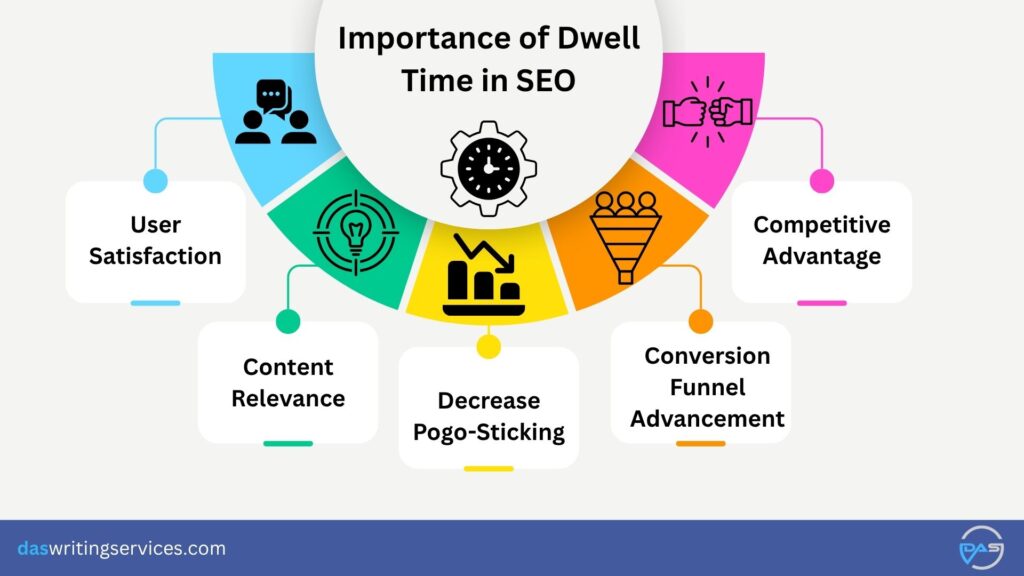
Dwell time in SEO acts as a crucial indicator of user experience and whether your content satisfies visitors’ queries. Let us find out why is dwell time in SEO important.
User Satisfaction
Dwell time reflects how well your content is optimised to match user intent. When a visitor comes to your page and spends time evaluating the content through constant scrolling or exploring the internal links, it creates a signal of user trust and a better experience. Meanwhile, a user can leave a top-ranking site within 10 seconds.
- A good dwell time indicates that the content is providing value to visitors.
- Search engines may track dwell time data for future search result rankings.
Content Relevance
Dwell time also determines the content quality. The tone, information, layouts, structures, and more impact the user experience. For example, in a travel blog, writing in a much more professional tone with tough jargon may not engage users. Conversely, a whitepaper or press release with a much more colloquial tone can reduce dwell time.
- An extended dwell time may indicate content credibility and usefulness.
- Contact trustworthy content writing service providers such as Das Writing Services for relevant content.
Decrease Pogo-Sticking
Pogo-sticking refers to moving from a page straight back to the SERP and clicking on another page randomly. It indicates the search query is not fulfilled by the previous page and the user has to go back to another result. Consequently, a good dwell time with relevant content helps reduce pogo-sticking.
- Excessive pogo-sticking makes search engines re-evaluate its relevance to that particular search query
- It may be a sign of poor loading speed of a page, content mismatch or other issue related to the web page performance.
Conversion Funnel Advancement
Dwell time usually optimises the conversion path. The more time the user spends on your site, the higher the chances of converting. Hence, if they click internal or external links, visit the contact page, or ask for a demo, they are more likely to become a lead statistically.
- The chances of conversion are close to zero if a visitor bounces from the site within 10 seconds.
- If they spend at least 2 minutes on the content, it is more likely that they will react to the call-to-action.
Competitive Advantage
The evaluation and up-gradation of search engines relies more on behavioural cues of users rather than just keyword density or backlinks. The real-time feedback on the quality and user-friendliness of content is its dwell time. Meanwhile, when multiple competitor websites are competing with the same keywords, dwell time often becomes a silent differentiator.
- The page that gains better people’s attention is more likely to rank on the SERP.
- Dwell time creates real differences for the same keywords, content structure or language.
How to Calculate Dwell Time?
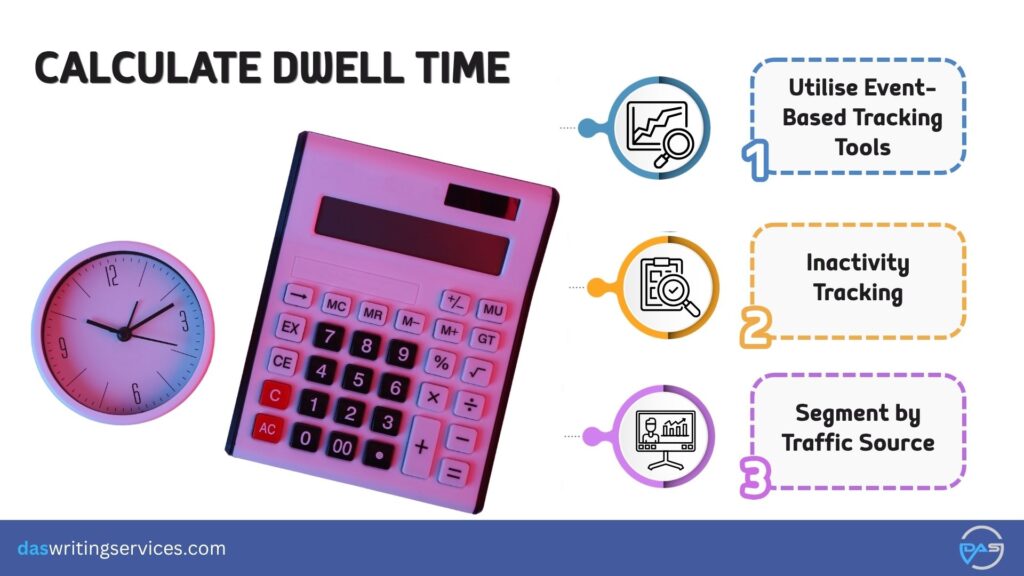
Dwell time is not a ready-to-find metric, similar to Google Analytics or Semrush. In fact, it is a combination of techniques that determine the behaviour of each user session.
Utilise Event-Based Tracking Tools
Event-based tracking tools, such as Mixpanel, Heap, or Microsoft Clarity, help to determine the following:
- Source of the user session.
- Detect the time of opening and closing the tab.
- Quantify the duration of the session.
Inactivity Tracking
Scroll depth and inactivity tracking are some of the significant determinants of user experience. However, Google Tag Manager or Custom JavaScript helps to manage the following:
- How much the page is scrolled.
- How much inactive time the user has spent.
- Track page visibility and user interactions.
Segment by Traffic Source
Genuine dwell time is possible to measure by defining traffic source, especially “organic search”.
- You can measure dwell time for search visitors.
- It is not effective for paid users or email subscribers.
How to Improve Dwell Time?
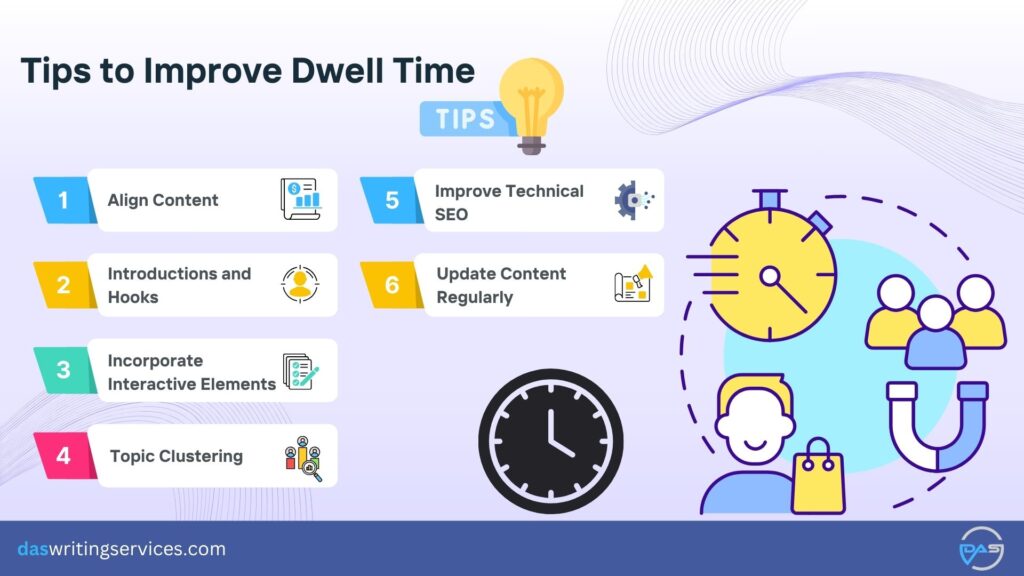
There is no universal formula to improve dwell time, but constant alignment with the search query, incorporating interesting visuals, following a crisp tone, and increasing user experience and more together can help.
- Align Content
In this AI-driven search era, people are more likely to jump to another page when content cannot satisfy the search query. Therefore, ensure your content fulfils the user’s intent behind their keyword search.
Tips to Improve:
You need to understand the user’s search intent, find keywords on the SERP and find results on your own.
- Introductions and Hooks
The moment a user lands on your page matters a lot. Your content heading and introduction must be attractive and make users immediately understand what is inside the content. Therefore, if users find it relevant, they will stay.
Tips to Improve:
Provide a predictive insight into what is inside the content in the introduction and read the ultimate guide for SEO writers.
- Incorporate Interactive Elements
Just static text discourages interaction. It makes users feel bored. It often increases the bounce rate as users spend less time on the page. Contradictorily, using small paragraphs, bullet points, and more headings and subheadings increases user experience.
Tips to Improve:
Adding infographics, animated graphs, charts, embedded videos, and encouraging people to go through the whole.
- Topic Clustering
Internal linking matters a lot for successful navigation of the pages. It strengthens semantic relevance with topic clustering. Consequently, it extends the duration of each session and improves site depth and domain authority.
Tips to Improve:
You can sum up at least 5 blogs into one cluster, defining the relevant topic.
- Improve Technical SEO
A slow-loading website or a mismatched mobile interface may cause harm to user experience. In fact, people may leave the page and visit another if the interface is poor or takes more than 800 milliseconds.
Tips to Improve:
Consider tools such as Google PageSpeed Insights, GTmetrix, and more to check site speed and improve if required
- Update Content Regularly
Trends and concepts are changing rapidly in this technology-advanced era. If the content remains outdated or irrelevant to modern concepts, the dwell time will drop significantly. Therefore, updating the content helps get better rankings than older ones.
Tips to Improve:
You may update blogs, landing pages, follow SEO trends, and other resources periodically to boost re-engagement and retention of users.
Does Shorter Dwell Time Always Mean Poor Content?
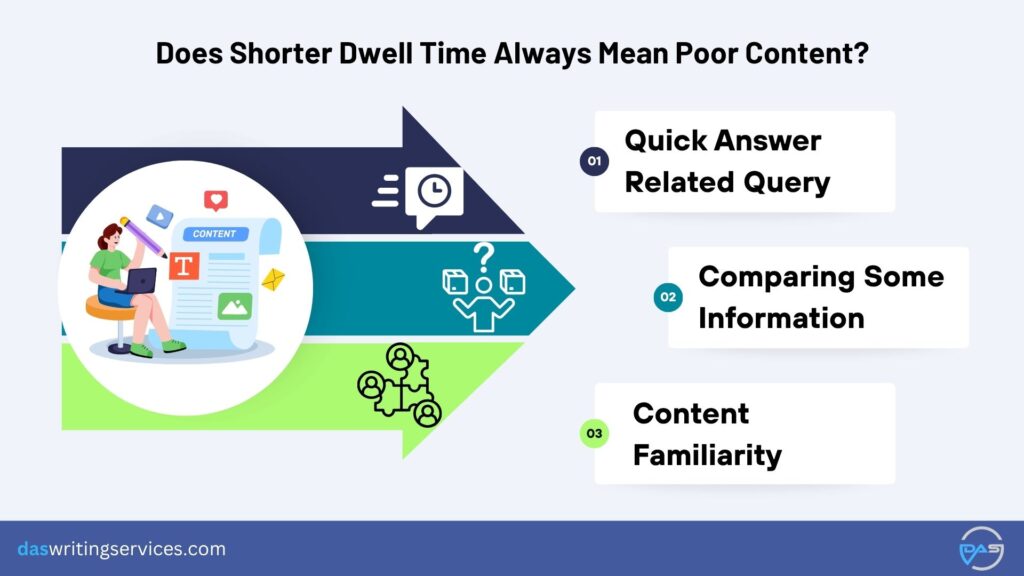
Not always. If a user spends a little time on your site, it does not always indicate poor dwell time. The relationship between the quality of content and dwell time is not that crystal clear. Rather, it is more nuanced than individuals think.
Find out what the common situation might actually indicate successful content rather than a problem:
Quick Answer Related Query
If an individual needs a quick answer for some search query, it might not always require spending more time on the page.
Example
If Mr A searches “Capital of India” and gets the answer “Delhi” on the very first page within 5 seconds, he might not spend extra time and leave the page. It does not mean the content is poor.
If the User is Just Comparing Some Information
If a user is just browsing to look for some information to compare and contrast before making a final decision, it may reduce dwell time for each visited page.
Example
If Mr A is comparing the price of an ear pod on different e-commerce sites to check prices before purchasing, it may make him spend less than 10 seconds on each site.
Content Familiarity
If a user is well-known to a topic and visits the site just for some clarity, it may also make him spend less time on the site, which does not denote that the quality is poor.
Example
If Mr A knows “which documents are required to link Aadhaar with a phone number”, but he still visits the site just to revise before proceeding. It may take a few seconds to read the required document parts from a webpage.
What is the Relation of Dwell Time, Bounce Rate, and SEO Impacts?
Do not confuse dwell time with bounce rate. Though both are related but not the same. You are aware of dwell time. Now, the bounce rate is when a user visits a site and leaves your website without any further action, such as visiting another page or clicking internal links. However, a low dwell time increases bounce rate and vice versa.
| Scenario | Average dwell time | Scroll | Bounce | Impact on SEO |
| User visits and leaves within 10 Seconds | Low | Less than 10% | Yes | Weak engagement, poor user experience |
| User visits, stays for 5 minutes, then leaves | High | More than 80% | Yes | Content worked, optimum user experience |
| User visits, stays for 5 minutes, visits interlinked pages/ asked for a demo/ visits the contact page | High | 100% | No | Excellent engagement, strong user experience |
Final Word
Dwell time estimates the average time spent on a particular site from getting in to leaving. It reduces the bounce rate, indicating higher content quality that fulfils user queries. It affects the competitive advantage of a site by ranking it higher than its competitors.
Dwell time is not the ultimate determinant of website performance and content quality. With different user intentions, the dwell time may affect a site poorly. Therefore, to improve dwell time, it is mandatory to include high-quality content.
You must rely on reputed content writing service providers such as Das Writing Services.
FAQs
- Is a longer dwell time always better?
Usually, a longer dwell time is better for site performance, indicating engagement. However, a longer dwell time without any further activity or repeated scrolling up and down may indicate that the user cannot find the exact information easily.
- Which kind of content boosts dwell time the most?
Engaging multimedia formats such as infographics, videos, or other interactive elements between static texts may improve the user interface and dwell time.
- What are the common mistakes while optimising dwell time?
Just focusing on content quality, ignoring technical SEO parts such as page speed and mobile friendliness, or user interface, are some of the mistakes while optimising dwell time.

Subhodip Das is the founder and CEO of Das Writing Services Pvt. Ltd. He has an experience of 12 years in the field of Digital Marketing and specialises in Content Writing and Marketing Strategies. He has worked with well-established organisations and startups helping them achieve increased Search Engine Rank visibility. If you want to grow your business online, you can reach out to him here.


