
Get Free Content Sample

 Add as preferred on Google →
With companies increasingly relying on Search Engine Optimisation (SEO) to generate revenue, demand for branded search and organic search is also growing rapidly. Generally, they work together to bring long-term visibility to your website and ensure higher SEO conversions. However, how they bring website revenue differs.
Keep reading to learn their importance with examples. Also, explore how they differ in objectives, authority-building, SERP rankings, user intent, and importance in AI-powered searches.
What is Branded Search?
It is a type of search query through which people specifically search for your brand on search engines by including your brand’s name or products. Conversion rates are generally higher as people who trust your brand are likely to take action. Some of its benefits are:
- Create brand awareness by indicating your brand’s quality and popularity.
- Boost acquisition rates that help maximise revenue.
- Attract high-converting visitors with branded paid search.
- Offer better control over websites, as they are based on specificity.
Examples of Branded Search: Search terms that include your company name, product name, and brand-specific terms, such as “Nike running shoes” or “DWS content writing services”.
What is Organic Search?
It is a method of search enquiry through which search engines find and rank website content naturally. They rank websites they feel are relevant to the user’s search query. Organic search results are primarily based on quality and relevance instead of payment. Some of its benefits are:
- Cost-effective technique yielding long-term results.
- Good content and optimisation offer sustainable growth.
- Targeted intent content ensures better conversion rates.
- Boost brand authority with consistent appearance on search results.
Example of Organic Search: These search terms contain products or services you offer, such as “affordable running shoes” or “best SEO content writing company”.
You can improve your website’s search engine rankings by working with Das Writing Services to create content that efficiently answers your audience’s search queries.
What are the Differences Between Branded Search v/s Organic Search?
Since the branded search v/s organic search examples above have cleared the basic concepts, let us explore how they differ based on their primary and technical aspects.
Below are some of the differences between branded and organic search based on their primary aspects:
| Primary Aspects | Branded Search | Organic Search |
| Objective | Engage with customers who are familiar with your brand. | Attract new customers to your website without running ads. |
| Brand Authority | Establish authority by displaying your brand at the top of search results. | Build brand authority by targeting industry-specific keywords through content. |
| SERP Ranking | Measured by user engagement level, brand identity and customer base. | Measured by quality of content, backlinks, and keyword optimisation. |
| User Intent | Users specifically know the product/services they want. | Users want to gain information about some product/services. |
Below are some of the differences between branded and organic search based on their technical aspects:
| Technical Aspects | Branded Search | Organic Search |
| Keywords | Has brand or specific product names | Has industry-specific terms |
| Click-through Rate | Higher but lower search volume | Higher search volume |
| Conversion Rate | Almost 2x higher | Lower but attracts more customers |
| Traffic Volume | Less than organic search | Almost 80% of organic traffic |
Branded Search v/s Organic Search: What Matters in AI-Powered Search
Gone are the days when people treated search engines as digital librarians. If you wanted to read a book, you just had to enter the query, and they would suggest a list of good books to read.
Nowadays, search engines are like your personal assistant. Not only will they give you a list of good books to read, but they will also provide a summary for each. The objective of AI citation is to help you with decision-making.
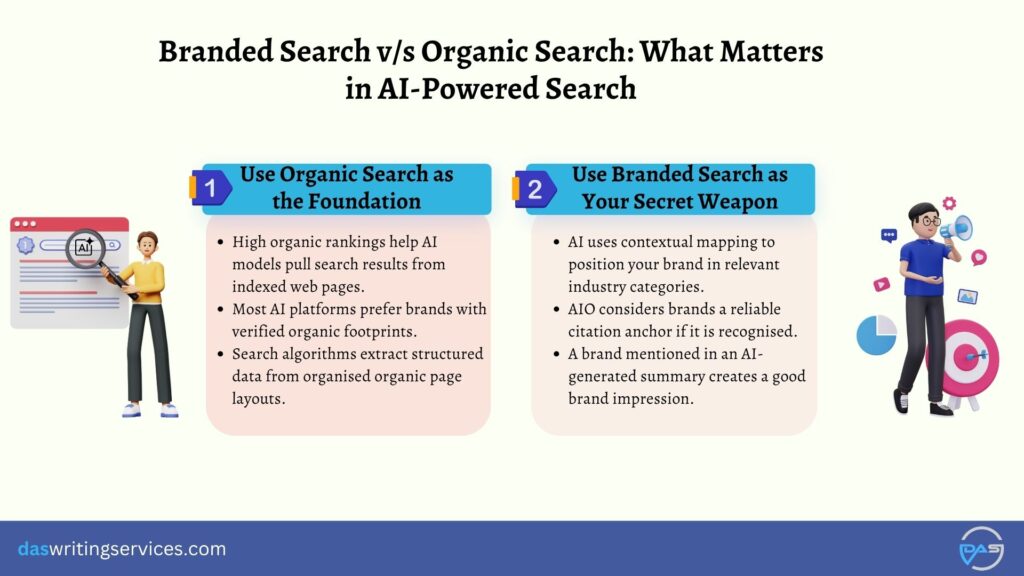
Use Organic Search as the Foundation
Since the search intent for every organic search is an answer, it still acts as the foundation for AI-powered searches. The AI summaries you get to see when you search a query are generated through various sources.
AI bots crawl through websites to find the exact information users are looking for. Good and informative content will make AI cite your brand as a source by linking to it inside the AI answer. If you want to use content that AI actually wants to see, make sure you choose the right company offering SEO content writing services.
If you are wondering “Why is organic search important in AI-powered searches?” you can take a look below:
- High organic rankings help AI models pull search results from indexed web pages.
- Most AI platforms prefer brands with verified organic footprints.
- Search algorithms extract structured data from organised organic page layouts.
Use Branded Search as Your Secret Weapon
According to the Times of India, the two core principles for a brand willing to establish itself as a leader in the marketplace are credibility and trust. This is why establishing your brand authority has become the need of the hour for almost every company.
An easy way to establish your brand authority in today’s AI world is by targeting branded search. AI notices when numerous people search for your brand. They are more likely to mention companies with a strong brand presence if someone asks for a recommendation.
If you are wondering, “Why does brand search matter in AI-powered searches?” you can take a look below:
- AI uses contextual mapping to position your brand in relevant industry categories.
- AIO considers brands a reliable citation anchor if they are recognised.
- A brand mentioned in an AI-generated summary creates a good brand impression.
Why Do You Need Both to Win in This AI Era?
AI loves the authority of organic content, and citations build brands. This is why you need both organic and branded search volume to win in this AI era. The three primary pillars you should focus on are:
- Authority Content: Instead of writing for keywords, you need content which both humans and AI bots can understand.
- User Experience: A fast-loading and user-friendly website with good quality content ensures that people will stay longer. Even AI search tools prefer websites with easy-to-read content.
- Digital PR: AI views brands as a leader in their respective fields if there are more mentions of your brand on blogs, news sites, community and social media.
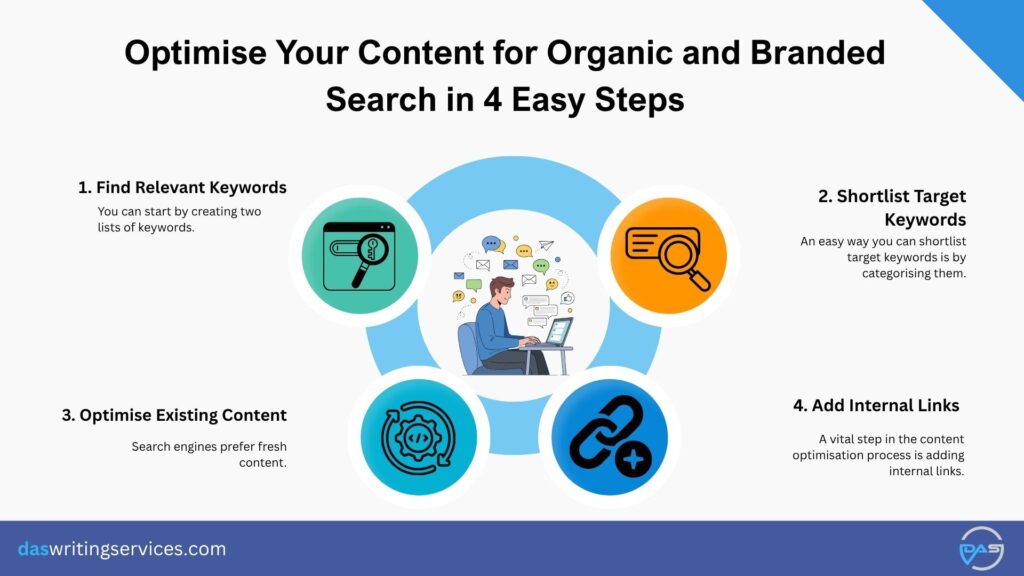
Optimise Your Content for Organic and Branded Search in 4 Easy Steps
Most companies optimise content to protect their brand’s online reputation and boost branded search traffic. Some of the easy steps you can follow are mentioned below:
- Find Relevant Keywords
You can start by creating two lists of keywords. One with the keywords you rank for and another one with the target keywords you still do not rank for. Though there are numerous online SEO tools, it is always advisable to approach a company offering professional SEO services.
Pro Tip: Do not worry about spelling errors while typing, as most search engines autocorrect terms before showing results.
- Shortlist Target Keywords
An easy way you can shortlist target keywords is by categorising them. Create separate lists for underperforming keywords and pages whose target keywords do not match the search intent. Generally, keywords that do not appear on the first page are considered underperforming keywords. You can identify pages with mismatched intent by checking the bounce rates.
Pro Tip: An easy way you can start shortlisting keywords is by sorting them according to their search volume. Higher search volume indicates that the keywords are potentially valuable.
- Optimise Existing Content
Search engines prefer fresh content. You can either create new content or optimise existing content so search engines have something they can rank. Generally, companies optimise existing pages that are underperforming or pages with mismatched intent for organic and branded search.
Pro Tip: It is advisable to create new content for keywords that have not yet ranked. Otherwise, you can also include them on existing pages if they match the search intent.
- Add Internal Links
A vital step in the content optimisation process is adding internal links. Not only do the links help with SEO, but users can also easily navigate your website. Search engines consider these links to understand what your page is all about when discovering, crawling or indexing pages.
Pro Tip: Keep internal links short, as it helps with easy navigation and prevents messy content blocks.
Why Do Companies Need Organic Search for Long-Term SEO Growth?
Organic search helps companies achieve long-term SEO growth by catering to their wider marketing goals. It helps boost a brand’s overall digital credibility.
The four common ways organic search helps in long-term SEO growth are mentioned below:
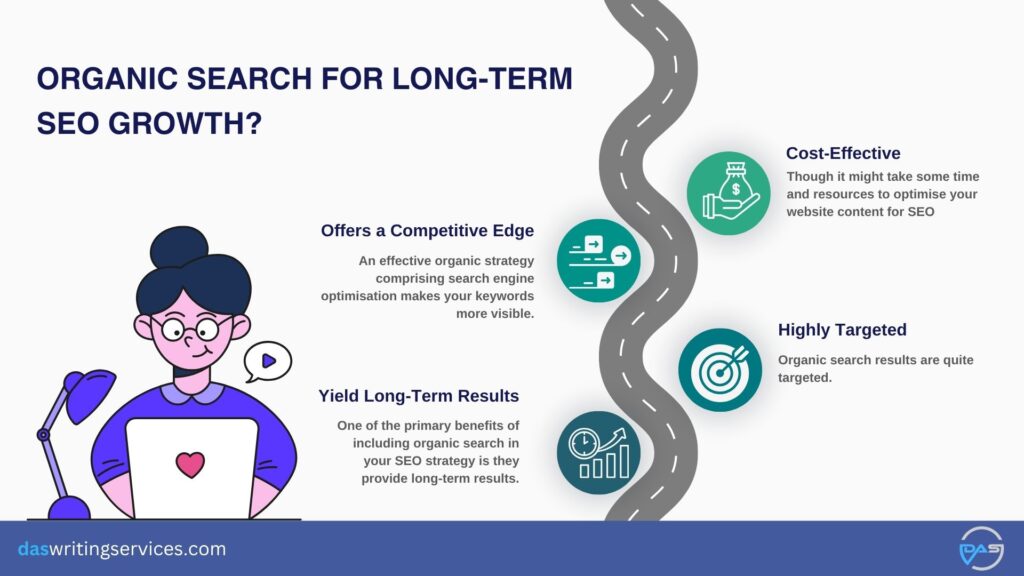
- Offers a Competitive Edge
An effective organic strategy comprising search engine optimisation makes your keywords more visible to your target audience. Even a small business can get a competitive edge by choosing the right company offering SEO services.
- Cost-Effective
Though it might take some time and resources to optimise your website content for SEO, you do not need a huge investment to bring organic traffic to your website. They are more cost-effective than paid advertising, where you need sufficient budget for set-up and maintenance.
- Yield Long-Term Results
One of the primary benefits of including organic search in your SEO strategy is they provide long-term results. Traffic from paid advertisements can stop abruptly once your budget ends. You can optimise your online presence with organic strategies crafted to generate sales and revenue.
- Highly Targeted
Organic search results are quite targeted. Companies offering the service ensure that your brand appears exactly where your target audience is. They shortlist keywords that are industry-specific and relate to the goods and services you are offering. The objective is to bring visitors who are interested in what you are offering.
Final Thoughts
A closer analysis of branded search v/s organic search shows why both matter in today’s AI-driven digital world. They are an integral part of every SEO strategy. Boosting brand visibility and driving organic traffic becomes easier when you choose the right company offering the service.
At Das Writing Services, we have carved a niche in the industry by creating SEO-specific content that can drive the sustainable visibility your brand needs.
Frequently Asked Questions
- What strategies do companies use to improve brand search rankings?
Some of the strategies you can use to boost brand search rankings are publishing relevant content consistently, building a robust Google Business Profile (GBP), boosting website speed and earning backlinks from reliable sites.
- What strategies do companies use to improve organic search rankings?
Some of the strategies you can use to improve organic search rankings are keyword research and optimisation, technical optimisation, on-page optimisation, link building and professional content marketing services.
- Is branded search or organic search more important for SEO?
Both are important for SEO, as a good strategy comprises both. While branded search leads to conversions and builds trust, organic search brings a new audience to your website. Organic SEO also helps a brand earn visibility through content and technical optimisation.

Subhodip Das is the founder and CEO of Das Writing Services Pvt. Ltd. He has an experience of 12 years in the field of Digital Marketing and specialises in Content Writing and Marketing Strategies. He has worked with well-established organisations and startups helping them achieve increased Search Engine Rank visibility. If you want to grow your business online, you can reach out to him here.


