
Get Your Website Content Audit

 Add as preferred on Google →
Picture this: your latest campaign report lands on your desk showing 100,000 impressions. At first glance, it feels like a resounding win.
Then you notice the unique reach was only 5,000. That gap between exposure and actual audience size catches out even experienced B2B marketers, and it can quietly lead to skewed reporting and misallocated budgets.
Reach vs impressions is one of the most misunderstood pairings in social media analytics, yet understanding the difference between impressions and reach is fundamental to accurate performance tracking and ROI evaluation.
In this guide, we unpack what each metric means, how the major platforms calculate them, and how to use both to build a sharper B2B content strategy.
What Is the Difference Between Impression and Reach?
At its core, the difference between reach and impressions comes down to one question: are you counting people or are you counting views?
Reach measures the number of unique individuals who encountered your content, while impressions measure every single time that content appeared on a screen, including repeat visits from the same person.
This distinction matters because the two numbers answer different business questions. Reach tells you how far your message has physically spread across a market. Impressions tell you how often your audience is being reminded that message exists.
A campaign can post huge impression figures while only ever reaching a small, tightly targeted pool of decision-makers, or it can generate broad reach with comparatively few repeat views.
Need blogs that rank and convert? At Das Writing Services, we create SEO and GEO-optimised blog content that attracts qualified traffic, builds authority, and helps your business generate consistent organic leads.
| Metric | What It Measures | Counts Repeat Views? |
| Reach | Unique people who saw your content | No |
| Impressions | Total times your content was displayed | Yes |
According to the Sprout Social Index, 84% of B2B marketers choose LinkedIn as their primary organic social network, while 76% rely on it for paid campaigns.
For B2B organisations, where buying committees often include several stakeholders who need repeated exposure before they act, this distinction shapes how a campaign should be planned, measured, and reported to leadership.
According to Gartner, a typical B2B buying group involves 6 to 10 decision-makers, each armed with four to five pieces of information they have gathered independently.
Treating the two as interchangeable, as many teams still do, risks presenting a single vanity number instead of a genuine account of campaign performance.
Getting this right at the reporting stage also protects budget conversations. A stakeholder who only ever sees an impressions figure may assume a campaign reached a far larger audience than it actually did, creating unrealistic expectations for the pipeline that spend should generate.
Presenting reach and impressions side by side, along with the resulting frequency, gives finance and leadership teams a far more honest read of what a campaign genuinely delivered.
What Is Reach?
Reach is the total number of unique users or accounts that have seen your post, advert, or digital asset at least once.
No matter how many times an individual returns to view the same piece of content, reach counts that person only once. It is, in essence, a headcount of your audience rather than a count of views.
This makes reach the natural metric for brand awareness and market expansion goals. If a B2B software provider is launching in a new vertical, reach tells the marketing team how many distinct professionals within that vertical have been exposed to the brand, rather than how many times a smaller group has scrolled past the same advert.
Reach also splits into organic and paid categories on most platforms. Organic reach comes from followers and algorithmic distribution without spend behind it, while paid reach results directly from advertising budget.
Data from Rival IQ shows that organic reach on Facebook business pages has dropped to approximately 1.5% to 2% of total page followers, making paid reach essential for expansion.
Your website deserves content that sells. Das Writing Services crafts compelling website content, including homepages, service pages, and landing pages, designed to engage visitors and turn them into loyal customers.
What Are Impressions?
Impressions measure the total number of times your content is displayed on a screen, regardless of whether the viewer clicks, scrolls past, or engages with it in any way.
If a single user sees your post three times in one afternoon, that generates three impressions but contributes only one to your reach total.
A high impressions count on a relatively small reach figure usually means the same group of people is encountering your content repeatedly, which can be a deliberate and valuable outcome for retargeting or brand reinforcement campaigns.
For complex B2B propositions, impressions carry particular weight. Buyers rarely act on a single touchpoint; they need several exposures to a message before it sticks.
Impressions are the metric that shows whether that repetition is actually happening, and at what frequency, across the length of a sales cycle.
According to research by LinkedIn, B2B buyers require an average of 7 to 10 content touchpoints before making a buying decision, underscoring why frequency driven by impression counts is critical in long sales cycles.
The Mathematical Relationship Between Reach and Impressions
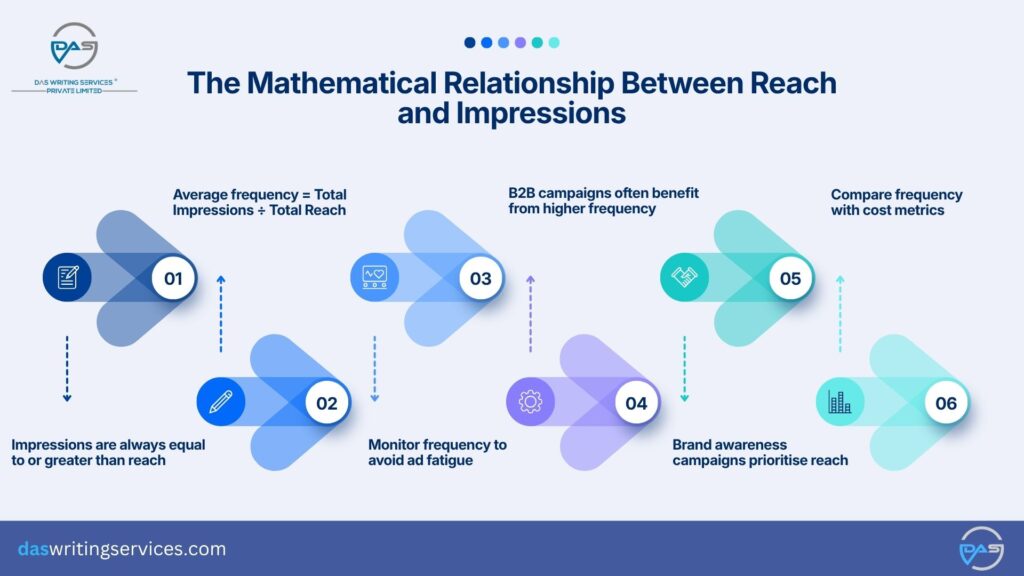
Reach and impressions are closely connected. While reach measures the number of unique people who see your content, impressions count every view. Analysing both together helps you understand audience exposure, campaign efficiency, and advertising performance.
- Impressions are always equal to or greater than reach. Since impressions include repeat views from the same users, reach can never exceed impressions. Both metrics are equal only when every person sees the content exactly once.
- Average frequency = Total Impressions ÷ Total Reach. Frequency measures how many times, on average, each unique person has seen your content.
- Monitor frequency to avoid ad fatigue. According to Brandwatch, a high frequency means the same audience is repeatedly seeing your content. While repeated exposure can improve brand recall, excessive repetition may reduce engagement and lead to ad fatigue.
According to Nielsen Media Research, maintaining an ad frequency between 3 and 5 exposures per user yields the biggest boost in brand recall without triggering ad fatigue.
- B2B campaigns often benefit from higher frequency. Account-based marketing campaigns usually target a limited group of decision-makers. Showing the same message three or more times can improve familiarity before the sales team begins outreach.
- Brand awareness campaigns prioritise reach. When the goal is to introduce your brand to new audiences, it is generally more effective to maximise reach while keeping frequency relatively low.
- Compare frequency with cost metrics. If frequency continues to rise while engagement remains flat or declines, it often indicates audience saturation. Reviewing metrics such as cost per mille (CPM) alongside frequency helps identify when creative assets or audience targeting should be refreshed.
Looking for persuasive marketing copy? Our expert copywriters at Das Writing Services create high-converting copy for websites, advertisements, emails, and campaigns that inspire action and improve your marketing ROI.
Reach vs Impressions Across Major Social Platforms
Every social platform calculates and labels reach and impressions using its own measurement standards, which makes cross-channel reporting genuinely tricky without a shared frame of reference.
| Platform | Reach Metric | Impressions Metric | Key Nuance |
| Organic, Paid & Viral Reach | Organic, Paid & Viral Impressions | Separates paid promotion from views driven by friends’ interactions | |
| Accounts Reached | Views / Impressions | Measures unique accounts across posts, Stories and Reels | |
| TikTok | Reached Audience | Total Video Views | Impressions are framed around video view counts |
| Members Reached | Impressions | Does not use the word “reach” natively; reports “Members Reached” instead | |
| YouTube | Unique Viewers | Thumbnail Impressions | Impressions require a thumbnail to be at least 50% visible for one second |
| X (Twitter) | Not natively tracked | Impressions | No native reach metric; focus is entirely on impression counts |
When to Prioritise Reach vs When to Prioritise Impressions
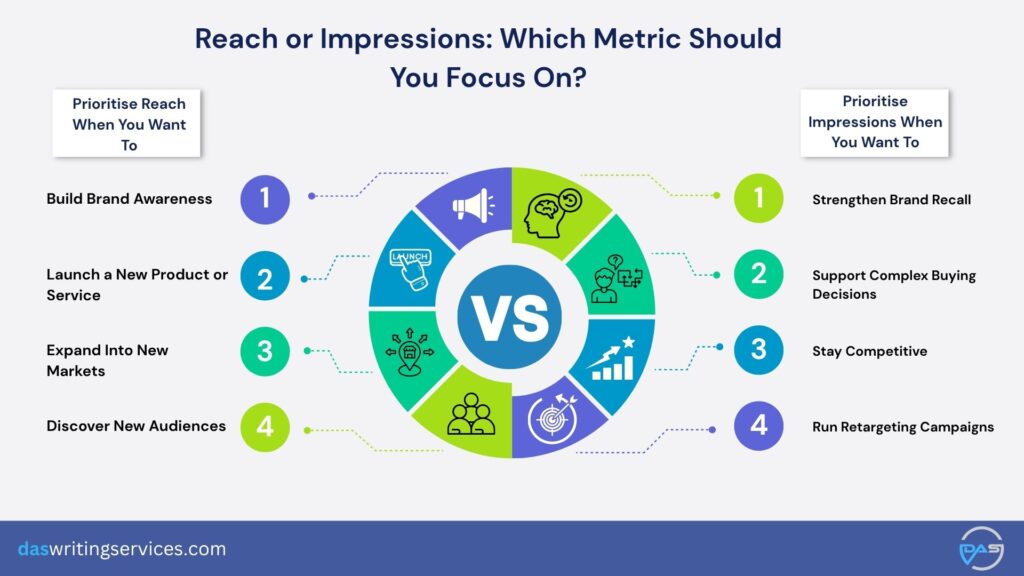
Choosing between reach and impressions depends on your campaign objective and where your audience is in the marketing funnel.
While reach helps you connect with new audiences, impressions reinforce your message and keep your brand memorable.
Prioritise Reach When You Want To:
- Build Brand Awareness: Introduce your business to as many potential customers as possible.
- Launch a New Product or Service: Generate maximum visibility during the launch phase.
- Expand Into New Markets: Reach audiences in new regions, industries, or customer segments.
- Discover New Audiences: Identify which audience groups engage most with your campaigns for future targeting.
Prioritise Impressions When You Want To:
- Strengthen Brand Recall: Repeated exposure helps people remember your brand.
- Support Complex Buying Decisions: B2B products and high-value purchases often require multiple interactions before customers take action.
Internal data from LinkedIn Marketing Solutions indicates that target account members who see an ad at least 4 times are 33% more likely to respond to sales outreach.
- Stay Competitive: Frequent visibility keeps your brand top of mind in crowded markets.
- Run Retargeting Campaigns: Show ads repeatedly to people who have already interacted with your brand, increasing the chances of conversion.
According to WordStream, retargeting campaigns which prioritise high impression frequency over broad reach boost ad engagement by up to 400% compared to standard display ads.
Best Practice:
Most successful marketing campaigns use both metrics together. Focus on reach to attract new prospects at the top of the funnel, then increase impressions to nurture those prospects until they are ready to convert.
Simplify complex topics with confidence. Das Writing Services delivers professional technical writing that transforms difficult concepts into clear, accurate, and reader-friendly content for your customers and stakeholders.
Interpreting the Signals: What Reach and Impressions Tell You Together
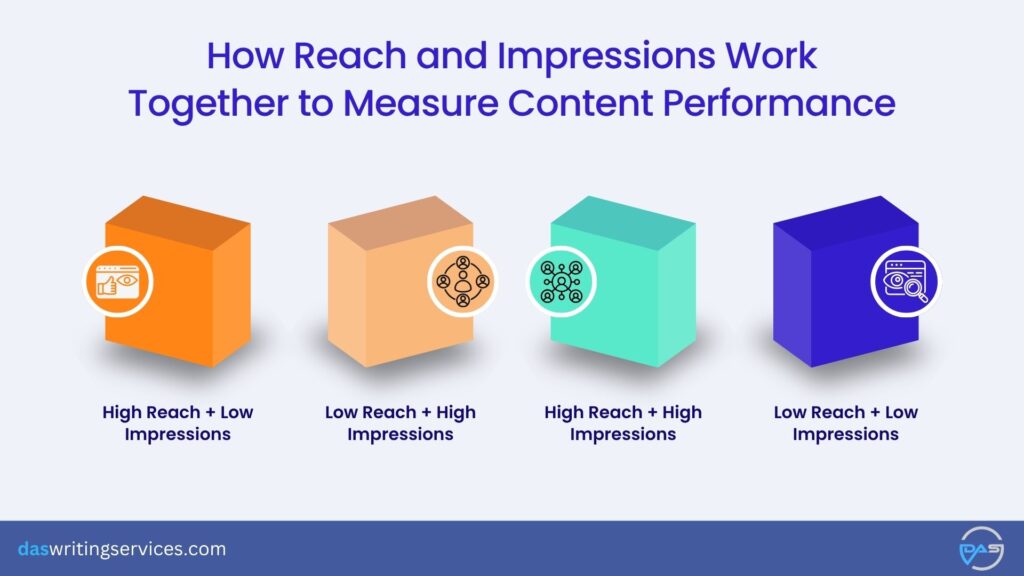
Analysing reach and impressions together provides a more complete view of campaign performance. Their combination shows whether your content is reaching enough people, generating sufficient repeat exposure, or requires optimisation.
- High Reach + Low Impressions
This indicates your content is reaching many unique users, but most see it only once or twice. It is ideal for brand awareness and product launches, though additional touchpoints may be needed for complex buying decisions.
- Low Reach + High Impressions
A small audience is seeing your content repeatedly. This is common in retargeting and niche B2B campaigns, where repeated exposure builds trust. However, excessive frequency can eventually lead to audience fatigue.
Studies by AdEspresso show that as frequency rises above 9 exposures per user, Cost Per Click (CPC) increases by over 98%. It demonstrates how over-delivering impressions to a small reach directly inflates ad spending.
- High Reach + High Impressions
This is often the ideal scenario. Your campaign is reaching a wide audience while reinforcing the message through multiple views, helping improve both brand awareness and recall.
- Low Reach + Low Impressions
Low values for both metrics usually indicate an underperforming campaign. Restrictive targeting, limited budgets, weak creative, or poor distribution may be limiting visibility, making it important to review and optimise the campaign strategy.
A Practical B2B Example
A B2B company promotes its new CRM integration service through a paid social campaign. One ad reaches 8,000 unique users and generates 20,000 impressions, meaning each person sees it about 2.5 times.
This repeated exposure is ideal for nurturing prospects and improving brand recall. Another ad reaches 12,000 users but records only 13,000 impressions, making it better suited for building awareness among new audiences.
Neither result is inherently better. The right metric depends on the campaign objective. Analysing reach and impressions together provides a clearer understanding of campaign performance and overall marketing success.
Build a stronger social media presence with engaging content. At Das Writing Services, we create platform-specific social media posts that increase engagement, strengthen your brand voice, and connect with your audience.
What are the Tools for Tracking Reach and Impressions?
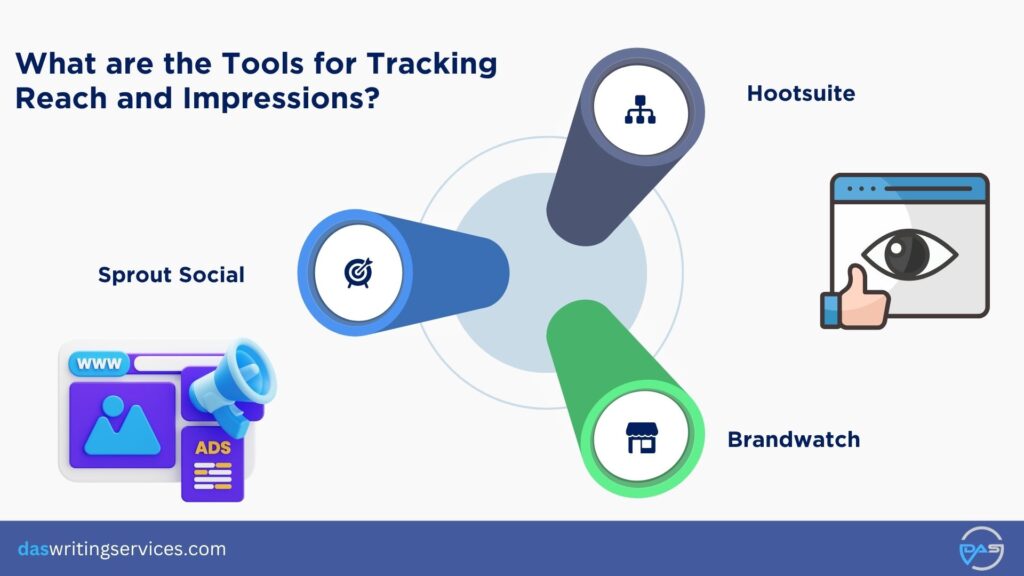
Tracking reach and impressions across multiple platforms can become difficult when each social network reports data differently. Using a dedicated analytics platform brings all your metrics into one place, making campaign performance easier to measure and compare.
- Sprout Social
Sprout Social is designed for cross-channel reporting, allowing marketers to track reach and impressions across multiple platforms from a single dashboard. It also supports campaign tagging, audience segmentation, and predictive publishing to help maximise organic reach.
- Hootsuite
Hootsuite simplifies multi-account management by combining performance data from platforms such as Facebook, LinkedIn, Instagram, TikTok, and X. Its benchmarking tools also let businesses compare their reach and impressions against industry averages.
- Brandwatch
Brandwatch goes beyond standard analytics by combining social listening with performance tracking. It monitors reach and impressions alongside brand sentiment, share of voice, and engagement trends, helping businesses understand the impact behind the numbers.
Want your brand to stand out with creative storytelling? Das Writing Services offers professional creative writing services that combine fresh ideas with strategic messaging to leave a lasting impression on your audience.
What are the Strategies to Optimise Both Metrics?
Improving reach and impressions requires more than increasing your advertising budget. The most effective campaigns use targeted strategies to attract new audiences while ensuring existing prospects see your message often enough to remember it.
- Expand Your Reach
Focus on growing your audience by creating valuable, shareable content that encourages organic distribution. Publish original research, industry insights, infographics, and short-form videos that people are likely to engage with and share.
Collaborating with industry experts, hosting webinars, guest posting, and partnering with complementary brands can also introduce your business to entirely new audiences. Optimising content for each platform’s preferred format further improves organic visibility.
According to the Content Marketing Institute (CMI), 73% of successful B2B marketers cite original research articles and case studies as the single most effective content type for driving top-of-funnel organic reach.
- Increase Your Impressions
Build impressions by maintaining a consistent publishing schedule and repurposing high-performing content into multiple formats, such as blog posts, carousels, videos, and email newsletters.
Retargeting campaigns are also effective because they repeatedly expose interested prospects to your brand. Additionally, responding to comments and participating in conversations keeps your content active, extending its visibility and generating additional impressions.
Research from Salesforce reveals that 80% of business buyers expect consistent, cross-channel content interactions, reinforcing the need to repurpose key assets to maintain high impression rates.
- Balance Reach and Impressions
Successful marketing campaigns treat both metrics as complementary rather than competing goals. Use reach to expand brand awareness at the top of the funnel, then increase impressions to reinforce your message during the consideration and decision stages.
Optimise your content for the future of search. Das Writing Services creates voice search optimised content that helps your business stay visible across search engines, AI assistants, and voice-enabled devices.
Conclusion
Mastering reach vs impressions turns social reporting from a vanity exercise into a genuine growth tool. Reach shows how far a message spreads across a target market; impressions show how often repetition builds lasting recall.
According to Forrester Research, B2B brands that balance broad reach with targeted high-frequency impressions achieve a 28% higher pipeline conversion rate than those focusing solely on vanity impressions.
Auditing platform-specific metrics and matching strategy to campaign goals ensures every content investment delivers measurable business value, rather than simply looking impressive on a slide.
Need high-quality articles that educate and convert? Our experienced writers at Das Writing Services produce well-researched articles tailored to your industry, helping you establish credibility and drive meaningful customer engagement.
Frequently Asked Questions
- What is a healthy reach-to-impressions ratio?
It depends on campaign objectives. For broad, top-of-funnel awareness, a ratio close to 1:1.2 or 1:1.5 usually indicates strong audience expansion. For retargeting or complex B2B sales cycles, a ratio of 1:3 or higher is common, showing prospects are engaging with a message repeatedly to build recall.
- Is reach always lower than impressions?
Yes. Because reach counts unique individuals while impressions count total displays, including repeat views, impressions will always be equal to or higher than reach. Reach can never exceed impressions.
- How do reach and impressions affect CPM?
Cost per mille measures the cost paid for every 1,000 ad impressions served. While CPM is calculated directly from impressions, monitoring reach alongside it ensures a brand is not paying to serve ads repeatedly to the same narrow audience segment.
- Why do some platforms not display reach data?
Platforms such as X focus primarily on impressions and engagement velocity rather than tracking unique accounts. In these cases, marketers typically rely on third-party analytics tools or secondary indicators, such as profile visits, to estimate unique audience growth.
- Which matters more for B2B marketing, reach or impressions?
Neither is inherently more important; the right metric depends on funnel stage. Reach matters most for awareness and market expansion, while impressions matter most for message reinforcement, retargeting, and moving considered buyers towards a decision.

Subhodip Das is the founder and CEO of Das Writing Services Pvt. Ltd. He has an experience of 12 years in the field of Digital Marketing and specialises in Content Writing and Marketing Strategies. He has worked with well-established organisations and startups helping them achieve increased Search Engine Rank visibility. If you want to grow your business online, you can reach out to him here.


