
Get Free Content Sample

 Add as preferred on Google →
Generative AI has transformed digital publishing platforms. As more and more AI content gets rolled out, it has become impossible to distinguish human-written content from AI-generated content.
While visual AI content contains a visible watermark, text remains a hard thing to put a watermark into without changing the text. To solve this, text watermarking is a technique which is visible to machines but not to readers.
In this blog, let us discuss how text watermarking works and how it changes the landscape of digital content across Google.
What Does Text Watermarking Mean?
Traditionally, we understood watermarks as something which could distinguish someone’s work from the rest. However, with the advent of generative AI, the meaning and application of AI have changed rapidly.
Putting a watermark on AI-generated images or videos is easier. For example, when you generate an image from Google Gemini, you can see the Gemini logo in the right-side corner. However, when it comes to text, there is no simple way to put a watermark without making it obvious. As AI writing is highly indistinguishable from human-written text, it is important to set a standard.
This is exactly what the EU Artificial Intelligence Act seeks to combat. According to Article 50 of this Act, providers of AI must ensure that synthetic audio, video and text that their models produce carry a machine-readable watermark which distinguishes it as artificially generated or manipulated.
How Do LLMs Generate Text?
Now that we know what text watermarking is, let us understand how AI actually produces synthetic text.
- At its core, large language models (LLMs) generate one word at a time. This depends on the previous word that has been generated.
- When choosing the next word, the LLM looks at the previous word and compiles a list of probable words.
- To choose this, the AI uses a random number generator to pick a word.
For example, if the sentence is ‘The Starry Night is an artistic representation of stars and ….’ the next word could be ‘moon’ or ‘night’ and not ‘astronaut’. To the human reader, it does not matter which word is chosen, as it would mean the same.
How Does AI Text Watermarking Work?
We now know how large language models like Claude or Gemini generate text. But how does incorporating a watermark into it work? Let us understand below:
- Earlier, AI used to use a random number generator to select the next words in a text.
- Now, instead of using a random probability, it will use a secret mathematical key.
- This key, when combined with the previous words that are written, will determine the next set of words.
Thus, instead of it being arbitrary, the words in a generated text will now follow a consistent pattern. In this way, the word choice will seem random to the reader, but a machine can detect the probability of whether or not AI has been used.
Which AI Companies Watermark Text?
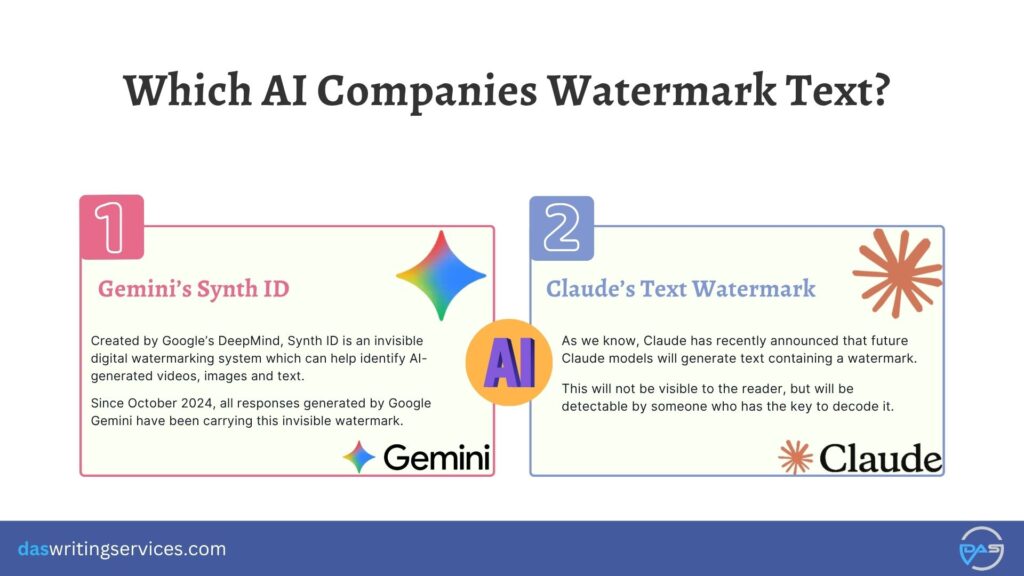
Major AI companies such as Claude and Google Gemini have started watermarking their text in order to comply with evolving rules and regulations.
- Gemini’s Synth ID
Created by Google’s DeepMind, Synth ID is an invisible digital watermarking system which can help identify AI-generated videos, images and text. Since October 2024, all responses generated by Google Gemini have been carrying this invisible watermark.
- Claude’s Text Watermark
As we know, Claude has recently announced that future Claude models will generate text containing a watermark. This will not be visible to the reader, but will be detectable by someone who has the key to decode it.
How Does AI Text Watermarking Change Search Engine Rankings?
With the introduction of AI text watermarking, a question arises: ‘How does it impact content that we see across search engines?’
The answer is simple: it does not. But there is a catch. Google rewards content that showcases Experience, Expertise, Authoritativeness, and Trustworthiness (EEAT).
Moreover, if a piece of content carries a watermark, it does not mean that Google will not index the page. Google has always emphasised quality content no matter how it is produced.
Plus, Claude has clarified that if a text contains a watermark, it does not automatically mean that it has been written with AI. This is because people use AI for proofreading, editing and many other editorial tasks.
However, if you use AI to produce content that manipulates the search rankings, then that will violate Google’s spam policies.
Why Is Human-Written Content Still Relevant?
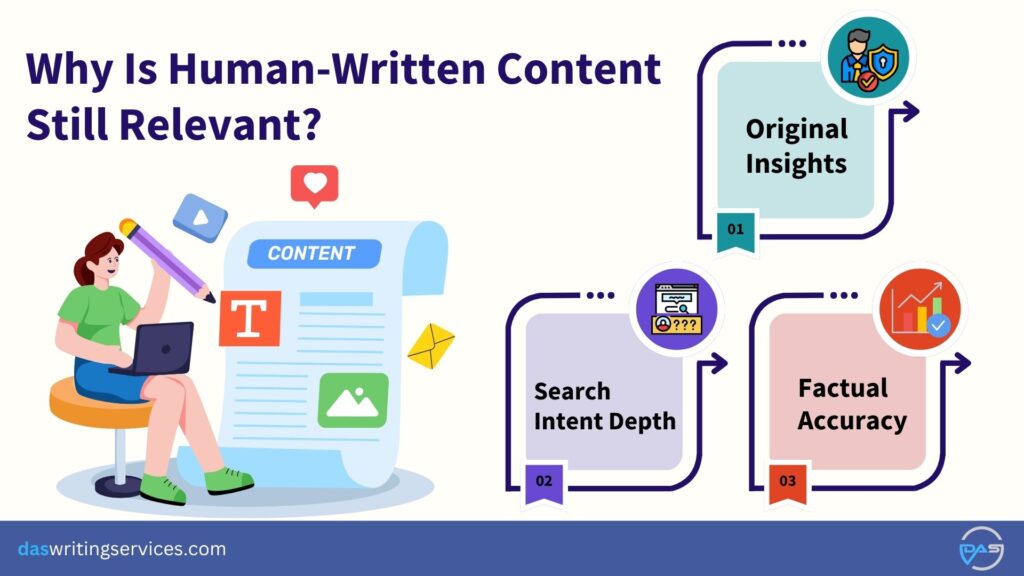
Text watermarking is not a new concept; it has been in place for 2 years. AI is a tool that can help digital marketers automate many manual tasks. However, AI-generated text still lacks the nuance that a professional writer can provide. Here is why human-written content still matters:
- Original Insights: A professional writer can curate your business’s essence and provide insights pulled from real-world experiences. LLMs cannot cite real-world experiences.
- Search Intent Depth: Professional writing services can understand the why within a query and provide context. AI does not understand human emotions and produces a rehashed version of already existing content.
- Factual Accuracy: Although AI can help in the research process, it often hallucinates. On the other hand, a human writer can cross-check and verify relevant facts and data, which increases the quality of content.
Contact Das Writing Services and scale your website to the next level! Our highly qualified team produces 100% human-written and high-quality content such as blogs, webpages, product descriptions, and more.
Final Thoughts
The AI boom is likely to continue in the near future. The technology has made countless manual tasks easier. However, accountability and correct usage still remain top priorities. That is where AI text watermarking comes in. It not only complies with the EU AI Act of 2026, but it also establishes proper guidelines for the future.
You can distinguish your website from countless other AI-generated slop with Das Writing Services. Get professional writing help today and scale your content to the next level!
Frequently Asked Questions
- Does AI add a watermark to texts?
Yes, Anthropic’s Claude and Google’s Gemini use machine-readable text watermarking in synthetic content.
- How to detect AI watermarks in texts?
Humans cannot detect AI watermarks in text. However, you can use specialised algorithms that can decode the statistical token patterns in generative texts.
- How does AI text watermarking work?
AI watermarking works by using a secret mathematical key in its random number generation technique. This makes the text predictable and follow a certain pattern.

Subhodip Das is the founder and CEO of Das Writing Services Pvt. Ltd. He has an experience of 12 years in the field of Digital Marketing and specialises in Content Writing and Marketing Strategies. He has worked with well-established organisations and startups helping them achieve increased Search Engine Rank visibility. If you want to grow your business online, you can reach out to him here.


