
Get Free Content Sample

 Add as preferred on Google →
LLMS TXT is a simple text file that helps all the AI models to understand which are the most important pages on your website. Instead of replacing traditional SEO files, it works as a guide. Recent studies by Ahrefs show that around 28% of the 137K websites already publish an llms.txt file. However, their adoption is still in its early stages.
Search behaviour has changed rapidly. Rather than clicking through multiple search results, people now ask ChatGPT, Claude, Gemini, etc and other AI models for direct answers. This shift has increased the importance of llms.txt and other AI-focused optimisation methods.
While the file is not a sure-shot ranking factor, many people believe it makes high-value content easier for AI systems to discover and interpret.
What Problem Is LLMs.txt Trying to Solve?
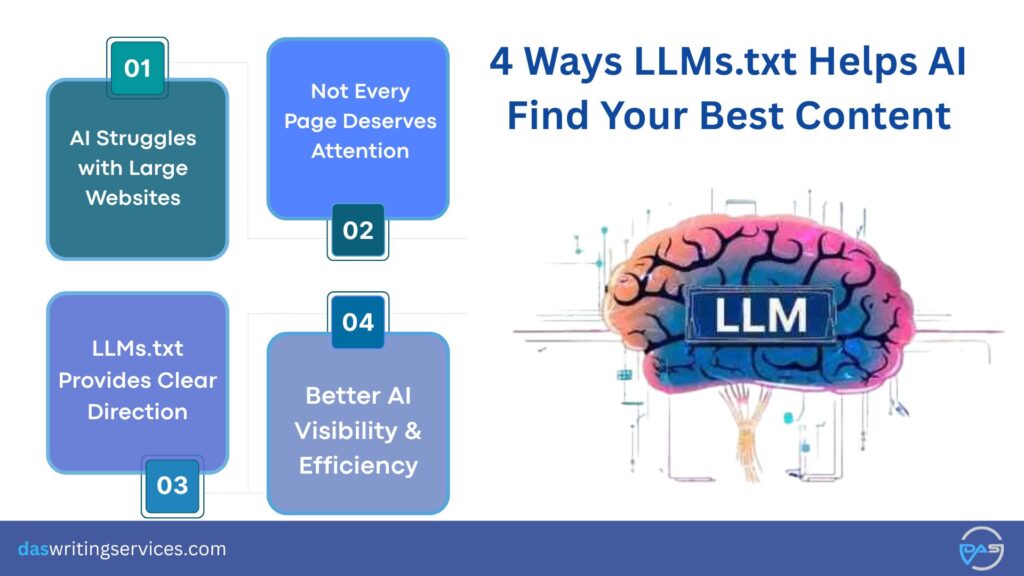
With LLMs.txt we aim to solve a simple problem. AI models often struggle to identify the most useful pages on large websites and this file gives the AI models a clear path which they can follow.
Most of the websites contain hundreds or even thousands of webpages. Some pages provide valuable information. On the other hand, other pages have outdated blogs or navigation pages. This is where llms.txt becomes useful because AI systems may spend time on content that offers little value without proper guidance.
Instead of forcing AI models to crawl an entire website, llms.txt guides them towards the most important pages. You can think of it as a carefully prepared reading list for AI models.
This approach becomes even more important for websites with extensive documentation, knowledge bases, SaaS products, or technical resources. Website owners can highlight trusted content rather than leaving AI to guess which pages deserve attention.
How Are LLMs.txt Files Structured?
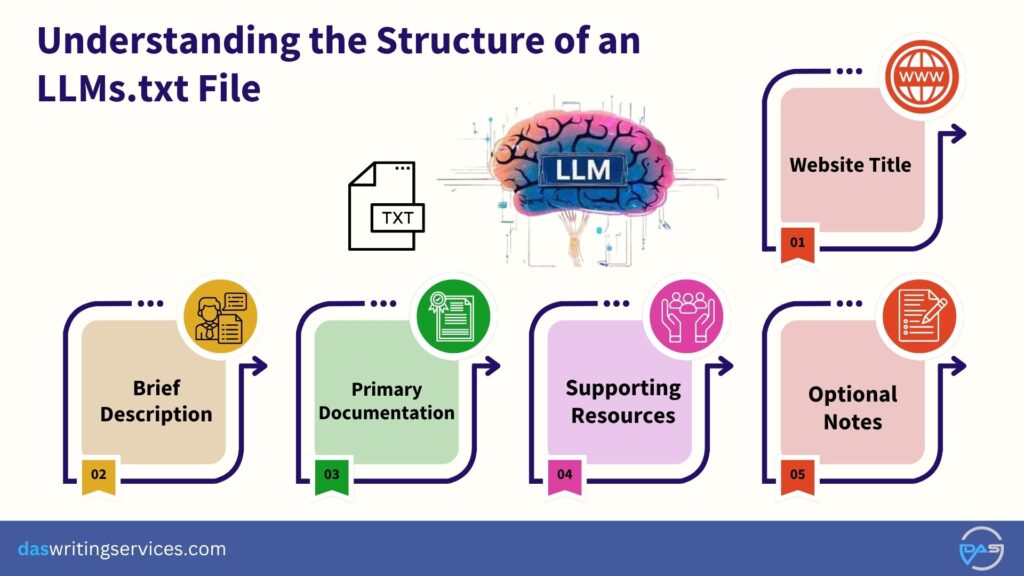
An llms.txt file follows a simple Markdown format. It usually contains a title, a short description, and links to the pages that AI systems should prioritise.
Unlike XML sitemaps, this file is easy for both humans and AI models to read. Instead of it focuses on quality. It highlights the content that offers the greatest value rather than listing every URL.
The exact structure may be different between websites. Even so, most llms.txt files include the same core elements. A typical llms.txt file contains these following sections below:
- Website Title: It is the introduces the website or brand.
- Brief Description: It explains the offerings of the website.
- Primary Documentation: This links to important guides, product pages, or knowledge base articles.
- Supporting Resources: It includes FAQs, tutorials, API documentation, or research papers where relevant.
- Optional Notes: This provides extra context that may help AI systems understand the website better.
This structure keeps the file clean and organised. It also allows AI models to identify trusted content much faster.
Several AI-focused SEO tools now support automatic generation of these llms.txt files. At the same time, many businesses still prefer to build them manually so they can choose the most valuable pages with better accuracy.
As AI search becomes more sophisticated, websites with clear information hierarchies are likely to perform better. Before implementing AI-focused optimisation this is another reason why businesses invest in better content architecture.
How to Create an LLMs.txt File?
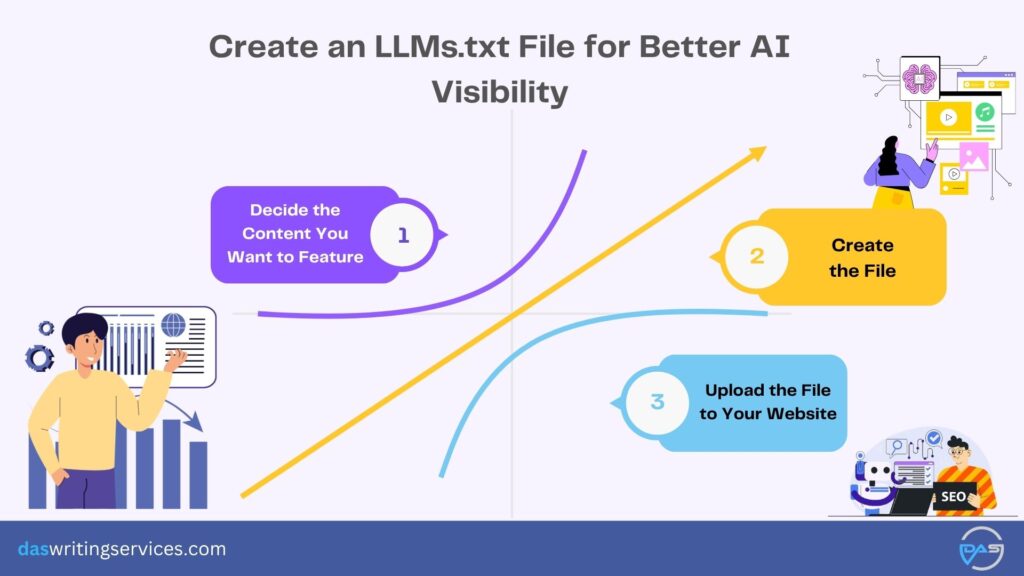
Creating an llms.txt file is straightforward. You only need to decide which pages deserve attention, build the file in Markdown format, and upload it to your website.
The process does not take long. However, the quality of your file depends on the pages you choose. A well-planned file offers far more value than a long list of random URLs. Here is a detailed understanding of what is the process of creating an LLMs.txt file:
- Decide the Content You Want to Feature
You can start this by choosing the pages you feel that best represent your website. Then you need to focus on quality instead of volume. Not every page belongs in an llms.txt file. AI systems benefit more from evergreen content than archive pages or temporary announcements.
Before you make your selection, ask yourself which pages answer user questions most effectively. Here are some examples of the pages:
- Service pages with complete information.
- Comprehensive blog articles.
- Product documentation.
- Help centres and knowledge bases.
- Pricing pages where appropriate.
- Research reports or white papers.
Once you have selected these pages, review them carefully. Remove outdated information and refresh statistics where needed.
Many organisations work with Das Writing Services to update existing content before preparing AI-ready resources. Fresh, authoritative content gives every optimisation effort a stronger foundation.
- Create the File
The next step is to build the file in Markdown format. You need to keep the layout clean and easy to read. You need to begin with your website name and a short description. Then organise your links under clear headings.
Just avoid unnecessary formatting or excessive explanations. A simple structure is often the most effective. You can keep these best practices in mind:
- You can use descriptive section headings.
- You can add only high-value URLs.
- Just check every link before publishing.
- Finally update the file whenever major content changes occur.
After completing the file, you need to review it one final time. Small mistakes such as broken links or outdated pages can reduce its usefulness. It is important to remember that the goal is clarity. The easier your file is to understand, the more useful it becomes for AI systems.
- Upload the File to Your Website
Once your file is ready, you need to upload it to your website’s root directory. This makes it accessible through a standard URL. Most websites place the file here: https://yourdomain.com/llms.txt
After you upload, open the URL in your browser. You need to confirm that the file loads correctly and displays the expected content. You should also review the file regularly. Over time you can add new blog posts, updated documentation, revised service pages, etc.
If your organisation publishes large amounts of content each month, expert guidance can save your time. Das Writing Services can help you identify high-value pages, refine your AI content strategy, and keep your website ready for both traditional search engines and emerging AI platforms.
Is LLMs.txt Going to be the Future of GEO?
LLMs.txt has the potential to support GEO, but it is unlikely to become the only solution for GEO. It works best as one part of a broader AI optimisation strategy.
Generative Engine Optimisation (GEO) focuses on when you make your content easier for AI search engines to understand, retrieve, and cite. Website owners are looking for practical ways to improve their visibility because AI-powered search will continue to grow.
The file offers a structured way to highlight your most valuable content. However, it cannot replace well-written articles, topical authority, or technical SEO. AI models still evaluate content quality, relevance, and credibility before using it in their responses.
Final Word
LLMs.txt is a simple addition to modern SEO and GEO strategies. It helps AI systems discover your most important content, although its real-world impact is still evolving.
As AI-powered search becomes more common, website owners should focus on creating trustworthy content before chasing new technical trends. A well-written article, accurate information, and a clear website structure will always provide the strongest foundation.
The LLMs.txt file for SEO should therefore be viewed as an enhancement rather than a replacement for traditional optimisation. It complements existing SEO practices.
If you want to create content that performs well across Google, AI search platforms, and answer engines, Das Writing Services can help.
Frequently Asked Questions
1. Is LLMs.txt a factor for Google ranking?
No. Google has not confirmed that llms.txt is a ranking factor. Your rankings still depend on content quality, backlinks, user experience, and other established SEO signals.
2. Does llms.txt help to improve AI citations?
There is no guarantee that it will increase AI citations. Content quality and authority remain the biggest factors.
3. Is llms.txt really beneficial?
It offers a low-cost way to organise important content for AI systems. While the benefits are still developing, it can support a future-ready SEO strategy.
4. Should every website create an llms.txt file?
Not necessarily. Websites with extensive documentation, knowledge bases, SaaS products, or large content libraries are likely to benefit the most. Smaller websites can also adopt it if they want to prepare for AI search.
5. How often should you update an llms.txt file?
Review the file whenever you publish important content, update service pages, or restructure your website. Keeping it current ensures AI systems always have access to your most valuable resources.

Subhodip Das is the founder and CEO of Das Writing Services Pvt. Ltd. He has an experience of 12 years in the field of Digital Marketing and specialises in Content Writing and Marketing Strategies. He has worked with well-established organisations and startups helping them achieve increased Search Engine Rank visibility. If you want to grow your business online, you can reach out to him here.


