

Get Free Content Sample

 Add as preferred on Google →
For businesses publishing content has pretty much become an unspoken rule. In fact, the average business will produce hundreds of content pieces this year alone. According to industry data, 74% of marketers say content marketing helped them to generate demand or leads in 2025.
While almost two-thirds of global businesses use some type of content marketing, many end up losing money due to lack of strategy. Any forward-looking organization monitors their content performance to understand if it provides value in comparison to the resources it consumes.
In this blog, we will define what it means, why tracking the performance of your content marketing matters, how to measure it, and how to optimize your campaign for better business outcomes.
What is Content Performance?
At its core, content performance refers to the impact that your published content has on your target audience and what impact it leaves on your organization. It is not just about whether a blog post was published or a video went live; it is about how that content contributes to business outcomes such as creating brand awareness, establishing thought leadership, generating leads, conversions, and retention.
The key is aligning the ‘what’ (your content) with the ‘why’ (your business goal) and then measuring your performance against the relevant KPIs.
In simple words, great content is not just well-written or visually appealing – it is measurable. You need to know how your content is performing in terms of metrics, channels, audience segments, and outcomes.
Why You Must Track Content Performance of your Business?
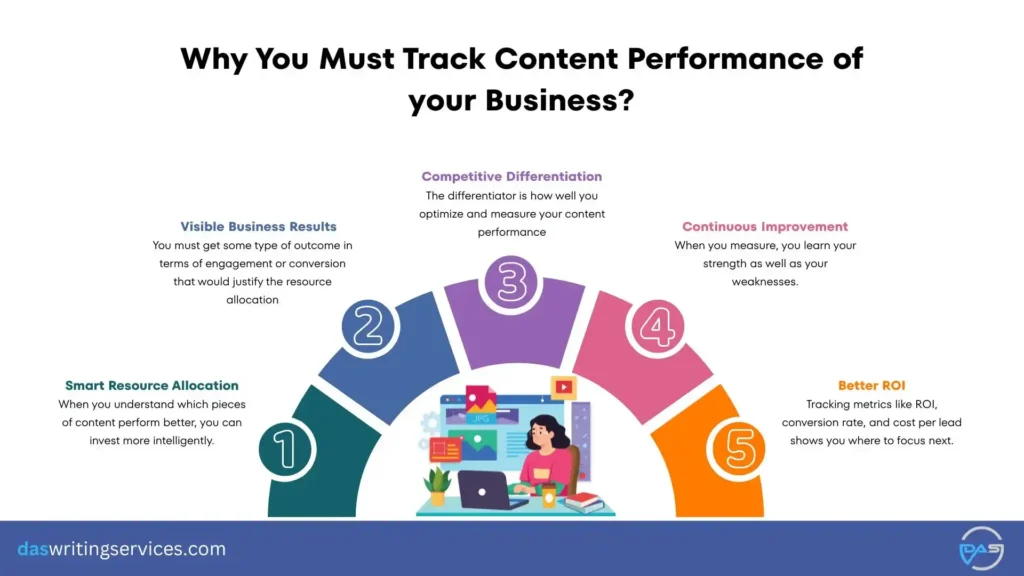
There are several critical reasons why tracking and optimizing content performance is non-negotiable for any business using some form of content to engage with the users:
1. Smart Resource Allocation
When you understand which pieces of content perform better, you can invest more intelligently. So if your social media posts are driving more engagement than podcasts and whitepapers, it is a cue that your audience prefers the posts more than podcasts.
2. Visible Business Results
In 2025, 62% marketers said content marketing strategy helped them to nurture audiences, and 49% said it helped generate sales or revenue. You must get some type of outcome in terms of engagement or conversion that would justify the resource allocation to the leadership.
3. Competitive Differentiation
With more than 80% of marketers using content marketing and over half planning to increase spend, simply creating content is not enough. The differentiator is how well you optimize and measure your content performance. It would set your apart from the competitors and create a distinctive brand identity for your business.
4. Continuous Improvement
When you measure, you learn your strength as well as your weaknesses. Content performance analysis enables you to refine strategy, optimize messaging, and make decisions based on real customer behavior and feedback.
5. Better ROI
By focusing on performance, you shift content from being a cost-centre to a strategic investment. Tracking metrics like ROI, conversion rate, and cost per lead shows you where to focus next.
Ready to boost your content performance? Partner with us and watch your content deliver measurable results.
What are The Key Content Performance Metrics to Track?
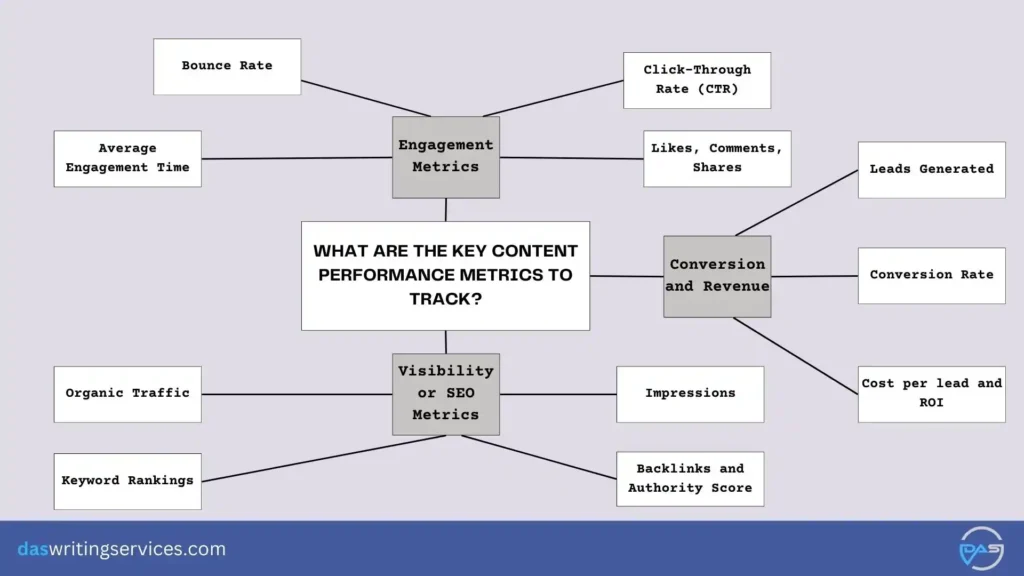
Before diving into dashboards and analysis, you need to agree on which metrics will define success. The right metrics depend on your business objectives. Here is a breakdown of key categories and metrics you should monitor:
Need an infographic on which KPIs to track and why (Note: Do not rip off the same headers and text of the content)
1. Engagement Metrics
These metrics reveal how your audience interacts with content and whether it holds their attention. It includes:
- Average Engagement Time: A higher value of average engagement time generally signals compelling content.
- Bounce Rate: A high bounce rate usually shows that the content does not meet user expectations or intent.
- Click-Through Rate (CTR): It is often used for promotional content, email, or social media campaigns.
- Likes, Comments, Shares: It is for social media or interactive channels and measures resonance and virality.
This is useful when you are just starting out in your content marketing strategy. Increased engagement time and higher CTR with reduced bounce rate is a sign that your content marketing strategy is reaching the right audience group.
2. Visibility or SEO Metrics
These metrics show how visible and discoverable your content is across search engines, AI answer engines and other digital channels.
- Organic Traffic: Tracks the number of visitors coming to your site through unpaid search results.
- Keyword Rankings: It reflects how your content ranks for specific target keywords over time.
- Impressions: It shows how frequently your content appears in search results or on social platforms, even if users do not click.
- Backlinks and Authority Score: These represent external validation of your content. When other websites link to your pages, it signals to search engines that your content is credible.
Also Read: How to Build Backlinks in 2025: 16 Effective Strategies
3. Conversion and Revenue
These metrics measure the actual business impact of your content.
- Leads Generated: Counts the number of leads captured through forms, downloads, or newsletter signups.
- Conversion Rate: It shows the percentage of visitors who complete a desired action, such as filling out a form or making a purchase.
- Cost per lead and ROI: It measures how much you spend to acquire each lead, while ROI shows the overall return compared to your investment in content creation.
By tracking all of the above, you can build a content performance dashboard that gives you full visibility of how content is functioning and where it needs improvement.
How to Conduct a Content Performance Analysis?

Conducting a robust content performance analysis or audit is more than just crunching numbers. It is about aligning them with business goals, and turning insights into action. Here is a structured process of how to do a content performance analysis:
1. Evaluate Your Objectives
Start by asking what this content is meant to achieve. Increase traffic? Generate leads? Enhance customer engagement?
Without aligning the content with specific objectives, you risk measuring the wrong things.
2. Select Your Key Performance Indicators (KPIs)
Based on your objectives, pick the relevant metrics from the list we outlined earlier.
For example, if the goal is to boost lead generation, then conversion rate and cost per lead become crucial. If brand awareness is the goal, then page views, impressions, and social media shares matter more.
3. Collect Data
Use tools like Google Analytics 4 (GA4), HubSpot, Ahrefs, and marketing automation platforms. If you have many channels, consolidating into a single dashboard simplifies analysis and overall communication.
4. Report and Share Insights
Summarize key findings in a content performance report that your team can understand. Highlight wins, risks, and opportunities. Use clear language that links back to business goals.
If you are ready to take your content performance to the next level, our team at Das Writing Services is here to help. Let’s make your content work smarter and deliver real results. Click below to request a custom content audit

9 Tips to Optimize Content Performance for Better Results
Content performance optimization involves refining your content to maximize engagement and business outcomes. Here are some key tips to focus on:
1. Align Content Strategy with Business Goals
Ensure your content themes, formats, and distribution channels are mapped to strategic objectives of your business. If you are aiming for lead generation, then content should include clear conversion paths.
2. Use a Solid Content Performance Dashboard
Build a dashboard that tracks your key metrics in one place. This gives you real-time or regular snapshots of performance and alerts you to anomalies.
3. Refresh or Repurpose Content
When analysis reveals content that is under-performing but has potential, consider updating it. You can update it by refreshing keywords, updating statistics, improving visuals, and adding calls-to-action. You might also repurpose high-performing content into other formats. For example, you can turn a blog into a video.
4. Experiment with Formats and Channels
Your audience may prefer certain formats, such as videos, infographics, short-form videos, or channels such as LinkedIn, email, or search. Test variations and compare results. Use findings from your analysis.
5. Employ SEO and Visibility Tactics
Optimize content for search, target appropriate keywords, ensure metadata is correct, build backlinks, and track keyword rankings and impressions. These improve organic visibility and strengthen content performance.
Also Read: Search Engine Optimization (SEO) Made Simple: Learn & Implement
6. Use Data to Personalize and Segment
Segment your audience and tailor content accordingly. For example, senior leadership may prefer executive briefs, while newbie marketers want informational or educational content for marketing. By using segmentation, you improve relevance and hence performance metrics.
Also Read: What is Content Personalization?
7. Set Benchmarks and Continuous Review
Use past performance or industry benchmarks to establish performance expectations. Then monitor regularly (weekly or monthly) to spot trends or issues early.
8. Improve Content Quality and Relevance
High-quality, audience-centric content remains essential. That might mean more in-depth research, stronger storytelling, better visuals, improved UX, and optimized formats for mobile and desktop.
9. Stay Updated with Evolving Trends
Optimizing content is an ongoing process. Algorithms, AI tools, and audience behaviour shift constantly. Your strategy must stay flexible. What works now may not perform six months later.
What are the Common Challenges to Improving Content Performance?
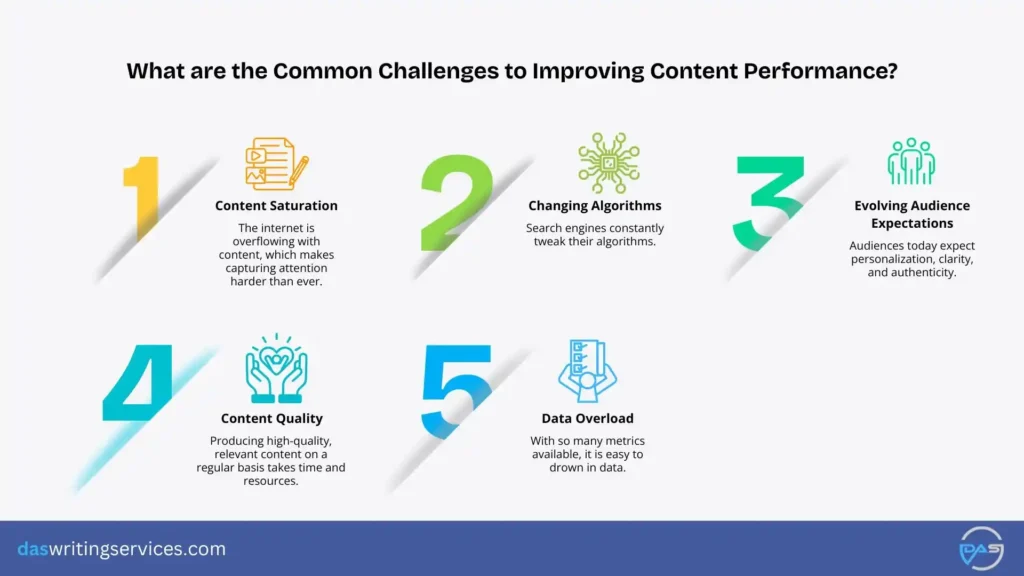
While the benefits of improving content performance are clear, actually getting there is not always easy. Several hurdles can make it difficult to see consistent results. However, recognizing them helps you plan proactively.
1. Content Saturation
The internet is overflowing with content, which makes capturing attention harder than ever. Standing out requires a mix of creativity, strategy, and genuine value.
2. Changing Algorithms
Search engines constantly tweak their algorithms. Even a small update can affect how your content ranks, and staying ahead often requires strong technical SEO know-how.
3. Evolving Audience Expectations
Audiences today expect personalization, clarity, and authenticity. Keeping up with their changing preferences is ongoing but absolutely worthwhile.
4. Content Quality
Producing high-quality, relevant content on a regular basis takes time and resources. It is no surprise that a survey found that 83% of marketers prioritize creating fewer but higher-quality content pieces. They recognize that quality drives better engagement and results than simply focusing on quantity.
5. Data Overload
With so many metrics available, it is easy to drown in data. Without a clear strategy, analyzing performance can quickly become confusing rather than insightful.
By anticipating these challenges, you can build your content performance programme to be robust and adaptive.
If managing these challenges feels overwhelming, connect with our expert team today to unlock genuine business growth through a proven content strategy.
Takeaway
Simply producing content is no longer enough. Every brand is publishing, but only those that measure and refine their efforts truly stand out. The real differentiator lies in how well your content performs, how effectively it engages, drives conversions, and supports your business goals.
By setting clear objectives, tracking meaningful metrics, and analyzing performance regularly, you gain the clarity needed to make smarter decisions. Applying these insights can turn your content strategy into a measurable, revenue-driving business asset.

Rohit Majumdar, a professional SEO content writer with a specialisation in Digital Marketing and Finance, is working at Das Writing Services. In his SEO content writing career, he has worked for different clients offering products and services like insurance, FDs, brokerage, and digital marketing. Following his passion, he also contributes to our blog, exchanging valuable ideas. You can also contact him on LinkedIn for any queries.


