
Get Free Content Sample

 Add as preferred on Google →
You can humanise AI content, but it takes a lot more than just changing a few words. Here our goal is to make every sentence feel natural, helpful, and trustworthy.
AI has become a major part of content creation. According to Omni Bound, ChatGPT usage has increased and reached 900 million weekly active users in February 2026, with adoption expanding across different age groups, industries, and countries.
At the same time, Google continues to emphasise that our content needs to be original, accurate, and we must write it for people instead of search engines.
That is why businesses need to treat AI as a writing assistant, not a replacement for human writers. This guide explains how to make AI-generated content feel authentic while improving user experience and search visibility.
What Makes Every Content Feel Human?
Human content feels natural because it reflects experience, emotion, personal touch and clear thinking. Readers need to feel that there is another person who understands their questions and they offers practical answers.
On the other hand, AI often produces content which is grammatically correct. But still it usually misses personality, context, and original human insights. Many articles follow similar sentence patterns. Also, the ideas are repetitive or generic that add little to no value. Human-written content stands out because it offers:
- Personal observations where appropriate
- Clear opinions supported by facts
- Sentence flow which is natural
- Context that matches the reader’s intent
- Real examples without any generic explanations
Google also encourages creators and content writers to focus on quality, originality, value, etc rather than how they produce the content. Content remains the priority which shows experience, expertise, authoritativeness, and trust.
Best Techniques to Make AI Content Feel Authentic
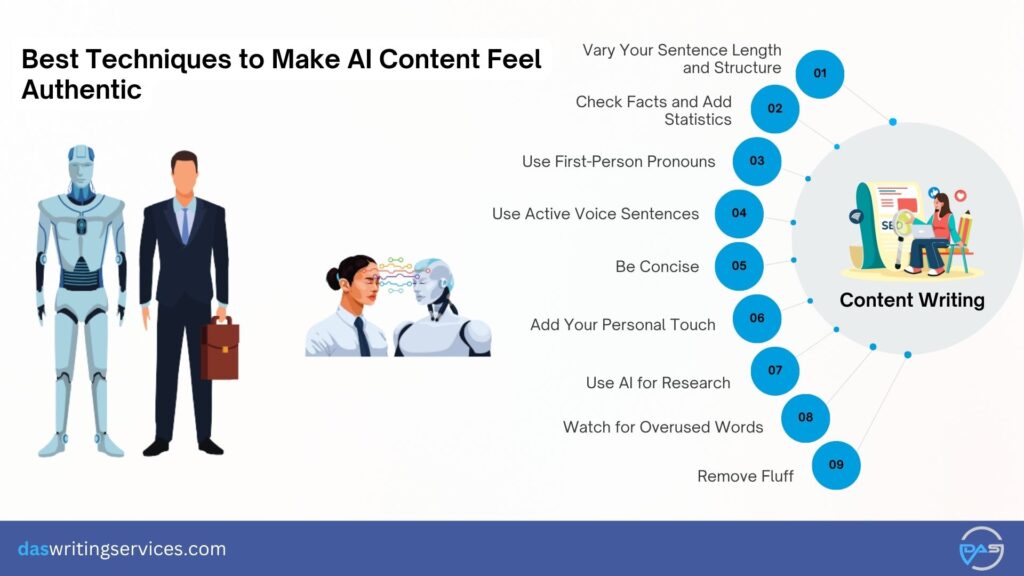
You need to refine the language, improve the flow, and add real value for your readers. Here is a detailed understanding of how to humanise AI generated content while keeping it informative and SEO-friendly:
- Vary Your Sentence Length and Structure
AI usually follows predictable writing patterns. Many paragraphs contain sentences of similar length. It makes the content feel repetitive. Readers can quickly notice this rhythm, even if they cannot explain why it feels unnatural.
You need to mix short sentences with longer sentences. You can also use different paragraph lengths. A brief sentence can highlight an important point. On the other hand, a longer paragraph can explain a complex idea in more detail.
- Check Facts and Add Statistics
AI can generate convincing information, but it does not always provide accurate or current facts. You need to manually verify every claim before publishing.
If you add reliable statistics, it strengthens your content because they support your arguments with evidence. Industry reports, government publications, and official company announcements are excellent sources for trustworthy information.
For example, Google emphasise that helpful, reliable, and people-first content should remain the focus.
- Use First-Person Pronouns
Content feels more authentic when readers sense that a real person is speaking to them. First-person language helps create that connection with the readers. But you need to use it naturally in your content. Do not make it sound forceful.
Instead of saying, ‘Businesses should review AI-generated content before publishing,’ you can write, ‘We always review AI-generated content before publishing because accuracy is an important factor.’ This simple change makes the advice feel more genuine and practical.
You do not need to use ‘I’ or ‘we’ throughout the article. Many top content writers in India follow this approach. They combine expert knowledge with practical insights.
- Use Active Voice Sentences
Active voice makes writing direct and easy to follow. Active voice shows who is performing the action and it improves readability. AI often relies on passive voice because it sounds neutral. Unfortunately, it can also make content feel distant and less engaging.
For example, ‘The article was reviewed before it was published’ sounds less natural than ‘The editor reviewed the article before publication.’ The second version is shorter, clearer, and more conversational.
Whenever possible, you can rewrite passive sentences into active voice. This small adjustment helps humanise AI content and creates a stronger connection with readers.
- Be Concise
Readers appreciate content that respects their time. Even when the information is accurate, long explanations and repeated ideas reduce engagement.
You need to review every paragraph with a critical eye. Remove unnecessary words, simplify complicated sentences, and avoid repeating the same point in different ways. Clear writing and concise explanations make it easier for readers to find the answers they need.
- Add Your Personal Touch
AI can organise information efficiently, but it cannot replace genuine experience. Readers connect more strongly with content that includes practical observations, expert opinions, or lessons learned from real situations.
You do not need to share personal stories throughout the article. Instead, include insights or examples that demonstrate experience or explain how a recommendation works in practice.
- Use AI for Research
AI works best as a research assistant rather than a complete content creator. It can help you generate ideas, organise information, identify trends, and build an initial outline.
Many professional writers begin with AI-assisted content research before adding expert insights, updated statistics, and original analysis. This approach combines speed with accuracy and results in higher-quality content.
If you want to humanise AI content, let AI support your research while human expertise shapes the final article.
- Watch for Overused Words
AI frequently repeats the same vocabulary across different pieces of content. Words such as delve, leverage, robust, transform, and seamless appear so often that they make articles sound generic.
You need to read your draft carefully and replace these words with simpler alternatives wherever possible. Plain language usually creates a stronger connection with readers because it feels more natural.
- Remove Fluff
Generic phrases rarely add value. Expressions such as ‘In today’s digital world,’ ‘game changer,’ or ‘think outside the box’ appear in countless AI-generated articles and often weaken the overall message.
Replace these cliches with specific examples or practical advice. Readers appreciate clear and useful information far more than familiar buzzwords. The more specific your writing becomes, the more valuable it feels. If you plan to humanise AI content online, remember that editing matters just as much as writing.
Why is it Important to Humanise AI Content?
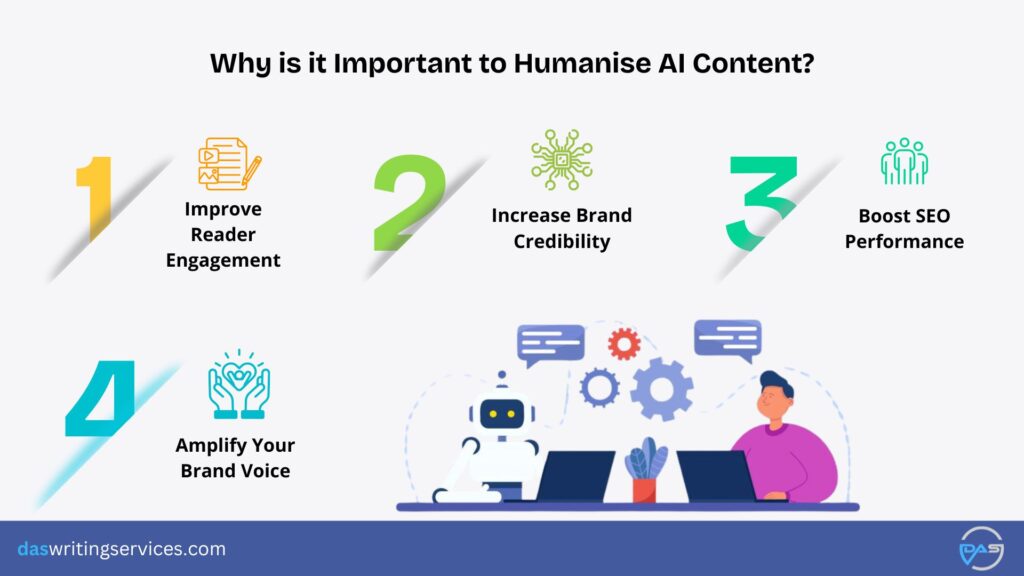
AI can produce a first draft within minutes. However, only thoughtful editing can turn that AI generated draft into content that informs, persuades, and converts. Here are the biggest reasons why businesses should humanise AI content before publishing:
- Improve Reader Engagement
Humanised content keeps readers interested because it feels natural and relevant. Instead of sounding repetitive or robotic, it answers questions in a clear and conversational way. Organisations that consistently publish high-quality content are more likely to achieve their marketing goals.
Better engagement also leads to stronger results. Readers spend more time on your website, explore other pages, and are more likely to return when they find useful information.
- Increase Brand Credibility
Your content shapes how people see your brand. If an article contains awkward phrasing, repeated ideas, or factual errors, readers may question your expertise.
Human editing helps eliminate those issues. It improves clarity, strengthens accuracy, and ensures every article reflects your brand’s standards.
At Das Writing Services, we create content that sounds natural and aligns with every client’s unique brand voice. This approach helps businesses build credibility while maintaining consistency across all their content.
- Boost SEO Performance
Search engines reward content that satisfies user intent. Google continues to emphasise that helpful, original, and people-first content performs better than content created only to rank for keywords.
Human editing improves SEO because it removes repetitive wording. It also strengthens topical depth and creates a better reading experience. It allows writers to add original insights and relevant examples that AI cannot provide.
- Amplify Your Brand Voice
Every brand communicates differently. Some brands prefer a friendly and conversational tone, while others need a more professional style. AI cannot consistently capture those differences without careful editing.
Human writers understand how to adjust tone, vocabulary, and sentence flow to match a brand’s identity. This consistency helps readers recognise your business and builds stronger relationships over time.
Can Google Detect AI Content?
Yes, Google can detect patterns that suggest content was generated by AI. Google uaases its AI-powered spam detection system, SpamBrain, to identify mathematical patterns in content. However, Google’s AI content policy makes it clear that quality matters more than how the content is created.
AI-generated content is not penalised simply because AI was used. It may be affected if it is published at scale, offers little value, or lacks experience, expertise, authoritativeness, and trustworthiness (E-E-A-T). The best approach is to refine every draft with human expertise before publishing.
Final Word
AI has transformed content creation, but it has not replaced the need for skilled writers and editors. The most successful content combines AI’s speed with human creativity, critical thinking, and real-world expertise.
If your business wants content that sounds natural and delivers measurable results, expert editing makes all the difference.
Das Writing Services helps businesses create high-quality, SEO-focused content that readers trust and search engines value. Our team ensures every piece feels authentic, engaging, and aligned with your brand voice.
Frequently Asked Questions
How to make AI write like a human?
Start with AI for drafting and research. Then edit the content by adding original insights, verified facts, varied sentence structures, and a consistent brand voice. Human review remains the most effective way to make AI-generated content feel authentic.
What are the best free AI humaniser tools?
Several platforms offer free features that improve AI-generated text. However, no humanise AI content tool can fully replace human editing. Choose a solution that improves readability while allowing manual refinement.
Can businesses rely entirely on AI for content writing?
AI is excellent for drafting, brainstorming, and research. However, businesses should combine AI with experienced writers and editors to maintain accuracy, originality, and a strong brand voice.

Subhodip Das is the founder and CEO of Das Writing Services Pvt. Ltd. He has an experience of 12 years in the field of Digital Marketing and specialises in Content Writing and Marketing Strategies. He has worked with well-established organisations and startups helping them achieve increased Search Engine Rank visibility. If you want to grow your business online, you can reach out to him here.


