
Get Free Content Sample

 Add as preferred on Google →
Search is no longer only about ranking on a results page. It is about being chosen by AI. ChatGPT, Google AI Overviews, and Perplexity AI are changing how people find information.
Users now get direct answers instead of clicking multiple links. This means your brand must be visible inside those answers.
This shift has introduced a new metric called AI visibility. It focuses on whether AI systems use and show your content when answering questions. A brand can rank high on Google and still not appear in AI responses.
In this guide, you will learn what AI visibility means and how to measure it. You will also understand how to improve your presence across AI platforms.
What Is AI Visibility?
AI visibility is the measure of how often and how clearly your brand appears in responses generated by AI tools like ChatGPT, Google Gemini, Perplexity AI, and Claude. Instead of focusing only on search rankings, it looks at whether AI systems include your brand when answering user questions.
This visibility usually appears in two ways. The first is mentions, where your brand is named as a relevant option. The second is citations, where AI tools include a link to your website as a source.
AI visibility shows if your content is trusted and useful enough for AI models to use in their answers. Even if you rank well on search engines, your brand may not appear in AI responses. That is why this metric is becoming essential for measuring true digital presence today.
Why Does AI Visibility Matter in 2026 for Businesses Competing in AI-Driven Search?
AI visibility has become a critical factor for business growth in 2026. As AI platforms increasingly shape how users discover and evaluate information, being included in AI-generated answers now determines whether your brand is even considered in the buying journey.
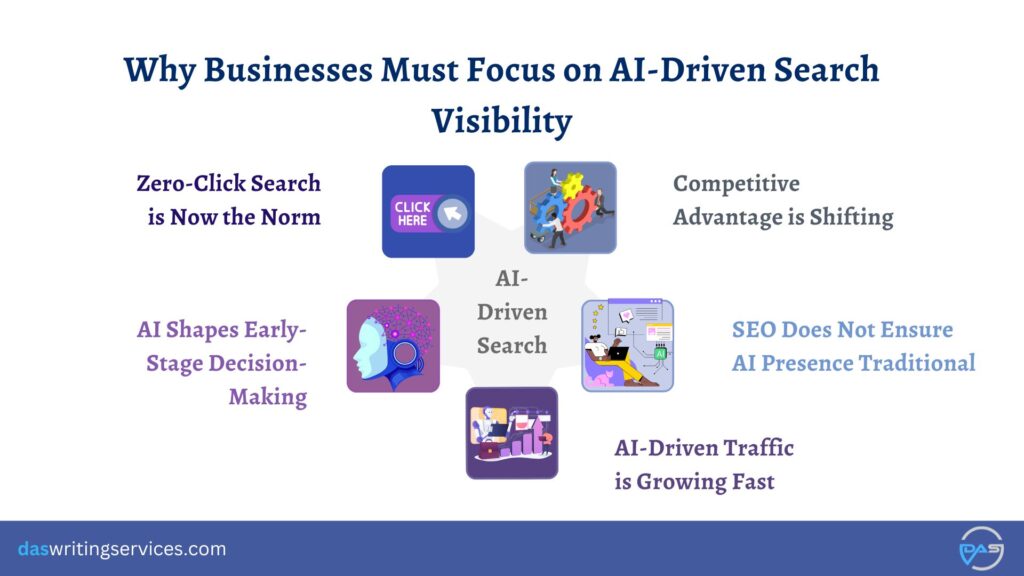
- Zero-Click Search is Now the Norm
Users no longer rely on multiple website visits to gather information. They expect direct answers. If your brand is not part of those answers, you lose visibility before the user even considers clicking through to a site.
About 56% of Google desktop searches now end without users clicking any external website, according to Datos and SparkToro Q4 2025.
- AI Shapes Early-Stage Decision-Making
Modern buyers conduct extensive research before engaging with sales teams. AI tools help them compare options, evaluate use cases, and shortlist vendors. This means AI-generated recommendations often become the first filter in the decision process.
- AI-Driven Traffic is Growing Fast
AI platforms are no longer experimental. They are becoming primary discovery channels. Brands that appear in AI responses benefit from increased visibility, referral traffic, and trust. Over time, repeated mentions strengthen authority and create a compounding advantage.
According to Semrush, outbound referral traffic from ChatGPT to external websites grew by 206% in 2025. More than 30% of this traffic is concentrated across just 10 domains, while over 20% goes to Google.
- SEO Does Not Ensure AI PresenceTraditional
Strong rankings on search engines do not guarantee inclusion in AI responses. AI systems prioritise clarity, structured data, and consistency across sources. Content that is not optimised for AI may be ignored even if it ranks well.
To bridge this gap between traditional SEO and AI presence, explore our deep dive into 2026 SEO trends, where we unpack how intent-driven strategies ensure your content thrives in both worlds.
- Competitive Advantage is Shifting
Early adopters of AI visibility strategies are building strong positions. As AI tools continue to learn from existing patterns, brands that are already visible will be recommended more often, making it harder for others to compete later.
How Does AI Visibility Work Across Platforms Like ChatGPT, Gemini, etc.?
AI visibility works differently across platforms because each AI system uses its own method to select and present information. ChatGPT and Google Gemini rely on a mix of training data, real-time retrieval, and source evaluation to generate answers.
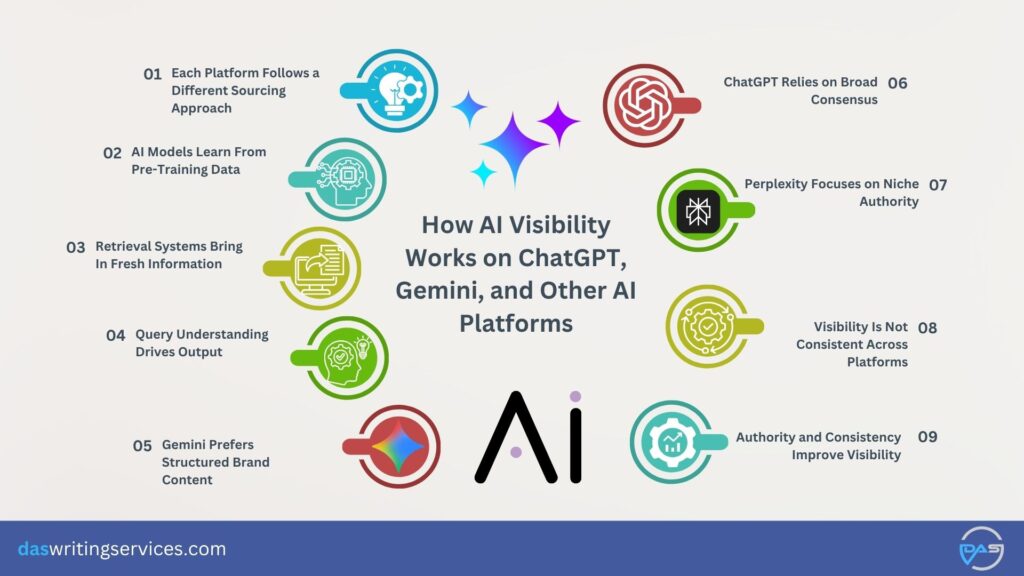
- Each Platform Follows a Different Sourcing Approach
ChatGPT, Google Gemini, and Perplexity AI prioritise different types of content, which affects where and how your brand appears.
- AI Models Learn From Pre-Training Data
They are trained on large datasets that include websites, articles, and structured content. This forms the base knowledge used in responses.
- Retrieval Systems Bring In Fresh Information
Many AI tools use real-time data retrieval to improve accuracy and include up-to-date content in their answers.
- Query Understanding Drives Output
AI breaks user queries into smaller parts and analyses intent before generating responses step by step.
- Gemini Prefers Structured Brand Content
Google Gemini often cites well-organised pages from official websites, especially those with schema and clear information.
- ChatGPT Relies on Broad Consensus
ChatGPT uses a mix of sources, including third-party directories and listings, to form balanced answers.
- Perplexity Focuses on Niche Authority
Perplexity AI prioritizes industry specific and trusted sources for more precise recommendations.
- Visibility Is Not Consistent Across Platforms
A brand may appear frequently on one platform but be missing on another due to different ranking signals.
- Authority and Consistency Improve Visibility
Strong content structure, accurate data, and presence across multiple sources increase chances of being cited.
What Are the Most Important Metrics to Measure AI Visibility Effectively?
Measuring AI visibility requires a combination of volume, quality, and competitive insights. As platforms like ChatGPT and Google AI Overviews evolve, businesses must track multiple signals to understand their true presence.
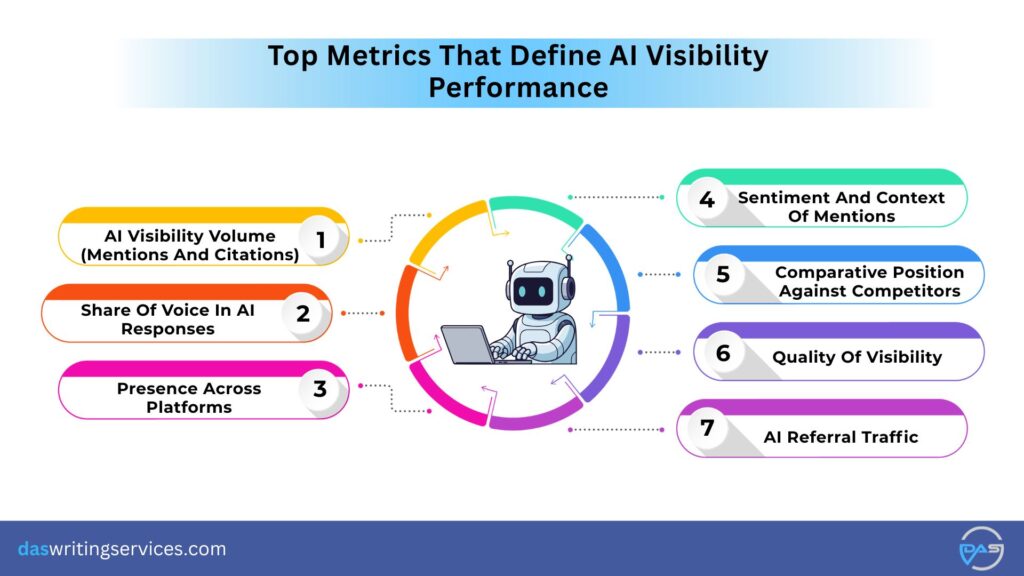
- AI Visibility Volume (Mentions And Citations)
This measures how often your brand appears in AI-generated responses. Tracking mentions and citations over time helps you understand whether your visibility is growing or declining.
- Share Of Voice In AI Responses
This shows how frequently your brand appears compared to competitors for key queries. It helps you understand whether you are part of the buyer’s consideration set.
- Presence Across Platforms
It is important to track whether your brand appears at all on different AI tools. If you are not present, you are effectively invisible in that channel.
- Sentiment And Context Of Mentions
AI does not just mention brands, it describes them. Tracking whether your brand is positioned positively or negatively helps manage perception and trust.
- Comparative Position Against Competitors
AI responses often include only a few options. Your placement among competitors can directly influence user decisions.
- Quality Of Visibility
Not all mentions are equal. Being a primary recommendation with a citation carries more value than a minor mention.
- AI Referral Traffic
This tracks how many users visit your website from AI platforms. It is a strong indicator that visibility is driving real engagement and conversions.
What Is the Step-by-Step Process to Measure AI Visibility for Your Content?
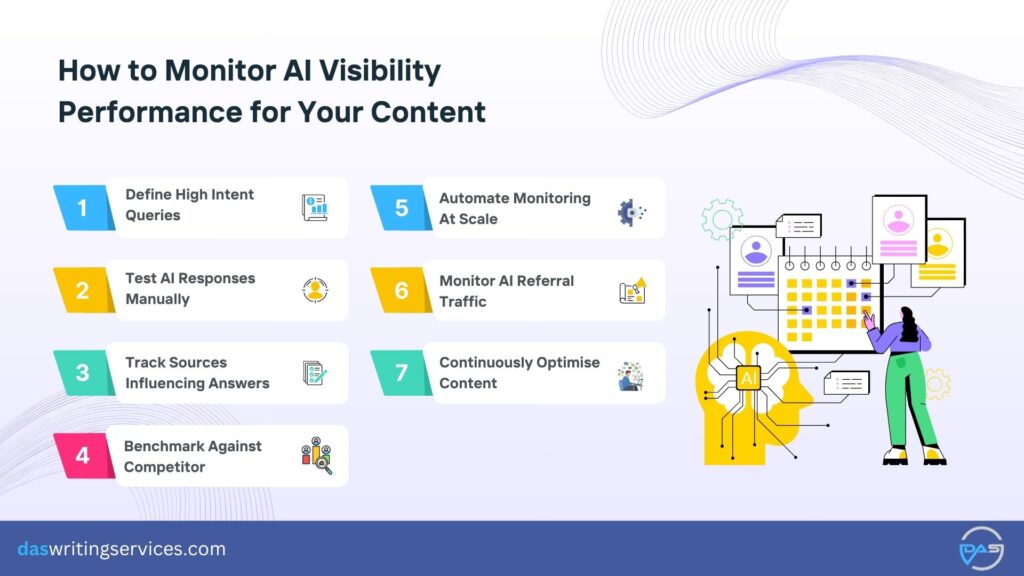
Measuring AI visibility is not a one-time activity but an ongoing system that tracks how your brand appears across platforms like ChatGPT, Google Gemini, and Perplexity AI.
- Define High Intent Queries
Start by identifying the questions your audience is asking. These can come from search data, sales calls, or customer conversations. Group them by intent, such as informational, comparison, and decision stage queries.
- Test AI Responses Manually
Run these queries across major AI platforms and record whether your brand is mentioned, cited, or excluded. Also, note competitor presence and how AI describes each brand.
- Track Sources Influencing Answers
Identify which websites and content types are repeatedly cited. This helps you understand where AI systems are getting their information and where your brand needs to appear.
- Benchmark Against Competitors
Compare your visibility with 2 to 3 key competitors. Measure share of voice, co-mentions, and gaps where competitors dominate AI responses.
- Automate Monitoring At Scale
Use tools or custom systems to track hundreds of queries regularly. Set a cadence for daily, weekly, and monthly tracking to identify trends and sudden changes.
- Monitor AI Referral Traffic
Track visits coming from AI platforms in analytics tools. This shows whether visibility is driving actual user engagement.
- Continuously Optimise Content
Improve content structure, add schema, update data, and create clear answer formats. Regular updates increase your chances of being cited and improve long-term AI visibility.
Which Tools Can You Use to Track and Monitor AI Visibility Accurately?
Tracking AI visibility requires tools that go beyond simple mention counting. The best platforms combine prompt-level tracking, competitor benchmarking, and actionable insights across systems like ChatGPT and Google Gemini.
Here are some of the most effective tools to monitor AI visibility:
- Rankscale
Focuses on AI readiness and content audit. It helps identify why your brand is not being cited and suggests improvements based on structure, authority, and content clarity.
- Peec AI
Known for prompt discovery and ease of use. It suggests relevant queries and shows visibility, sentiment, and competitor positioning in a simple interface.
- AirOps
Turns visibility gaps into actions. It connects missing AI mentions to specific content updates, new pages, or SEO improvements.
- Profound
Offers high-level visibility insights with strong sentiment and topic tracking. Useful for strategic planning rather than deep technical fixes.
- Scalepost
Tracks AI crawler activity and referral traffic. It helps measure how AI systems access your content and whether it drives engagement.
- SEO Clarity ArcAI
Connects AI visibility with performance metrics like traffic, engagement, and conversions. Ideal for enterprise-level tracking.
- SEMrush AI Toolkit
Links AI visibility with traditional SEO signals. Helps understand how authority and backlinks influence AI mentions.
- Scrunch AI
Focuses on content optimisation. It improves how AI systems read and interpret your website through structured enhancements.
- Conductor
Provides end-to-end tracking with workflow integration. It connects AI visibility data directly to content creation and performance.
- Ahrefs Brand Radar
Tracks brand visibility across AI and web platforms using large-scale prompt data and competitive insights.
Many of these AI tools overlap with powerhouse SEO platforms. Check our roundup of the best SEO tools for Indian businesses to see how they integrate for maximum impact.
What Are the Common Challenges in Measuring AI Visibility and How Can You Overcome Them?
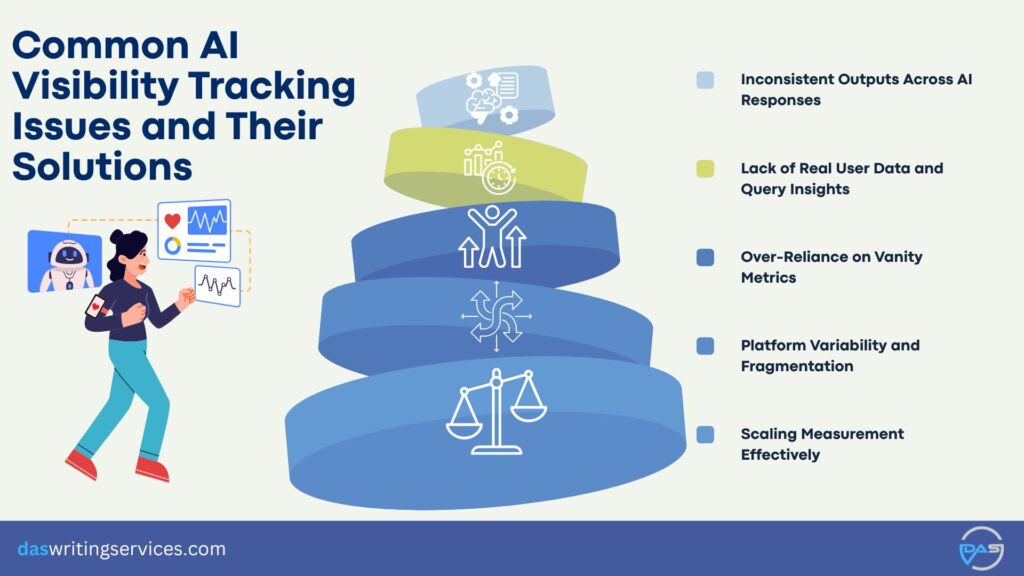
Measuring AI visibility is not as straightforward as traditional SEO. Because platforms like ChatGPT and Google Gemini rely on dynamic and probabilistic systems, marketers must deal with variability, limited data, and evolving metrics.
- Inconsistent Outputs Across AI Responses: AI models can generate different answers for the same query. This makes single tests unreliable.
How to Overcome: Run large-scale testing across 50 to 200 prompts and repeat them over time to identify consistent patterns instead of isolated results.
- Lack of Real User Data and Query Insights: AI platforms do not share actual prompt data, search volume, or impressions. This means all visibility metrics are modelled estimates.
How to Overcome: Build prompt libraries using keyword research, customer queries, and competitor analysis to simulate real user behaviour.
- Over-Reliance on Vanity Metrics: Simple metrics like mention count do not reflect true performance or impact. They ignore quality, sentiment, and competition.
How to Overcome: Focus on share of voice, citation quality, sentiment, and how visibility connects to leads or conversions.
- Platform Variability and Fragmentation: A brand may perform well on one platform but not on others due to different ranking signals.
How to Overcome: Track performance across multiple AI systems and compare results to identify gaps and opportunities.
- Scaling Measurement Effectively: Manual tracking is time-consuming and cannot capture trends at scale.
How to Overcome: Use automated tools to monitor visibility regularly and analyse trends over time for better decision-making.
What Are the Best Strategies to Improve Your AI Visibility in 2026?
AI visibility in 2026 depends on how clearly your content communicates with both users and machines. Instead of only ranking on search engines, your goal is to become a trusted source that AI tools can easily extract, understand, and present as a direct answer.
Key strategies to improve AI visibility:
- Focus on Clear Content Structure: Use simple headings and organise content into logical sections. Each section should answer one specific question directly.
- Adopt Conversational Language: Write the way people ask questions. Natural phrasing increases the chances of being picked by AI assistants and voice search.
- Create Answer-First Content: Start sections with a direct, short answer before adding details. This improves extractability for AI systems.
- Use Structured Data (schema): Implement FAQ, Article, and HowTo schema to help AI understand context and content type more accurately.
- Improve Content Depth: Cover topics in depth rather than writing shallow posts. AI prefers comprehensive and well-explained information.
- Keep Content Updated: Regular updates signal freshness and reliability, which increases chances of AI citation.
- Optimise for Mobile and Speed: Fast-loading, mobile-friendly websites are easier for AI crawlers to process.
- Build Authority Signals: Gain backlinks, publish expert content, and maintain consistent brand mentions across platforms.
- Enhance Multimedia Optimisation: Use descriptive alt text and metadata for images to support visual AI search.
- Track AI Visibility Performance: Monitor how often your content appears in AI-generated answers and refine your strategy accordingly.
These strategies form the backbone of AEO. Dive deeper into our comprehensive AEO guide for 2026, packed with actionable templates to make your content AI-ready.
How Does Das Writing Services Help You Improve AI Visibility and Brand Mentions in AI Platforms?
At Das Writing Services, we focus on creating content that AI systems can easily understand and trust. We write every piece manually with experienced writers. We do not use automation or spam. This helps us maintain a clear and consistent brand voice.
Our in-house team includes writers, editors, and content experts. We structure content with clear answers and simple flow. This makes it easier for AI tools to pick and display your content in their responses.
With 14 years of experience, we have worked with more than 400 brands. We understand how to build strong authority and trust signals that AI platforms prefer.
We also optimise content for both SEO and AEO. This improves your visibility in search results and AI-generated answers. Our goal is simple. We help your brand become visible, trusted, and easy to recommend.
Final Takeaways
AI visibility is not a trend. It is the new foundation of digital presence. As platforms like ChatGPT and Google Gemini evolve, search is shifting from links to intelligent answers. In the near future, users will not search; they will ask. And AI will decide which brands deserve to be seen.
This changes everything. Rankings will matter less. Relevance, clarity, and trust will matter more. Content will no longer compete for clicks. It will compete for inclusion in AI-generated responses.
Brands that adapt early will build a strong advantage. Every mention will act like a recommendation. Every citation will build authority. Over time, AI systems will learn which brands are reliable and continue to prioritise them.
The future belongs to brands that communicate clearly, stay consistent, and provide real value. AI visibility is not just about being present. It is about being preferred.
If your content is structured well, updated regularly, and built on expertise, AI will recognise it. And when AI recognises your brand, your growth becomes scalable, compounding, and far more predictable.

Subhodip Das is the founder and CEO of Das Writing Services Pvt. Ltd. He has an experience of 12 years in the field of Digital Marketing and specialises in Content Writing and Marketing Strategies. He has worked with well-established organisations and startups helping them achieve increased Search Engine Rank visibility. If you want to grow your business online, you can reach out to him here.


