
Get Your Website Content Audit

 Add as preferred on Google →
Traditional SEO often relies on the assumption that one keyword requires one dedicated page. This approach creates inefficiency. Brands may spend 3 to 6 months building 1,000 separate pages just to cover market demand.
Keyword clustering provides a more effective approach by organising semantically related keywords into structured clusters. For example, in one case, researchers recorded a 1,250% growth in blog traffic within 6 months after structured clustering adoption.
Another case shows a single optimised page ranking for more than 2,200 keywords and attracts 183,100 organic visits each month. Instead of publishing 1,000 individual pages, keyword clustering reduces the requirement to 30 to 50 well-planned pages. This reflects a 95% improvement in efficiency.
Sound interesting and effective? Let’s take a deep dive on keyword clustering. By the end, you will clearly understand why keyword clustering SEO is now essential and how you can use it for your brand for competitive SEO success. Let’s get started.
What is Keyword Clustering for SEO?
Keyword clustering is the process of grouping related search terms based on shared user intent and semantic relevance. Instead of creating separate pages for every keyword, one well-optimised page targets multiple related queries.
This approach enables brands to establish topical authority more quickly and utilise content resources more effectively.
Core Principle of Keyword Clustering
Keyword clustering prioritises intent over individual keywords.
- One page targets a group of related keywords.
- Keywords share the same search purpose.
- Content addresses a complete topic, not a single phrase.
- Authority grows around topics rather than isolated pages.
Example: King Size Mattress
Search terms such as king size mattress, king mattress, king bed mattress, and best king mattress may look different, but the intent is the same. Users want to research or purchase a king mattress.
Traditional SEO would require multiple pages. However, keyword clustering achieves better results with one comprehensive page that covers all variations and captures the combined search demand.
Your website deserves engaging, SEO-friendly blogs that drive results. Let Das Writing Services create blog posts designed to rank for all 100-plus keywords in your cluster. Contact our team now!
How Does Keyword Clustering Work?
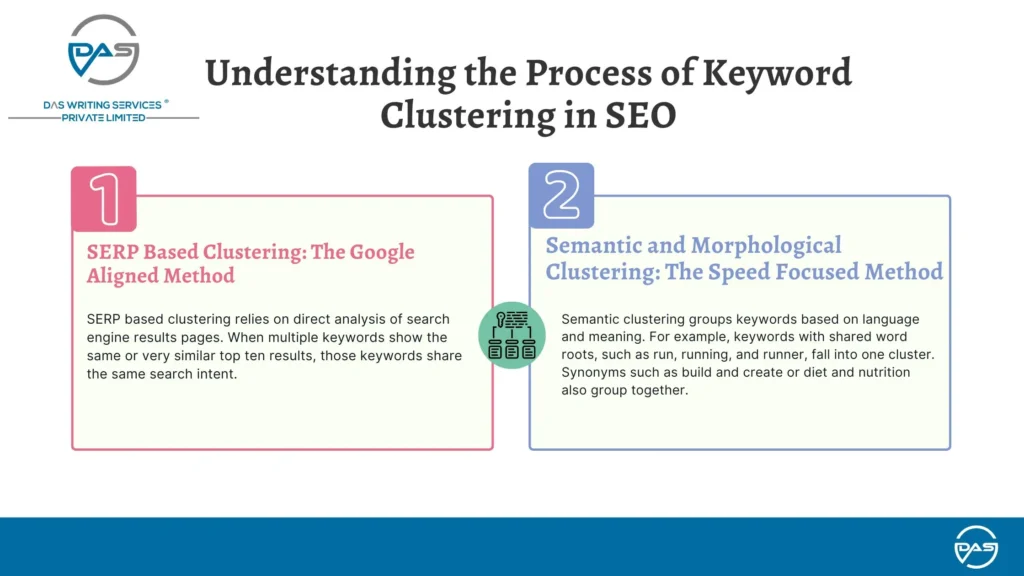
Keyword clustering works through two main methodologies: SERP-Based Clustering and Semantic/Morphological Clustering. Understanding these approaches helps ensure your strategy aligns with how Google determines search intent and topic relevance.
SERP Based Clustering: The Google Aligned Method
SERP based clustering relies on direct analysis of search engine results pages. When multiple keywords show the same or very similar top ten results, those keywords share the same search intent. If five to seven or more URLs match across the top ten results for two keywords, they belong in the same cluster.
For example, searches such as how to start a podcast and steps to launch a podcast return almost identical top results. This shows that users seek the same type of information. One well-optimised page can target both keywords effectively.
As this method follows how Google groups searches, it ensures your content competes within the correct result set rather than operating in isolation.
Semantic and Morphological Clustering: The Speed Focused Method
Semantic clustering groups keywords based on language and meaning. For example, keywords with shared word roots, such as run, running, and runner, fall into one cluster. Synonyms such as build and create or diet and nutrition also group together.
This approach saves time and works well for large keyword lists since it does not require SERP analysis. Despite its speed, semantic clustering has limits. Language similarity does not always reflect search intent.
Keywords that appear related may produce different search results and satisfy different user needs. Without SERP validation, this method may not fully align with how search engines interpret intent.
One well-structured page can rank for dozens of keywords, but only when it is crafted correctly. Das Writing Services creates comprehensive website content that fully addresses entire keyword clusters. Request a free content audit now!
Why Use a Keyword Clustering Tool Instead of Manual Clustering?
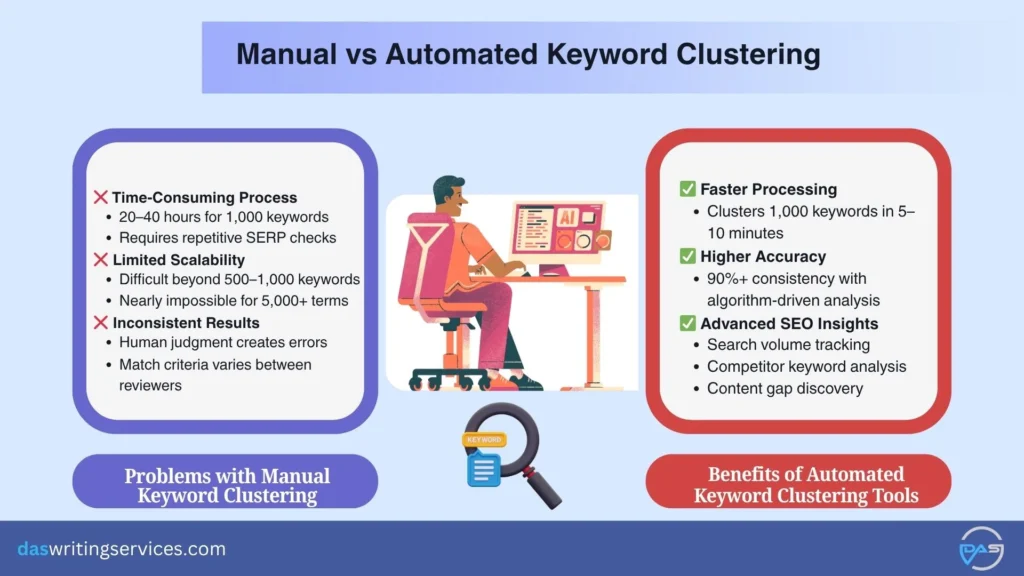
You cannot scale manual keyword clustering. Reviewing more than 1,000 keywords for SERP can take up to 20 to 40 hours of repetitive work.
This includes entering each keyword into Google, reviewing the top ten results, and tracking URL overlap across many pages.
Human judgment also creates inconsistency. Differences in match criteria often lead to error rates of 20% to 30%. Complexity increases as the list grows, which raises the chance of mistakes.
When keyword lists exceed 5,000 terms, manual clustering becomes unrealistic. Without dedicated teams and several months of effort, accurate clustering at this scale is not feasible.
Key Differences Between Automated Tool & Manual Clustering
| Factor | Automated Tool | Manual Clustering |
| Accuracy | 90%+ and consistent | 70% to 80% and variable |
| Scalability | Unlimited up to the tools limit | Limited to about 100 to 500 keywords |
| Time for 1,000 keywords | 5 to 10 minutes | 20 to 40 hours |
| Consistency | Algorithm-driven precision | Human variability |
| SERP Analysis | Complete and automated | Partial and manual |
What is the Most Effective Approach?
The most effective keyword clustering strategies combine automation with human review. Automated tools handle the first stage within 5 to 10 minutes. A short manual review of one to two hours, then confirm accuracy.
Clustering tools deliver insights that manual work cannot match at scale. They show total search volume per cluster, highlight keyword difficulty patterns, expose content gaps, track competitor keyword coverage, and measure cluster performance after publication.
Key clusters receive direct SERP checks, adjustments reflect business goals, and domain knowledge refines the final output. This method preserves tool speed while ensuring quality through expert judgment.
Keyword clusters perform better with quality backlinks from high authority sites. Das Writing Services creates SEO optimised guest posts that earn backlinks and help you dominate your cluster keywords. Take a trail now!
Best Keyword Clustering Tools: Free & Premium Tools
If you are a beginner, you can start with free clustering tools and then move to premium and paid tools.
Free Keyword Clustering Tools
- Google Sheets
Google Sheets can support manual clustering for small keyword lists under 200 terms. Keywords can be imported, modifier columns created, and COUNTIF formulas used to identify relationships. While this option is free, it requires strong spreadsheet skills, takes significant time, and does not support SERP analysis.
- Google Search Console
Google Search Console shows keywords that already generate impressions and traffic at no cost. Its main limitation is scope. It only displays keywords that currently rank, which means it does not reveal clustering opportunities for new or low-visibility terms.
- Freemium SEO Tools
Freemium access from tools such as Semrush free trials, Ahrefs free tier, and SE Ranking free tier allows users to explore advanced features before purchase. These versions offer limited credits but provide useful insight into premium clustering and analysis capabilities.
Best Premium Keyword Clustering Tools
- Semrush
Semrush’s keyword clustering algorithm uses SERP analysis across a database of billions of keywords. Its Keyword Magic Tool groups thousands of terms quickly and exports clusters into Keyword Strategy Builder. The pricing falls between USD 120 to USD 499 per month. It is suitable for agencies and teams that manage large-scale SEO projects.
- SE Ranking
SE Ranking groups keywords using SERP similarity with adjustable accuracy levels. It shows matching URLs, supports hard and soft grouping, and integrates with Google Sheets. Its pricing falls between USD 39 and USD 119 per month. It is a cost-effective option for small teams.
- Surfer SEO
Surfer SEO combines SERP data and NLP to cluster keywords and guide content creation. It provides content scores, word count ranges, and term usage based on top results. Pricing from USD 89 to USD 399 per month, this keyword clustering tool suits writers and marketing teams focused on content optimisation.
- Ahrefs
Ahrefs applies SERP based clustering with strong competitor intelligence backed by a 35 trillion link index. It helps estimate traffic potential and identify dominant competitor clusters. Pricing ranges from USD 99 to USD 999 per month, designed for competitive and advanced keyword research.
Das Writing Services creates SEO & GEO-friendly content writing services along with free tips on keyword clustering for your audience. Schedule a call to plan your content roadmap now!
How to Cluster Keywords? A Complete Step-by-Step Process
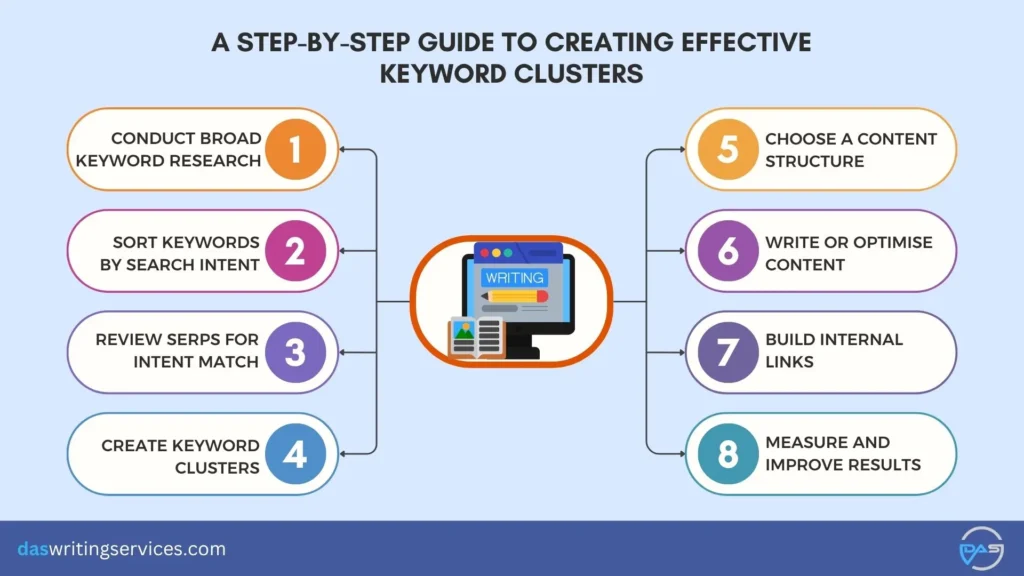
Effective keyword clustering SEO follows a clear 8-step process that converts raw keyword data into structured and usable clusters. This framework allows you to scale efficiently from 100 keywords to more than 10,000.
- Conduct Broad Keyword Research
Start by collecting 1,000 to 10,000 keywords from keyword tools, Google Search Console, competitors, forums, etc. Place all keywords in one spreadsheet with search volume and remove duplicates.
- Sort Keywords by Search Intent
Add an intent column and label each keyword as informational, commercial, transactional, or navigational. Never mix different intents in one cluster. If two keywords solve different user goals, they need separate pages.
- Review SERPs for Intent Match
Search each keyword in Google and note the top ten URLs. Compare the overlap between keywords. Seven or more matching URLs means a strong cluster. Four to six need review. One to three require caution. No overlap means separate pages. Here, keyword clustering tools can save your time and effort.
- Create Keyword Clusters
Group keywords with the same intent and SERP overlap. Choose the highest volume term as the primary keyword. Add related terms as secondary keywords and calculate the total cluster volume. Keep notes on why each cluster exists for clarity and future updates.
- Choose a Content Structure
Decide how you will cover each cluster. Use one strong page for focused clusters. Use a pillar and supporting pages for large or complex topics. Base this choice on search volume, competition, depth needed, and your available resources.
- Write or Optimise Content
Use the primary keyword in the URL, title, H1, and opening paragraph. Place secondary keywords naturally in headings and body text. Write for readers first, not search engines. Clear structure and helpful depth always perform better than forced optimisation.
- Build Internal Links
Link the main pages to supporting pages and link back to the main page. Add contextual links between related topics. Aim for three to seven internal links per page. This helps search engines understand the structure and improves the authority flow across your site.
- Measure and Improve Results
Track impressions, rankings, clicks, and positions in Search Console and analytics tools. Improve content when rankings stay low or click rates drop. Expand sections where keywords underperform. Let performance data guide every update you make.
Das Writing Services crafts professional press releases for media and industry influencers. Get a free press release content as a sample and free tips from our SEO for distribution.
What Mistakes Should You Avoid in Your SEO Keyword Cluster Strategy?
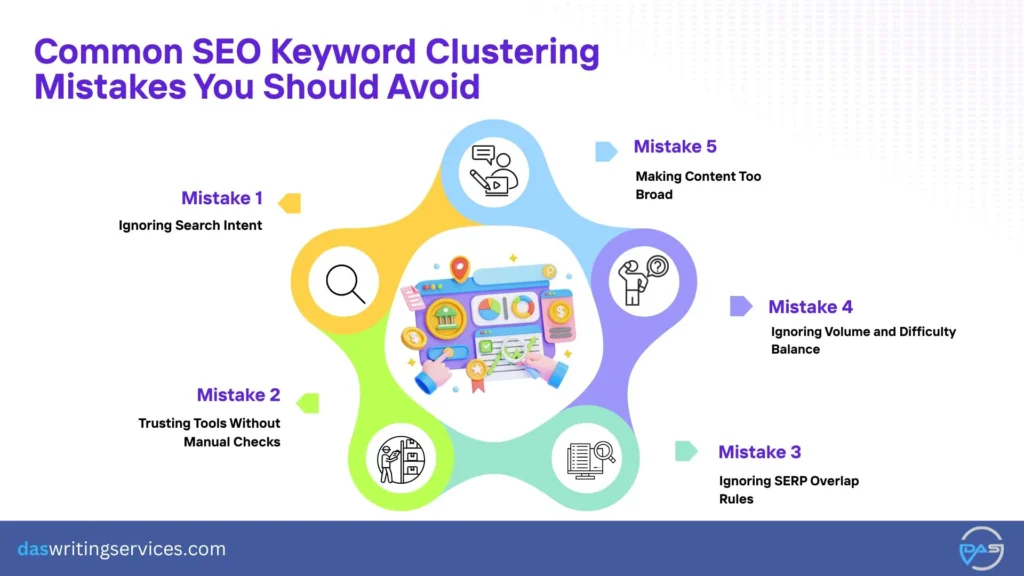
The most expensive keyword clustering mistakes usually happen when you ignore search intent, trust tools without review, or skip performance checks after publishing. These errors can cost you weeks of effort and limit rankings. There are 5 common mistakes:
- Mistake 1: Ignoring Search Intent
You cannot group keywords with different goals on one page. For example, “buy a standing desk” and “how to stand at a desk” need different content. Always separate keywords by intent first. If intent words differ, pause and rethink the cluster.
- Mistake: 2 Trusting Tools Without Manual Checks
Tools save time, but they are not perfect. If you skip manual review, you may group keywords with different SERPs. Always spot check 10% to 20% of clusters. One to two hours of review can save weeks of rework.
- Mistake 3: Ignoring SERP Overlap Rules
Keywords with only zero to two matching URLs should not sit in one cluster. This usually leads to poor rankings and irrelevant traffic. Stick to the five to seven matching URL rule and use strict accuracy settings when possible.
- Mistake 4: Ignoring Volume and Difficulty Balance
If your site is new, do not chase high-volume and great difficulty clusters first. Start with easier clusters to build authority. Use a simple score that balances search volume, difficulty, and business relevance.
- Mistake 5: Making Content Too Broad
One page should solve one clear problem. If you mix too many topics, users get shallow value. Ask yourself if one page can fully answer the search. If not, split the content into separate pages.
How to Measure and Track Your Keyword Clustering Performance?
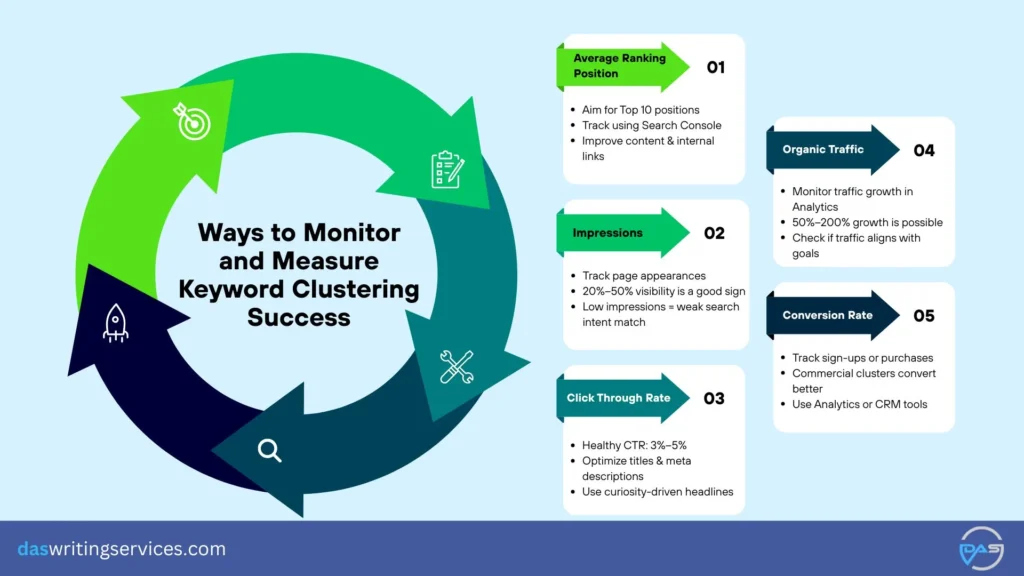
To evaluate keyword clustering SEO success, you need to track five core metrics: average ranking position, impressions, click-through rate (CTR), organic traffic, and conversion rate. Without clear measurement, any optimisation effort becomes guess-based rather than data-driven.
- Average Ranking Position
This shows where your cluster keywords rank on average. Aim for the top 10, with the top 20 as an early goal. Track this in Search Console or rank tools. If rankings stay low, improve content depth, internal links, and on-page SEO. Expect changes in four to eight weeks.
- Impressions
Impressions show how often your page appears in search results. Over time, aim to reach a large share of your cluster search volume. 20% to 50% is a strong early sign. Track this in Search Console. Low impressions mean your content may not match search intent well.
- Click Through Rate
CTR shows how many people click after seeing your page. A healthy target is 3% – 5% for top results. If CTR is low, rewrite titles and meta descriptions to highlight benefits or curiosity. Search Console shows CTR automatically.
- Organic Traffic
This tracks visitors from search engines. A 50% to 200% increase within three months is common when clusters work well. Monitor organic traffic in Google Analytics. If traffic grows but results do not, your page may attract readers without supporting your business goal.
- Conversion Rate
This shows how many visitors take action, such as sign up or buy. Rates vary by industry, often between 0.5% and 5%. Track this through analytics or CRM tools. Commercial intent clusters usually convert better than informational ones.
Final Thoughts
The outdated one keyword one page approach no longer works. Search engines now focus on understanding user intent and topic relevance rather than exact phrases. Pages that cover topics in depth, connect ideas clearly, and satisfy user needs perform better over time.
Keyword clustering allows you to group related keywords by intent and SERP similarity. With the right structure, a single page can rank for dozens or even thousands of keywords. SERP based clustering delivers higher accuracy, while semantic methods help speed up early research.
Automation makes clustering practical at scale. What once took days of manual work now takes minutes with the right tools. When combined with light manual checks, this approach ensures both speed and accuracy.
Brands that adopt clustering build authority faster and gain compounding organic traffic. Cluster SEO is the foundation of modern SEO growth.
Keyword clustering is a full strategy, not just a tactic. Das Writing Services handles research, writing, editing, and SEO packaging. Get your first content fully written and audited within 72 hours with a free estimate and content strategy. Click contact us now!
FAQs on Keyword Clustering
- Is keyword clustering necessary for every website?
Not every website needs keyword clustering, but it is very useful for sites that want to build topical authority. It works best for websites that publish in-depth content and aim to target many related keywords within a single broader topic.
- How do keyword clusters differ from topic clusters?
Keyword clusters group related search terms based on intent and similarity, while topic clusters take a broader approach by organising content around a main theme, with a pillar page supported by related subtopic pages.
- How do search engines interpret keyword clusters?
Search engines see keyword clusters as sets of related keywords that share meaning and context. These clusters help search engines understand the main topics covered on a page or website, which improves relevance and can support stronger rankings in search results.
- How is keyword clustering different from keyword stuffing?
Keyword clustering is a white hat SEO practice that groups related keywords to match user intent and improve relevance. Keyword stuffing is a harmful tactic that overuses keywords to manipulate rankings, often hurting user experience and search performance.
- How is keyword clustering different from traditional keyword research?
Traditional keyword research targets individual high-volume keywords, while keyword clustering focuses on semantic connections between terms. It groups keywords with the same search intent, which helps you create more complete content that covers entire topics instead of single keywords.

Subhodip Das is the founder and CEO of Das Writing Services Pvt. Ltd. He has an experience of 12 years in the field of Digital Marketing and specialises in Content Writing and Marketing Strategies. He has worked with well-established organisations and startups helping them achieve increased Search Engine Rank visibility. If you want to grow your business online, you can reach out to him here.


