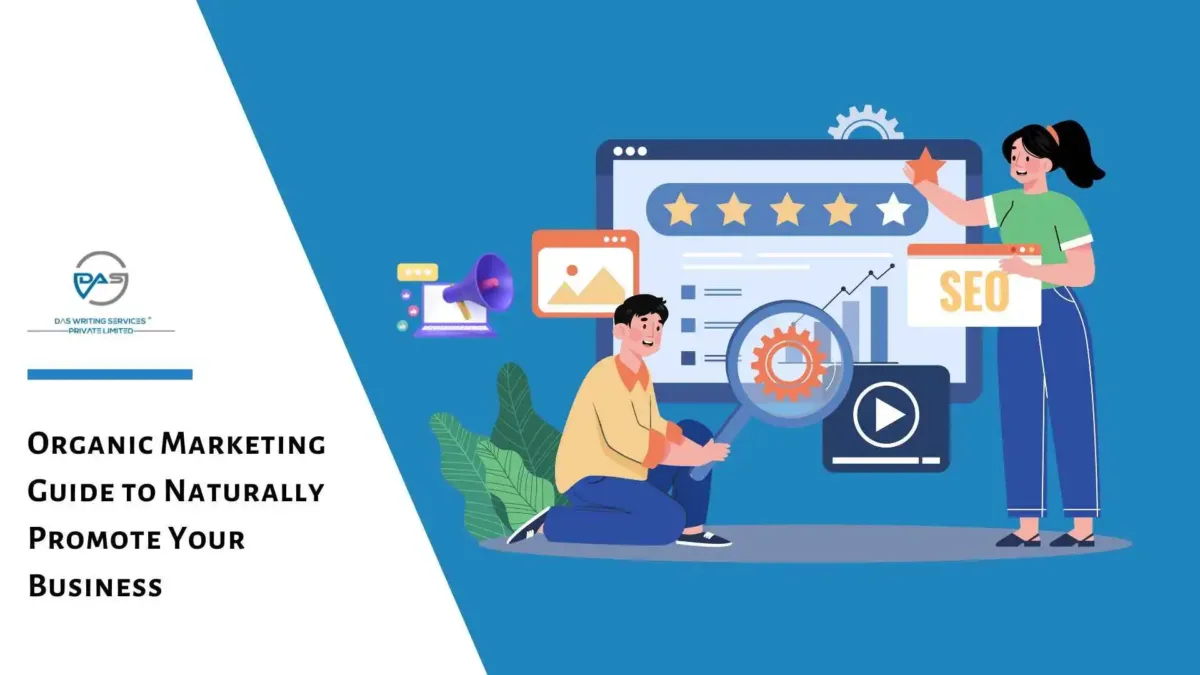
Organic marketing lets you promote a business or its products without having to pay a third party vendor or distributor for it.
We’ll explain, every time an ad appears on Instagram feed or a sponsored link shows up against a Google search – it means the company is paying Meta and Google to display the advertisement to the potential buyer.
In 2024 Q4 alone, Google reported total ad revenue of $72.5 billion, maintaining more than 10.5%YoY growth.
But when a potential buyer discovers the business and its products or services by themselves without any ads, that’s what organic marketing is all about. Yet the question remains, if there is a way to promote without paying, why would people invest millions on ads?
In this blog, we are discussing different strategies to promote a business naturally, without ads. What are its advantages and potential drawbacks and how exactly should you go ahead with organic marketing to make it worthwhile of your time as well as money.
10 Popular Organic Marketing Channels + Examples
First of all let us clear one thing out, while you do not need to pay for distribution of the marketing message, organic marketing does need your time and resources to craft compelling strategies that draw customers.
So, you would need to invest your time or hire an expert to create compelling organic marketing plans that can engage the users. Check out the following channels and examples of organic marketing to choose the one suitable for you.
1. Email Marketing Campaign
It is one of the elementary marketing channels especially if you are using content to reach other businesses. And before you say that nobody reads mails anymore, check out the numbers. In 2024, for every $1 spent on email marketing, businesses recouped $35 on average across industries.
However, precise segmentationis essential to get email marketing right. You may use CRMs like Salesforce and Mailchimp to categorize your contact list as per different demographics and their position in the conversion funnel.
Check out this promotional email from Semrush,
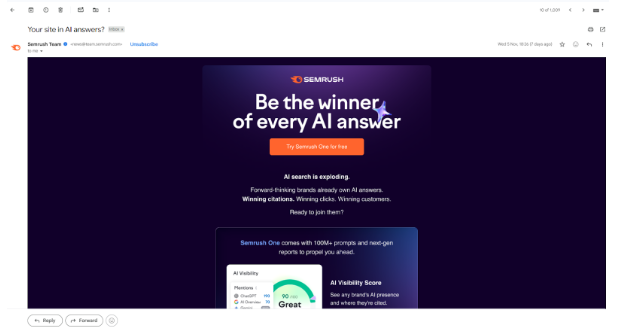
As a leading business facing venture – they consistently perform email marketing campaigns to nurture and convert the audience. With email marketing, the trick is to make sure precision targeting as per user cohort and consistent messaging.
2. SEO Content Creation
With SEO content, you create blogs, articles, and website content to target specific keywords i.e. audience groups who are searching for those keywords.
Based on a thorough understanding of the challenges and pain points of the target audience, you create personalized content. This helps you drive new users to the website and improve brand recall.
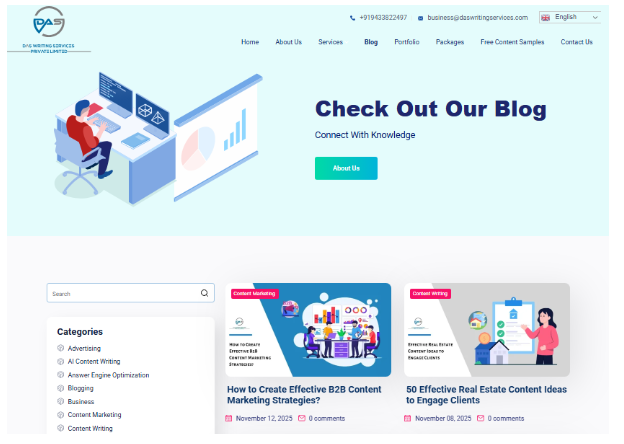
For example, at Das Writing Services, we publish blogs for our audience looking to drive organic and sustainable growth. That is how we optimize our website content around the common pain points shared by our audience.
3. AI Search Content Optimization
As we have already discussed, appearing on AI searches are affording an added layer of privilege to the brands. This is creating enhanced credibility for websites appearing as citations on the SERP features like AI Overview and AI Mode. Following content optimization tips for AI search appearances, a business can get cited or mentioned by Google’s AI Overview organically. This helps maintain consistent brand identity and reputation across all relevant platforms.
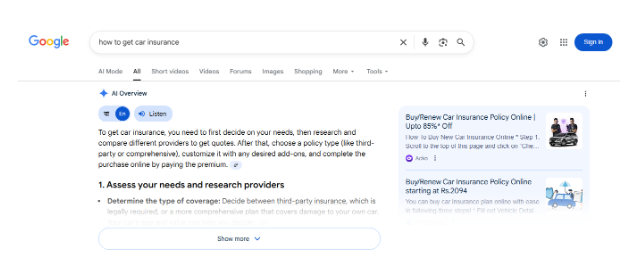
For example, Acko is one of our partners creating AI optimized content to promote their brand organically on Google AI Overview. As a result, they are securing citations on the AI Overview which naturally enhances their credibility and brand identity.
4. Affiliate Marketing
This is a win-win organic marketing strategy for both affiliate marketers as well as businesses. By creating content about your product or service, the marketers stand a chance to earn commissions from conversions.
Simultaneously, as a brand you get organic mentions and promotions in YouTube and forums.
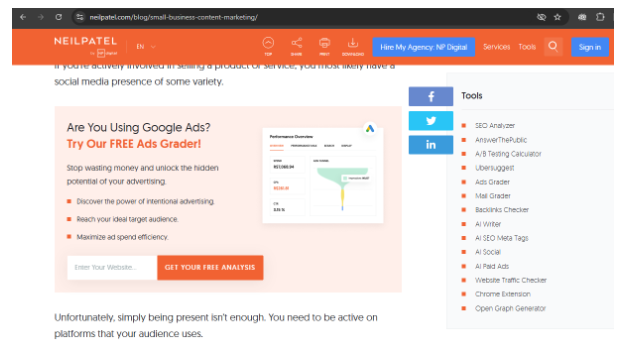
For example, Neil Patel the blog section of his website to promote different SEO and marketing tools. Value driven blogs attract natural visitors and by contextually mentioning the tools, the website simultaneously promotes them and redirects visitors to the landing pages.
5. Organic Social Media Campaigns
Creating text or media based social media posts are great organic marketing tricks used by most businesses. Approximately 90% of businesses across both small scale and enterprises use social media these days.
As per Statista’s report, 83% marketers use facebook, 78% use Instagram and 69% of marketers use LinkedIn to promote their product and services online. Social media plays a vital role to engage audience and potential buyers across all touchpoints. It enhances the recall ability of your brand.
6. Guest Posting
As a Subject Matter Expert (SME), you can publish blogs on your peers’ website. They get a quality post while you get a backlink and access to an extended audience group.Depending on your strategy, guest posting lets you drive considerable traffic back to your website.
Also Read: 200+ Free Guest Posting Sites
With a conversion-first approach, you can lead them to your landing pages. Or if brand promotion is your priority, you can use these posts to gain new users.
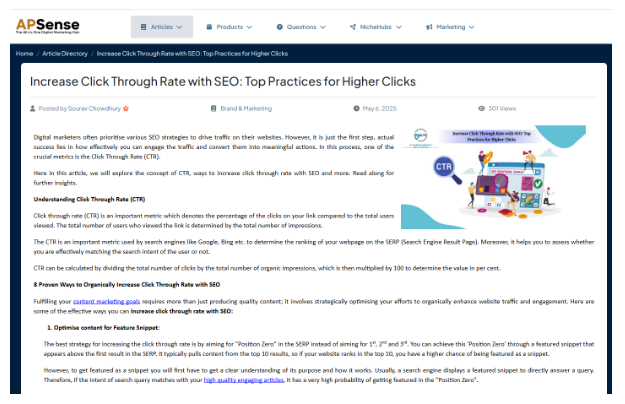
For example, you can see a guest post that we contributed on our peer’s site in the above screenshot. It helps us engage and inform wider community of marketers who aren’t necessarily into SEO and content marketing.
7. User Generated Content (UGC) – social media posts, testimonials
Having reviews from customers, and engagement on social handles is equivalent to word of mouth marketing. Instead of a brand writing about themself, users opinion work a lot better in spreading the reputation of a company. Even the most generic comments like, “liked it a lot” speaks volumes to the prospective buyers.
It is the key to building trust and communicates authenticity of a brand. Surveys by independent agencies suggest that UGC and trust signals can increase a site’s conversion by up to 161%.
Having a deliberate strategy that can foster a sense of community among the users can encourage people to contribute spontaneously to spread the goodwill. In fact, to drive 40% of consumers noted that user reviews influence their final purchase. This is a great tool for b2c companies to acquire new customers.
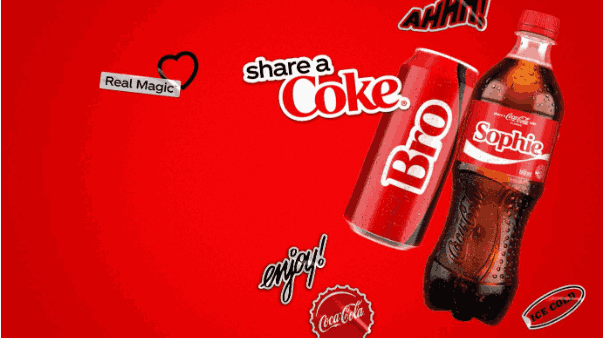
For example, Coca Cola’s Share a Coke campaign is cited as one of the largest and most popular and successful UGC campaigns. Where users were encouraged to share the personalized labels on their social handles.
8. Public Relations
When media outlets naturally create content about your business, it is a great source of boosting public relations keeping them engaged and informed about the brand. For instance, media coverage for CSR activities and community engagement events can help you get the benefits of organic marketing.
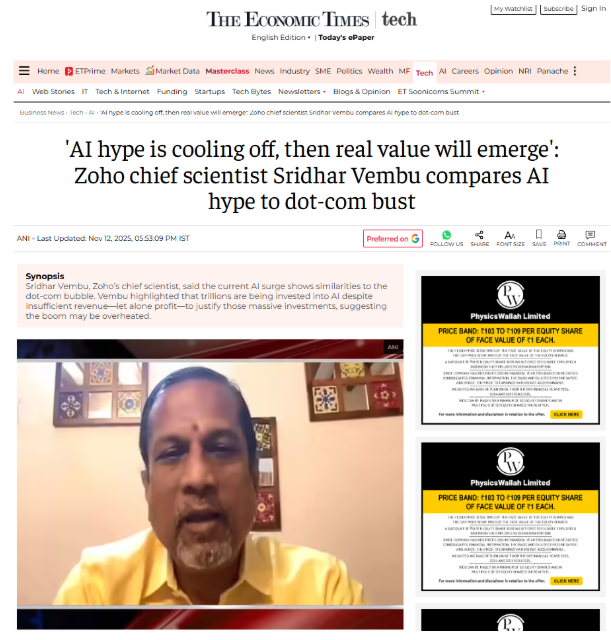
Take the example of Sridhar Vembu, the co-founder of Zoho Corp. He has been in the news lately as a thought leader in tech and AI driven transformations. Aside from boosting his own personal brand, the media coverageis affording organic marketing for Zoho without having to make any additional efforts.
9. YouTube Videos
Every time a common user wants to know how to do something, YouTube becomes the top choice. In fact, 8 out of 10 times, how-to queries on Google directly refer to YouTube videos rather than informational articles.
As a business, offering helpful guides and walkthroughs around your solutions help you claim thought leadership in the industry. A helpful content always produces engaged visitors which strengthens your brand value online.
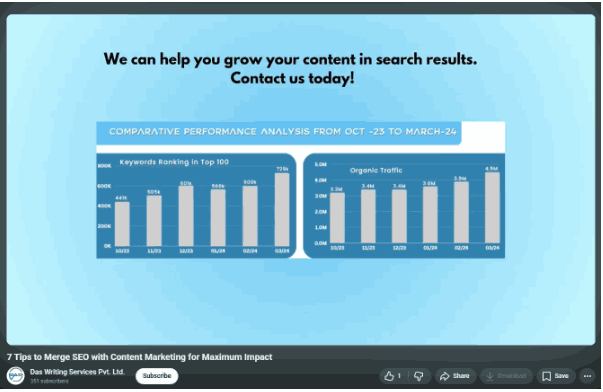
For example, at Das Writing Services’ YouTube handle we often publish byte sized videos to engage SEO content writers and marketers on the benefit and techniques of using organic marketing for businesses.
10. Podcasts
While it is the era of short form byte sized videos, podcasts has been performing surprisingly well in India. Both audio only and audio visual podcasts are enjoying upto 55% engagement making it one of the most lucrative organic marketing channels in India at present.
It is useful to engage urban emerging youth to enhance market reputation and claim thought leadership.
For example, the podcast with Amul’s MD, JayenMehra, highlights how the company manages to turn a profit in spite of being a co-operative business at its roots.

Benefits of Organic Marketing
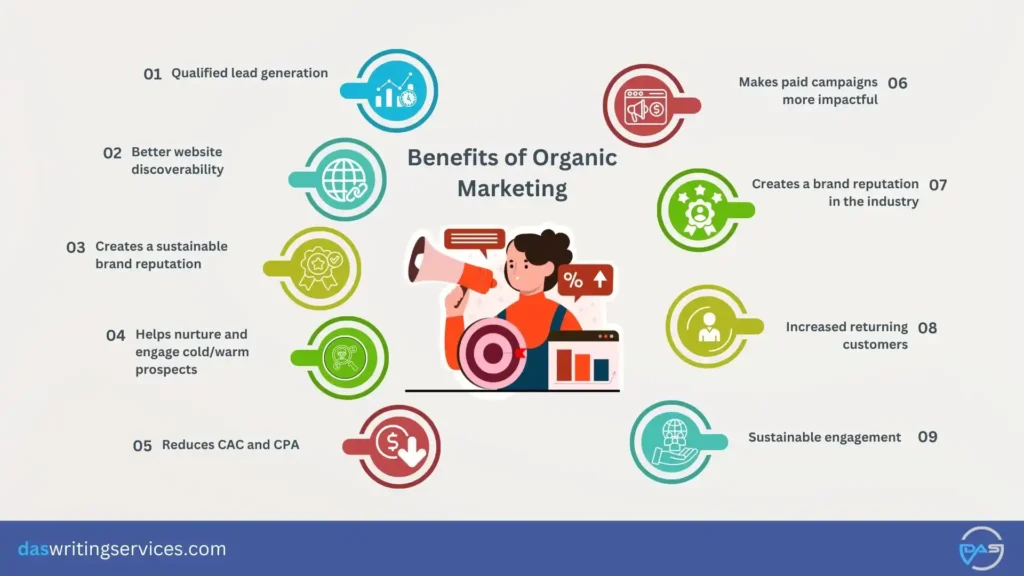
Paid marketing can trigger immediate results driving up to 2%-5% conversion rates depending on industries. However, organic marketing campaigns give a lot of room for a brand to grow and delivers long-term sustainable results.
- Qualified lead generation
People who find your business naturally tend to stick around longer. Especially when a brand positions itself as a solution to the target group, the users arrive naturally and organically over time, showing more intent to avail services compared to cold leads generated by extensive outbound activities.
- Better website discoverability
With SEO and latest optimization strategies for AI search, organic marketing makes sure that people are finding your website and business profiles, not just a random ad. It is no wonder (enter stat) that increased number of new user acquisition to the website directly impacts the brand reputation of a company.
- Creates a sustainable brand reputation
Just as we were saying in the last pointer, an all-around organic holistic marketing makes your brand discoverable across multiple touchpoints i.e. website, email, SERP, Google Discover, Social Media, Answer engines, forums and so on.
It does not only enhance brand recall but also creates a cohesive brand experience for the users.
- Helps nurture and engage cold/warm prospects
Creating engaging, helpful content helps all businesses. Especially when you have many people leaving the marketing funnel midway, value driven organic marketing helps you reconnect with these prospects.
- Reduces CAC and CPA
Organic marketing is famous for nurturing prospective members.When it is done effectively, organic marketing campaigns takes away a lot of heat from your sales team. With organic marketing, leads are qualified and people already know about your business.
It reduces friction and shortens the overall journey of a SQL (sales qualified lead) turned into a client. That means lesser need to burn cash for each customer acquisition.
- Makes paid campaigns more impactful
When used in combination with organic campaigns, paid marketing campaigns can efficiently retarget dormant prospects. It makes your PPC becomes more cost-effective and ensure precision targeting. It reduces your overall CPC expenses while ensuring that
- Creates a brand reputation in the industry
Depending on the type of organic marketing channel you choose, you can create specific collaterals that positions you ahead of the competitors.
Especially for a B2B venture, case studies and original first party surveys claim thought leadership and enhance your brand reputation among the competitors.
- Increased returning customers
Oftentimes, people just forget about your brand if you are not showing up consistently across various channels like social media and email inbox. Contributing valuable content to the email list and social media keeps people engaged with your brand. It also reminds them of your brand’s services and value propositions.
- Sustainable engagement
Steady growth is always preferable than overnight success, at least in business. Organic marketing campaigns build your brand piece by piece, one post there and a new subscriber here.
It builds your brand through a predictable momentum that keeps users naturally engaged over time. For stakeholders and investors, this suggests stability and consistency, a key ingredient in the growthtrajectory of a brand.
Organic vs Paid Marketing: Which One to Choose?
While we are primarily talking about organic marketing here, it does not mean that organic is inherently better than paid.
Both demand a separate mention for their role in the industry. Almost 53% of all website traffic comes from organic searches while 84% of brands report achieving desired goals with paid advertising.
So, if you want a TLDR version – go for organic marketing to promote business and build a brand, choose ads for immediate sales.
When Do You Need Organic Marketing?
When you are in for the long game – organic marketing helps you grow your business steadily.DataReportal noted, almost 33% of internet users discover new brands via search engines.
Now that AI searches are taking the center stage, that number is only going up. Meanwhile most marketers are agreeing that visibility on AI answer engines like Google’s AI Mode and ChatGPT has a greater impact on the brand identity of a company.
So, follow this checklist and if the answer is ‘Yes’ for more than 5 of them, you should be actively focusing on organic marketing.
- Are you looking to improve your website traffic quality and conversion consistency?
- Are you struggling to maintain engagement once ad budgets are paused?
- Do you have a clearly defined target audience or buyer persona?
- Are you aiming to build long-term trust and brand authority rather than short-term sales?
- Does your audience engage with content such as blogs, videos, or social media posts in your niche?
- Is your business focused on sustainable growth instead of quick conversions?
- Are you trying to reduce dependency on paid ads over time?
- Do you want to improve brand recall and visibility across search and social platforms?
- Do people already search for your product/service online using relevant keywords?
- Do you already have a website or blog that can host valuable content?
Brands Scaling with Organic Marketing
PL Capital
Marketing for fintech companies can be tricky. First of all, there are lot of compliance and regulatory hurdles; secondly, lucrative ads and paid promotions hardly work as trustability and authority are major roadblocks in conversion.
So, in spite of being one of the oldest stock brokers and AMCs (Asset Management Company) in India, PL had little market share online.
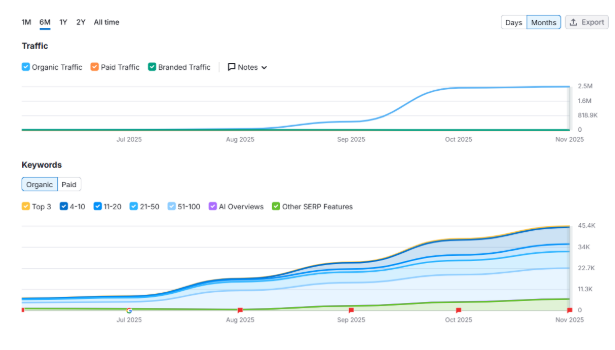
However, it changed over the past 6 months as PL Capital collaborated with Das Writing Services to create informative content to drive relevant traffic to the website and generate enquiries and conversions.
Star Health Insurance
The insurance industry shares a lot of similarity with fintech companies. Firstly, there are a lot of compliance barriers which limits a lot of marketing campaigns their potential. Additionally, there is an increasing need for transparency and clear documentation from the insurers to reduce onboarding friction.

Organic content marketing, in this case, helps brands like Star Health Insurance communicate transparency and authenticity that increases credibility of products. It has helped them scale operations to align with this digital-first ecosystem in India’s insurance market.
Takeaway
Overall, organic marketing is a strategic for brands willing to take it slow and steady. As an inbound marketing strategy, it works the best when balanced with outbound remarketing campaigns as well. Marketing is not about closing sales but keeping your visitors and potential audience engaged into your product and services.Sales is an eventuality that results out of precision marketing as per the user requirements.

Ritish Dutta is a seasoned Content Developer with over 7 years of experience in the industry. Currently, at Das Writing Services, he writes SEO-optimized content that caters to our diverse clientele. Ritish utilizes his critical insights and experience to talk about digital marketing, SEO content writing, content strategy, and AI.
Leave a comment
All comments
droversointeru
I think this is among the most important info for me. And i'm glad reading your article. But want to remark on some general things, The web site style is perfect, the articles is really nice : D. Good job, cheers