
Content optimization is the cornerstone of a successful digital marketing strategy. In an era where billions of pieces of content are distributed daily, optimization is the process to make sure your message reaches the target audience.
With SERP features like AI Overview redefining content visibility, traditional SEO optimization tricks like keyword integration and maintaining content structure can be a beginning but is definitely not enough.
To maintain visibility across different channels like SERP, AI Mode, AI Overview, social media and generative AI engines, one needs to practice all-round content optimization to enhance presence and brand mention across multiple touchpoints. This presence, ultimately, helps you drive business enquiries to the website and grow your brand online.
In this blog, we are discussing some key optimizing strategies you can use for different digital marketing channels.
If you are looking to optimize content in bulk, click on the link below to reach out to our experts

What is Content Optimization?
Content optimization is the process of refining and enhancing digital content to improve its visibility and user engagement across digital marketing channels. This involves making sure that your content lives up to the guidelines and algorithms of the respective platform and appeals to the preferences of your target audience.
Some essential SEO content optimization practices include keyword integration, crafting attractive meta titles and descriptions, building authoritative backlinks, and keeping the content updated regularly.
How to Optimize Your Website Content for SEO?

1. Write People-First Content
Prioritize content that answers user queries precisely and effectively. For that, you must have a concrete idea about the intended target group to recognise their pains and offer original solutions. While optimization is essential, it should never come at the cost of content quality.
2. Use Headings for Skimmability
Clear headings help structure your content for both users and search engines. Hierarchical use of headings (H1, H2, and H3) makes it easier for search engines to understand the content flow and for users to scan and navigate your article quickly. This not only boosts SEO but also enhances user experience.
3. Post New Content Regularly
Regular updates signal to search engines that your website is active, encouraging more frequent crawling. New content also keeps your audience engaged and coming back for more.
Whether it is blog posts, videos, or infographics, consistent content creation helps establish authority and build a loyal following.
Read Related Blog: How to Start a Blog in 10 Steps
4. Optimize Existing Text
Regularly revisiting and updating older outdated content is vital for staying relevant. This could involve refreshing obsolete information, adding new data, improving readability, or integrating new keywords that have gained relevance over time. Updated content often experiences a boost in organic rankings and user engagement.
5. Keep Your Code Clean for Fast Page Loading
A cluttered codebase can slow down your website and negatively impact both user experience and SEO. Use clean, minimal code, reduce unnecessary scripts, and ensure your website follows best practices for page speed optimization. This also includes using a fast, reliable hosting service and implementing caching solutions.
Tips for Content Optimization for Social Media
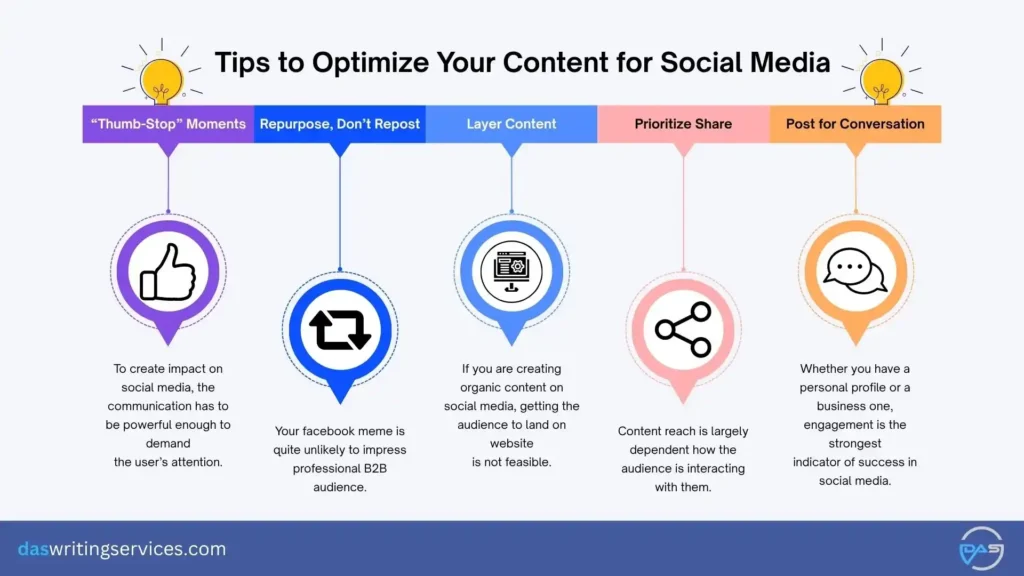
1. Design Content for “Thumb-Stop” Moments
To create impact on social media, the communication has to be powerful enough to demand the user’s attention. Statements or visuals that evoke strong emotionalresponse tend to have this effect. Start with such a hook to avoid being ‘scrolled through’.
2. Repurpose, Don’t Repost
Your facebook meme is quite unlikely to impress professional B2B audience. Similarly, updates of an organizational milestone won’t be effective for Instagram audiences. Since each platform has a unique identity – plan your content schedule around ideas and themes. Once the core idea is finalised, tailor the message as per each social media platforms.
For example, turn your communication into a punchier text for X, vertical video for Instagram, thought leadership tone for LinkedIn.
3. Layer Content with Micro CTAs
If you are creating organic content on social media, getting the audience to land on website is not feasible. Rather your posts may use relevant CTAs to encourage an action. It could be sharing or saving the link for future reference. Both of these user actions prove useful for social media and increases user reach.
4. Prioritize Share Velocity Over Reach
Content reach is largely dependent how the audience is interacting with them. Your instagram reel will automatically cater to wider user base when people find it relatable. Likewise, a LinkedIn article will naturally get reposts and reach more people when the audience gets value.
5. Post for Conversation, Not Just Impressions
Whether you have a personal profile or a business one, engagement is the strongest indicator of success in social media. So, make sure your users have something to say about your posts. Ask them to leave questions or better yet, encourage them to explaining something to you in the comments.
Know More: Content Repurposing: A Comprehensive Guide to Maximising Your Content Strategy

How to Perform Content Optimization for AI Visibility?

1. Write in Q&A Format
Focus on popular questions and answering the queries directly. Instead of beating around the bush to give context, follow your header with direct and crisp answers to get featured in AI responses. Following that you can add context and statistics to strengthen your position.
2. Front-Load the Answer
Whatever may be the topic of your content, do not make the reader scroll till the middle of the page to get the answer. If you must, address the main query in the first 40–60 words, then expand with examples or data.
3. Target “Mini-Intents,” Not Just Keywords
Writing around just keywords may not be enough if you want your optimized content to secure citations in AI searches. Keyword tools often fail to account for long tail queries which makes up more than 90% of AI prompts and search queries. Map what users actually want to know, e.g., “how fast,” “which is best,” “step-by-step guide”to structure snippets.
4. Use Layered Headers (H2–H4)
Make sure to structure your content for inverted pyramid information architecture. Write the most important information – essentially answering the ‘what’ just underneath an H2. Follow that with H3s and H4s that further elaborate on its nuances.
5. Make Data Machine-Readable
In order for a page to secure citations in AI Overview and AI Mode, make sure you are adding information in bullets and lists for easy extraction. Additionally, use structured data or schema on your pages to optimize the content for crawlers and AI agents.
Know More: How to Rank on AI Search
What are the Tips for Landing Page Content Optimization?
1. Lead with Value, Not Brand
Your H1 should solve the user’s problem in plain language before you even mention your product. Your brand identity may give you an edge against the competitors but once they are in the landing page, it’s your product’s value that keeps them interested.
2. Use Frictionless Content Hierarchy
A clear content hierarchy begins with the main heading which branches out to elaborate subsequent subheadings. Start with articulating the pain points followed by benefits, visual cues and finally the CTA. Keep the texts pointer driven as opposed to using walls of texts.
3. Anchor CTAs Contextually
Place your CTAs as soon as you have discussed your value propositions and differentiating factors. Instead of one CTA button at the bottom, place themwhere intent peaks. Analyse the page’s heatmap to determine the appropriate location.
4. Borrow from Sales, not Ads
Focus on directly responding to objections and pain points within the first two fold of the page. Your landing page may double as an ad but overemphasizing on promotional messaging can your page appear pushy.
5. Optimize for Skimmers
To optimize your content for the best experience, make sure your UI has enough contrasting elements. This helps skimmers reach the main content intuitivelyand absorb the necessary sections without having to focus on understanding the page layout.
Read Related Blog: Tips to Optimize Landing Pages
What are the Tips to Optimizing Video Content?
1. Front-load Curiosity
Whether you are optimizing content for long-form or short-form video, the crisis or the hook of the content must appear within the first 2-3 seconds. By igniting curiosity within the initial seconds – you can reduce the drop-off rates.
2. Write for Silent Viewing
Especially for vertical videos, most users prefer to watch on mute, so use on-screen captions and visual cues for a seamless experience.
3. Structure your Message
Even if it is a long format video, following a definite structure distinguishing the subtopics promotes better understanding. Divide the content into chapters for better engagement. It should also help you repurpose the content into bite sized shorts. You can also distribute them on other channels.
4. Design for Retention Metrics, Not Views
Track analytics to identify where users tend to leave. Views are a common by-product when you have returning audience. By optimizing the content pace and information format you can minimize drop-offs. Additionally, you can start a series of multiple videos – this compels the users to keep coming back.
5. Add “Second-screen” Cues
Subtle animations, on-screen branded URLs, QR codes encourage users to use the secondary device like smartphone while consuming content on TV or laptop. It compels the user to shift from being a passive audience to an attentive user – enhancing brand recall.
Tips to Email Marketing Content Optimization
1. Create Headline, Not Subject Line
Rather than informing the purpose of the mail, treat the subject field as a tool to hook attention. Keep it short, benefit-first, curiosity-led.Accompany the subject line with a suitable preview text that can communicate the proposed value.
Allow your subject line aka headline to appeal to the curiosity. Then, use a preview text to articulate the value proposition.
2. Optimize for Mobile
People read more than 70% of emails on mobile, so use compact paragraphs and clear visual breaks. Address the primary pain point within the first fold of the body, don’t make them scroll all the way down for the CTA –place them in the middle for intuitive navigation.
3. Personalize by Context, Not Just Name
Having a mail address the recipient by their name is quite a cliché at this point. Nobody cares about them anymore. Rather than personalising based on name, micro target specific user groups based on interests.
For example, for audiences in the awareness stage, the email may offer an educational pdf. Comparatively, a user who is in the consideration stage may feel more encouraged to click on the landing page URL to explore discounts and offers.
4. Design CTA like a Punchline
Don’t make CTAs an obligatory button. To drive effective conversions, tweak the CTAs according to the captions and the topic. Personalization makes them appear less intrusive and promotional and converts better.
5. Use Micro-Patterns
Rather than fancy visuals, people interact with email communications based on the value. Creating segment specific preview texts, CTA placement, and tailored sign-off tone can actually increase engagement and click through rates.

6 Steps to Content Optimization Guide for Search Everywhere Optimization
The following is a general step-by-step practice that you should incorporate across the content plan for maximum visibility. Whether it is social media or SEO, being mindful about the proven practices are essential to get discovered by the target audience across multiple touchpoints.
Step 1: Look out for Popular Keywords/Topics
Declaring a focus keyphrase let’s you define the topic of your content to the bots that crawl your site for indexing it.Begin by conducting keyword research to identify the popular topics in your domain.
This involves both primary keywords (main topics) and secondary or semantic keywords that support the primary ones.
You can use keyword generator tools or Google Trends to identify which topics are receiving more attention from users. Creating blogs, social media posts, short videos around such topics are more likely to drive traffic.
Step 2: Competitor Research
Analysing competitors helpsyou understand what’s working in your niche. Identify the top-ranking content for your topicto understand the user intent. For SEO content look at their content length, keyword density, backlink strategy, for social media and YouTube – pay attention to user engagement metrics (like comments or social shares).
Having understood the user search intent, identify the gaps left by the existing competitors. You can address this in your content —whether it’s providing more depth, updating information, or offering unique insights. This approach ensures that your content stands out and offers more value than competitors.
Step 3: Content Structure and Readability
A well-structured content improves user experience thus increases visibility. Whatever is structured and easier to understandtends to hold user attention.
For text based content, break your content into digestible sections using clear headers (H1 for title, H2 for main sections, and H3 for subsections). Use bullet points, numbered lists, and short paragraphs to make scannable content.
For visual content, focus on UX best practices and chapter division for long-form videos to retain user attention. Search engines favour content that is easy to navigate, and users are more likely to engage with content that is simple to consume.
Step 4: Encourage Navigation
Be it website or YouTube – leading users to other related content with internal links or link cards is always the preferred practice. This helps users discover more resources, keeping them engaged longer.
Additionally, internal links help search engines understand the structure of your site, distributing link equity (or “SEO juice”) across your pages and improving topical authority.
Step 5: Metadata Optimization
Metadata has a significant role to play in driving visibility and clicks. Crafting a meta title that’s both keyword-rich and compelling can attract clicks across different touchpoints like SERP, Google Discover feed, YouTube home feed or Google Recommendations.
The meta description should briefly summarise the content and include a call to action if possible. Alt text for images not only makes your content accessible to visually impaired users but also helps crawlers and bots understand what the image is about, contributing to better visibility across the board.
Step 6: Mobile Optimization
With mobile traffic dominating the web, you have to make sure your content is mobile-friendly. Use responsive design so that your content adjusts seamlessly to different screen sizes. Additionally, ensure that text is easily readable without zooming, buttons are large enough to be tapped, and multimedia (images, videos) scales appropriately.
Tools like Google’s Mobile-Friendly Test can help identify issues that need fixing. Slow-loading mobile content often leads to higher bounce rates, so page speed optimization is key.
Read Related Blog: How to Use Mobile Marketing to Increase Conversions
Takeaway
Especially in 2025, the content optimization practices are undergoing a complete shift. Rather than considering it as a challenge, platform specific marketing strategy offers an opportunity for unparalleled reach across various channels. It creates more leverage for emerging brands to strengthen their messaging and nurture the prospect with helpful content throughout the buyer journey.

Ritish Dutta is a seasoned Content Developer with over 7 years of experience in the industry. Currently, at Das Writing Services, he writes SEO-optimized content that caters to our diverse clientele. Ritish utilizes his critical insights and experience to talk about digital marketing, SEO content writing, content strategy, and AI.
Leave a comment
All comments
Kaley Mejia
Great information shared.. really enjoyed reading this post thank you author for sharing this post .. appreciated
Desiree Powell
This is really interesting, You’re a very skilled blogger. I’ve joined your feed and look forward to seeking more of your magnificent post. Also, I’ve shared your site in my social networks!
jantlar
Hello, I liked your site very much, I will visit your site again.
SEO
This article reflects a high level of expertise and professionalism. The detailed analysis and clear explanations make it an invaluable resource for professionals.
Coleman Dixon
Wonderful article!
Asa Skinner
I truly appreciate your technique of writing a blog. I added it to my bookmark site list and will