Large Language Model Optimisation, or LLMO, is shaping how brands gain visibility in AI-driven search environments. It focuses on helping platforms like ChatGPT, Perplexity, and Google AI Overviews understand and reference your content in direct answers.
Unlike traditional SEO that depends on rankings and clicks, LLMO aims to place your brand inside responses that users trust. This shift matters as user behaviour moves toward quick answers instead of browsing multiple links.
Strong content with clear structure, factual depth, and consistent brand signals improves your chances of being cited. LLMO also focuses on authority and relevance, so AI systems treat your content as reliable.
Brands that adapt early can secure stronger visibility, better trust, and higher impact in this evolving search landscape.
In this guide, you will get a detailed understanding of Large Language Model Optimisation (LLMO), including how it works, why it is important, how to optimise, challenges and more.
What are Large Language Models (LLMs) and LLM Optimisation (LLMO)?
Large Language Models, or LLMs, are advanced AI systems trained on vast amounts of text data to understand and generate human-like language. They can answer questions, create content, translate text, and even write code by identifying patterns in language.
Popular examples include ChatGPT, Gemini, Claude, etc. Gartner predicts 25% of traditional search volume will shift to AI by 2026. Perplexity AI processes 35-45 million queries daily in 2026, up from 30 million in 2025.
Large Language Model Optimisation, or LLMO, focuses on improving how your content appears in responses generated by these systems. Instead of aiming for search rankings, LLMO works to get your brand mentioned, cited, or recommended within AI answers. It relies on clear structure, credible information, and strong authority signals so models treat your content as trustworthy.
As AI-driven search continues to grow, LLMO helps businesses stay visible in a space where users increasingly rely on direct answers rather than traditional search results.
Why LLM Optimisation Matters in 2026?
People now turn to AI tools like ChatGPT, Claude, and Perplexity for quick, direct answers instead of browsing multiple search results.
ChatGPT has 900 million weekly active users and 5.35 billion monthly visits as of early 2026. Semrush analysed over 100 million citations across ChatGPT, Google AI Mode, and Perplexity from 230,000 prompts.
This change has made Large Language Model Optimisation, or LLMO, essential for staying visible and competitive. Here is why LLMO matters today:
- Your Brand Can Become Invisible
If your content is not structured for AI, it may never appear in responses. That means users will not discover you at all.
- Competitors Are Already Gaining an Advantage
AI tools often recommend brands they recognise. If your competitors are optimised and you are not, they will dominate these conversations.
- Search Behaviour is Changing Rapidly
More users prefer instant answers over traditional search. This reduces reliance on clicks and increases the importance of being cited.
- Traditional Metrics Miss Real Impact
Many interactions now happen without website visits. Missed mentions in AI responses mean lost opportunities that analytics may not show.
- Authority and Clarity Drive Visibility
AI systems prefer content that is clear, structured, and trustworthy. Strong brand signals increase your chances of being selected.
How LLMs Work: The Mechanics Behind AI Visibility?
LLMs do not work like traditional search engines. Instead of ranking entire web pages, they understand queries, retrieve relevant information, and generate answers by combining insights from multiple sources.
This shift from page ranking to meaning-based retrieval defines how AI visibility works today. Here is how LLMs actually work behind the scenes:
- Semantic Understanding Over Keywords
LLMs convert queries into meaning-based representations, not just words. This helps them understand intent, context, and language variations.
- Vector embeddings power retrieval
Content is stored as vectors in a semantic space. Similar ideas appear close together, so even if the wording differs, relevant content can still be found.
- Retrieval Augmented Generation (RAG)
Tools like ChatGPT and Perplexity use RAG to fetch relevant content, combine it, and generate accurate responses with references.
- Passage-level Extraction, Not Page Ranking
LLMs select specific sections or paragraphs that directly answer a query instead of evaluating entire pages.
- Intent-Driven Content Selection
The system first identifies what the user wants, then retrieves matching content types such as definitions, comparisons, or reviews.
- Citation Depends on Usability
Clear, structured, and factual content is more likely to be used and cited in responses.
- Different Models, Different Behaviour
ChatGPT focuses on contextual mentions, Gemini relies on structured authority signals, and Perplexity emphasises cited sources.
Let’s see a quick comparison between the two leading AI tools, ChatGPT vs Gemini.
How to Optimise Your Website Content for LLMs: The 5 Core Pillars?
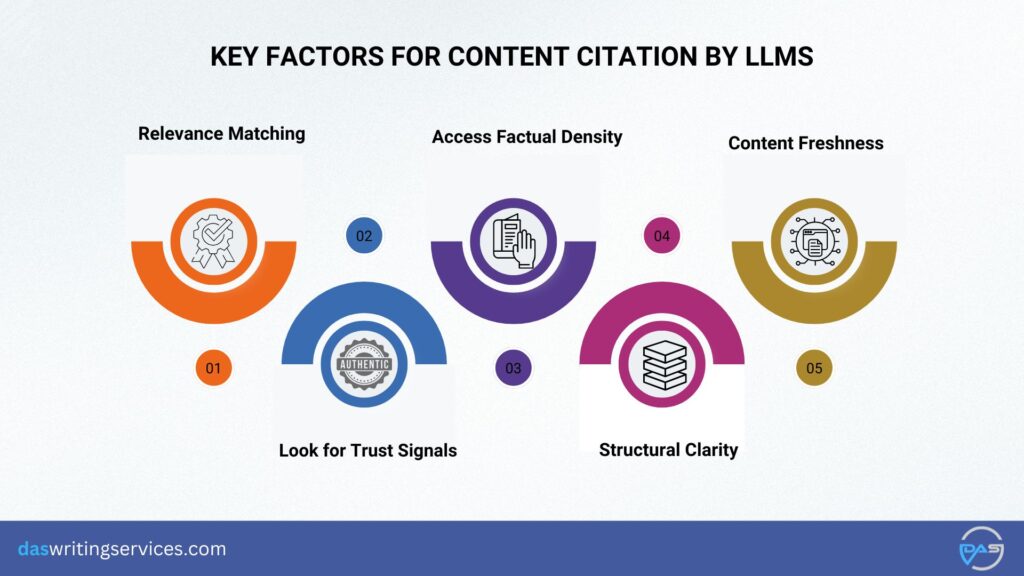
In practice, LLMO works best when expanded into a 5-pillar framework that combines content quality, structure, authority, uniqueness, and entity clarity.
Original research receives 12x more citations than aggregated content per Content Marketing Institute data. This adds relevant statistics and boosts generative AI appearances by 65.5%.
This approach aligns better with how platforms like ChatGPT and Perplexity actually retrieve and cite information.
- Content Excellence
Start with high-quality, user-focused content. Write clear, direct answers using simple language and logical flow. Focus on real problems, natural queries, and complete topic coverage instead of keyword stuffing.
- Structured and Semantic Content
Once content is created, organise it for easy extraction. Use headings, lists, FAQs, and well-defined sections. Each passage should make sense on its own, since LLMs often pull specific sections instead of full pages.
- Information Gain
Your content must add something new. Include original insights, case studies, data, or expert opinions. Unique value increases the chances of being cited instead of ignored.
- Authority and Mentions
Build trust through consistent brand mentions across credible sources. Appear in industry content, discussions, and reviews so AI systems associate your brand with expertise.
- Entity Optimisation
Ensure your brand is clearly defined and consistent across platforms. Use schema, profiles, and accurate information so LLMs understand who you are and what you represent.
Together, these pillars create a complete system that improves how AI understands, selects, and recommends your content.
Do you run an export business/thinkuing to start one? Read our blog to learn how to get clients for export business.
AEO vs GEO vs LLMO: What’s the Difference?
AEO builds structure, GEO adds depth, and LLMO strengthens brand understanding. Combined, they ensure your content performs across both search engines and AI-driven platforms.
| Aspect | AEO (Answer Engine Optimisation) | GEO (Generative Engine Optimisation) | LLMO (Large Language Model Optimisation) |
| Main Goal | Provide direct answers to user queries | Get included in AI-generated summaries | Get your brand cited in AI conversations |
| Search Intent | Clear question-based queries | Exploratory and research-driven queries | Open-ended and conversational prompts |
| Where It Appears | Featured snippets, answer boxes | AI summaries like Google AI Overviews | Tools like ChatGPT and Perplexity |
| Content Style | Short, structured, easy to scan | In-depth, contextual, well-researched | Detailed, authoritative, entity-focused |
| Optimisation Focus | Clear formatting and direct answers | Depth, credibility, and context | Brand clarity, consistency, authority |
| Role in Strategy | Captures quick answer queries | Builds topical authority | Shapes how AI talks about your brand |
How to Monitor and Track LLM Visibility?
Monitoring LLM visibility is not as straightforward as traditional SEO tracking. There is no single ranking position or clear attribution path.
Instead, it involves understanding how AI platforms interpret, mention, and recommend your brand across different contexts.
BrightEdge data shows AI Overviews on 48% of queries by March 2026, up 58% YoY, with impressions up 49% but CTR down 30%. Semrush’s AI Visibility toolkit tracks citations across platforms.
The goal is to track perception, not just traffic. Here is how to effectively monitor and track LLM visibility:
- Define What Actually Matters
Start by identifying high-impact queries. Focus on prompts that influence decisions, such as “best tools,” comparisons, and category explanations. Track how your brand appears, how it is described, and whether key features are included or missing.
- Analyse Brand Positioning and Sentiment
Evaluate how AI platforms like ChatGPT, Gemini, and Perplexity frame your brand. Look at tone, accuracy, and consistency. This helps you understand whether your brand is seen as trustworthy, relevant, or outdated.
- Track Mentions Across the Ecosystem
LLM visibility is influenced by multiple sources, such as articles, forums, and reviews. Monitor where your brand is mentioned and cited. Platforms like Reddit, Quora, and news sites often shape how AI models respond.
- Monitor Consistently Over Time
AI outputs change frequently. Run weekly checks for key queries, monthly reviews for positioning shifts, and deeper quarterly analysis to identify trends and competitor movements.
- Use Dedicated Monitoring Tools
Manual tracking is inconsistent. Tools like Semrush, BrightEdge, and Similarweb help track AI visibility, sentiment, and competitor presence at scale.
- Connect Insights to Business Impact
Since direct attribution is complex, combine LLM data with trends like branded search growth, traffic shifts, and conversions. This gives a clearer picture of how AI visibility contributes to overall performance.
What are the Common Mistakes in Content Optimisation for LLMs?
Optimising for LLMs is also about avoiding common mistakes that reduce your chances of being cited or trusted.
Even strong content can fail if it lacks clarity, credibility, or accessibility for AI systems like ChatGPT and Perplexity. Here are the key mistakes to avoid in LLM optimisation:
- Focusing Only on Traditional SEO
Over-optimising for rankings while ignoring readability and clarity can make content less useful for AI. Balance both human value and AI structure.
- Blocking Access to Content
Content behind paywalls or login barriers cannot be accessed by LLMs, which limits visibility and citations.
- Using Overly Promotional Language
Sales-heavy content reduces trust. LLMs prefer informative, neutral, and helpful content that genuinely solves user problems.
- Ignoring Off-Page Presence
Relying only on your website is not enough. Mentions across platforms, forums, and publications help build credibility.
- Publishing Generic or Outdated Content
Content that lacks originality, updates, or clear authorship signals appears less trustworthy and less likely to be cited.
- Weak Structure and Vague Headings
Poor formatting, unclear headings, and missing internal links make it harder for AI to extract useful information.
- Neglecting Technical Performance
Slow loading pages, poor mobile experience, or heavy scripts can prevent proper content access.
- Expecting Quick Results
LLM optimisation takes time. Consistency and long-term effort are key to building visibility and authority.
How Das Writing Services Can Help You in LLM Optimisation (LLMO)?
Das Writing Services helps brands stay visible across both search engines and AI platforms by combining SEO, AEO, and LLMO strategies.
LLMO-optimised brands saw 35% higher AI citations correlating with branded search growth, per 2026 benchmarks from Semrush and BrightEdge studies.
The focus is on creating content that ranks on Google and also appears in responses from tools like ChatGPT and Google AI Overviews.
- SEO + AEO Optimisation: We structure content for rankings, featured snippets, and AI answers to ensure complete digital visibility.
- 100% Human Content: No AI or generic writing. Our experts create original, research-driven content that builds authority and trust.
- In-House Team: Dedicated writers, editors, and strategists ensure consistency and structured content for better AI visibility.
- Performance Tracking: We provide monthly reports on clicks generated by each content piece, so you see real impact, not just rankings.
- Custom Sample First: Evaluate our writing quality and brand alignment before scaling your content strategy.
- Proven Experience: With 14 years of expertise and 400-plus brands, we deliver measurable growth and scalable results.
If you already have content on your website and you are looking for content optimisation, you can also contact us.
Final Takeaway
LLM optimisation (LLMO) is not just a shift in tactics; it is a shift in how influence is built online. Visibility is no longer owned by the highest-ranking page but by the most trusted voice within an answer.
This means brands need to think beyond publishing and start engineering how they are understood. The real advantage lies in shaping narratives, not just creating content. When your brand consistently appears in explanations, comparisons, and recommendations, it becomes part of the decision-making layer itself.
That is where long-term value is created. Businesses that invest in clarity, credibility, and ecosystem presence today will not just adapt to AI-driven search but will define how they are represented within it.
If you want your brand to be part of AI-generated conversations, Das Writing Services can help you build that visibility. Get in touch to create content that performs across search engines and AI platforms with measurable impact.

Subhodip Das is the founder and CEO of Das Writing Services Pvt. Ltd. He has an experience of 12 years in the field of Digital Marketing and specialises in Content Writing and Marketing Strategies. He has worked with well-established organisations and startups helping them achieve increased Search Engine Rank visibility. If you want to grow your business online, you can reach out to him here.
Leave a comment