
Get Free Content Sample

 Add as preferred on Google →
Businesses are now publishing more content than ever before, yet many struggle to improve search rankings, attract qualified leads or generate measurable business growth.
Different content formats, ranging from blog posts and videos to social media updates, podcasts, and email campaigns, continue to flood digital channels. Still, volume alone is no longer enough to get results.
This kind of disconnect often stems from a common misconception that publishing more content automatically leads to more traffic and sales.
According to Content Marketing Institute’s 2025 B2B research, only 29% of marketers rate their content strategy as very effective, while 42% of those with underperforming strategies say the biggest reason is a lack of clear goals.
The difference between a bad content strategy and an effective one is not how much content a business creates, but whether every piece of content supports a clear objective and meets audience needs.
What is Defined as a Content Strategy?
A content strategy is a structured plan for creating, managing, distributing and optimising content which supports both business objectives and audience needs.
Content strategy goes far beyond deciding which blog to publish next week.
A strong content strategy will ensure that every piece of content which a brand posts serves a purpose, reaches the right audience and contributes to measurable business goals.
For instance, instead of asking “What content should we publish today?”, a content strategy asks:
- Who are we trying to reach?
- What problems are the audience trying to solve?
- Which topics matter the most to the audience?
- How does this content support business goals?
- Which channels would be the best to use for content?
What is the Difference Between a Bad Strategy and a Good Content Strategy?
At first glance, a bad strategy and a content strategy can look very similar. This is because both of them involve creating content, publishing on various mediums, optimising them for search engines and tracking performance. However, the difference lies in why those activities are being carried out.
The table below highlights the key differences between both types of content marketing strategy:
| Bad Content Strategy | Good Content Strategy |
| Targets a broad or undefined audience. | Built around detailed audience research and buyer personas. |
| Content is created without any clear established business objective. | Every piece of content aligns with specific business goals. |
| SEO is treated as an afterthought. | SEO is integrated from planning to optimisation. |
| Individual pieces of content exist in isolation. | Content is interconnected through topic clusters and internal linking. |
What Does a Bad Content Strategy Look Like?
A bad strategy does not always look like poor writing or low-quality content. In most cases, businesses invest significant time and resources into producing well-written articles, social posts, and video strategy. The problem is that these efforts lack direction.
Here are a few things which form a perfect recipe for bad strategy:
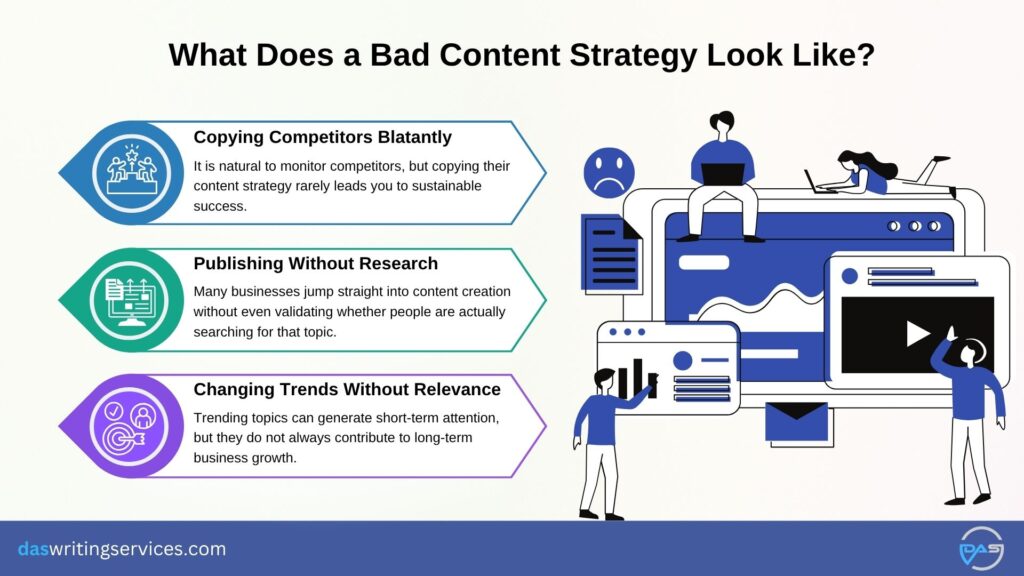
- Copying Competitors Blatantly
It is natural to monitor competitors, but copying their content strategy rarely leads you to sustainable success. Know that every business has a different audience, value proposition and goals. What works for one brand may not work for another.
For instance, a startup notices that an industry leader has published a successful article on Top Marketing Trends for This Year. Without even understanding why this article performed well, or whether it even aligns with its own audience, the startup published a similar piece of content.
The result will be nothing substantial, as it blends into a crowded space without offering any unique perspective. This is because original insights, customer experiences and industry expertise are much harder to replicate than recycled topics.
- Publishing Without Research
Many businesses jump straight into content creation without even validating whether people are actually searching for that topic. This can lead to articles which get less traffic regardless of how well they have been written.
A strong content strategy begins with research, including:
- Proper keyword research to understand demand.
- Audience research to discover their pain points.
- Search intent analysis to determine what users expect from a query.
- Proper competitor analysis to identify opportunities and content gaps.
- Changing Trends Without Relevance
Trending topics can generate short-term attention, but they do not always contribute to long-term business growth. Many brands rush to create content around viral news or popular social media conversations, hoping to capitalise on increased visibility.
While this occasionally works, constantly chasing trends often leads to inconsistent messaging and a diluted brand authority.
For instance, a B2B logistics company suddenly publishing entertainment-related content simply because it is trending may attract just temporary traffic, but very little of it will convert into qualified leads.
What are the Core Elements of an Effective Content Strategy?
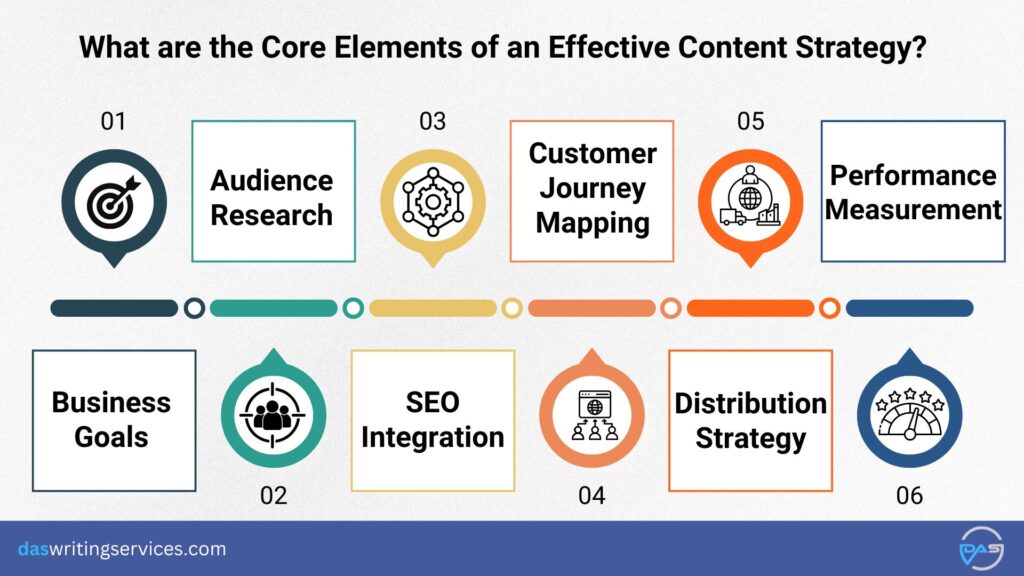
An effective content strategy is always a combination of multiple elements that work together. There are a few core elements like:
- Business Goals
Before creating a single piece of content, businesses need to answer a simple question: What are we trying to achieve?
- For instance, when the popular streaming platform Netflix creates content around upcoming shows, the goal is not merely to generate website traffic. Their content strategy supports subscriber engagement, viewership and retention.
- Very similarly, an insurance company which publishes health insurance guides may aim to generate qualified leads rather than attracting general readers.
When you curate content with a clear business goal, it becomes easier to decide which topics deserve attention and which do not.
- Audience Research
One of the biggest mistakes businesses make is creating content based on what they want to say rather than what the audience wants to know.
- A good example of this is HubSpot. Its blog became one of the most visited marketing resources because it focused on answering the practical questions which marketers and business owners were actively searching for.
Audience research proves fruitful and helps businesses identify pain points, interests, search behaviour and content preferences. The better that you understand your brand audience, the more likely it is to create content which resonates.
- SEO Integration
Even exceptional content can sometimes go unnoticed if people cannot find it.
- Consider how travel websites compete for search visibility. When someone searches for “best places to visit in Japan“, they usually click on one of the first few results. Travel brands invest heavily in SEO because appearing on the first page can drive thousands of visitors every month.
This is exactly why SEO, or Search Engine Optimisation, should be integrated into content planning strategy from the beginning. Proper keyword research, search intent analysis, internal linking and content optimisation help ensure that valuable content reaches the audience for whom it was created.
- Customer Journey Mapping
Nowadays, people rarely make any purchasing decisions instantly. The majority of customers first move through different stages before becoming buyers.
- Think about someone looking for project management software. They might begin by searching “how to improve team productivity“. Later on, they may compare different tools and then eventually look for product reviews before making the final purchase decision.
Hence, by mapping content marketing to the customer journey, businesses like yours can stay relevant throughout the decision-making process instead of appearing only at the final stage.
- Distribution Strategy
Creating content is only part of the equation. Getting it to the right people is equally important.
- For instance, a research report published by a B2B company may generate limited results if it remains on the company website. However, when the same report is promoted through LinkedIn, email newsletters, industry publications, webinars and social media, its reach can increase significantly.
A multi-channel approach of content distribution allows a company to maximise the value of every content asset it produces.
- Performance Measurement
Without proper measurement, content strategy becomes just guesswork. There are many businesses which assume that a blog is successful because it receives traffic. However, traffic alone does not reveal whether the content generates leads, sales or customer engagement.
- Just imagine a company publishing two articles. One gets 20,000 visitors but guarantees no enquiries. Another attracts only 2,000 visitors but produces dozens of qualified leads. Performance data quickly shows which piece delivers greater business value.
Ultimately, an effective content strategy succeeds because they balance creativity and planning.
Final Words
Bad strategies often create the illusion of progress because teams stay busy publishing, posting and promoting content. However, an activity alone does not guarantee results.
An effective content strategy shifts focus from how much content you produce to how well that content supports your audience and your business goals.
Creating great content starts with having the right strategy behind it. If you are looking to improve your SEO performance, attract qualified leads and build long-term authority, Das Writing Services can help. Contact us today to see how a strategic approach can transform your content marketing efforts.
Frequently Asked Questions
- How often should you review and update your content strategy?
A content strategy should be reviewed at least every quarter to make sure that it aligns with changing business goals and customer needs. It also should be up to date according to search trends.
- How do you measure success of a content strategy?
The success of your content strategy can be measured using KPIs (Key Performance Indicators) such as organic traffic, keyword rankings, click-through-rate (CTR), conversion rate and lead generation. The revenue influenced by the content is also an indicator of its success.
- How often should you perform a content audit?
The majority of businesses should conduct a content audit every 6 to 12 months. Regular audits can help you identify outdated content, broken links and keyword opportunities.

Subhodip Das is the founder and CEO of Das Writing Services Pvt. Ltd. He has an experience of 12 years in the field of Digital Marketing and specialises in Content Writing and Marketing Strategies. He has worked with well-established organisations and startups helping them achieve increased Search Engine Rank visibility. If you want to grow your business online, you can reach out to him here.


