AI tools now power real business decisions, content workflows, coding tasks, and research at scale. According to BCG reports, Gen AI adoption rate is 92% in India and 51% globally. At the centre of this shift is the debate around ChatGPT vs Gemini.
Both tools promise speed, intelligence, and reliability, but they work very differently. This guide breaks down how they compare, where they shine, and which one makes sense for you in 2026.
Key Differences Between ChatGPT and Gemini
When comparing ChatGPT vs Gemini, the differences go beyond surface-level features. These tools are built on different philosophies, ecosystems, and technical strengths.
ChatGPT is developed by OpenAI and focuses on conversational depth, reasoning, and structured outputs. Gemini, built by Google, is designed to work natively across Google’s ecosystem with strong multimodal capabilities.
Here is a detailed overview of the core differences between ChatGPT and Gemini:
| Aspect | ChatGPT | Gemini |
| Writing and Communication | It produces natural, conversational, and engaging text. Well-suited for essays, blogs, tutorials, and marketing copy where tone and flow matter. | Delivers concise, fact-focused writing with a more formal tone. Ideal for business documents, summaries, and technical reports. |
| Creativity and Ideation | Best for open-ended brainstorming, storytelling, and exploratory ideas. Expands generic prompts into detailed, imaginative outputs. | Offers structured and practical ideas grounded in data. Gemini is useful for slide decks, product summaries, and technical proposals. |
| Learning and Research | ChatGPT acts as an interactive tutor with step-by-step explanations that adapt to the learner’s level. | Gemini focuses on fast, research-driven results using Google Search integration and citation-style summaries. |
| Coding and Technical queries | Strong for learning and development. Explains code clearly, helps with debugging, and works across different IDEs with flexible API support. | Excels in structured problem-solving, large codebases, and mathematical tasks, especially within Google Cloud, Colab, and Vertex AI. |
| Model Design and Performance | Natively multimodal with a focus on conversational context, polished writing, and strong instruction-following across tasks. | Natively multimodal from the ground up, with strengths in reasoning, multimodal interpretation, and access to current information through Google Search. |
| Cost, Efficiency, and Data Privacy | Subscription-based access to advanced models with scalable API pricing. Enterprise plans offer strong data privacy controls. | Bundled with Google AI Pro and Workspace tools, which makes it cost-effective if you are already using Google services. |
ChatGPT vs Gemini – Comparing Multiple Benchmarks
Benchmarks offer a clearer picture of ChatGPT vs Gemini. The results highlight the key differences across reasoning, coding, mathematics, and language tasks. Here is what you can expect:
| Benchmark | ChatGPT 5.2 | Gemini 3 Pro |
| Overall Benchmark Leadership | Leads many standard benchmarks, especially reasoning and complex tasks. | Strong on massive context and multimodal reasoning. |
| Reasoning and Text Generation | Higher scores on many traditional reasoning and linguistic benchmarks. | Competitive but varies by test. |
| Context Window Size | Handles up to ~256k tokens effectively in long-context benchmarks. | Up to 1,000,000 tokens for input, suitable for very large documents. |
| Coding and Developer Tasks | Very strong at structured coding and multi-language benchmarks; often higher accuracy. | Competent in coding tasks but typically lags slightly behind ChatGPT. |
| Multimodal Processing | Strong image understanding and interpretation capability. | Excellent at multimodal reasoning, including images, video, and complex visual inputs. |
| Real-Time Integration and Data Freshness | Uses its model and tools to interpret complex inputs. | Deeply integrated with Google Search, which enhances access to current data. |
Together, these benchmarks show that ChatGPT 5.2 is the stronger choice for accuracy-driven tasks such as reasoning, coding, and professional decision-making, while Gemini 3 Pro stands out when scale, long-context processing, and native multimodal input are the priority.
From a business perspective, benchmarks are useful, but workflow fit matters just as much. If you rely heavily on digital content across Google platforms, Gemini’s environment can feel more seamless. If your work depends on structured thinking and clarity, then ChatGPT can be a better choice.
ChatGPT vs Gemini – Pricing Comparison Between the Two AI Models
Pricing plays an important role when comparing ChatGPT vs Gemini, especially for individuals, teams, and businesses planning long-term AI usage. While both tools are positioned as premium AI assistants, their pricing models reflect different offerings and values.
1. ChatGPT Pricing
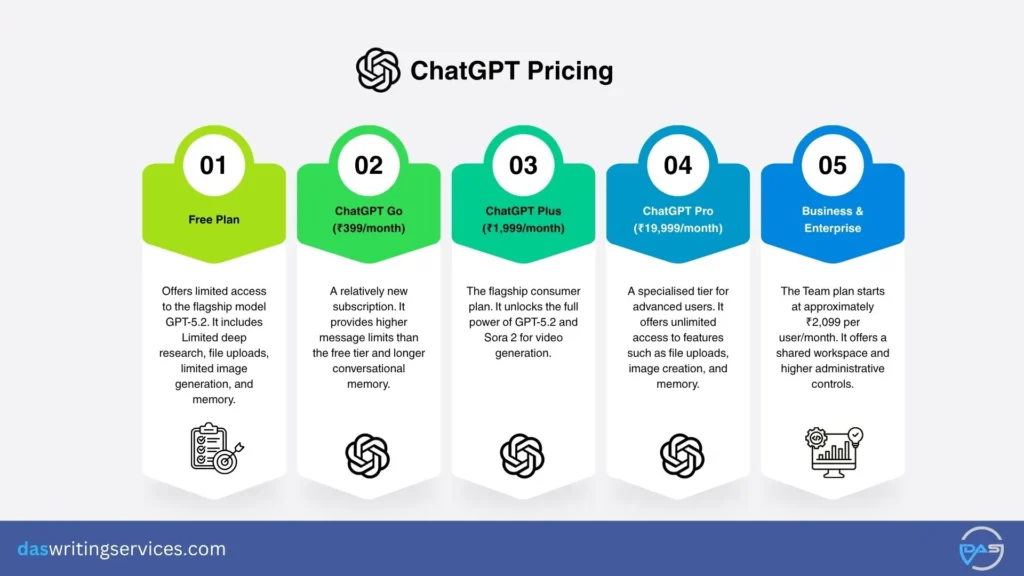
ChatGPT follows a more straightforward subscription-based pricing structure, with budget-friendly options:
- Free Plan: Offers limited access to the flagship model GPT-5.2. It includes Limited deep research, file uploads, limited image generation, and memory.
- ChatGPT Go (₹399/month): A relatively new subscription. It provides higher message limits than the free tier and longer conversational memory. This makes it ideal for students or casual users who outgrow the free version but do not need professional tools.
- ChatGPT Plus (₹1,999/month): The flagship consumer plan. It unlocks the full power of GPT-5.2 and Sora 2 for video generation. This tier is built for power users who need high reliability and early access to new features.
- ChatGPT Pro (₹19,999/month): A specialised tier for advanced users. It offers unlimited access to features such as file uploads, image creation, and memory.
- Business & Enterprise: The Team plan starts at approximately ₹2,099 per user/month. It offers a shared workspace and higher administrative controls.
Overall, ChatGPT’s pricing works well for users who want predictable monthly costs and strong performance for writing, reasoning, and coding tasks.
2. Gemini Pricing
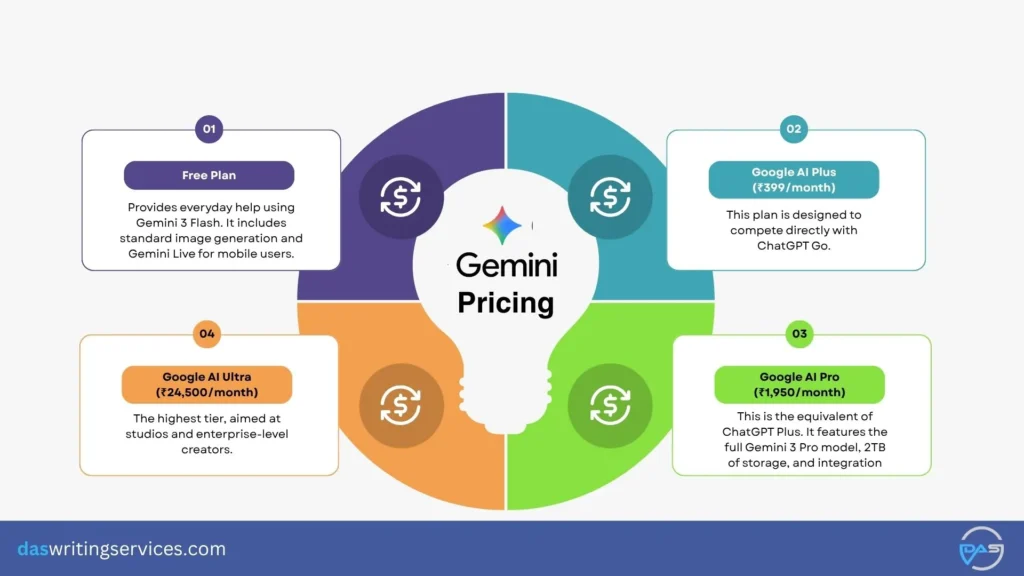
Google’s pricing is deeply integrated with its Google One ecosystem, often bundling AI access with cloud storage:
- Free Plan: Provides everyday help using Gemini 3 Flash. It includes standard image generation and Gemini Live for mobile users.
- Google AI Plus (₹399/month): This plan is designed to compete directly with ChatGPT Go. This plan offers enhanced access to Gemini 3 Pro and 200GB of Google One storage.
- Google AI Pro (₹1,950/month): This is the equivalent of ChatGPT Plus. It features the full Gemini 3 Pro model, 2TB of storage, and integration of Gemini into Gmail, Docs, and Slides. It also includes “Deep Research” capabilities and advanced monthly AI credits up to 1,000.
- Google AI Ultra (₹24,500/month): The highest tier, aimed at studios and enterprise-level creators. It offers massive 30TB storage, the highest usage limits for video generation (Veo 3.1), and priority server access.
Gemini’s pricing makes the most sense for teams deeply embedded in Google’s ecosystem, where AI becomes an extension of existing workflows rather than a standalone tool.
When comparing ChatGPT vs Gemini pricing, the difference is not just about the monthly cost. It is about how much value you extract from the surrounding ecosystem.
What are the Limitations of ChatGPT and Gemini?
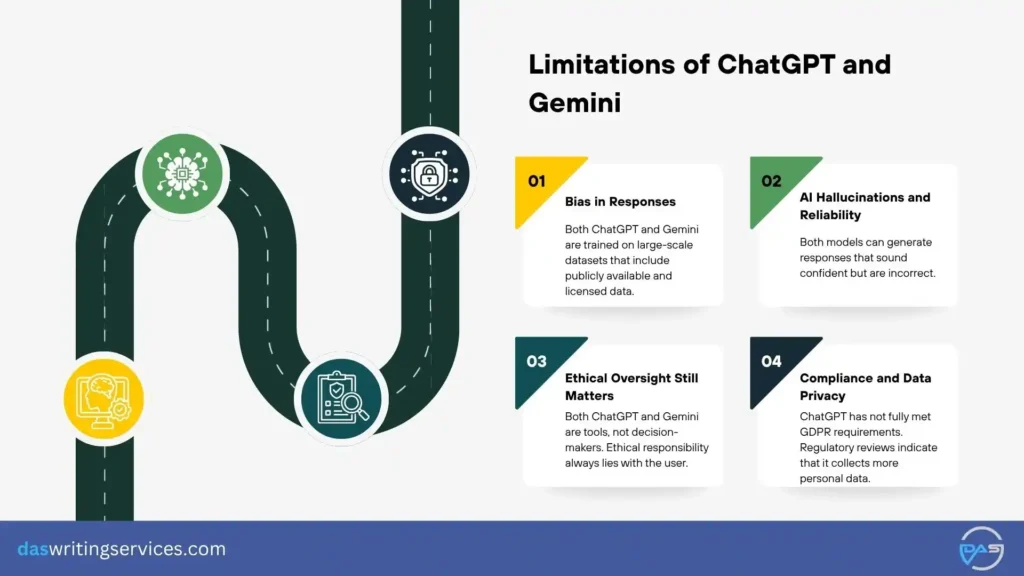
No AI tool is perfect, and a fair ChatGPT vs Gemini comparison must address limitations honestly. Knowing these drawbacks helps avoid unrealistic expectations:
1. Bias in Responses
Both ChatGPT and Gemini are trained on large-scale datasets that include publicly available and licensed data. As a result, they can sometimes reflect social, cultural, or ideological biases present in those sources.
In some cases, attempts to reduce bias can lead to historically or contextually inaccurate outputs. A widely discussed example involved Gemini generating images of a female pope. While the intention was to avoid reinforcing stereotypes, the output conflicted with historical facts.
2. AI Hallucinations and Reliability
Both models can generate responses that sound confident but are incorrect. These hallucinations are more likely when the prompt involves niche expertise, limited data availability, or speculative scenarios.
ChatGPT tends to produce detailed explanations, which improves understanding but also increases the risk of confidently presenting incorrect details if the source information is flawed.
3. Ethical Oversight Still Matters
Both ChatGPT and Gemini are tools, not decision-makers. Ethical responsibility always lies with the user. Outputs used for public communication, professional advice, or strategic planning should always be reviewed by subject-matter experts.
4. Compliance and Data Privacy
ChatGPT has not fully met GDPR requirements. Regulatory reviews indicate that it collects more personal data than necessary and does not consistently remove or mask identifying information.
Understanding these weaknesses is crucial if you plan to use AI to optimise your content or build scalable content workflows.
ChatGPT vs Gemini – Which One Should You Choose in 2026?
The real question in the ChatGPT vs Gemini discussion is not which tool is better overall, but which one fits your goals. Consider these factors while choosing between them:
1. ChatGPT vs Gemini for Image Generation
When it comes to visuals, the difference is subtle but important. ChatGPT integrates with advanced image models that allow detailed prompt-based image creation. Gemini supports image generation as well, but its strength lies more in understanding and analysing images.
2. Coding
Developers often compare ChatGPT vs Gemini for coding because both tools claim strong technical skills. In practice, ChatGPT is better at explaining code logic, debugging errors, and generating longer scripts. Gemini performs well for quick snippets and API references, especially within Google Cloud environments.
3. ChatGPT vs Gemini Pricing
Pricing plays a big role for individuals and businesses. ChatGPT’s premium plans in India start from ₹399 per month, depending on usage tiers.
On the other hand, Gemini’s advanced plans start from ₹399 per month as well. While pricing is comparable, value depends on how deeply you use each ecosystem.
If your goal is to build a sustainable content plan that balances AI efficiency with human creativity, ChatGPT often provides more flexibility. If your priority is productivity inside Google tools, Gemini may be the better choice.
What is the Future of AI assistants in 2026 and Beyond?
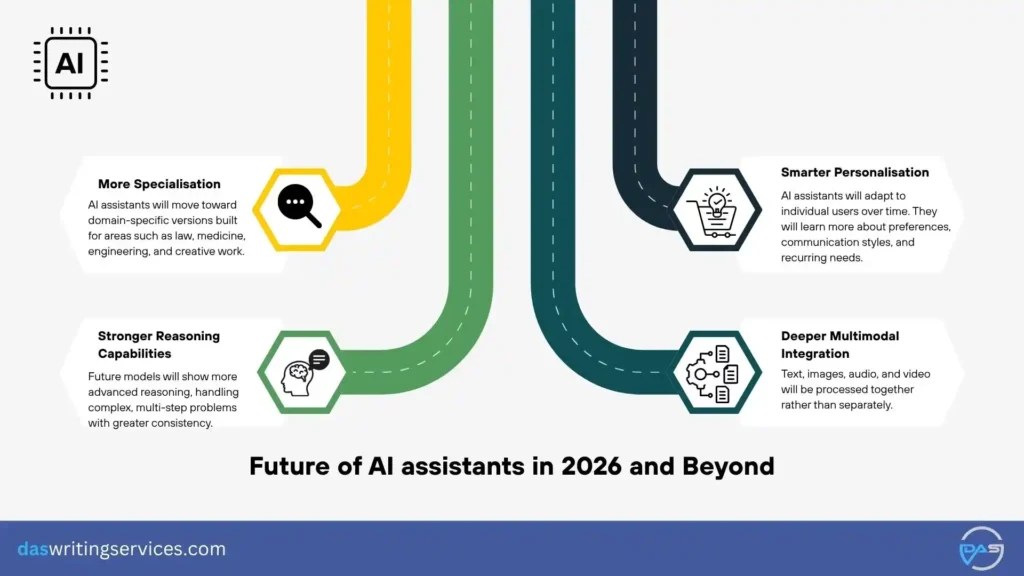
The rapid evolution of AI over the past few years suggests that the gap between human expertise and machine intelligence will continue to narrow.
As we move beyond 2026, the future of AI assistants such as ChatGPT and Gemini will be shaped by deeper specialisation, stronger reasoning, and more human-like interaction patterns.
1. More Specialisation
AI assistants will move toward domain-specific versions built for areas such as law, medicine, engineering, and creative work. This shift will improve accuracy and make AI more reliable in professional and high-stakes environments.
2. Stronger Reasoning Capabilities
Future models will show more advanced reasoning, handling complex, multi-step problems with greater consistency. Many tasks will reach near expert-level performance, especially in technical and analytical domains.
3. Deeper Multimodal Integration
Text, images, audio, and video will be processed together rather than separately. This will create a smoother experience where users can share mixed inputs and receive unified and context-aware responses.
4. Smarter Personalisation
AI assistants will adapt to individual users over time. They will learn more about preferences, communication styles, and recurring needs. It will make interactions feel more natural and efficient without losing user control.
Conclusion
The ChatGPT vs Gemini debate will continue as both tools evolve, but the answer is not binary. In 2026, the smartest approach is not choosing one blindly, but aligning the tool with your workflow.
For content-led businesses, AI should support strategy, not replace human intuition. Despite the surge in automation, many content marketing agencies like Das Writing Services still believe in human-written content as the gold standard for depth, nuance, and emotional resonance.
Frequently Asked Questions
ChatGPT is better for long-form writing, reasoning, and structured problem-solving. Gemini performs better when integrated into Google Workspace and for multimodal tasks. The better option depends on your use case.
Gemini benefits from real-time Google Search integration, which helps with fresh data. ChatGPT, however, provides deeper analysis and clearer synthesis, which makes it more suitable for in-depth research writing.
ChatGPT generally performs better for coding tasks that involve debugging, explanations, and complex logic. On the other hand, Gemini is useful for quick code references, especially within Google Cloud environments.
Gemini is better suited for creating realistic human images, as it tends to capture facial features. ChatGPT works well for objects and image refinements, but its human images may sometimes lack exact facial features.
For structured research, analysis, and long-form outputs, ChatGPT is often preferred. Gemini works well for fast fact-checking and summarising information sourced from Google Search.

Subhodip Das is the founder and CEO of Das Writing Services Pvt. Ltd. He has an experience of 12 years in the field of Digital Marketing and specialises in Content Writing and Marketing Strategies. He has worked with well-established organisations and startups helping them achieve increased Search Engine Rank visibility. If you want to grow your business online, you can reach out to him here.
Leave a comment