

Get Your Website Content Audit

 Add as preferred on Google →
As AI answers replace traditional search clicks by giving users direct answers, it has become crucial for businesses to get their content cited by AI platforms, including ChatGPT. To get cited, content needs to have direct answers, clear headings, and first-hand research.
According to Ahrefs, even though ChatGPT retrieves many URLs to answer a single query, it cites only about 50%. When AI experts dug deeper, they found that ChatGPT analyses the page title, its brief snippet, ID number, and URL to determine whether that particular page is worth citing or not.
If you are wondering, “How to get cited by ChatGPT?” Follow this detailed guide.
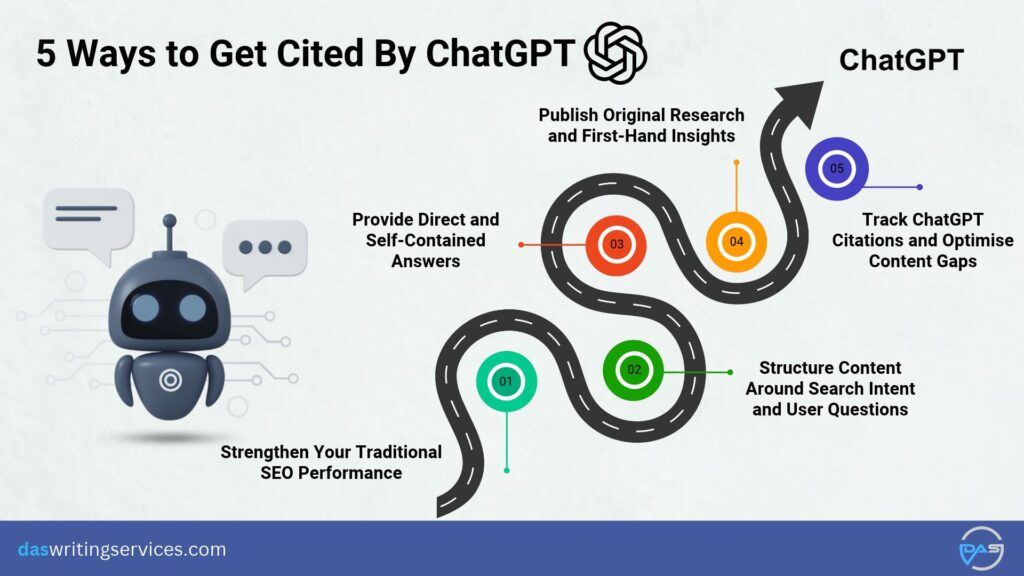
5 Ways to Get Cited By ChatGPT
The first step to get cited by ChatGPT is to become eligible. OpenAI starts by asking websites to allow OAI-SearchBot and IPs listed in searchbot.json to crawl. At this point, it does not guarantee a placement. When users ask a query, ChatGPT rewrites it, searches the web, and then cites a subset of pages.
So, websites that want to know how to get cited by ChatGPT can follow these ways:
- Strengthen Your Traditional SEO Performance
Unlike the popular belief that traditional SEO has lost its significance, it is important to note that SEO still plays an important part in AI answers. ChatGPT retrieves information through different channels, including its general search index.
For Example, in its April 2026 study, Ahrefs found that 88.46% of URLs were retrieved through SEO for AI answers. This makes search visibility an important consideration for businesses aiming to improve their ChatGPT citations.
- Structure Content Around Search Intent and User Questions
Users interact with ChatGPT differently from traditional search engines. Instead of entering short keywords, they often ask detailed, conversational questions. For example, a user searching for health insurance may ask, “Which health insurance policy is suitable for a family of four?” Optimizing for generative search requires businesses to identify such types of conversational queries and create content that addresses their underlying intent.
- Provide Direct and Self-Contained Answers
AI platforms need relevant information and an answer-first approach that they can understand and use to construct answers. Start each important section with a concise answer before explaining the topic in greater detail. For example, start with the benefits of comprehensive car insurance if the blog is about the benefits of comprehensive car insurance. After answering the query, you explain its coverage, exclusions, and claim process.
- Publish Original Research and First-Hand Insights
Generic information that appears across multiple websites gives AI platforms fewer reasons to select one source over another. This is called thin content or scaled content abuse. In contrast, original research, expert opinions, surveys, case studies, and first-hand experiences can make your content more distinctive and reliable.
For example, an insurance company can publish research on common reasons behind health insurance claim rejections or changes in health insurance buying preferences. Similarly, a digital marketing agency can publish its own SEO case studies, keyword research findings, and website performance reports.
- Track ChatGPT Citations and Optimise Content Gaps
Publishing optimised content is only one part of the process. You should also monitor whether ChatGPT retrieves, mentions, or cites your website. Start by creating a list of relevant prompts that potential customers might enter into ChatGPT.
For example, a digital marketing agency can test queries such as:
- Which agencies offer SEO content writing services?
- What are the best content optimisation strategies?
Run these prompts periodically and check:
- Whether ChatGPT mentions your brand.
- If it provides a link to your website.
- Which of your webpages receive citations.
- Competitors that appear in the answers.
- Whether the cited information is accurate.
- Which relevant queries your website does not address.
From Where Does ChatGPT Retrieve its Data?
Are you wondering, “How does ChatGPT select sources during citation”? The gatekeepers of ChatGPT categorize content sources using ref_type, which is a label for the channel the URL has been retrieved from. As per data found by Ahrefs, the ref_type=search has a citation rate of 88.46%, indicating that content that has an SERP ranking has a higher potential to get cited by ChatGPT. Let us look at other ref_type influences on ChatGPT citations:
| ref_type | Citation rate |
| news | 12.01% |
| 1.93% | |
| youtube | 0.51% |
| Academia | 0.40% |
Common Myths Regarding ChatGPT Citations
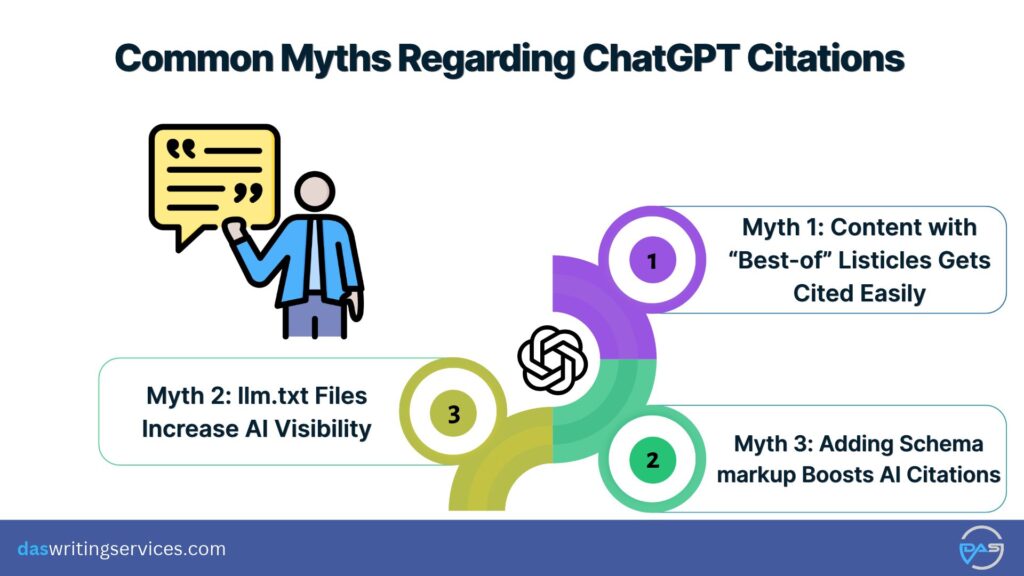
There are many misconceptions related to ChatGPT citations. These are as follows:
Myth 1: Content with “Best-of” Listicles Gets Cited Easily
This is one of the most common myths that businesses believe, and that is why they keep posting content that contains “Best” listicles. However, Ahrefs research has found that, in many cases, these listicles may recommend a competitor’s brand instead.
What to Do?
According to the Search Engine Journal, reaching out to other website owners to earn backlinks and word-of-mouth engineering through influencer campaigns or content collaborations might help. That way, ChatGPT may consider your website credible and authoritative in the long run.
Myth 2: llm.txt Files Increase AI Visibility
Instead of an official standard, this is a proposal. According to research conducted by SE Ranking, llm.txt only highlights a website’s most significant content for LLMs. Not only that, after analyzing 300,000 domains, it has been found that only 1 in 10 websites use llm.txt. So, it is evident that there is no relation between AI citations and llm.txt.
What to Do?
The best way to get cited is to make existing website content easy to crawl, cite, and parse. For that, you can use HTML links for navigation, submit accurate XML sitemaps, and keep the most important pages of your business easily accessible through the homepage.
Myth 3: Adding Schema markup Boosts AI Citations
After tracking 1885 pages with JSON-LD Schema for 30 days, the Search Engine Journal found that there has been no boost in terms of visibility in ChatGPT or Google AI Mode.
What to Do?
The best way is to utilise Schema markup only to build entity association in the long term. When there is a clearer Knowledge Graph, it becomes easier for AI models to understand your content.
Final Words
Now that you know how to get cited by ChatGPT, you are aware that getting cited by ChatGPT requires more than adding conversational keywords or publishing AI-friendly content. Businesses need to build a strong foundation through technical accessibility, traditional SEO, topical authority, original research, and credible brand mentions.
The idea is to create content that directly addresses user intent, provides accurate information, and offers genuine value. By combining these practices with regular AI citation monitoring, businesses can improve their opportunities to appear as reliable sources in ChatGPT answers.
Not sure about how to proceed? Choose Das Writing Services to make your website content Answer Engine Optimized so that it has a higher potential to get cited by different AI models.
Frequently Asked Questions
- How long does it take for ChatGPT to cite a website?
It is hard to mention a fixed timeline for ChatGPT to cite a website. Depending on the website’s crawl accessibility, search visibility, content relevance, and user queries, ChatGPT determines whether to cite a website or not.
- Does ChatGPT prefer long-form content?
No, until now, ChatGPT does not have a publicly established word-count requirement for citations. As per research, instead of focusing on article length, websites must prioritize relevance, factual accuracy, topical coverage, and clear answers.
- Can ChatGPT cite a new website?
Yes, if a new website is accessible and relevant to a user’s query, it may get cited. However, building search visibility, topical credibility, and independent brand recognition may take time.

Subhodip Das is the founder and CEO of Das Writing Services Pvt. Ltd. He has an experience of 12 years in the field of Digital Marketing and specialises in Content Writing and Marketing Strategies. He has worked with well-established organisations and startups helping them achieve increased Search Engine Rank visibility. If you want to grow your business online, you can reach out to him here.


