
Get Free Content Sample

 Add as preferred on Google →
A content gap analysis helps you discover topics, keywords, customer questions, etc your website does not answer well. It also helps you show where your existing pages need improvement. In 2026, this process has become more important because search now extends beyond Google to AI-powered platforms.
As per a report by Semrush, which analysed 126 million AI search prompts and found that brands with integrated SEO and AI strategies achieved stronger visibility across search and AI-generated answers. A content gap analysis needs to become a regular part of your SEO strategy if you want more qualified traffic, better rankings, and stronger authority.
What is a Content Gap Analysis?
A content gap analysis is the process where you identify topics, keywords, and user questions that your website does not cover or does not answer well. It compares your existing content with audience needs and competitor content. This helps you find opportunities to create new pages or improve existing ones.
For example, you may already have a blog about email marketing. On the other hand, your competitors might also cover AI email personalisation, automation workflows, campaign benchmarks, and compliance updates. Here these missing subtopics represent content gaps that prevent your page from becoming a complete resource.
What is the Importance of Content Gap Analysis?
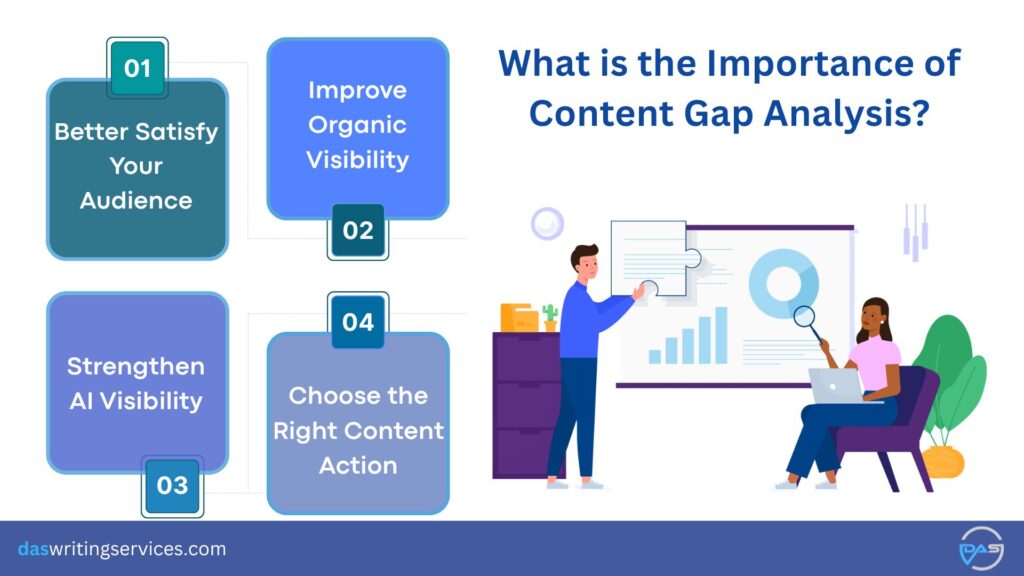
A content gap analysis helps you understand what your audience expects. It also helps you explain where your website falls short. Here is a detailed understanding of why content gap analysis is important:
- Better Satisfy Your Audience
A content gap analysis shows you topics that are missing from your website and identifies areas where existing content lacks depth. Google also continues to prioritise content that shows experience, expertise, authoritativeness, and trustworthiness (E-E-A-T).
- Improve Organic Visibility
If your website covers topics comprehensively, then search engines will reward your website. A content gap analysis helps you discover pages that need updates and keywords that your competitors already rank for. This process also supports keyword gap analysis, which identifies valuable search terms your website has not targeted yet.
If you need expert support to identify these opportunities, Das Writing Services can help you build a strategic content plan that aligns with your business goals and search demand.
- Strengthen AI Visibility
Search behaviour has significantly changed. To find answers many users now rely on AI-powered search experiences. A content gap analysis helps you make sure that you are prepared for this. It ensures your website covers related topics in depth and answers common follow-up questions.
- Choose the Right Content Action
A content gap analysis shows you what action you need for every page. Some of your articles only need updated statistics or additional sections. On the other hand, other articles may need a complete rewrite or a fresh content strategy.
A Step-by-Step Guide on Content Gap Analysis
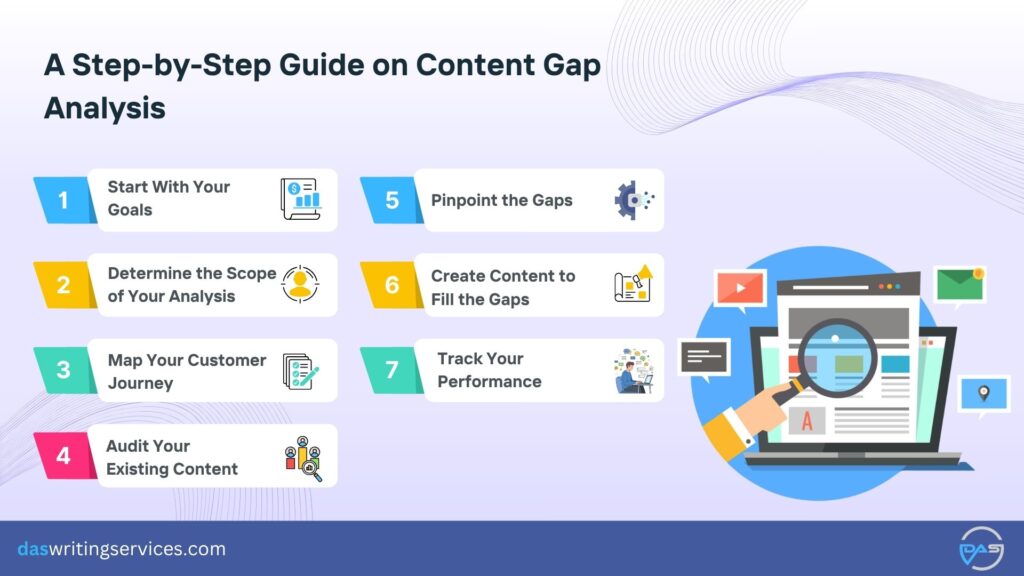
For a successful content gap analysis you need to follow a structured process. Each step helps you identify opportunities that improve your SEO strategy and create content your audience actually wants. Here is a detailed step by step process:
- Start With Your Goals
You need to start by defining what you want to achieve through your content gap analysis. Your objective can be anything. For example, your objective can be to increase organic traffic, generate more leads, improve topical authority, or strengthen your visibility in AI search results.
- Determine the Scope of Your Analysis
After that you need to decide what part of your website you want to analyse. You can review a single landing page, a blog category, your service pages, or your entire website. You can also compare your digital content against one or several competitors.
- Map Your Customer Journey
You need to make sure your content supports users throughout their buying journey. You must review if you have useful content for every stage. For example, awareness, consideration and finally the purchase decision.
- Audit Your Existing Content
After that review every important page on your website. You need to check if the information is updated, the content satisfies search intent, and your page covers the topic in depth. You also need to look for outdated statistics, weak internal linking, and content that needs improvement.
Many businesses also take help from a content gap analysis tool, which helps them simplify audits and compare their content with competitors.
- Pinpoint the Gaps
After the audit, you need to compare your content with your competitor websites and audience expectations. You need to identify missing topics, unanswered questions, weak keyword coverage, and pages that do not perform well anymore.
- Create Content to Fill the Gaps
Once you identify the gaps, you can prioritise them based on business goals and search demand. Some opportunities may require entirely new articles; on the other hand, others only need existing pages to be updated.
- Track Your Performance
Finally, track your rankings, organic traffic, engagement, and conversions to understand what is working. Review your content regularly because search trends, customer behaviour, and competitor strategies continue to evolve.
Final Word
A content gap analysis helps you understand what your audience needs and where your website can improve. It removes guesswork from your SEO strategy and helps you build content that performs across search engines and AI platforms.
Businesses that regularly evaluate and improve their content stay ahead of competitors. By making this process a regular part of your strategy, you create content that remains valuable today and continues to perform in the future.
Frequently Asked Questions
How often should we perform a content gap analysis?
You should perform a content gap analysis at least once every quarter. Regular analysis helps you respond to algorithm updates, changing search intent, and new competitor content before your rankings are affected.
How does ‘Social Search’ impact gap analysis?
Many users now search on platforms such as LinkedIn, YouTube, and Instagram before they visit Google. A content gap analysis should therefore identify content opportunities across multiple platforms.
Should I delete old content that has ‘gaps’?
Not always. In most cases, updating existing content delivers better results than deleting it. You can just refresh outdated information and add recent statistics.

Subhodip Das is the founder and CEO of Das Writing Services Pvt. Ltd. He has an experience of 12 years in the field of Digital Marketing and specialises in Content Writing and Marketing Strategies. He has worked with well-established organisations and startups helping them achieve increased Search Engine Rank visibility. If you want to grow your business online, you can reach out to him here.


