
Get Free Content Sample

 Add as preferred on Google →
Semantic SEO is a modern way of doing search engine optimisation that focuses on meaning, context, and user intent instead of just keywords.
Rather than creating content for one keyword, it aims to cover a complete topic clearly and helpfully. This helps search engines understand what your content is really about.
Semantic SEO helps you meet this expectation by creating content that is detailed, well-structured, and easy to understand.
In short, it is about writing content that answers real questions while making it easier for search engines to trust and rank your page.
What Exactly Is Semantic SEO?
Semantic SEO is an approach to search optimisation that focuses on the meaning behind content rather than just individual keywords. Instead of optimising for a single phrase, it targets an entire topic by understanding user intent, context, and how different concepts are connected.
The term “semantic” simply relates to meaning. Since search engines process language as data, they rely on patterns, associations, and probabilities to interpret what content is about.
Models like BERT help search engines understand context, synonyms, and sentence structure, improving result accuracy.
For example, if certain words and phrases frequently appear together, search engines assume they are contextually related. Semantic SEO leverages this by naturally incorporating related terms, entities, and ideas into content.
In practice, this means creating in-depth, well-structured content that answers multiple related questions and improves user experience. It also involves organising information in a way that machines can easily interpret.
Over 70% of searches are long-tail queries, which means users search in full phrases and questions rather than single keywords.
Ultimately, Semantic SEO bridges the gap between human language and search engine logic, helping content rank better while delivering real value to users.
As search evolves beyond traditional results into AI-generated answers, understanding the shift from SEO to GEO becomes essential, as explained in detail in our guide on SEO vs GEO.
Why Is Semantic SEO More Important in 2026?
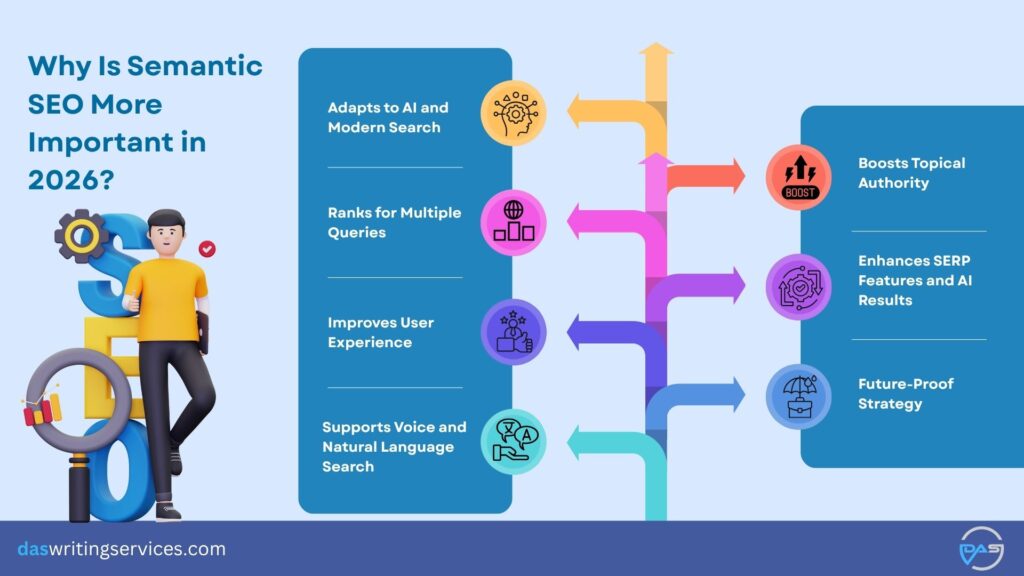
Semantic SEO has become essential in 2026 because search engines no longer rely on keyword matching alone; they focus on understanding intent, context, and meaning.
Search engines like Google now interpret search intent using AI models, meaning exact keyword matching is no longer the main ranking factor.
With AI-driven algorithms and natural language processing, search engines now prioritise content that genuinely answers user queries clearly and comprehensively.
- Adapts to AI and Modern Search
Search engines use AI and machine learning to interpret meaning. Semantic SEO helps your content align with these systems, making it easier to understand, trust, and rank.
- Ranks for Multiple Queries
Instead of targeting one keyword, semantic content covers a topic holistically. This allows a single page to rank for many related searches, increasing visibility and reach.
Top-ranking pages often rank for hundreds or even thousands of related queries, not just one keyword (Ahrefs industry analysis).
- Improves User Experience
Clear, structured, and intent-focused content helps users find answers quickly. This increases engagement, reduces bounce rates, and signals quality to search engines.
Long-form, in-depth content (1500+ words) tends to rank higher because it covers topics more comprehensively.
- Supports Voice and Natural Language Search
With the rise of voice search, users ask full questions. Semantic SEO ensures your content matches conversational queries.
Voice and conversational searches are increasing, with a significant share of users preferring natural language queries over typed keywords.
- Boosts Topical Authority
Covering related subtopics builds authority and trust, helping your site rank consistently across a subject area.
- Enhances SERP Features and AI Results
Well-structured semantic content is more likely to appear in featured snippets, “People Also Ask,” and AI-generated answers.
Pages optimised for semantic clarity are more likely to appear in featured snippets, which can capture 20%-40% of total clicks for a query.
- Future-Proof Strategy
Unlike outdated keyword tactics, semantic SEO evolves with search engine updates, keeping your rankings stable over time.
How Does Semantic SEO Actually Work Behind Search Engines and AI Systems?
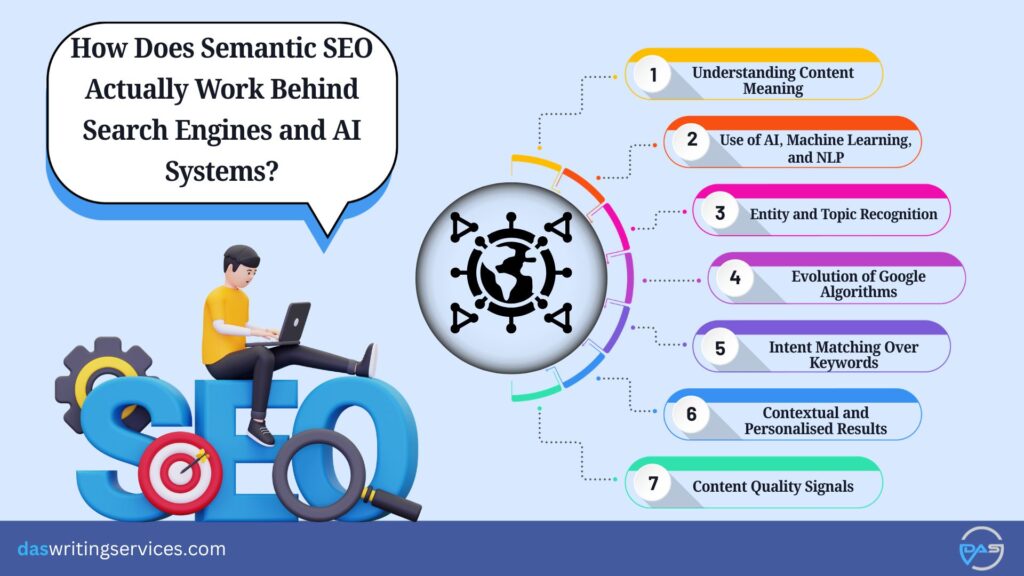
Semantic SEO works by enabling search engines and AI systems to understand the true meaning behind content and queries, rather than just matching keywords.
It focuses on intent, context, and relationships between concepts to deliver the most relevant results.
- Understanding Content Meaning
Search engines analyse what your content is about, who it is for, and why it is useful, going beyond simple keyword matching.
- Use of AI, Machine Learning, and NLP
Technologies like AI, Machine Learning, and Natural Language Processing (NLP) help interpret language, detect patterns, and understand context.
- Entity and Topic Recognition
Search engines identify entities (people, places, concepts) and map relationships between them to build a complete topic understanding.
- Evolution of Google Algorithms
Updates like Knowledge Graph, Hummingbird, RankBrain, and BERT have improved how Google processes intent and contextual meaning.
- Intent Matching Over Keywords
Instead of keyword density, search engines prioritise how well content satisfies user intent and answers queries.
- Contextual and Personalised Results
Results are tailored based on factors like location, device, language, and search behaviour. Results vary based on location, device, and search history. It makes context-driven optimisation more important than fixed keywords.
- Content Quality Signals
Search engines evaluate depth, relevance, structure, and authority to decide rankings and visibility.
What Is the Best Step-By-Step Semantic SEO Strategy?
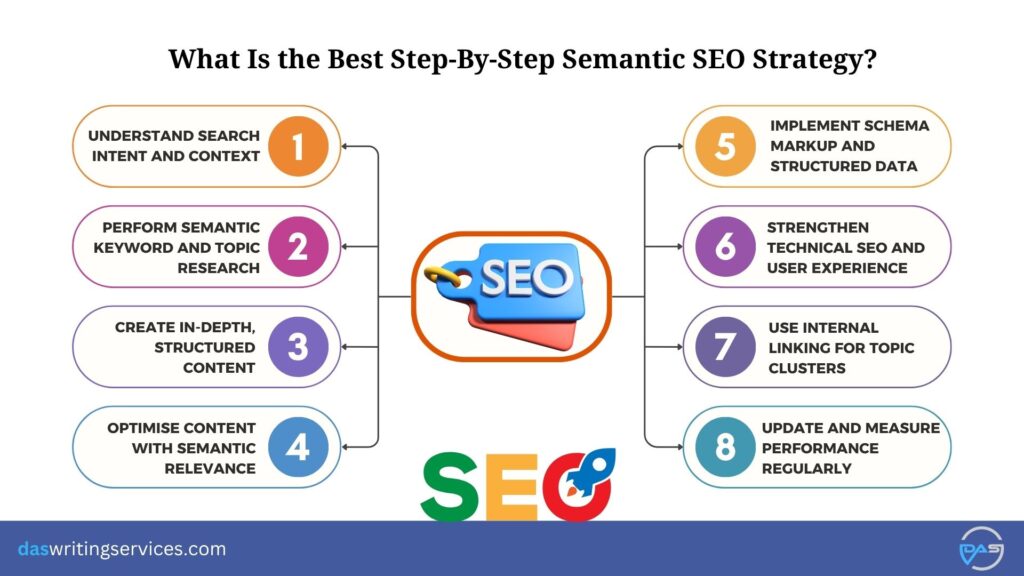
A strong semantic SEO strategy focuses on topics, intent, and content depth rather than isolated keywords.
It’s a structured process that helps search engines understand your content holistically while improving user experience and rankings.
- Understand Search Intent and Context
Start by identifying why users are searching: informational, navigational, or transactional. Use SERPs, “People Also Ask,” and related queries to uncover intent and expectations.
- Perform Semantic Keyword and Topic Research
Build a list of related keywords, entities, and long-tail queries. Group them into clusters to cover an entire topic instead of focusing on a single keyword.
- Create In-Depth, Structured Content
Develop comprehensive content that answers multiple related questions. Use clear headings (H2s, H3s), simple formatting, and natural language for better readability and AI parsing.
- Optimise Content With Semantic Relevance
Incorporate related phrases naturally, expand on missing subtopics, and replace vague terms with clearer, context-rich language to improve meaning and relevance.
- Implement Schema Markup and Structured Data
Add schema types like Article or FAQ to help search engines better interpret your content and improve chances of rich results.
- Strengthen Technical SEO and User Experience
Ensure fast loading speed, mobile responsiveness, and a clean site structure so both users and search engines can easily access your content.
- Use Internal Linking for Topic Clusters
Connect related pages with contextual anchor text to build topical authority and guide search engines through your content ecosystem.
- Update and Measure Performance Regularly
Track rankings, traffic, and engagement, then refine your content to maintain relevance and improve long-term performance.
Which Are the Best Semantic SEO Tools to Use in 2026?
Choosing the right semantic SEO tools in 2026 is essential for building topic-driven, AI-friendly content.
These tools help with keyword clustering, entity recognition, content optimisation, and performance tracking.
| Tool | Best For | Key Features | Pricing |
| InLinks | Entity-based SEO & internal linking | Knowledge graph optimisation, auto internal linking, schema support | Starts at $49/month |
| Surfer SEO | AI content optimization | Real-time content scoring, NLP keywords, SERP analysis | From $89/month |
| MarketMuse | Enterprise content strategy | Topic modelling, content briefs, gap analysis | From $149/month |
| Frase.io | Beginners & small businesses | AI content drafts, question research, SERP insights | From $14.99/month |
| Clearscope | Agencies & premium optimization | Content grading, Google Docs integration, entity tracking | From $170/month |
| NeuronWriter | Budget-friendly semantic SEO | NLP suggestions, competitor analysis | From $29/month |
| SE Ranking (AI Edition) | All-in-one SEO suite | Keyword clustering, content scoring, and site audit | From $55/month |
| Semrush | Advanced keyword & competitor research | Large keyword database, difficulty analysis, and content suggestions | Custom pricing |
| LSIGraph | Semantic keyword ideas | LSI keyword generation, real-time updates | Limited free + paid plans |
| Google Trends & Keyword Planner | Trend & demand analysis | Search trends, keyword volume, competition insights | Free |
What Are the Most Common Semantic SEO Mistakes to Avoid?
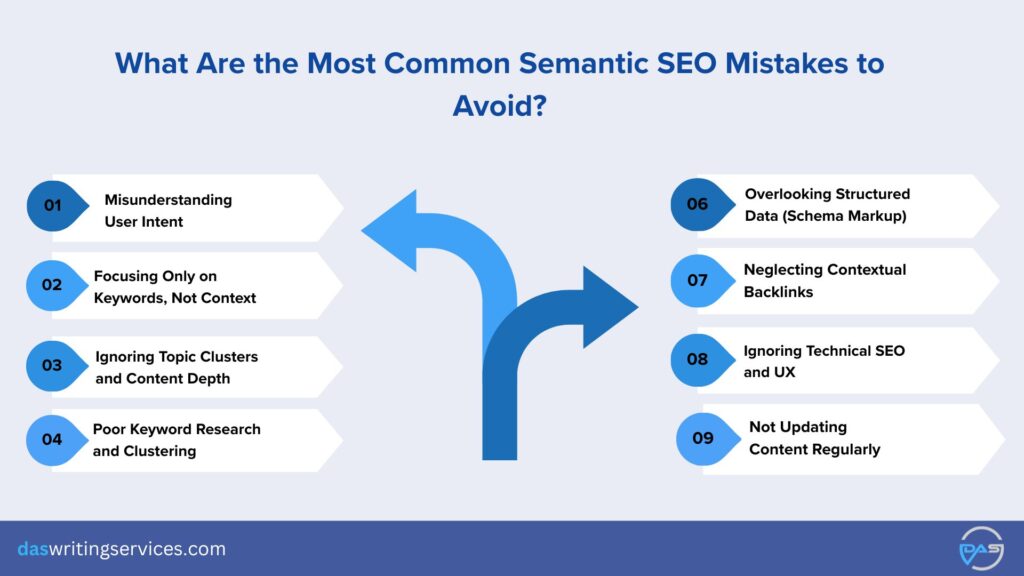
Semantic SEO can significantly improve rankings, but small mistakes can limit its effectiveness. Many websites still follow outdated practices or ignore how modern search engines interpret meaning, intent, and context.
Avoiding these common errors can make your strategy more accurate, user-focused, and future-proof.
- Misunderstanding User Intent
Creating content that doesn’t match what users actually want leads to poor engagement and rankings. Always align content with intent: informational, transactional, or navigational.
- Focusing Only on Keywords, Not Context
Keyword stuffing or relying on exact-match terms ignores how search engines evaluate meaning. Use natural language, related terms, and entities instead.
- Ignoring Topic Clusters and Content Depth
Publishing isolated pages without covering related subtopics weakens topical authority. Build clusters to show complete expertise on a subject.
- Poor Keyword Research and Clustering
Using a single tool, targeting only high-volume keywords, or not grouping queries properly can lead to missed opportunities and keyword cannibalisation.
- Overlooking Structured Data (Schema Markup)
Without structured data, search engines struggle to interpret your content fully, reducing the chances of rich snippets and enhanced visibility.
- Neglecting Contextual Backlinks
Focusing on quantity over quality backlinks reduces trust. Relevant, context-driven links signal authority and improve rankings.
- Ignoring Technical SEO and UX
Slow speed, poor mobile optimisation, and broken links harm both rankings and user experience.
- Not Updating Content Regularly
Outdated content loses relevance. Regular updates help maintain accuracy, improve engagement, and capture new search trends.
If you are new to optimisation, it’s important to first understand the fundamentals of Search Engine Optimisation (SEO) and how search engines rank content before moving into advanced semantic strategies.
What Is the Difference Between Semantic SEO and Traditional SEO?
Traditional SEO and Semantic SEO differ mainly in how they approach search optimisation. One focuses on keywords, while the other focuses on meaning, intent, and context.
As search engines have evolved with AI and Natural Language Processing, Semantic SEO has become a more effective and future-ready approach.
| Aspect | Traditional SEO | Semantic SEO |
| Core Focus | Keywords and exact-match phrases | User intent, context, and meaning |
| Content Strategy | One page per keyword | Topic clusters and comprehensive content |
| Keyword Usage | Keyword density and repetition | Synonyms, related terms, and natural language |
| Search Engine Understanding | Limited to keywords and tags | Deep understanding using entities and relationships |
| Optimisation Approach | Meta tags, titles, and basic on-page SEO | NLP optimisation, structured data, schema markup |
| Backlinks | Quantity-focused link building | Quality, relevance, and contextual backlinks |
| User Experience | Written for search engines | Written for users first, then optimised for search |
| Adaptability | Less flexible, short-term results | Highly adaptable, long-term strategy |
| Voice & AI Search | Limited support | Optimised for conversational and AI-driven queries |
How Das Writing Services Can Help You With Semantic SEO?
At Das Writing Services, we help businesses succeed with Semantic SEO by focusing on meaning, intent, and complete topic coverage instead of just keywords.
Our approach ensures your content is aligned with how modern search engines and AI systems understand information.
We begin with strategy and analysis, where we study your audience, map search intent, and build strong topic clusters with relevant semantic keywords.
Next, we assign experienced in-house writers and editors who understand your industry and create content that reflects real user needs.
In the content creation stage, we produce original, human-written content that naturally includes related terms, entities, and subtopics.
This improves both readability and search relevance. Our editing process refines tone, clarity, and structure to match your brand voice.
Finally, we optimise every piece for SEO and AEO with proper formatting, keyword placement, and quality checks. We also track performance through real impact metrics like clicks and engagement.
With our structured process and years of experience, we create content that ranks better, attracts the right audience, and builds long-term authority.
If you are also deciding between organic growth and paid strategies, you can explore our detailed comparison on SEO vs advertising to choose the right approach for your business goals.
Key Takeaways
Semantic SEO is about building content that reflects how people think, search, and consume information today. Instead of isolating keywords, it connects topics, entities, and intent to create a complete and meaningful content experience.
As AI and natural language processing continue to evolve, search engines prioritise clarity, structure, and relevance. Semantic SEO aligns perfectly with this shift by focusing on depth, context, and user satisfaction.
It enables a single piece of content to rank for multiple queries, strengthens topical authority, and improves long-term visibility.
Ultimately, success in modern SEO comes from delivering value, not just optimisation. Content that is well-structured, informative, and intent-driven will always outperform shallow, keyword-focused pages.
Want content that actually performs? We create semantic, high-impact content that drives rankings, traffic, and real business growth.

Subhodip Das is the founder and CEO of Das Writing Services Pvt. Ltd. He has an experience of 12 years in the field of Digital Marketing and specialises in Content Writing and Marketing Strategies. He has worked with well-established organisations and startups helping them achieve increased Search Engine Rank visibility. If you want to grow your business online, you can reach out to him here.


