
Get Free Content Sample

 Add as preferred on Google →
Every ecommerce business wants more traffic, higher visibility, and better conversions. However, many online stores invest heavily in product photography, paid advertising, and promotions while overlooking one of the most powerful sales tools on their website: the product description.
A product description is more than just a few lines explaining what a product does. It helps search engines understand your page while convincing shoppers that your product is the right choice.
This is where SEO for Product Descriptions becomes important. Instead of writing generic text or copying manufacturer content, businesses create unique, informative descriptions that answer customer questions and match search intent.
Whether you manage a small online store or thousands of products, learning how to create SEO-optimised product descriptions can improve organic traffic and revenue. This guide explains every important step, from keyword research to writing techniques, readability, technical SEO, and practical examples.
What Is SEO for Product Descriptions?
SEO for Product Descriptions is the process of writing product content that satisfies both search engines and potential customers. The objective is simple. Help search engines understand the product while giving shoppers the information they need before purchasing.
An effective SEO product description does much more than list specifications. It explains how the product solves a problem, highlights its advantages, answers common questions, and naturally includes relevant search keywords.
For example, instead of writing: “Steel water bottle with vacuum insulation.”
A better description would explain: “This insulated stainless steel water bottle keeps drinks cold for up to 24 hours and hot for up to 12 hours. Its leakproof lid makes it ideal for travel, office use, and outdoor activities.”
The second version tells search engines what the product is while showing customers why they should buy it. Well-written product descriptions also support other ecommerce channels, including:
- Google Search
- Google Shopping
- Online marketplaces
- Social commerce platforms
- Product feeds
- Internal website search
The better your descriptions, the easier it becomes for customers to discover your products across multiple platforms.
What is the Importance of SEO Product Descriptions?
Many online stores receive a large percentage of their visitors directly on product pages rather than through the homepage. People often search for a specific product, model, or feature before making a purchase.
If your product page appears at the right moment, you attract visitors who already have buying intent. Well-written, SEO-friendly product descriptions provide several advantages.
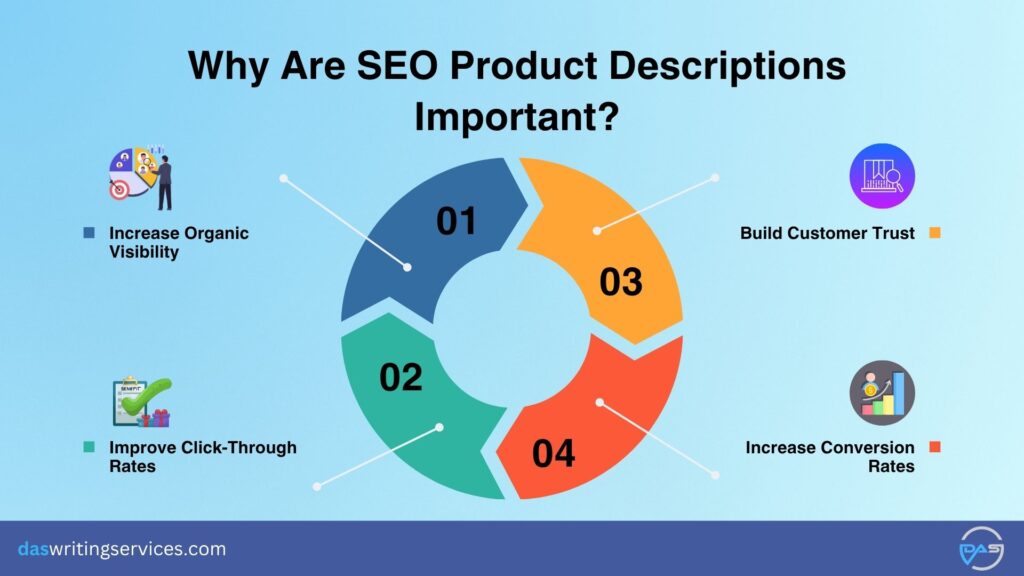
- Increase Organic Visibility
Search engines rely on page content to understand what your product offers. When descriptions naturally include relevant keywords and useful information, search engines can match your page with more search queries.
Instead of appearing for only one keyword, your page may rank for multiple related searches. For example, a backpack product page could rank for:
- Women’s hiking backpack
- Waterproof hiking backpack
- 45 litre trekking backpack
- Lightweight hiking backpack
Each additional ranking creates another opportunity to attract customers.
- Improve Click-Through Rates
Ranking on Google is only the first step. Your page title and meta description encourage users to click, but the quality of your overall product content also influences how search engines evaluate user satisfaction over time.
When shoppers consistently choose your listing and stay on the page, it sends positive engagement signals.
- Build Customer Trust
Customers hesitate when product information is incomplete or vague. According to a study by Salsify, 87% of consumers state that accurate, rich, and complete product content is a highly critical factor when making an online purchase decision.
These may include:
- Materials
- Size
- Weight
- Compatibility
- Usage
- Maintenance
- Warranty
- Delivery information
The more confidence customers have, the more likely they are to complete the purchase.
- Increase Conversion Rates
SEO brings visitors to your website. Strong copy convinces them to buy. A product description should explain why the product matters instead of simply describing what it is.
Customers purchase benefits rather than technical specifications. For example, “water resistant fabric” becomes far more persuasive when written as:
“The water-resistant fabric protects your belongings during unexpected rain while keeping the backpack lightweight for daily travel.”
How to Understand Search Intent Before Writing Product Descriptions?
Creating SEO optimised product descriptions is not just about adding keywords. It requires understanding your customers, using the right search terms, and presenting information in a way that helps both shoppers and search engines. Here are the key steps to follow.
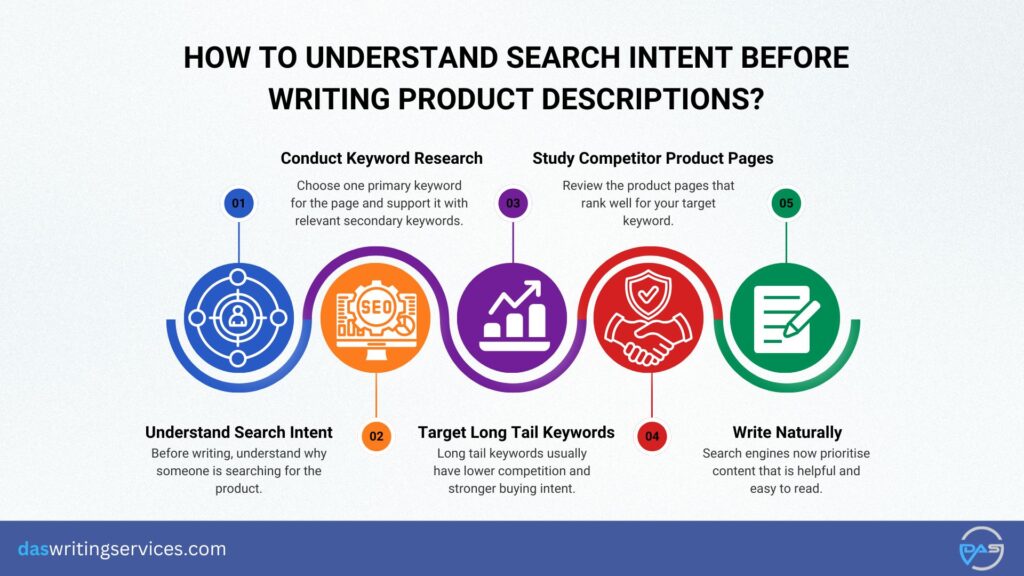
- Understand Search Intent
Before writing, understand why someone is searching for the product. Some users are comparing options, while others are ready to buy. Your description should answer their questions, explain the product’s value, and remove any doubts that may stop them from making a purchase.
- Conduct Keyword Research
Choose one primary keyword for the page and support it with relevant secondary keywords. Place these naturally in the title, headings, introduction, body content, meta tags, and image alt text. Focus on relevance and readability instead of repeating keywords unnecessarily.
- Target Long Tail Keywords
Long tail keywords usually have lower competition and stronger buying intent. Instead of targeting a broad term like laptop bag, optimise for a more specific phrase such as waterproof leather laptop bag for office travel.
- Study Competitor Product Pages
Review the product pages that rank well for your target keyword. Observe how they present features, explain benefits, answer common customer questions, and structure their content. Use these insights to create a more complete and valuable page rather than copying what others have written.
- Write Naturally
Search engines now prioritise content that is helpful and easy to read. Explain the product’s features and benefits in simple language, keep paragraphs concise, and use keywords only where they fit naturally. This improves both search visibility and the overall shopping experience.
How to Write SEO Optimised Product Descriptions That Convert?
An effective product description does more than describe a product. It helps shoppers make confident buying decisions while providing search engines with enough context to rank the page.
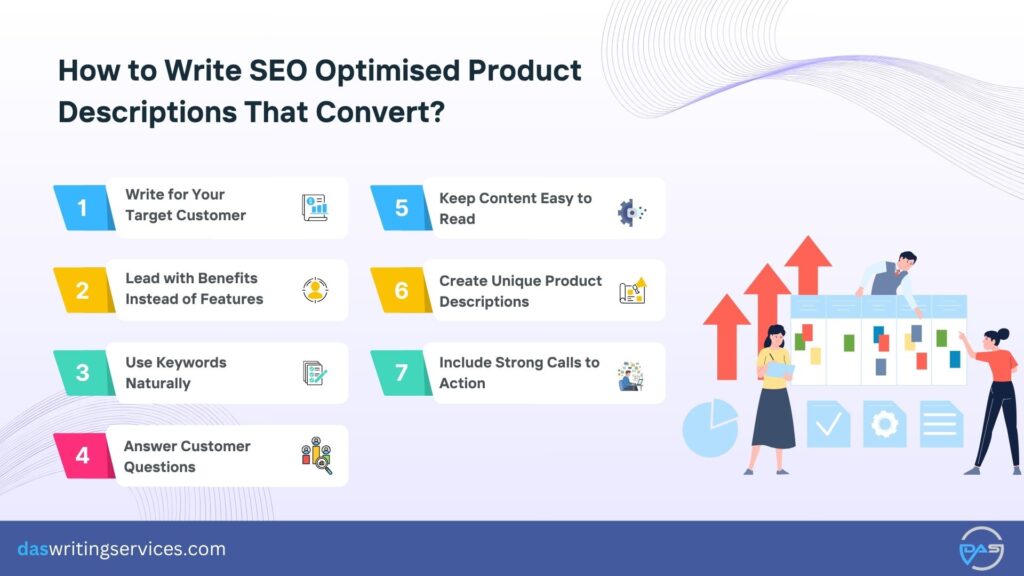
- Write for Your Target Customer
Start by identifying who the product is designed for. Different buyers have different priorities, so your content should address their specific needs and expectations.
Use language that resonates with your audience, highlight the benefits they value most, and answer the questions they are likely to ask.
- Lead with Benefits Instead of Features
Product features explain what an item has, but benefits explain why those features matter. Instead of only listing specifications, show how they improve the customer’s experience or solve a problem.
For example, rather than mentioning a waterproof fabric, explain that it keeps belongings safe during unexpected rain.
- Use Keywords Naturally
Keywords are essential for SEO, but they should fit naturally into your content. Include your primary keyword in important areas such as the title, headings, introduction, and body, while using secondary keywords where relevant.
Avoid repeating the same phrase excessively, as modern search engines reward helpful, readable content over keyword stuffing.
- Answer Customer Questions
A good product description removes buying hesitation by addressing common customer concerns. Include details about the product’s purpose, materials, size, compatibility, usage, or maintenance whenever relevant.
When shoppers quickly find the information they need, they are more likely to trust your brand and complete their purchase.
- Keep Content Easy to Read
According to an analytical study by Salsify, product listings that utilise well-structured, scannable bullet points successfully outrank their competitors 51% of the time.
Use short paragraphs, descriptive headings, bullet points where necessary, and simple language to improve readability.
Present the most important information first so visitors can understand the product quickly without searching through large blocks of text.
- Create Unique Product Descriptions
Avoid using the same manufacturer description across multiple websites or repeating identical content for similar products.
According to research by Reboot Online, a massive 92% of the lowest-performing eCommerce websites suffer from thin content issues, while duplicate content issues plague approximately 38% of eCommerce sites globally.
Original content also allows you to highlight your brand’s expertise and communicate your unique selling points.
- Include Strong Calls to Action
End every product description with a clear and persuasive call to action.
Encourage customers to take the next step by using action-oriented phrases such as Buy Now, Add to Cart, or Order Today.
A strong CTA creates urgency, guides users through the buying journey, and helps improve conversion rates.
What are the Best Practices of Technical SEO for Product Pages?
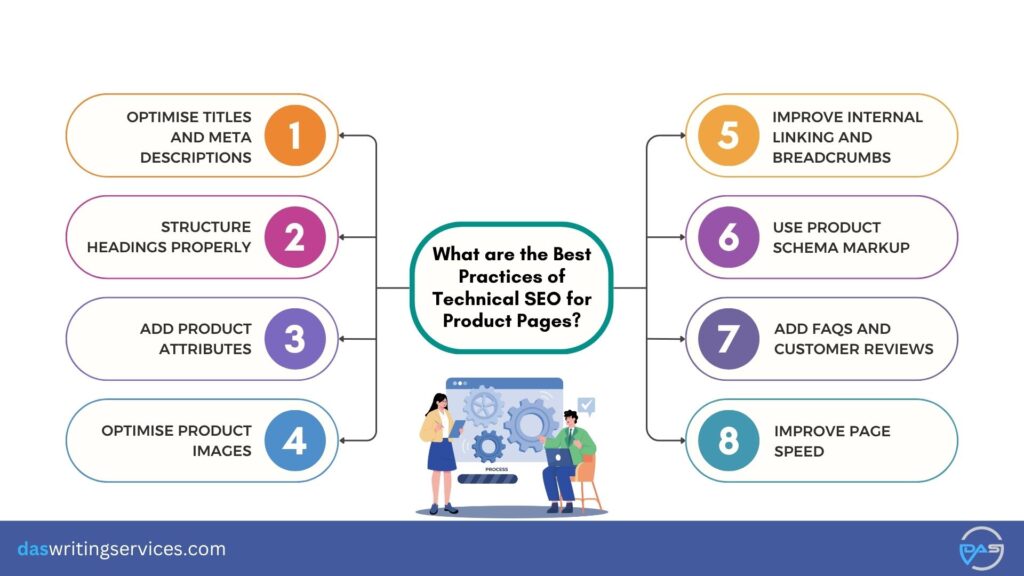
Writing SEO friendly product descriptions is only one part of product page optimisation. Technical SEO ensures search engines can understand, index, and display your pages correctly.
- Optimise Titles and Meta Descriptions
Every product page should have a unique title tag and meta description. Place the primary keyword near the beginning of the title, include important product details like brand or model, and write a compelling meta description that encourages clicks.
- Structure Headings Properly
Use only one H1 heading for the product name. Organise the rest of the content with H2 and H3 headings for sections such as features, specifications, reviews, and FAQs.
A clear heading hierarchy improves readability and helps search engines understand the page structure.
- Add Product Attributes
Include important product details such as brand, SKU, GTIN, model number, size, colour, material, and technical specifications.
These attributes help search engines understand the product while allowing your page to rank for more specific, high-intent search queries.
- Optimise Product Images
Use descriptive file names that include relevant keywords instead of generic names. Add meaningful alt text that explains the image naturally, compress files for faster loading, and use modern formats like WebP.
According to statistics tracked by ConvertCart, using product demonstration videos on your product detail pages (PDPs) directly influences the purchasing decisions of 64% of shoppers. Additionally, 74% of users who watch an explainer video on a product page subsequently make a purchase.
- Improve Internal Linking and Breadcrumbs
Link products to relevant categories, brands, collections, and related products to strengthen your internal linking structure.
Add breadcrumb navigation so users and search engines understand the site’s hierarchy. This improves navigation, distributes authority, and supports better crawling.
- Use Product Schema Markup
Implement Product schema markup to help search engines understand details like price, availability, ratings, brand, and SKU.
Proper structured data can generate rich results in search, making product listings more attractive and improving click-through rates.
According to Semrush’s analysis of over 3.2 million SERPs, listings featuring schema markup achieve an average of 58.3% higher click-through rates (CTR).
- Add FAQs and Customer Reviews
Include FAQs that answer common buyer questions and encourage genuine customer reviews. These sections add fresh, helpful content while addressing purchase concerns. Where applicable, use FAQ and Review schema to improve search visibility and increase trust with potential buyers.
- Improve Page Speed
According to performance data published by Queue-it, the peak converting eCommerce pages sit in a 1 to 2-second load window, achieving average conversion rates of 3.05%.
According to ConvertCart, for every additional second your product page takes to load, your conversion rate drops by 0.3%.
According to mobile site speed studies by Queue-it, making just a 0.1-second improvement to your mobile site’s loading speed yields an average 8.4% increase in retail conversion rates.
SEO Product Description Examples
The best way to understand SEO product descriptions is by comparing weak copy with optimised versions.
Effective descriptions naturally include relevant keywords, highlight customer benefits, and make products easier for both shoppers and search engines to understand. Here are a few practical examples.
- Poor vs Optimised Example
Poor Example: Blue stainless steel water bottle. High-quality bottle. Durable and lightweight. Buy now.
SEO Optimised Example:
Stay hydrated with this 1 litre stainless steel water bottle featuring double wall insulation that keeps drinks cold for 24 hours. The leak-proof design makes it ideal for travel, gym, and outdoor use. Shop the insulated stainless steel water bottle today.
- Fashion Product Example:
Poor: Women’s cotton shirt available in different sizes.
SEO Optimised: Women’s slim fit cotton shirt made from breathable fabric for all-day comfort. Available in multiple colours and sizes, this casual cotton shirt pairs easily with jeans, skirts, or formal trousers for everyday wear.
- Electronics Product Example:
Poor: Wireless earbuds with good sound quality.
SEO Optimised: Wireless Bluetooth earbuds with active noise cancellation, 30-hour battery life, and fast USB-C charging. Enjoy crystal clear calls, immersive sound, and a secure fit for work, travel, and daily workouts.
- Home and Kitchen Product Example:
Poor: Non-stick frying pan for cooking.
SEO Optimised: Cook healthy meals with this non-stick frying pan featuring a durable scratch-resistant coating and ergonomic heat-resistant handle. Suitable for gas and induction cooktops, it delivers even heat distribution for everyday cooking.
Conclusion
SEO for product descriptions is about creating content that helps both search engines and shoppers understand the value of a product.
By focusing on search intent, using relevant keywords naturally, highlighting customer benefits, and providing complete product information, businesses can improve organic visibility while increasing conversions.
Combining unique, easy-to-read descriptions with technical SEO elements such as optimised meta tags, product schema, image optimisation, and internal linking further strengthens product page performance.
Regularly reviewing and updating product descriptions also helps maintain rankings as customer behaviour and search trends evolve.
A well-optimised product page not only attracts more qualified traffic but also builds trust, improves the shopping experience, and encourages more customers to complete their purchases.
Frequently Asked Questions:
How long should an SEO product description be?
Aim for 100 to 400 words. Simple products (like a t-shirt) need fewer words, while complex products (like a camera) need more. Focus on giving helpful information rather than just trying to hit a high word count.
What are the best practices for writing SEO product descriptions?
Write unique descriptions for every item instead of copying and pasting. Use the search terms your customers naturally use, focus on how the product benefits the buyer, and use short paragraphs and bullet points so the text is easy to read.
Do product descriptions directly improve Google rankings?
Not by themselves, but they play a big role. Good descriptions help Google understand what you are selling. When you combine them with a fast, easy-to-use website, your chances of ranking higher increase significantly.
Can AI generate SEO-optimised product descriptions?
Yes, AI is great for creating quick first drafts. However, you should always review and edit the text to ensure the details are accurate, it matches your brand’s voice, and it doesn’t sound robotic.
How often should SEO product descriptions be updated?
It is best to review them every few months. You should definitely update them if the product details or prices change, if you notice new search trends, or if you need to answer common questions your customers are asking.

Subhodip Das is the founder and CEO of Das Writing Services Pvt. Ltd. He has an experience of 12 years in the field of Digital Marketing and specialises in Content Writing and Marketing Strategies. He has worked with well-established organisations and startups helping them achieve increased Search Engine Rank visibility. If you want to grow your business online, you can reach out to him here.


