If you own a website, wouldn’t you want to get a top rank on the search engine results page? SEO, like a guiding star, can help content reach its maximum potential.
In 2026, most people will still rely on organic search results. Around 94% of all clicks go to non-sponsored results rather than ads.
SEO has also evolved beyond just ranking on page one. Today, it’s about creating content that works well for AI-generated answers and zero-click searches.
In many cases, users get what they need directly from the search results page without visiting a website at all.
On that note, in this article, we will discover the intricacies of search engine optimisation and learn all the proven strategies to ace the digital world. Let us get started!
What is Search Engine Optimisation (SEO)?
SEO is not as complicated as it seems to be. We will simplify it as much as possible and help you understand it better.
When asked what SEO is, it can be defined as a strategy that enhances the visibility of a web page on the Search Engine Results Page (SERP).
Its main motive is to improve your visibility on SERP by attracting website traffic that will end up becoming your customers.
Das Writing Services is the best content marketing company in India, where we provide content and SEO packages at an affordable price. Get started with us just by dropping an email at business@daswritingservices.com.
What are the Types of SEO?
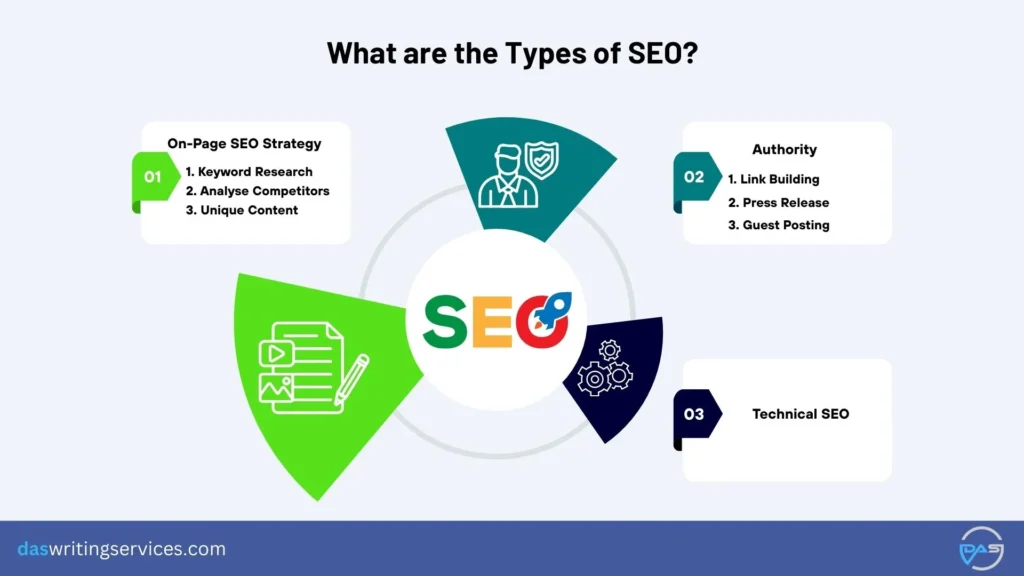
On-page, off-page SEO, and Technical SEO are the three types of search engine optimisation.
On-page SEO deals with anything visible on your webpage. Off-page involves anything that does not directly take place on your web page but ultimately aims to help with your strategy of SEO. Technical SEO, a bit different from these, deals with technical elements such as site speed, user experience, crawlability, and indexing.
A content writer should primarily be aware of the nuances of on and off-page SEO strategies. Before it gets confusing, let us discuss them in detail.
1. On-Page SEO Strategy
On-page SEO is the way by which you can optimise content for both search engines and users. It is everything that you do on a webpage to boost your rankings. Here are some steps that you can implement in your SEO strategy.
In 2025, the most important on-page signals include search intent fulfilment, optimised meta elements, content depth, and relevance. Know more about content optimisation.
- Keyword Research
Finding relevant primary and secondary keywords is the foundation step of an SEO strategy.
Now, one of the easiest ways to find popular keywords is, of course, Google Ads. You can type a keyword into the search field of Google Ads and find out how many people are searching for it. The tool offers great keyword options based on what people are searching for.
Focus on long-tail keywords, which make up about 35% or more of total search traffic. Many modern platforms now integrate AI tools directly into keyword discovery to find queries missed by traditional tools.
You can check the competition and search volume of these terms by using keyword tools like Semrush and Ahrefs as well.
- Analyse Your Competitors
Identifying and analysing your competitors is important in creating a successful SEO strategy.
It makes you understand who your target audience is and their needs and preferences. It also helps you to understand the behaviour, strengths, and weaknesses of your competitors.
Tools like Semrush can save you time in this case. If you type in your URL after clicking on the ‘Domain Overview’, a list of competitor websites will pop up that are targeting a similar audience group as you are.
Once the competitors are identified, you can proceed to identify their keywords you would want to compete with.
For instance, if your competitors are ranking higher for a high-volume topic, you can analyse that it is not just the keywords but content structure, readability, and user intent that matter most.
- Create Unique Content
If you want your content to stand out, there are two things that you can do: write something bigger or write something different.
Unique content makes a customer want to read it, as everyone likes the taste of freshness. If your content does not add much value, it will be difficult to retain the audience. In addition, publishing original content will help you improve Domain Authority.
Longer, in-depth content (e.g., 3,000+ words) tends to earn roughly 3x more traffic and 4x more backlinks compared to shorter content.
Take suggestions from your competitors. However, focus on creating something different, as nothing beats the power of good content.
Now that we have a fair idea of what an on-page SEO strategy is, it is time to learn about off-page strategies. Let us discuss some off-page search engine optimisation techniques that can drive organic traffic and improve domain authority.
2. Off-page SEO Strategy
Off-page SEO strategy is when you make efforts to boost a website’s search engine ranking without making visible changes on the website itself. Some of the common strategies include link building, press releases, and guest posting.
- Link Building
It is the practice of making other websites link to your site or build one-way hyperlinks. These links are also known as backlinks.
The more backlinks a domain has, the more authoritative Google considers it. In addition, it also improves search engine visibility to a great extent.
Some popular link-building strategies include public relations, content marketing, broken link-building, and so on. Know about the content marketing cost in India in detail.
In 2026, you need to spread backlinks across the web. About 95% of webpages have no backlinks at all.
This makes strong link-building strategies even more valuable, as websites with quality backlinks stand out easily and gain a clear competitive edge.
- Press Release
These are articles that you submit to different media channels and news outlets regarding new items or services that your firm offers.
Here, the articles should be keyword-optimised, informative, and engaging. It not only helps you promote brand awareness but also comes to the public’s attention and allows a growth marketing opportunity for your business.
Press releases can be used for a lot of occasions, like informing the public about a new venture inauguration, winning a prestigious award, and so on.
In recent years, many brands have successfully used SEO-optimised press releases for product launches and survival-marketing campaigns. Thus, they are earning high-authority links from news sites that improve both visibility and traffic.
- Guest Posting
Guest posting involves publishing articles on someone else’s website to reach a wider group of audience. It is an efficient way of link-building and improving search engine ranking.
While making guest posts, it is important to ensure that you’re publishing content on websites that are similar to your niche. Additionally, you must focus on creating value through your content.
Many guest posting sites are available to you for free. All you need to do is select the one that serves your purpose and use this off-page strategy to its ultimate potential.
Quality and relevance are now critical. A Semrush report also shows that 67% of businesses have already adopted AI for content marketing, and 78% of them are happy with the outcomes.
3. Technical SEO
Technical SEO improves backend elements to help search engines crawl and index pages correctly. It also improves user experience.
In 2025, it carried about 12% – 15% direct ranking weight and added over 25% impact through user signals. Mobile-first indexing is now standard and nearly 70% of global traffic comes from mobile devices.
- Pages loading for more than 3 seconds lose 53% of visitors, while optimised sites see up to 2.5x higher conversions.
- Structured data powers 84% of rich results and appears in 17% of AI Overviews.
- Product schema can improve click-through rates by 12%-30%. Core Web Vitals remain critical ranking factors.
- LCP under 2.5 seconds reduces bounce by 24%. INP under 200 milliseconds boosts conversions by 35%.
- CLS under 0.1 prevents 19% accidental clicks. Track results using PageSpeed Insights and Search Console.
A strong technical foundation combined with quality content can deliver 40%-60% better SERP performance.
Takeaway
It is safe to assume that you now have a strong grasp of modern SEO in 2026. Long-tail keywords now drive over 35% of traffic, and in-depth 3,000+ word content can generate up to 3x more traffic.
On the other hand, quality backlinks matter more than ever when and Core Web Vitals alone can lift conversions by 35%.
SEO will keep evolving. Staying consistent with publishing, building topical authority, using structured data, and tracking performance is essential.
As Bruce Clay rightly said, “SEO will only be done when Google stops changing things and all your competition dies.”Looking for well-researched and authoritative content for your brand? Contact Das Writing Services, where we deliver content writing services to hundreds of small to large companies. Start with a free sample for your brand.

Subhodip Das is the founder and CEO of Das Writing Services Pvt. Ltd. He has an experience of 12 years in the field of Digital Marketing and specialises in Content Writing and Marketing Strategies. He has worked with well-established organisations and startups helping them achieve increased Search Engine Rank visibility. If you want to grow your business online, you can reach out to him here.
Leave a comment
All comments
Ankit Kumar Nath
Very helpful!
Ahana Mukhopadhyay
This is quite an insightful blog I must say! Bookmarked for future reference 👍