The content marketing landscape is changing in 2026 with the rise of Generative Engine Optimization (GEO). After years of focusing on traditional Search Engine Optimization (SEO), search marketers are adapting to a new reality.
Over half of Google searches (58.5%) now end without a click, and AI-generated responses are appearing in almost half (47%) of queries. While SEO is not obsolete, it now needs to work together with GEO.
GEO tools platforms like Perplexity and Google’s AI Mode are fundamentally changing how users discover information. Today, GEO is much more than just another optimization trick. If traditional SEO boosts visibility in regular search results, GEO ensures your content appears in AI-generated responses.
From this blog about SEO vs GEO, you will understand how they work, GEO optimization techniques and future trends.
What is Search Engine Optimization (SEO)?
SEO is the process of improving a website’s visibility on search engines like Google, Bing, and Yahoo. It involves optimizing content, technical setup, and authority signals to achieve higher rankings in search engine results pages (SERPs).
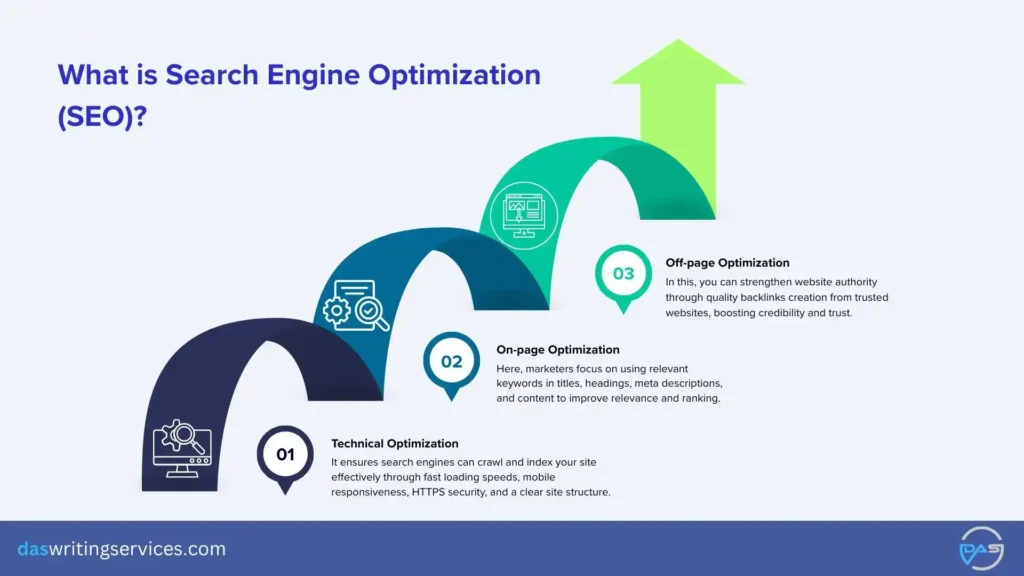
Traditional SEO is built on three main pillars:
- Technical Optimization: It ensures search engines can crawl and index your site effectively through fast loading speeds, mobile responsiveness, HTTPS security, and a clear site structure.
- On-page Optimization: Here, marketers focus on using relevant keywords in titles, headings, meta descriptions, and content to improve relevance and ranking.
- Off-page Optimization: In this, you can strengthen website authority through quality backlinks creation from trusted websites, boosting credibility and trust.
You can measure SEO performance using metrics such as keyword rankings, organic traffic, CTR, bounce rate, and conversions. The ultimate goal is to attract qualified visitors and drive engagement, achieved by ranking on the top three results.
Ready to dominate both traditional search and AI-powered discovery? At Das Writing Services, we craft SEO and GEO-optimized content that ranks on Google while getting cited by AI platforms. Contact us now!

What is Generative Engine Optimization (GEO)?
GEO focuses on optimizing content to appear in AI search results/answers from platforms like ChatGPT, Google AI Overviews, Perplexity, etc. As reported in August, the market share of generative engines continues to rise, catering to more than 8% of all online searches.
Also Read: How to Adapt to AI Overview in Content Marketing?
GEO marks a major shift from ranking on search pages to becoming part of the AI’s direct answer. When users ask questions, AI systems pull data from multiple sources to generate detailed, click-free responses.
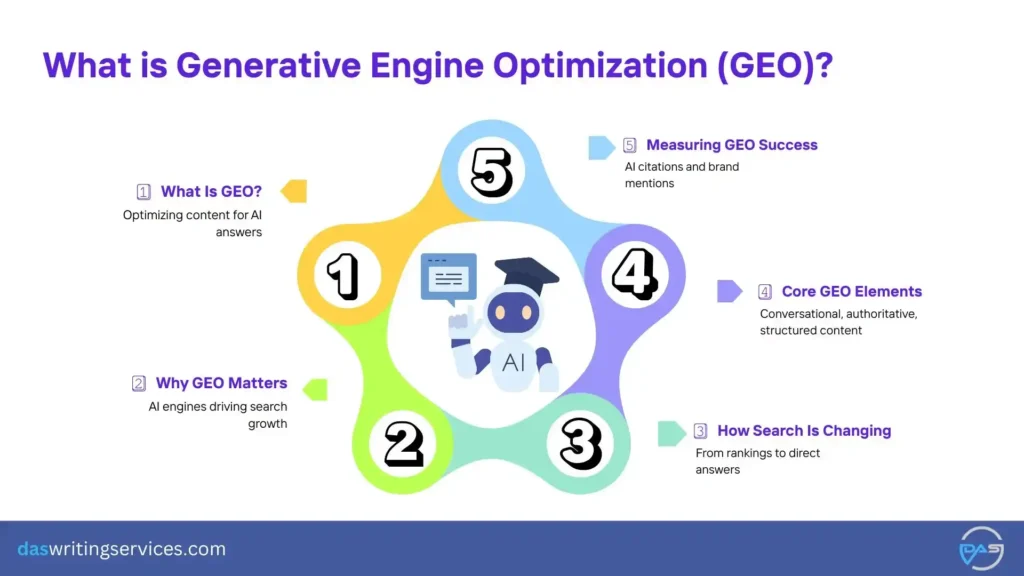
Core elements of GEO include:
- Conversational content aligned with natural language and user intent.
- Authoritative sourcing using credible data, citations, and expert insights.
- Structured formatting with headings, FAQs, schema, and clear sections for easy AI extraction.
GEO success is measured through citation frequency, brand mentions, and share of voice across AI platforms, boosting visibility in AI responses.
Key Differences Between SEO and GEO Marketers Need to Know
The key difference is that SEO depends on ranking signals to decide a page’s position in search results, whereas GEO focuses on the quality and organisation of information.
Let’s understand the difference between SEO and GEO:
| Aspect | SEO (Search Engine Optimization) | GEO (Generative Engine Optimization) |
| Main Purpose | Rank higher on traditional search engine results pages (SERPs). | Be mentioned, cited, or quoted in AI-generated answers. |
| Where It Works | Google, Bing, Yahoo, DuckDuckGo. | ChatGPT, Perplexity, Google AI Overviews, Copilot, Gemini. |
| Type of Queries | Short, keyword-based search phrases. | Conversational questions and prompts. |
| Optimization Focus | Meta tags, titles, keyword placement, and internal linking. | Verified data, schema markup, conversational tone, and supporting statistics or quotes. |
| Content Structure | Smooth narrative flow with keyword integration. | Self-contained sections with clear headings and FAQ-style formatting. |
| Traffic Outcome | Aims to drive visitors to your website. | Provides information directly inside AI platforms. |
| Link or Citation Strategy | Builds backlinks from trusted websites to increase authority. | Relies on credible sources and transparent citations to boost trust. |
| Update Importance | Frequent updates can improve rankings. | Fresh and reliable content helps AI engines prefer your material. |
| Keyword Usage | Strategic keyword placement throughout content. | Uses natural, human-like language that reflects real questions and solutions. |
| Citation Value | Backlinks carry more weight than content citations. | Citations and source credibility are key ranking signals. |
How Traditional SEO Works?
Traditional Search Engine Optimization works through three main stages: Crawling, Indexing, and Ranking.
- In the crawling stage, search engine bots explore the web, discovering new pages by following links.
- During indexing, the gathered content is analysed and stored in a massive database, making it retrievable for future searches.
- Finally, in the ranking stage, search engines determine where a page appears in search results.
The ranking of your website in SEO depends on several factors, such as keyword relevance, backlink quality, etc.
Also, it depends on user experience signals like bounce rate and time on page, content depth, and technical performance, such as site speed and mobile-friendliness.
Transform your website’s presence with content built for the future of search. We specialise in creating high-quality, well-researched articles, blogs, and web pages optimized for both search engines and generative AI platforms.
How AI-Driven GEO Works?
GEO helps your content stand out to AI tools like ChatGPT or Google AI Overviews and works in four main steps.
- First, during content ingestion, AI systems gather information from the web through training or real-time searches.
- Next, in knowledge extraction, the AI identifies key facts, ideas, and relationships within your content.
- Then comes relevance assessment, where the AI selects the most accurate and helpful sources to answer user questions.
- Finally, in response generation, the AI combines this information to create an answer.
Content that is clear, well-organised, insightful, and authoritative has a higher chance of being referred to or included in AI-generated responses, even without a direct website reference.
How SEO and GEO Work Together?
SEO and GEO are not competing. They work together to boost your visibility across both traditional search engines and AI-powered platforms.
Research from Ahrefs shows that websites with strong SEO also perform better in generative search. For example, Wikipedia appears in 16.3% of ChatGPT mentions and 12.5% of Perplexity citations. This indicates that effective SEO and authority directly supports GEO success.
SEO builds the foundation that GEO depends on. Before AI tools can reference your content, search engines need to find, index, and trust it. Core SEO practices like having a well-structured website, fast-loading pages, and strong domain authority are essential for both traditional and AI-driven visibility.
Both SEO vs GEO prefer quality content that demonstrates Experience, Expertise, Authoritativeness, and Trust (E-E-A-T). By showing author credentials, using proper citations, and sharing expert insights, you can improve your rankings and increase the chances of Ai citations.
Also Read: What Is Answer Engine Optimization
The most effective approach is keeping proper SEO optimization while adding GEO techniques for conversational queries and AI-friendly content. This combined strategy ensures your brand is discoverable everywhere people search.
GEO Optimization Tips and Techniques You Can Follow
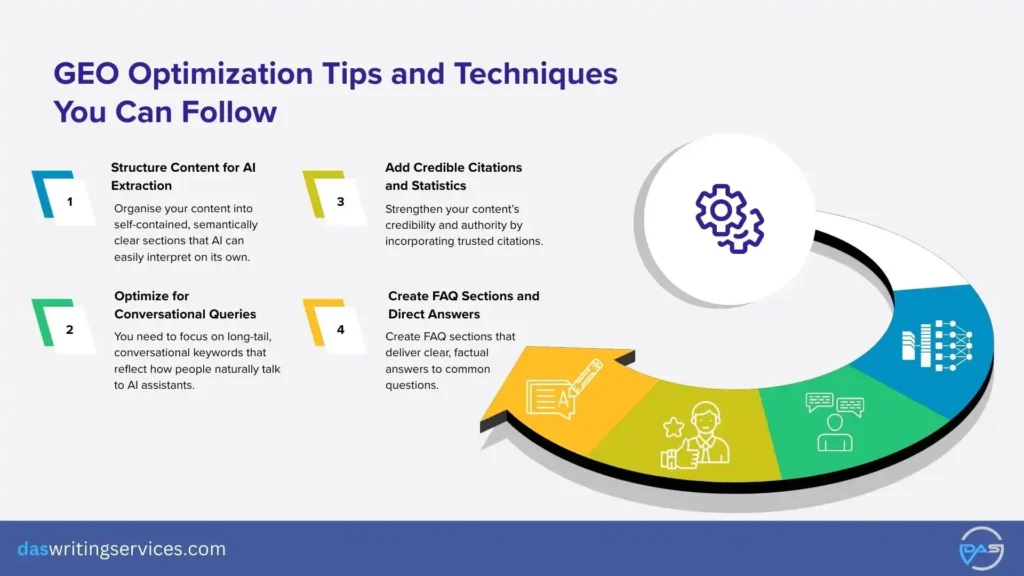
- Structure Content for AI Extraction
Organise your content into self-contained, semantically clear sections that AI can easily interpret on its own. Each passage should focus on one distinct idea and use descriptive H2 and H3 headings that mirror how people naturally phrase queries.
Make sure every section stands independently, without needing context from other parts. This helps AI systems extract and understand information accurately across search and conversational platforms.
- Optimize for Conversational Queries
You need to focus on long-tail, conversational keywords that reflect how people naturally talk to AI assistants. Rather than optimizing for short, generic terms like “garage door repair,” use natural, question-based phrases such as “how to fix a garage door that will not open.”
Leverage platforms like Quora and Reddit to uncover real user language and search behaviour to ensure your content aligns with authentic, intent-driven conversations.
- Add Credible Citations and Statistics
Strengthen your content’s credibility and authority by incorporating trusted citations, up-to-date statistics, and expert insights. Studies indicate that referencing reputable sources can boost visibility in AI-generated results by up to 40%.
Link to industry reports, academic studies, and government publications, and include clear author bylines to build trust and increase the chances of your content being cited by AI systems.
- Create FAQ Sections and Direct Answers
Create FAQ sections that deliver clear, factual answers to common questions. Keep each response concise, under 300 characters and focus on objective facts rather than opinions.
Start answers with context-rich keywords like price, risk, timeline, or ROI to help AI systems quickly recognise, categorise, and extract relevant information.
Visibility is the actual success. Make sure your brand is seen everywhere. Our team at DWS understands the difference between SEO vs GEO. Get content that works for both your brand.
Future Trends of SEO and GEO
The search landscape is rapidly evolving, and beyond 2026, your brand’s online success will depend on mastering both traditional SEO and GEO. Emerging trends include
- Multi-modal search, where users find content through text, voice, images, and video. Additionally, platform-specific optimization for systems like ChatGPT, Perplexity, Gemini, and Google AI Overviews is essential.
- Fresh, regularly updated content and personalised experiences will play a bigger role as AI models favour relevance and recency.
- The winning strategy is search everywhere optimization which ensures visibility across all platforms people use to discover information.
Brands that create useful, structured, expert-driven content will stand out to both humans and AI.
AI search will replace traditional SEO; it expands it. The key to future growth is integrating both approaches seamlessly.
Takeaway
Worried about– SEO vs GEO? The shift from SEO to GEO marks one of the biggest changes in digital marketing since Google’s inception. With AI-driven searches growing rapidly, optimization is no longer just about ranking on one platform.
Brands that combine both SEO and GEO strategies like conversational content and credible sources will lead in visibility.
The future of search is multi-platform, AI-powered, and focused on direct answers, not clicks. If you adapt early, you will gain the biggest advantage.
Frequently Asked Questions:
1. Is GEO replacing SEO?
No. GEO does not replace SEO. SEO is the foundation for visibility and authority, while GEO helps your content appear in AI-generated answers. To achieve the best results, you can combine both strategies.
2. Do I need GEO if I already have strong SEO?
Yes. Even top-ranking pages can miss out on AI exposure. As more searches are getting answered directly by AI overviews, GEO ensures your content stays visible.
3. What are the key GEO ranking factors?
Strong GEO performance depends on clear structure, credible citations, conversational tone, schema markup, and independent, fact-based sections. Adding citations and statistics can improve further visibility.
4. How can I measure GEO performance?
Track AI citations, brand mentions, and traffic from platforms like ChatGPT, Perplexity, and Google AI Overviews. Tools such as Semrush’s AI SEO Toolkit can help measure results.
5. Should I optimize differently for each AI platform?
Yes. Each AI tool uses different data and citation styles. ChatGPT summarises without sources, Perplexity highlights citations, etc.

Subhodip Das is the founder and CEO of Das Writing Services Pvt. Ltd. He has an experience of 12 years in the field of Digital Marketing and specialises in Content Writing and Marketing Strategies. He has worked with well-established organisations and startups helping them achieve increased Search Engine Rank visibility. If you want to grow your business online, you can reach out to him here.

Leave a comment