
Return on Investment (ROI) in digital marketing shows how much your business earns relative to its marketing spends.
Unlike traditional marketing, which often relies on rough estimates and high costs, digital marketing gives access to accurate audience targeting and flexible strategies. 83% of marketing leaders now consider showcasing ROI as their top priority, up from 68% five years ago. With digital marketing offering flexibility and precision ROI tracking, businesses can allocate marketing budget on specific channels that yield visible returns.
No matter the size of your business, whether you are a startup with a small budget or a large company aiming to grow faster, understanding the ROI of digital marketing is essential.
Want digital marketing solutions with proven ROI? Connect with our experts today!

Understanding Digital Marketing Return on Investment
Digital marketing return on investment is a key measure that shows how much money a business earns compared to what it spends on digital marketing.
It helps determine whether online marketing campaigns are making a profit or a loss, giving a clear picture of how effective the marketing efforts are. Only if the revenue from a campaign is higher than the amount spent, it means the campaign was successful.
Currently, just 36% of marketers are able to measure ROI accurately, underscoring the need for effective tracking systems. By tracking ROI, businesses can see which strategies are working, improve future campaigns, and decide where to invest their marketing budget for the best possible results.
How to Measure ROI in Digital Marketing?
To calculate your digital marketing ROI, first add up all your marketing expenses and determine the net profit made from the campaign.
Next, divide your net profit by the total marketing cost, then multiply the result by 100 to get your ROI percentage.
- ROI of Digital Marketing = (Net Profit / Total Digital Marketing Costs) X 100
This formula helps you clearly see how much you gained compared to what you spent, making it easier to measure the success of your marketing efforts.
Example:
Total digital marketing costs: ₹1,00,000, Revenue earned from digital channels: ₹6,00,000, Net Profit: ₹5,00,000 (calculated as revenue – total marketing costs)
Now, apply the ROI formula: (5,00,000 / 1,00,000) X 100 = 500%
The result is a digital marketing ROI of 500%.
Alternatively, you can express ROI as a ratio. To do this, divide your net profit by your total cost: (5,00,000 ÷ 1,00,000) = 5
So, your ROI of digital marketing ratio would be 5:1, meaning you earned ₹5 for every ₹1 spent on digital marketing.
Rank higher on search engines with our SEO-optimized, human-written content. Outsource content from our expert writers who craft quality blogs, articles, and website copy that drives qualified traffic to your business. Contact now!

KPIs to Measure Digital Marketing ROI
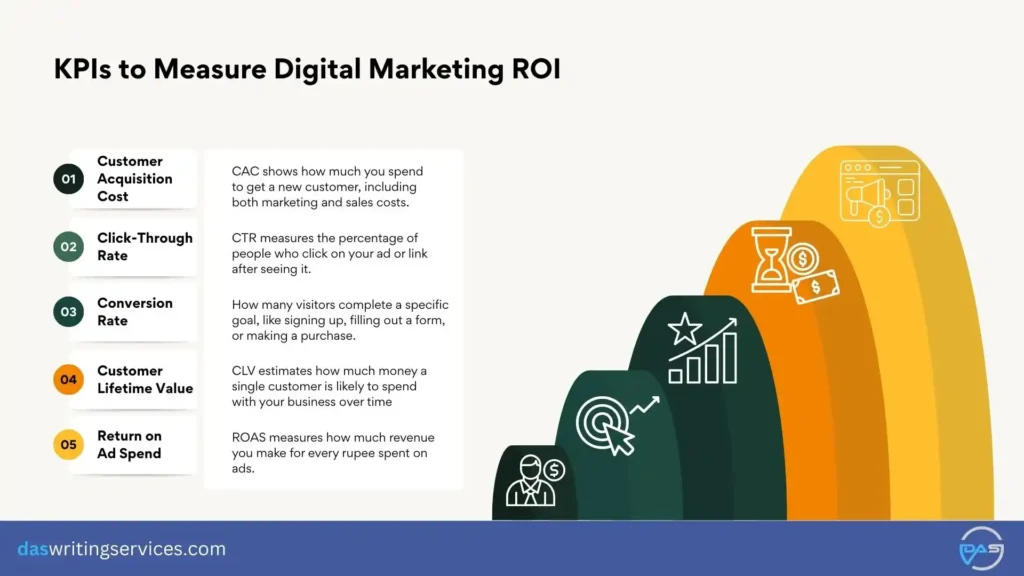
Measuring ROI in digital marketing means tracking key numbers that show how well your campaigns are performing. Here are five important metrics to keep an eye on:
1. Customer Acquisition Cost (CAC)
CAC shows how much you spend to get a new customer, including both marketing and sales costs. A lower CAC means your marketing is working efficiently and you are gaining customers at a lower cost.
Follow this formula to calculate your CAC,
Customer Acquisition Cost = Marketing + Sales Expense / Number of new customers acquired.
2. Click-Through Rate (CTR)
CTR measures the percentage of people who click on your ad or link after seeing it. A high CTR means your message is appealing and successfully encourages people to take action.
For example: For ads, 6% is the average CTR across industries. For commercial intent organic searches, the CTR can go up to 2-3% when a page is ranking between SERP #1-4.
3. Conversion Rate
This tells you how many visitors complete a specific goal, like signing up, filling out a form, or making a purchase. A higher conversion rate means more of your traffic is turning into convertible leads or sales.
For example: As per general standards, 2-3% is the average conversion rate for digital marketing. SaaS products tend to have more than 10% conversion rate due to their freemium subscription model.
4. Customer Lifetime Value (CLV)
CLV estimates how much money a single customer is likely to spend with your business over time. The higher your CLV, the more valuable your customers are. You can increase it by offering great products, service, and ongoing engagement.
To calculate, CLV = average transaction value x average transaction frequency x customer lifespan
5. Return on Ad Spend (ROAS)
ROAS measures how much revenue you make for every rupee spent on ads. A higher ROAS means your ad campaigns are more effective and delivering better returns.
To calculate, ROAS = (Revenue from Ads/Cost of Ads) X 100
Advantages of Calculating ROI of Digital Marketing
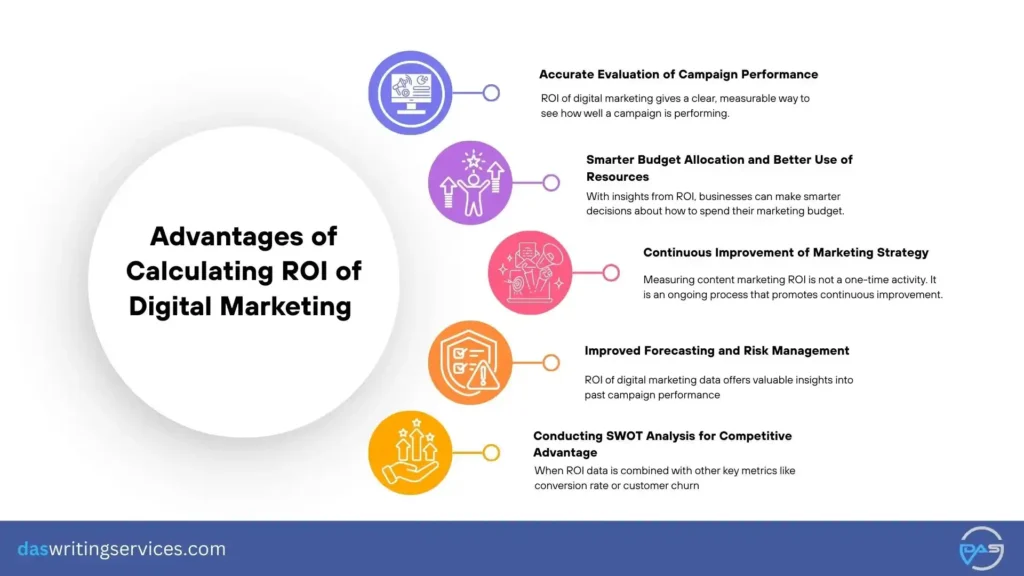
The benefits of measuring digital marketing ROI are wide-ranging and highly valuable for businesses. These are some key advantages:
1. Accurate Evaluation of Campaign Performance
ROI of digital marketing gives a clear, measurable way to see how well a campaign is performing. By comparing the ROI of different marketing activities, you can identify which strategies bring the best results and which ones need improvement or can be stopped. This helps optimise the overall marketing mix and focus on channels that generate the most profit.
2. Smarter Budget Allocation and Better Use of Resources
With insights from ROI, businesses can make smarter decisions about how to spend their marketing budget. By analysing which platforms or campaigns provide the best returns, you can increase investment in high-performing areas and cut down on wasteful spending. 64% of companies now use past ROI performance to guide future marketing budgets, ensuring every rupee is invested efficiently for maximum impact.
3. Continuous Improvement of Marketing Strategy
Measuring content marketing ROI is not a one-time activity. It is an ongoing process that promotes continuous improvement. By regularly tracking and analysing ROI, businesses can adjust their strategies, respond to market changes, and refine campaigns for better results. This ongoing optimisation keeps marketing efforts relevant and effective over time.
4. Improved Forecasting and Risk Management
ROI of digital marketing data offers valuable insights into past campaign performance, which helps businesses predict future results more accurately. It also assists in identifying potential risks by showing which marketing efforts may not perform as expected. This allows companies to plan, set realistic goals, and reduce financial risk.
5. Conducting SWOT Analysis for Competitive Advantage
When ROI data is combined with other key metrics like conversion rate or customer churn, it helps perform a detailed SWOT analysis (Strengths, Weaknesses, Opportunities, and Threats). This enables businesses to understand what is working, fix weak areas, explore new opportunities, and stay ahead of competitors.
We deliver 100% human-written, fact-checked content by trained professionals who understand your industry. Every piece undergoes rigorous editing and SEO optimisation. Partner With Us for unique and effective content.
Challenges in Calculating Digital Marketing ROI
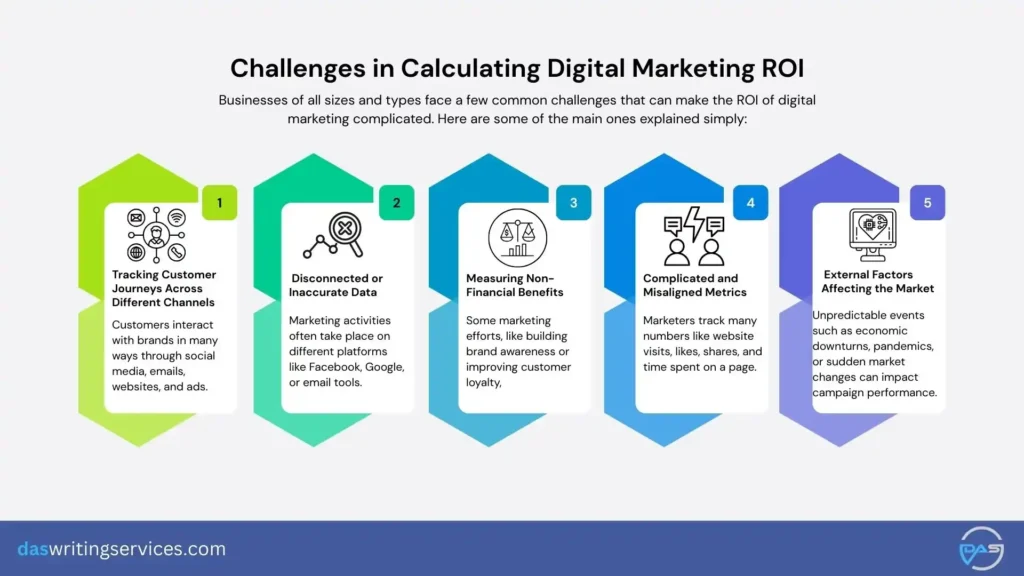
While calculating the ROI of marketing campaigns helps you plan your expenses sensibly, getting a clear picture of the ROI is not easy when you cannot track the customer lifecycle effectively.
Businesses of all sizes and types face a few common challenges that can make the ROI of digital marketing complicated. Here are some of the main ones explained simply:
1. Tracking Customer Journeys Across Different Channels
Customers interact with brands in many ways through social media, emails, websites, and ads. This makes it hard to know which specific interaction led to a sale. Some users also stay anonymous, making it even more difficult to measure ROI accurately. 47% of marketers find it challenging to measure ROI across multiple channels, making attribution more complex.
2. Disconnected or Inaccurate Data
Marketing activities often take place on different platforms like Facebook, Google, or email tools. When the data from these platforms is not connected, it is hard to see the complete performance of a campaign or calculate the real return on investment.
3. Measuring Non-Financial Benefits
Some marketing efforts, like building brand awareness or improving customer loyalty, do not immediately bring in money. While they are valuable for long-term success, it is hard to assign a clear financial value to these benefits when calculating the ROI of digital marketing.
4. Complicated and Misaligned Metrics
Marketers track many numbers like website visits, likes, shares, and time spent on a page. While these metrics are useful, they do not always show the full picture of ROI and can confuse if not aligned with business goals.
5. External Factors Affecting the Market
Unpredictable events such as economic downturns, pandemics, or sudden market changes can impact campaign performance. These external disruptions can make earlier ROI forecasts less reliable or completely outdated.
What is a Good Digital Marketing ROI?
A good marketing ROI is generally around a 5:1 ratio, meaning you earn ₹5 for every ₹1 spent.
An ROI of 2:1 is only slightly profitable once you factor in other business costs like salaries or rent, while an ROI of 10:1 is outstanding.
However, what counts as a “good” ROI can vary depending on your industry, competition, and goals. Some sectors require bigger budgets to stand out.
In short, ROI is an important measure of success, but it should not be the only one. Focus on your overall goals and key performance indicators (KPIs) to get a complete picture of your marketing performance.
Proven Strategies to Improve Your Digital Marketing ROI
Here are seven simple but powerful digital marketing strategies that can help you get better results and higher returns:
1. Targeted Advertising
Focus your ads on specific groups of people based on their age, interests, or online behaviour. Using data and insights helps you show the right message to the right audience, leading to more clicks and sales.
2. Content Marketing
Create helpful and engaging content that solves your audience’s problems or answers their questions. Content marketing builds trust, increases brand visibility, and attracts more visitors to your website naturally.
3. Search Engine Optimization (SEO)
Use smart keyword research, strong on-page content, and quality backlinks to make your website rank higher on Google and other search engines. Better rankings bring in more free traffic and potential customers.
4. Email Marketing
Send personalised emails to different groups of your audience. Targeted email campaigns help build relationships, encourage repeat purchases, and keep customers engaged with your brand.
5. Social Media Marketing
Use a mix of organic posts and paid ads on social media platforms to connect with your audience. This strengthens brand loyalty, encourages interaction, and drives more visitors to your website.
6. Conversion Rate Optimization (CRO)
Improve your website’s design, layout, and call-to-action buttons by testing different versions (A/B testing) and studying user behaviour. This helps turn more visitors into actual customers.
7. Mobile Optimization
Make sure your website looks and works great on mobile phones and tablets. A smooth mobile experience keeps visitors on your site longer and increases your conversion.
Takeaway
Measuring and tracking the ROI of digital marketing is crucial for your brand’s online success. Without it, companies risk wasting time and money on campaigns that do not deliver results.
Monitoring digital marketing ROI and key metrics lets you quickly adjust underperforming strategies and invest in what works best. Improving ROI starts with high-quality content that connects with your audience.
Frequently Asked Questions:
1. What are the disadvantages of digital marketing?
Digital marketing rapidly changes across platforms, has fierce competition from global brands, accurately measuring ROI is difficult, and a constant need for mobile optimisation to remain competitive.
2. Which digital marketing has the highest ROI?
Smart Insights reports that email marketing delivers one of the highest returns on investment, generating USD 40 in revenue for every USD 1 spent. In contrast, SEO yields an ROI of USD 22.24, while mobile marketing achieves USD 10.51.
3. Is AI replacing digital marketing?
AI will not reduce digital marketing. Instead, AI is revolutionising the marketing landscape, making it more dynamic and engaging. It serves as a powerful ally that enhances speed and efficiency. Today, marketing teams frequently work hand-in-hand with AI-driven tools.
4. Who is the richest digital marketer?
Neil Patel is widely recognised as one of the most successful and influential figures in the digital marketing world. His remarkable achievements demonstrate that with the right knowledge, strategies, and skills, digital marketing can unlock endless opportunities.
5. Why is ROI important in digital marketing?
ROI shows how much money a company earns compared to what it spends on marketing. It measures how much profit your business makes from the money it invests in marketing.

Subhodip Das is the founder and CEO of Das Writing Services Pvt. Ltd. He has an experience of 12 years in the field of Digital Marketing and specialises in Content Writing and Marketing Strategies. He has worked with well-established organisations and startups helping them achieve increased Search Engine Rank visibility. If you want to grow your business online, you can reach out to him here.

Leave a comment