Ever looked at your screen and paused at the semicolon key, unsure if it will improve your sentence or ruin it? You are not alone.
Many writers either avoid it or use it too much, which makes writing confusing. This small mark may seem old or complicated, but it helps connect ideas in a smooth way without a full stop.
In this guide, you will learn what a semicolon is and how to use it in three main ways: to join sentences, to separate items in a list, and to link ideas with transitions. You will also see common mistakes and how to avoid them.
Clear examples and a simple cheat sheet will help you understand it easily. By the end, you will know when and why to use a semicolon and make your writing better with confidence. Let’s get started.
What Is a Semicolon? Understand the Definition
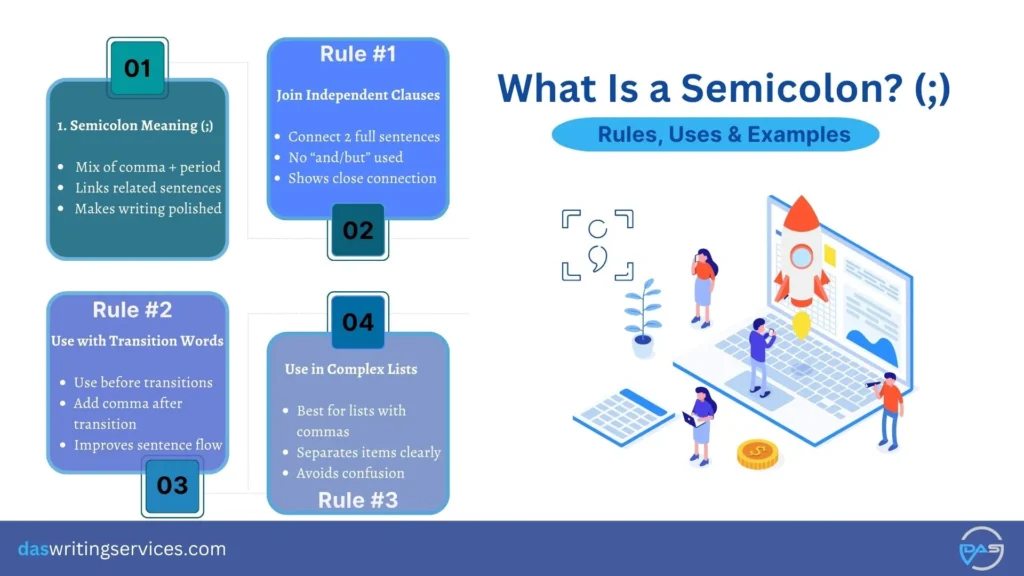
Think of a semicolon as a mix of a period and a comma: ; It sits between the two in strength. It is stronger than a comma, which shows a light connection, but softer than a period, which ends a thought, making it an important tool in professional article writing services.
A semicolon links two related sentences. Each part can stand on its own, but the semicolon keeps them together for a smoother flow.
It gives equal value to both ideas, like two parts of the same thought. For example: “I love coffee; it fuels my mornings.” This avoids comma errors and keeps the sentence clear and natural.
Its use has gone down in modern writing. Data from tools like the Google Ngram Viewer shows a drop of about 40% since 1980, based on style guides such as The Chicago Manual of Style.
Still, it has value today. In a world full of commas, a semicolon helps your writing stand out and look more polished.
Core Rule #1 – Independent Clauses
An independent clause is a complete sentence. It has a subject and a verb. For example, “The cat sleeps.” It makes sense on its own.
Rule: Use a semicolon to connect two related sentences. Do not add words like and, but, or.
Why use a semicolon instead of a period? A period separates ideas. A semicolon keeps them close and shows they are linked.
Do not use a comma here. That creates a comma error and can confuse the reader.
Examples:
- Wrong: I hiked the trail, it was muddy.
- Correct: I hiked the trail; it was muddy.
Another example: She aced the exam; her preparation paid off.
Quick test: Replace the semicolon with a period. If both parts still make full sentences, the semicolon is correct.
Note: Do not use a semicolon with words like and, but, or.
- Wrong: I went; and she stayed.
- Correct: I went; she stayed.
Use this rule well, and your writing will feel clear and smooth.
Do you know the Essential Skills For Every Professional Content Writer? Read our blog to learn more.
Core Rule #2 – Use Semicolons with Transition Words
Transition words connect ideas. Common examples are, however, therefore, moreover, nevertheless, indeed, as a result, and for example.
- Rule: Use a semicolon before the transition word and a comma after it when you join two full sentences.
- Pattern: [sentence]; transition word, [sentence]
Why this matters: A comma alone is not enough and creates an error.
Examples:
- Wrong: I wanted to go, however, it rained.
- Correct: I wanted to go; however, it rained.
More examples:
- She studied hard; therefore, she passed.
- The plan failed; nevertheless, we tried again.
- He loves hiking; for example, he climbs peaks every week.
Important note about “however”:
Do not use a semicolon if it sits inside one sentence and does not start a new one. In that case, use commas.
Example: Biking, however tiring, builds strength.
Always check the structure. If both sides are full sentences, use a semicolon. If not, use commas.
Core Rule #3 – Semicolons in Complex Lists
Lists can become hard to read when each item already has commas. This is where a semicolon helps. You can think of it as a stronger separator.
Rule: Use semicolons to separate items in a list when the items already include commas.
Example:
- Confusing: We will visit Paris, France, London, England, and Berlin, Germany.
- Clear: We will visit Paris, France; London, England; and Berlin, Germany.
The second version is easier to read because each place stands out clearly.
More examples:
- Product details: Choose apples, red and crisp; bananas, yellow and ripe; or oranges, juicy and sweet.
- Academic sources: Sources include Smith, 2020, on climate; Jones, 2021, on policy; and Lee, 2022, on tech.
Simple tip: If each item in a list has commas inside it, use semicolons to separate the items. This keeps your writing clear and easy to follow.
Semicolon Vs Colon: Do Not Confuse Them
Semicolons and colons may look similar, but they have different uses.
Quick comparison:
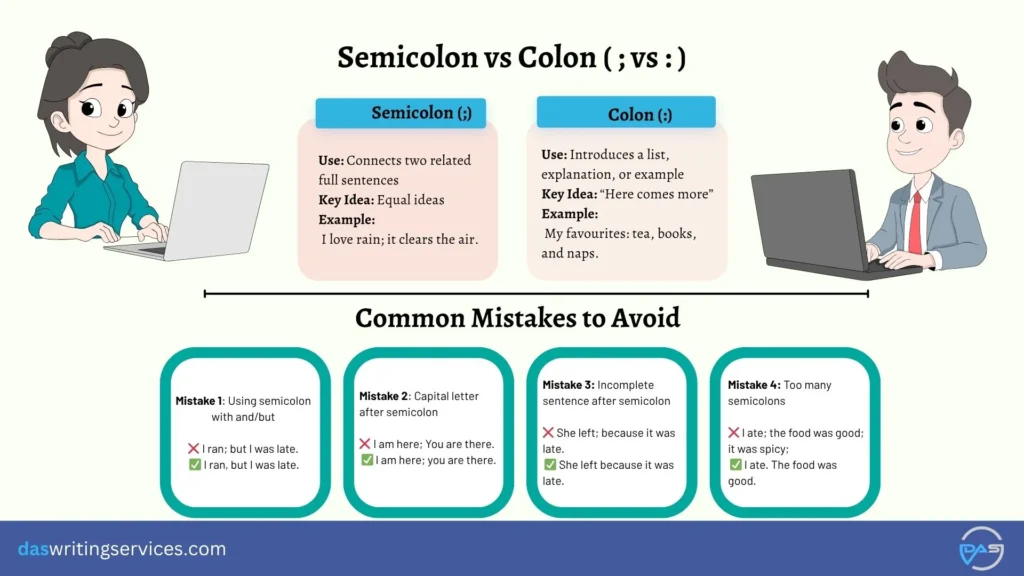
Semicolon (;)
- Use: Connects two related full sentences
- Example: I love rain; it clears the air.
Colon (:)
- Use: Introduces a list, explanation, or example
- Example: My favourites: tea, books, and naps.
Simple idea:
- A semicolon connects equal ideas.
- A colon introduces what comes next.
Common Mistakes and How To Avoid Them
Semicolons can confuse even skilled writers. Here are common errors and how to fix them.
Mistake 1: Semicolon with words like and, but, or
- Wrong: I ran; but I was late.
- Right: I ran, but I was late.
- Or: I ran; I was late.
Mistake 2: Capital letter after a semicolon
- Wrong: I am here; You are there.
- Right: I am here; you are there.
Use a small letter unless it is a proper noun.
Mistake 3: Semicolon with an incomplete sentence
- Wrong: She left; because it was late.
- Right: She left because it was late.
The part after the semicolon must be a full sentence.
Mistake 4: Too many semicolons
- Wrong: I ate; the food was good; it was spicy; I loved it.
- Right: I ate. The food was good. It was spicy, and I loved it.
Simple Tip:
Use the test. Replace the semicolon with a period. If both parts still make full sentences, it is correct. Always focus on clear and easy writing.
When Should You Use A Semicolon?
Semicolons work best in formal writing. Use them in academic papers, nonfiction, and business emails where clear links between ideas matter. They are useful in reports, too. Example: “Sales rose; profits followed.”
Be careful in casual writing like blogs, stories, or social media. In these cases, periods or dashes often feel more natural and easier to read.
Do not use a semicolon just to sound advanced. Use it only when it makes your sentence clearer. Use it less, and it will have more impact.
Ever tried to write a travel blog? Read our blog to know How to write a travelogue.
Quick Reference Cheat Sheet
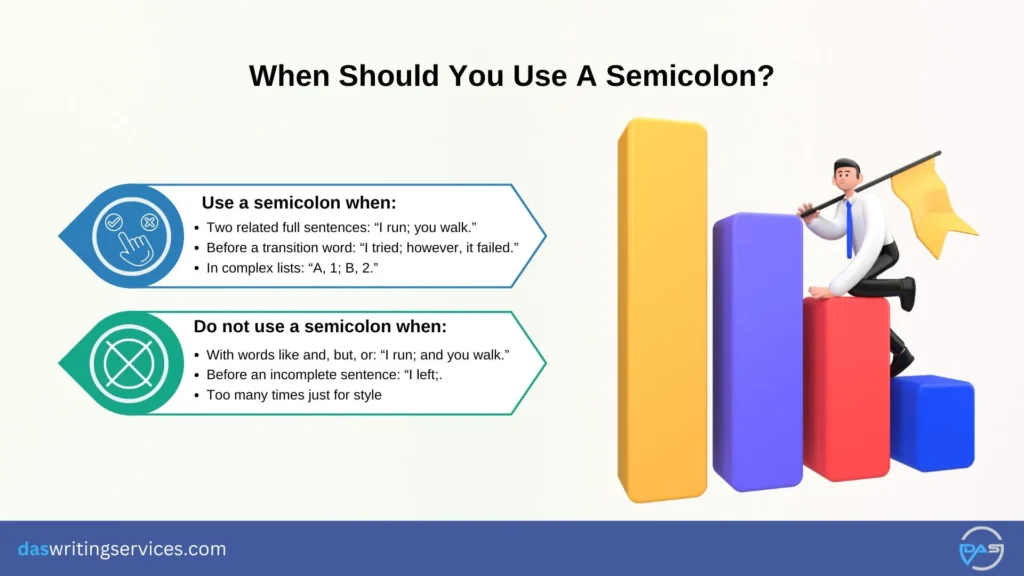
Use a semicolon when:
- Two related full sentences: “I run; you walk.”
- Before a transition word: “I tried; however, it failed.”
- In complex lists: “A, 1; B, 2.”
Do not use a semicolon when:
- With words like and, but, or: “I run; and you walk.”
- Before an incomplete sentence: “I left; because it rained.”
- Too many times just for style
How Das Writing Services Can Help in Professional Content Solutions
At Das Writing Services, we focus on delivering real impact through content. Our team tracks the clicks generated by each piece every month, so you see clear results from what we create.
We provide custom samples to match your exact needs before starting. Experienced professionals write every piece. We do not use AI or spam methods. This helps us maintain your brand voice with accuracy and consistency.
Our in-house team of writers, editors, and content architects works closely to create structured and meaningful content. With 14 years of experience, we have supported hundreds of brands in achieving measurable growth.
We create content that is optimised for both SEO and AEO. This helps to stay visible across search engines and AI platforms.
At the same time, we ensure clarity, correct grammar, and strong readability. This helps you communicate better, build trust, and present a professional brand image.
Final Takeaway on How to Use a Semicolon?
A semicolon is about writing with control. When you use it correctly, your ideas stay connected without becoming cluttered. It helps you guide the reader, which shows that two thoughts belong together while still giving each space to stand on its own.
Do not force it into every paragraph. Use it when clarity improves and when the connection between ideas truly matters.
Over time, it becomes less of a rule to remember and more of a tool you naturally apply to make your writing smoother and more precise.
If you want clear, structured, and professionally written content, we are here to help. Let us create impactful content that strengthens your brand voice and drives real results.

Subhodip Das is the founder and CEO of Das Writing Services Pvt. Ltd. He has an experience of 12 years in the field of Digital Marketing and specialises in Content Writing and Marketing Strategies. He has worked with well-established organisations and startups helping them achieve increased Search Engine Rank visibility. If you want to grow your business online, you can reach out to him here.

Leave a comment