A digital marketing strategy is an agenda driven long-term plan that wants to generate specific business outcomes such as site visits, lead generation and sales conversions. An optimized digital marketing plan not only boosts sales but also enhances a company’s brand reputation online and creates a buzz around the company.
Over the globe, digital marketing is popular for delivering consistent and measurable ROI. For instance, litmus’ State of Email Report 2025 notes an average email marketing ROI standing between 10x to 36x of the allocated budget for email marketing. Similarly, SEO continues to attract up to 32.9% new users to businesses and products.
Due to these concrete results, a robust digital marketing strategy continues to be an asset in a business’ journey to scale. In this blog, we are elaborating the framework to creating a solid marketing strategy for your online audience. Additionally, we will go deeper into some popular digital marketing channels that can help execute your plan.
Difference between Digital Marketing Plan & Strategy
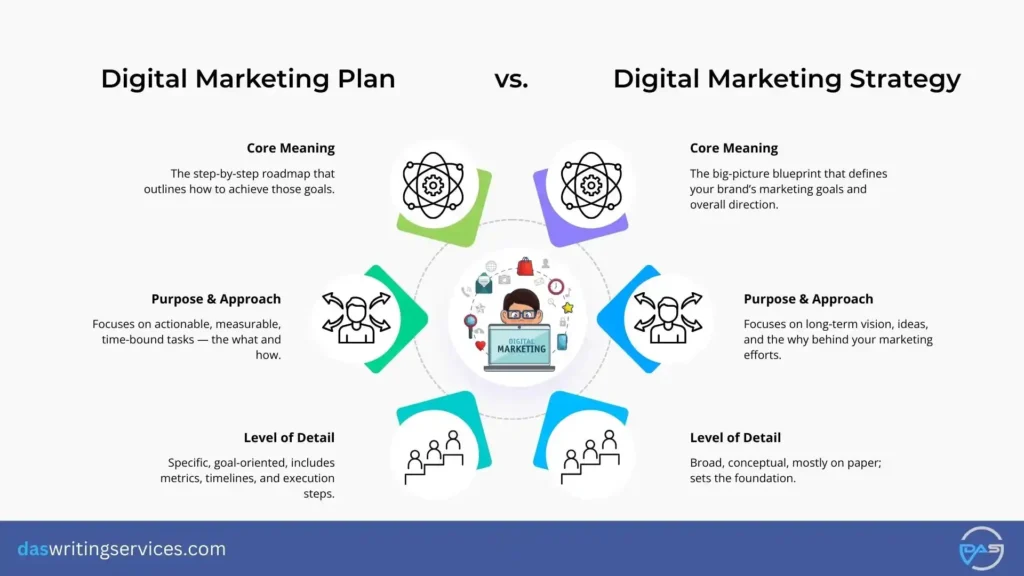
People often confuse between a digital marketing plan and digital marketing strategy. A marketing strategy is the blueprint of marketing objectives and tactics to secure desired outcome for your brand. It is overarching and mostly happens on paper.
Comparatively, a digital marketing plan is a general roadmap to secure specific, measurable, actionable, relevant and time-bound performance and outcome.
We can consider it this way, a digital marketing strategy is the general ideology, whereas a marketing plan is a specific goal oriented phenomenon.
Framework to Creating Digital Marketing Strategy with Example
We are going to proceed with this framework based on an example. Let’s consider a business by the name EcoSwig, a reusable drinkware brand creating tumblers, bottles and travel mugs out of recycled stainless steel. Some of the value propositions of this brand are its commitment to sustainable manufacturing and thermal insulated material.
Let’s see how we will create the digital marketing strategy for this company.
1. Analyze the Market: SWOT Analysis
Before actually creating a strategy we start at the foundation – by securing an understanding of the strengths and weakness of our business and the industry through the SWOT framework.
Strength: Homegrown brand, sustainability positioning
Weakness: Not affordable for everyone, demand is concentrated in specific target groups
Opportunities: Capturing the sustainability focused user group, tailored corporate branding strategy for bulk order
Threat: Established industry players, saturated market for stainless steel bottles, cheap knock-offs
2. Articulate the objectives: 5s (Sell, Serve, Sizzle, Speak, Save)
Conceptualized by Chaffey & Smith, this 5s model would help us lay down the objectives behind creating a digital marketing strategy for EcoSwig.
Sell: That is the final goal behind any marketing campaign. Yet the rest of the objectives have to be realized for the sell to happen.
Serve: The brand and its product placement should create a positive experience for the audience. The strategy must choose specific tools that contribute some value to the user. For instance, sustainable production and material is an essential feature of EcoSwig that complements sustainable lifestyle of users.
Sizzle: For our brand EcoSwig, the sizzle factor can be infused through flashy social media ads that highlight its multicolor variants.
Speak: Here we plan on engaging with different users through social media posts, survey, polls and feedbacks.
Save: One of the bigger objectives behind a robust digital marketing strategy is to reduce the CAC and CPA of the users.
3. Strategize & Plan: Segment User Groups as per Buyer Persona, Choose the Right Channels
Based on the SWOT analysis, we can neutralize the threats by addressing two of the Ss – serve and speak. Thereby, creating a strong brand voice around the company.
This will be a two-step process where in the first one we will categorize the prospective audience groups into two cohorts. Unisex consumers between age group 18-35. Secondly, we will be targeting the corporate buyers.
For the first user group, channels like social media ads, posts, eCommerce SEO and quick commerce marketing will be useful. The creative will highlight splashy colors, recycled material and contemporary style iconography to establish an aspirational brand.
For corporate and institutional bulk buyers, channels like SEO content creation, bulk order landing page optimization, email outreach and LinkedIn ads will be appropriate marketing solution. The messaging will be a bit different, highlighting commitment to sustainability, tailored branding solutions and custom quotations for seasonal bulk orders.
4. Delegate & Distribute Roles & Responsibilities
Having determined the marketing objectives, user groups and appropriate channels the digital marketing strategy for EcoSwig is pretty much ready on paper. Now all that is left to perform is distribute the responsibilities and communicate stakeholders’ expectations out of the marketing strategy.
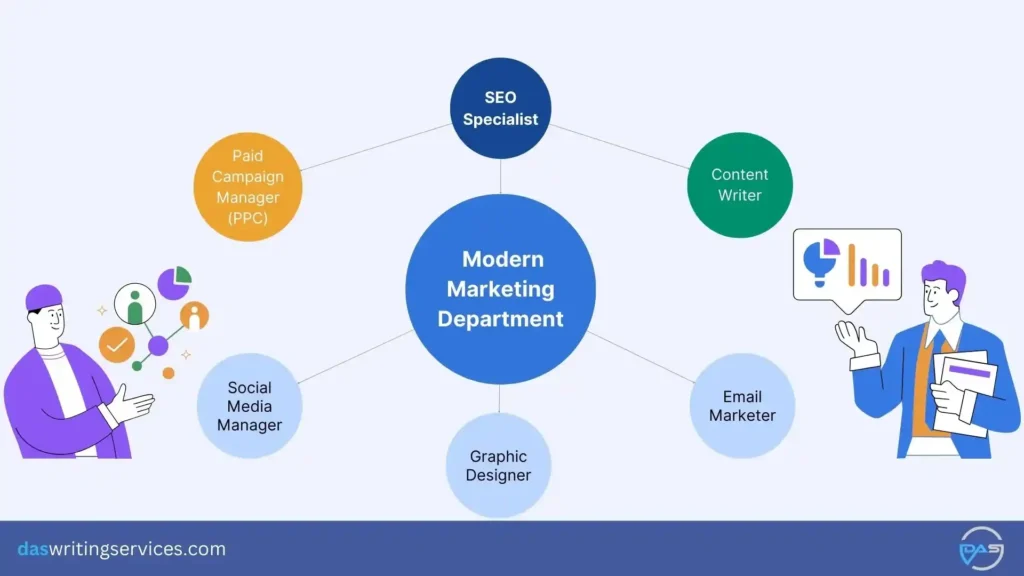
The CMO will lay down the KPIs of each marketing channels and set out expected outcomes in terms of attributes like: website visits, landing page visits, bounce rate across website and email marketing, open rates, CTR, PPC impressions, channel specific conversion etc.
5. Monitor Performance & Adapt
A key characteristic of today’s digital-first marketing strategy is that marketing is no longer a time-bound activity but a key component of a business engaging existing consumers and prospective consumers at every stage of the journey.
For our sustainable drinkware brand, we will perform this lifecycle marketing where the potential users will be guided through the process. From being completely ignorant about the brand to learning its name, becoming aware about the value it brings to the table, to conversion and retargeting.
The most vital step in all types of marketing strategy is to measure the performance out of each channel. Rarely do plans on-paper perform as per expectations in reality and that is the norm. Monthly review of the KPIs across all the channels will let us understand how to proceed further.
If content and social media are performing well, we can increase the budget of them and try to understand what is working. Since our product relies on its visual appeal, we can run A/B tests for ads and emails to recognize user preference towards creative visuals and captions.
5 Popular Digital Marketing Channels to Execute your Strategy
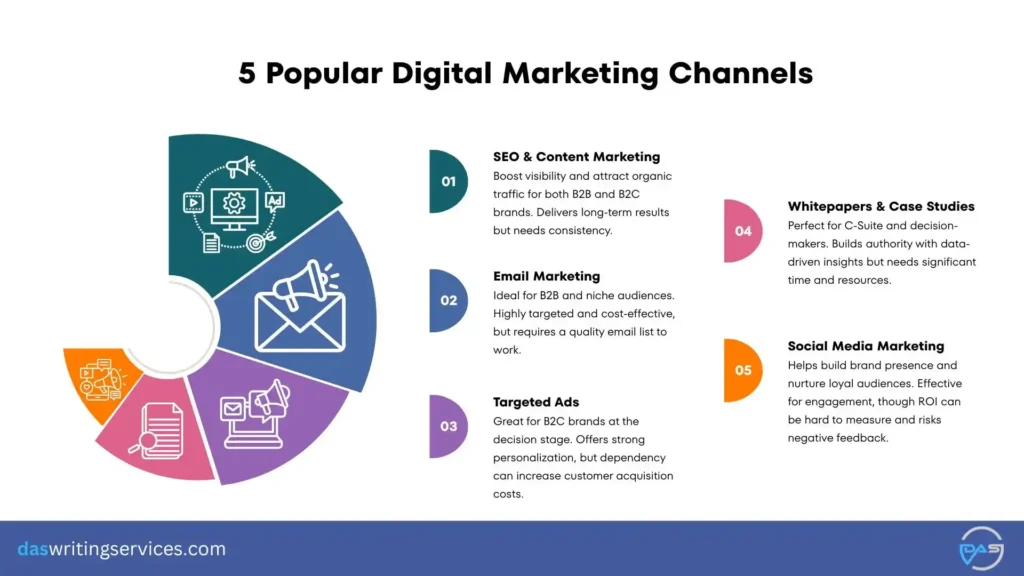
Below are the most popular digital marketing tactics that are used by businesses around the world to enhance their brand online.
1. SEO & Content Marketing
Suitable for: Both B2B and B2C businesses focused on increasing visibility and drive increased traffic
Advantages: Provides long term results to enhance brand recall and establish thought leadership, nurtures audiences in the awareness and consideration stages of marketing
Disadvantages: Requires consistent activity for months without upfront results, campaign is vulnerable to search engine algorithm changes
2. Email Marketing
Suitable for: B2B audiences, particularly for targeting C-Suite leadership to target niche products and user groups
Advantages: Allows precise targeted campaign management, cost-effective to produce
Disadvantages: An email list of legitimate contacts is required to get any impact
3. Targeted Ads
Suitable for: Most effective for B2C campaigns, to encourage users at the decision stage of their buyer journey
Advantages: Distributors offer personalization and targeting tools to allow efficient campaign management.
Disadvantages: Increased dependency on ads quickly drives up customer acquisition cost (CAC)
4. Whitepapers & Case Studies
Suitable for: Engaging C-Suite users and policymakers in organizations, secure investments and claim thought leadership
Advantages: Highlights authority in the industry with original insights and statistics
Disadvantages: Tends to be time and resource intensive
5. Social Media Marketing
Suitable for: Building a cohesive brand visibility, engage users at multiple touchpoints
Advantages: Strengthens remarketing, creates loyal audience group, encourages repeat purchases
Disadvantages: Organic marketing ROI is difficult to measure, potential risk of negative publicity
Takeaway
For a digital marketing strategy to work, it requires lot of updates and revisions. From the analytics tools we can recognize what is working and which channels are giving suboptimal ROI that do not align with our marketing objectives.
Timely intervention and adaptive planning is the cornerstone to make sure that your long term marketing goals becomes a reality.
Frequently Asked Questions
1. Do I need coding for digital marketing strategy?
Coding is not an essential skill for digital marketers. Yet, having a rudimentary understanding of HTML, JavaScript and CSS proves useful for people working in SEO.
2. What is an example of a digital marketing strategy?
Nike offers a segment on their website called ‘Nike By You’ which lets you fully customize the visual appeal of your website. It represents a digital marketing strategy to engage users and offer personalized products to enhance brand loyalty of the users.
3. Do I need SEO if I am running ads?
SEO supports your paid campaigns by creating a steady user base for the website. SEO optimization also aligns your website to signal trustworthiness with relevant content and website architecture.

Subhodip Das is the founder and CEO of Das Writing Services Pvt. Ltd. He has an experience of 12 years in the field of Digital Marketing and specialises in Content Writing and Marketing Strategies. He has worked with well-established organisations and startups helping them achieve increased Search Engine Rank visibility. If you want to grow your business online, you can reach out to him here.
Leave a comment
All comments
virtual assistance services
Great concepts This would be really helpful. I appreciate your sharing.
Gurneet Kaur
Really, It is a very helpful and informative post. Many Digital Marketing professionals will be benefited from this post. Personally I followed some renowned blogs like : Marketing Land,Digital Vidya,Moz Blog and Search Engine Journal on regular basis. Now, after reading this post I have some new area from where I can get ideas.
Raksha Gajbhiye
Excellent blog on digital marketing it is a nice field to sell all the product or service. I really appreciate the blog, Please keep sharing.