AI searches are changing how conventional SEO and content marketing worked till now. Thanks to SERP features and AI Overview, more than 65 per cent of Google searches in 2024 had no clicks.
But this deficit created a new opportunity for brands. Nowadays, companies that appear as citations receive better quality traffic with increased conversion potential. Needless to say, featuring in AI citations and link cards is giving an additional layer of credibility to businesses.
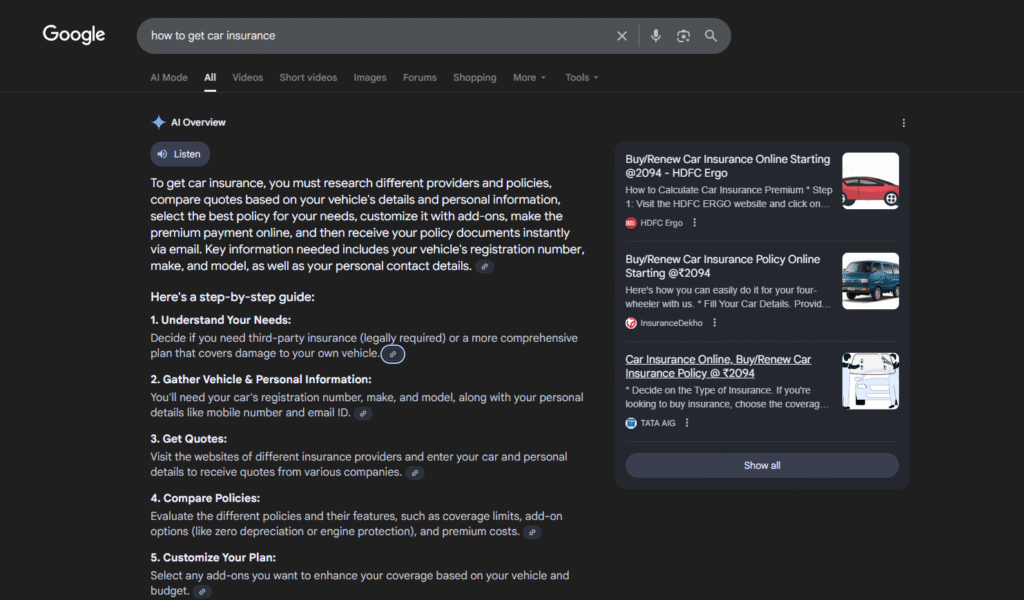
For instance, the 3 sites appearing on the link card the right hand side are definitely getting improved brand perception in the industry.
To maintain organic visibility, optimizing for Answer Engines (AEO) is essential. Answer Engines like Gemini, Alexa, Siri, ChatGPT, Google’s AI Overview, and Microsoft’s Copilot – all are driving considerable traffic away from the traditional SERP.
With answer engine optimization businesses can tap into the new channels which are the key to achieving your content marketing goals in 2025.
Want it done for your content?

What is Answer Engine Optimization (AEO) & Why You Need It?
Answer Engine Optimization (AEO) is a process of web content optimization to be discoverable by AI-powered tools such as voice assistants (e.g. Alexa, Siri), chatbots (e.g. Grok) and smart search engines (e.g. Google AI Overviews).
Nowadays, almost 38% web searchers rely on Google’s SGE or AI Overview to get their answers. This means they prefer immediate responses rather than scrolling down through hundreds of pages and links.
This paradigm shift from AI platforms to AI assistants is visible in studies, which says:
- 400+ million users have started using OpenAI products each week
- 45% of users choose social media for search options
- Daily installation of the Bing mobile app has increased 4x since its launch
- 25% of organic traffic will choose AI chatbots and other virtual platforms by 2026
Additionally, being featured on tools like ChatGPT and Gemini does send vital signals of trustworthiness to the user. To not lose out on this qualified and tech savvy user cohort, businesses must modify their content – making it suitable for AI and voice searches.
How to Optimize Your Website for Answer Engine Optimization (AEO)?
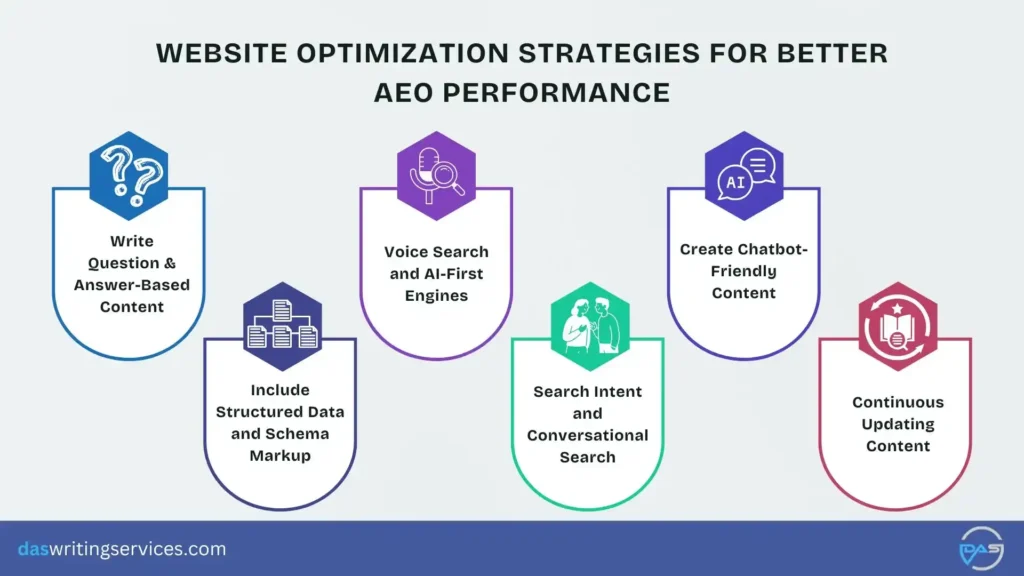
To optimize your website for Answer Engine Optimization (AEO), generate structured content with pointers and examples directly answering user queries. Choose long-tailed keywords and keep answers short and crisp. Also, implement structured data to enhance AI-first search optimization.
Let us break down the key steps below:
1. Write Question & Answer-Based Content
- Create question-based H2s/H3s that reflects the user search patterns, particularly for natural language queries.
- Answer clearly what, how, and why questions under the subheads.
- Provide content in the form of numbered lists, bullet points and FAQ-rich snippets.
2. Include Structured Data and Schema Markup
- Provide schema markup (How-to, FAQ, Article) to enable search engines to understand the context of content.
- Increase content visibility over People Also Ask (PAA) and featured snippet sections.
3. Voice Search and AI-First Engines
- Optimize voice-enabled search, providing a natural response (40-60 words) with short paragraph length.
- Consider tools such as Google’s NLP API for examining the different aspects of semantic search.
4. Search Intent and Conversational Search
- Involves search intent optimization, analyzing the services that users seek to obtain with a detailed guide and comparison of products.
- Write in a conversational search tone which is short, clear, crisp and easy to read.
5. Create Chatbot-Friendly Content
- Start with easy to follow definition/description. Then give context and example to ease user understanding.
- Break content into short answers to appear in the AI overview section and other similar formats.
6. Continuous Updating Content
- Keep refreshing old content on a regular basis to align with the evolving nature of AI-first search optimization.
- Updating data and information on developing topics once every 3-6 months. Update evergreen content annually.
So, are you ready to future-proof your content?
Smart implementation of AEO strategies for content marketers at present enables wide visibility in tomorrow’s evolving search landscape. Begin optimizing now to turn your content AI-ready!
Know More: AI Copy vs Human Writers: Which One Do You Need?
If you are still unsure, reach out to us today to see how it works

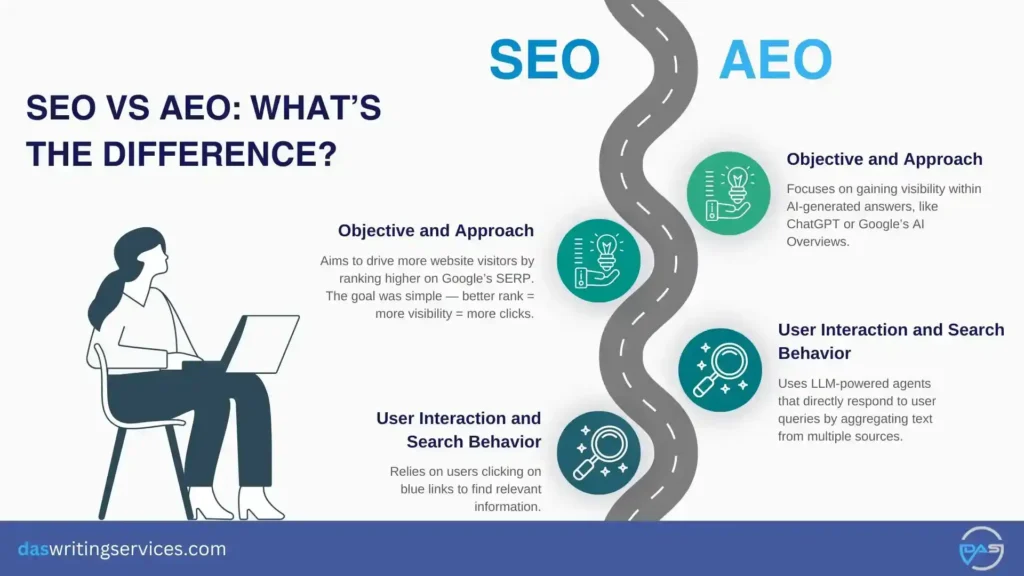
What are the Key Differences Between AEO and SEO?
| Parameters | Answer Engine Optimization (AEO) | Search Engine Optimization (SEO) |
| Meaning | Provides direct and short answers to users’ queries for AI-first platforms such as AI Overview, ChatGPT and AI voice assistants. | SEO focuses on increasing the website’s visibility on traditional search engine platforms such as Bing and Google, following the ranking strategies. |
| Objective | Targets citations or visibility on zero-click searches and voice queries, offering FAQs and answer-based questions. | Targets clicks on websites through targeting keywords and generating backlinks. |
| Focus of Content | Emphasizes answer-based content writing, maintaining clarity and transparency. | Puts focus on meta tags, keyword density and building of links. |
| Format of Output | Follows the format of tables, bullet points, FAQs, featured snippets and structured content. | Considers pillar pages, long-form articles and SEO optimized pages. |
| Tools and Metrics | Can be tracked by setting up a custom segment on GA4. | Tracks ranking of keywords, organic traffic, domain authority and bounce rate. |
| AI Adaptability | A significant part of AI-first search optimization strategies. | Optimized for non-AI dominated navigational queries. |
| Voice Search Optimization | An essential component of the AEO and voice search strategy. | Still in the evolving phase for voice-based outcomes. |
| Approach of Content Writing | Tailored specifically for content writing for AEO with the use of question-answer format, clarity and structured data. | Focuses on keyword-based content writing, content clustering around authoritative topics. |
The Future of Answer Engine Optimization (AEO) in SEO
Answer Engine Optimization (AEO) may be the new buzz word in town. But seasoned professionals agree – AEO is nothing new that SEOs have not been doing all this time. Good SEO has always been about catering to the user search intent. The rise of AI answer engines are because these tools are doing it more efficiently than most SEOs.
So if you are still doing SEO and content marketing in 2025, words like ‘delivering value’ and ‘addressing user pain points’ cannot be vague marketing term for you. The underlying idea is simple, people use search engines and AI to find answers and solve problems.
If you can make this journey simpler for the user – you will naturally get featured, be it SEO or AEO or GEO (or any other new buzz word that may come) your brand will maintain its visibility across the board.
7 Key AEO Trends in 2025
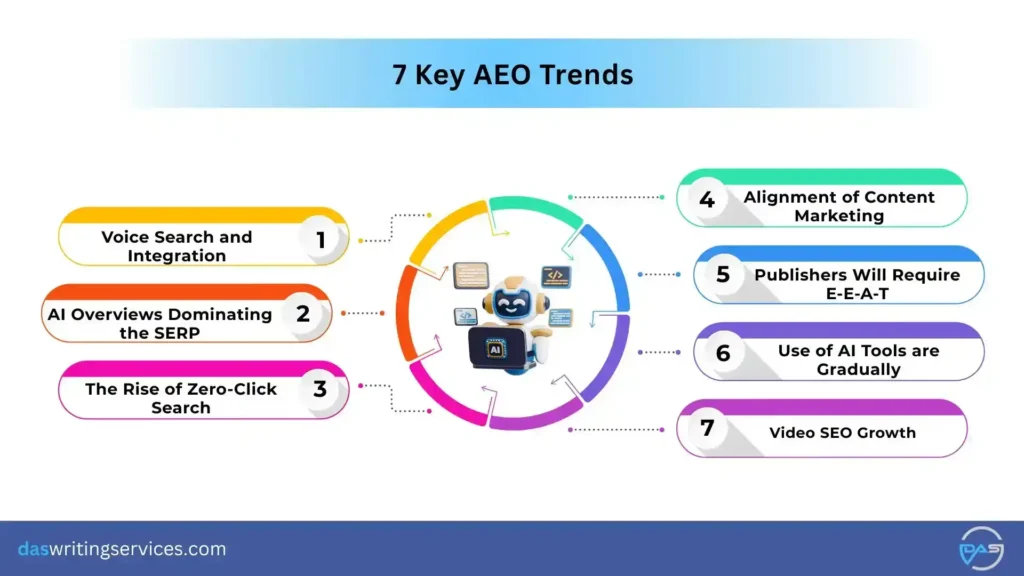
1. Voice Search and Integration of Conversational AI
With the rising popularity of mobile assistants and smart speakers, voice search is not a feature anymore; it is a necessity. Studies suggest that by 2025, voice searches will comprise over 60% of search queries overall.
- Majority of voice searches are questions, aligning with NLP and AEO practices.
- Voice search of Google generates answer-based content, around 30-40 words in length.
- Voice questions are lengthy and conversational.
Actionable Tip: Go for the implementation of conversational keywords and optimize content for natural language queries. To understand real-time voice intent, use Google’s NLP and AnswerThePublic.
2. AI Overviews Dominating the SERP
AI overviews, earlier known as Search Generative Experience, is a unique approach towards incorporation of generative AI into the search experience. At present, approximately 15% of SERPs feature an AI overview.
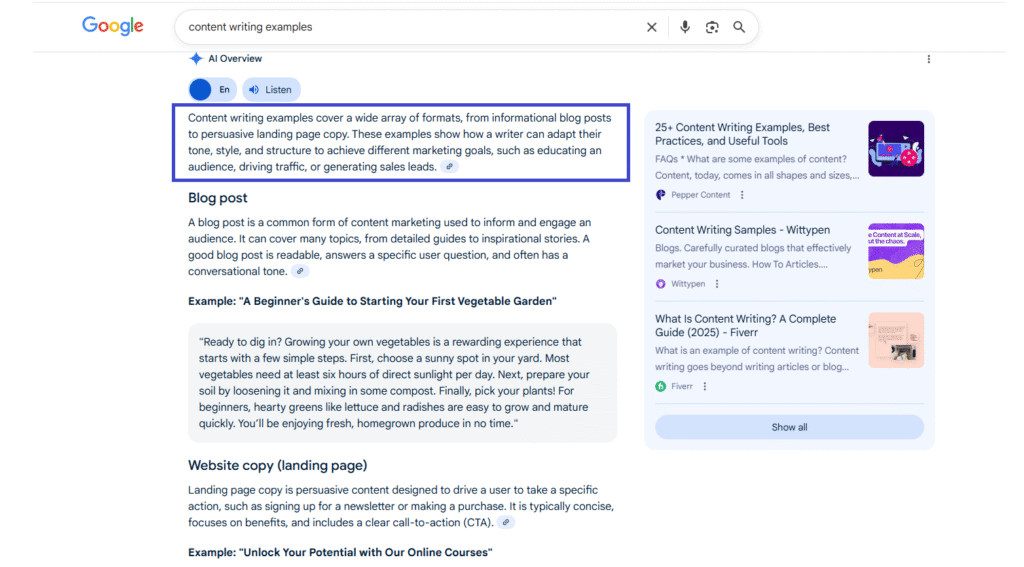
- Use of AI is now to personalize search results, predicting keyword trends and analyzing user intent.
- SurferSEO and HubSpot are gradually integrating AI for optimizing the flow of content and providing competitor insights.
Actionable Tip: Use AI-powered tools for optimizing headers, researching trends and implementing semantic SEO. Also, create audio, text and video from the same piece of content with the help of AI.
3. The Rise of Zero-Click Search
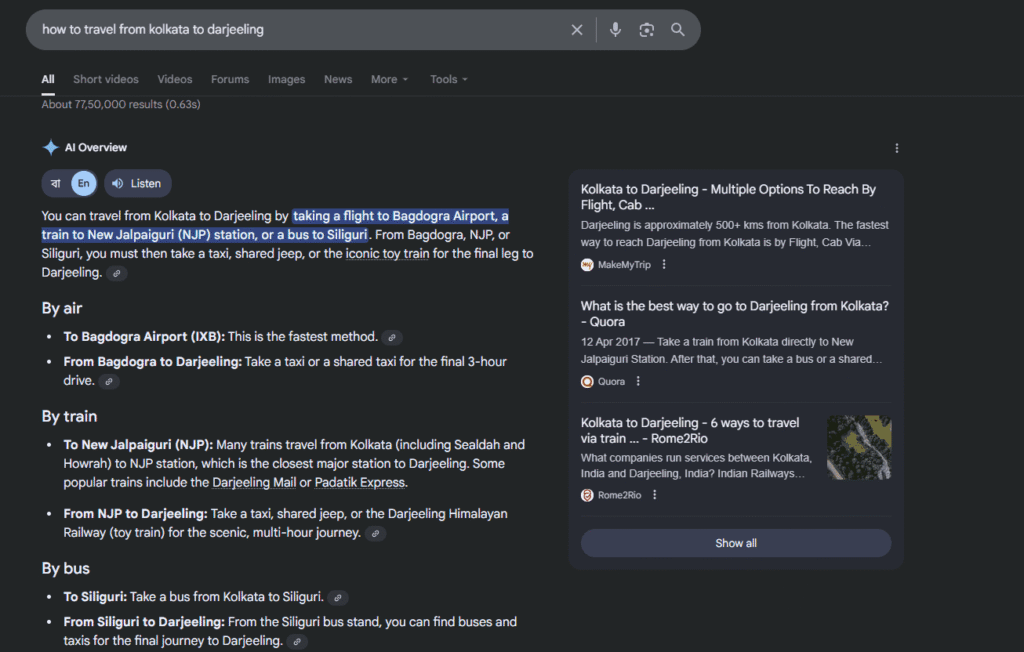
With Google providing instant answers via SERP features, users get their answers without much engagement. Approximately 65% of Google searches during 2024 have ended without a click. Zero click satisfies the queries of users instantly through maps, summaries, calculators and widgets.
- AI-first engines such as Google’s Search Generative Experience (SGE) and Bing Chat have led to the rise of zero-click content search through integration of answer-based content writing and conversational AI directly.
- Recent research reveals that when there are AI overviews, CTR reduces on average by 15.5%.
- Sites with ranking in position 1 find CTR losses of up to 34.5%, according to Ahrefs.
Actionable Tip: To maintain visibility in this environment, write in bullet points, tables and short paragraphs. Also, create FAQ-rich snippets using the schema markup and include stats and comparison tables to appear in AI-driven search results.
4. Alignment of Content Marketing Trends with Search Intent
One of the major content marketing trends in 2025 is associated with alignment of content precisely with search intent – whether it is transactional, navigational or informational.
- 90% of pages in top rank align directly with user intent
- Content serving multiple intents with clear CTAs notice 40% higher conversion rate
Actionable Tip: Create content for each stage of the buyer journey. Implement intent-specific headings such as “Best tools for”, “How to”, “Comparison between”, etc. Also, make sure to complement blog post with videos and a downloadable checklist.
Also Read: How to Use a Content Marketing Funnel?
5. Publishers Will Require E-E-A-T and Brand Signals
As Google search algorithms evolve with the integration of AI, E-E-A-T (Experience, Expertise, Authoritativeness and Trustworthiness) and brand signals have remained consistent. In 2025, these two ranking factors are crucial to determine whether your content will appear in the featured snippet and AI overview.
- Google prefers use of E-E-A-T and sets it as a quality benchmark in terms of differentiating any credible source from generic content.
- Brand signals help AI-driven search results to find out if the source is trustworthy. Brand signals include direct traffic, analysis of search volume, and real-world credibility.
- During Google updates, sites with extreme organic traffic but low brand recognition are found to be suffering the most.
Actionable Tip: For strengthening your brand signal and E-E-A-T:
- Get featured on any well recognized and reputable social media platforms
- Build presence outside Google, such as Instagram reels, YouTube videos and any live events, such as SEO related conferences and webinars, for enhancing your authority.
- Start investing in long-term branding rather than any short-term keyword hacks.
6. Use of AI Tools are Gradually Transforming SEO Workflows
AI reshapes the process of creating and optimizing content by SEO professionals in 2025. From researching keywords to drafting articles, AI is now a significant part of the SEO workflow.
- Tools such as Semrush’s ContentShake AI are capable of generating high-ranking content up to 12x faster. This tool helps to boost efficiency without quality compromise.
- A study by Semrush, after analysis of 20,000+ articles, reveals that the ranking of AI-generated content is quite similar to human-written content.
- Specifically, 58% of human-written content and 57% of AI content constitute top 10 search results in Google.
Actionable Tip: Combining AI-generated content with human editing ensures content quality, branding voice and E-E-A-T compliance. Make sure to use AI for scalability and speed, but also keep a human touch.
7. Video SEO Growth – Increase of Video-Rich Content
In 2025, video-rich content has become necessary for high visibility and engagement in SERPs. It is thus no longer an option. Video SEO is important not only for ranking on YouTube but also in Google’s search results in the video section.
- Google nowadays prioritizes video results, particularly explained videos, YouTube shorts appearing in AI overviews and featured snippets.
- YouTube shorts and TikTok videos are a key influence on search trends and website traffic.
- 91% of businesses consider video as a marketing tool, whereas 93% of marketers say video marketing yields a good ROI.
- Search behaviour is rapidly changing, with users preferring easy-to-understand visual explanations over lengthy text.
Actionable Tip: Invest in keyword optimized videos on blogs and landing pages. For further enhancement, use captions, descriptive titles and schema markup. Also, transform long-form videos into short clips for easy access on platforms such as YouTube Shorts, Instagram and TikTok.
Frequently Asked Questions On AEO
1. Is it possible for AEO to replace SEO?
No, AEO can’t replace SEO entirely. AEO is a significant portion of SEO focusing on direct and short answers. Still, traditional SEO is essential to track ranking, traffic and enable visibility across search engines.
2. How effective is AI SEO?
AI SEO is quite effective for data analysis, prediction of trends and fast optimization of content. Furthermore, it enhances rankings, traffic, and creates better strategies depending on users’ search behaviour.
3. Can I align AEO with SEO?
Yes, you can align AEO with SEO. AEO is focused on generating short and crisp instant answers, while SEO enhances visibility. Combining both boosts your content ranking in AI-driven search results.
4. What are the advantages of using AEO with SEO?
Combining AEO with SEO improves your chances of featuring in voice searches, answer boxes and AI-driven tools. Alongside this, it also enhances visibility, builds trust and user engagement with zero clicks.
5. What are some tools can I use with AI SEO?
Some popular tools you can use with AI SEO include Frase, Surfer SEO, Semrush, Jasper AI, MarketMuse and ChatGPT. Effective use of these tools helps with keyword research, content optimisation and AI-driven suggestions for better performance.

Subhodip Das is the founder and CEO of Das Writing Services Pvt. Ltd. He has an experience of 12 years in the field of Digital Marketing and specialises in Content Writing and Marketing Strategies. He has worked with well-established organisations and startups helping them achieve increased Search Engine Rank visibility. If you want to grow your business online, you can reach out to him here.
Leave a comment