
Get Free Content Sample

 Add as preferred on Google →
Content marketing is a part of digital marketing where businesses plan, create, and distribute various forms of online content like blog posts, website content, videos, and podcasts to attract and engage a defined target group.
The fundamental motivation behind content marketing is to engage new users and retain existing customers by catering to their pain points. With content marketing, a company also showcases its expertise and claims thought leadership in the industry.
It is especially useful in the B2B industries where 77% marketers use content marketing to generate demand and leads. Content marketing is more important in the age of AI than ever before as quality content paves the way for brand visibility in AI searches.
If you want to know how content marketing can help your brand scale new heights, click below to schedule a consultation.

Why is Content Marketing Important?
Popular marketing strategies involve ads, events, sponsorship etc – they are usually known as outbound marketing practices where the businesses reach out to the target audience.
Content marketing, on the other hand, is an inbound marketing practice where users are attracted to the business website by creating helpful content. It encourages potential customers to discover and engage with the brand naturally.
Third party surveys observe, with inbound marketing like content each lead can cost less than $14 compared to lead generation costs incurred in outbound marketing strategies.
Also Read: How to Boost Lead Generation with Content Marketing?
In the digital-first society we often invest millions on online and social media ads which most people ignore. With more than 42% of global users actively using ad blockers, or tuning ads out deliberately, relying solely on outbound marketing can drain your budget without much ROI.
Contrarily, content marketing drives increased engagement that proves more cost-effective in terms of performance.
What are the Benefits of a Content Marketing Campaign?
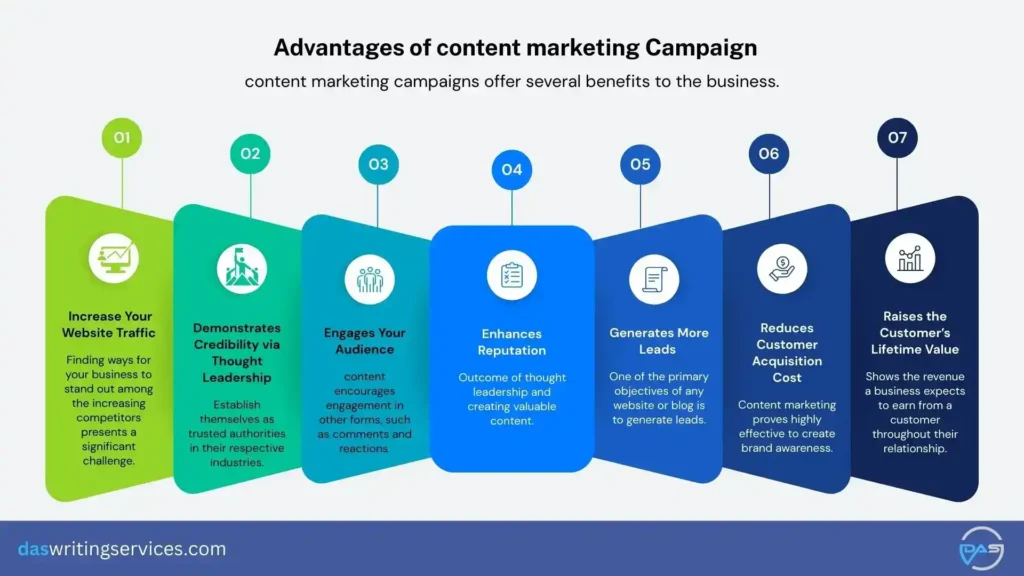
Unlike intrusive promotional campaigns like ads or sponsored social media content, organic content marketing caters to highly relevant target groups that may naturally come across the content. As a result, content marketing campaigns offer several benefits to the business.
1. Increase Your Website Traffic
Finding ways for your business to stand out among the increasing competitors presents a significant challenge. That is why, content marketing is beneficial to make it easy for people to find you.
When your name pops up at the top of the search results or as citation on AI overview more people will find out about your business and increase your website traffic. Similarly, producing relevant content can capture user attention on social media platforms, leading to increased traffic to your website.
2. Demonstrates Credibility via Thought Leadership
Brands aim to establish themselves as trusted authorities in their respective industries. Especially for B2B companies, it is a vital tool to drive engagement. One way to do so is to establish your brand as a thought leader. How to do so?
By providing insightful and original content, brands can differentiate themselves from competitors and become go-to resources for information. This authority helps build a loyal customer base that values the brand’s insights.
Thought leadership can significantly boost a brand’s visibility in search engines and social media platforms. Quality content that resonates with audiences is more likely to be shared, increasing reach and engagement
3. Engages Your Audience
Providing your audience with meaningful and useful content can lead them to find it so impressive that they feel compelled to share it with their friends and followers. Additionally, this type of content encourages engagement in other forms, such as comments and reactions.
Subscribing a channel on YouTube, liking a post on Facebook, and retweeting on X are some of the most sought-after forms of engagement.
4. Enhances Reputation
A good reputation is the obvious outcome of thought leadership and creating valuable content. Your audience will have a positive impression of you if the content you produced helped them in any way.
Further, when they share it online or discuss it via word-of-mouth, it will improve your reputation even more.
5. Generates More Leads
A lead is a person or organization interested in your offerings and has the potential to become a customer in the future.
One of the primary objectives of any website or blog is to generate leads. This is a vital component of a broader strategy aimed at boosting sales, as each lead represents a potential customer.
Content marketing not only improves the number of visitors to your website but also increases the chances of those visitors turning into leads, and ultimately into customers. Ultimately, the more leads you generate, the greater your opportunities for making sales.
6. Reduces Customer Acquisition Cost
Customer Acquisition Cost (CAC) typically includes marketing costs and additional discounts. While highly competitive channels like PPC and social media ads drive up the costs for user acquisition – content marketing proves highly effective to create brand awareness.
Content marketing can lead to a reduced CAC since a single piece of content can potentially engage a wide audience. Moreover, most of the content created for content marketing remains valuable for a long time. Thus, content marketing helps acquire customers over a long period.
Content marketing ensures that your sales team is not burdened by the outreach effort for acquiring new customers, and instead can focus on using a more personalised approach.
7. Raises the Customer’s Lifetime Value
Customer Lifetime Value (CLV) shows the revenue a business expects to earn from a customer throughout their relationship.
Providing valuable content to your clients can significantly extend their relationship with your brand. Don’t underestimate the importance of the psychological impact of making your customers valued.
When customers recognize that you want to address their needs and challenges even after a transaction is completed, they will feel valued and appreciated.
Top 9 Types of Effective Content for Marketing Campaign
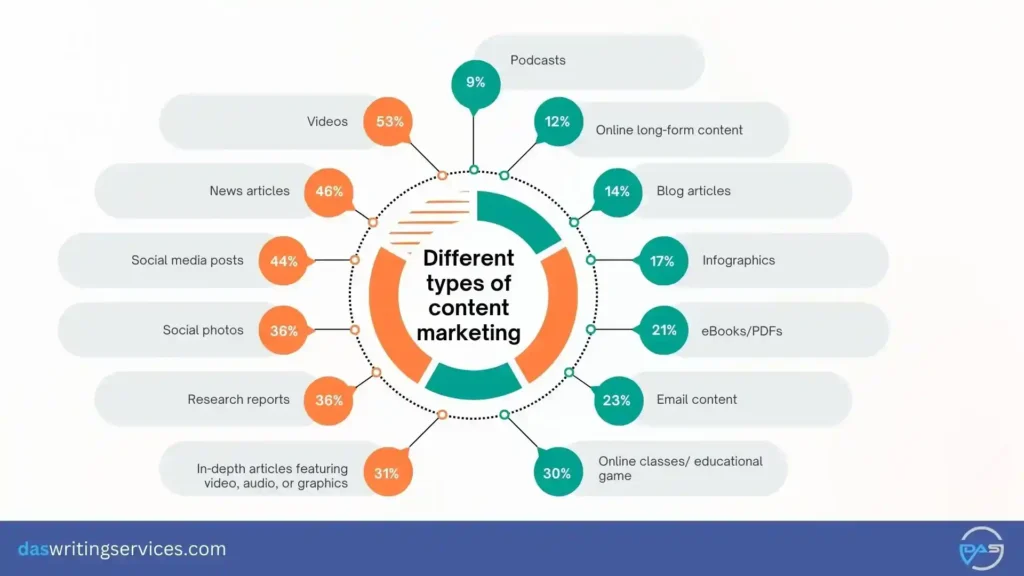
1. Blog Content Marketing
Blogging has emerged as a highly effective tool for content marketing. Incorporating a blog into your content strategy is cost-effective and more straightforward to produce compared to multimedia formats like video. It enables businesses to capture the attention of both audiences and search engines.
To maximize the impact of your blog posts, concentrate on a single topic for each post. This approach allows for clarity and depth. You must consider the ideal blog post length. You can diversify your content length by including short blogs (500 to 1,000 words), medium-length pieces (1,200 to 2,000 words), and extensive articles (over 2,000 words).
2. Video Content Marketing
Videos serve as a powerful medium for brands to convey intricate ideas and emotions in mere seconds. The rise of smartphones has made it easier and more cost-effective to produce high-quality videos with engaging visuals, voiceovers and music.
Businesses leverage video for various purposes, including unveiling new features, showcasing product demonstrations, narrating employee anecdotes, and sharing customer testimonials. Some brands even create engaging experiences like concerts or game shows to foster intimate connections with their audiences.
Furthermore, videos can be repurposed into different formats, such as blog posts and social media updates. This versatility means that investing in video not only enhances your marketing efforts but also accelerates the creation of additional content across various platforms.
3. Social Media Content Marketing
Businesses typically select a combination of social media platforms that resonate with their target audience. Popular choices include X, YouTube, Instagram, Facebook, and Pinterest.
For B2B companies, LinkedIn and X (formerly Twitter) have proven to be effective venues for engagement.
This approach to content marketing offers significant advantages by allowing businesses to connect with customers in a more interactive environment. Rather than relying solely on email or a website for communication, brands can post updates and entertaining content on social media to capture the attention of their audience.
Read Related Blog: Content Marketing vs Social Media Marketing
4. Podcasts Content
Utilizing podcast content marketing enables companies to engage with target audiences through engaging audio content.
Organizations have the option to launch their own podcasts or participate as guests on existing shows within their sector, thereby broadening their reach to potential clients. A podcast can focus on addressing the challenges faced by the audience, while also incorporating, insights into industry developments, customer testimonials, case studies, and other compelling stories that foster a deeper emotional bond with listeners.
Despite its effectiveness, many companies underestimate the potential of podcasting due to uncertainty about how to leverage audio content. However, podcasts are rapidly becoming an essential medium for businesses aiming to connect with their target market.
5. Webinar
Webinars serve as a fantastic platform for building connections with your audience while providing valuable information. These live sessions allow you to interact with participants by addressing their inquiries on the spot, and the material generated can also be utilised for creating insightful blog articles.
To successfully host a webinar, it’s important to outline a clear structure and do comprehensive research on the chosen topic. Sending out invitations well in advance and offering reminders the day before the event can help boost attendance.
Creating a checklist that includes necessary equipment and other essential details is crucial to ensure everything runs smoothly on the day of the webinar.
6. Email Marketing
Email marketing stands out as a highly effective channel for promoting your business. It combines the best of direct and digital marketing. By utilizing email, you can effectively showcase your products or services to your audience and potential customers.
This approach not only helps to inform your audience about new offerings and promotions but also complements your broader marketing strategies. It aids in generating leads, enhancing brand visibility, and fostering customer relationships. Newsletters serve as a means to communicate updates about the organization and to highlight recent blog entries.
7. Case Studies and Testimonials
Case studies and testimonials serve as powerful tools for enhancing a brand’s credibility, particularly at the final stages of the sales process. These resources effectively narrate the success stories of clients, supported by their endorsements.
One key advantage of this type of content is its ability to showcase the practical applications and advantages of your product or service. You can feature case studies and testimonials on your company website and blog to maximize their reach.
To create compelling case studies and testimonials, it’s beneficial to interview your clients. Encourage them to discuss the challenges they faced and illustrate how your product or service provided effective solutions.
8. Ebooks
Ebooks serve as a powerful tool for collecting valuable information, such as names and email addresses of potential customers. Many visitors find it hard to resist the allure of downloading an ebook, particularly when it covers a topic that resonates with their interests.
As a result, ebooks are a comprehensive resource for raising your lead generation and boosting sales.
Creating an ebook involves several steps, including writing and editing the content—similar to crafting a blog post—and collaborating with a graphic designer for the visual elements.
9. Infographics
Infographics are a popular form of content marketing that presents interesting statistics and facts in a visually appealing format. While they are primarily used in B2B marketing, they can also be effective in B2C contexts, particularly for illustrating instructions or product features.
Businesses often convert existing content, such as studies or survey results, into infographics to highlight key points easily. This format is beneficial as it simplifies complex concepts into engaging visuals that are easy to read and share.
In an age where audiences prefer skimmable content, infographics allow consumers to grasp information swiftly. Additionally, businesses can break down the original infographic into smaller segments, making them ideal for social media sharing and increasing engagement.
10. Paid Ads
While it’s not too cost effective to depend solely on paid ads, they can be useful for the final leg of the marketing funnel.
Also Read: How to Create a Winning Content Marketing Funnel?
Paid advertising works best when combined with inbound marketing strategies. For top and middle of the funnel audience – PPC and social media ads are too resource intensive. Rather, consider your paid advertising initiatives as a means to close sale for audience who are in the bottom of the funnel.
In contrast, inbound strategies such as content marketing add depth and sustainability to your efforts. While paid ads can help you achieve specific goals, it’s the inbound marketing approach that fosters long-term loyalty and engagement among your audience.
How Does Content Marketing Work?
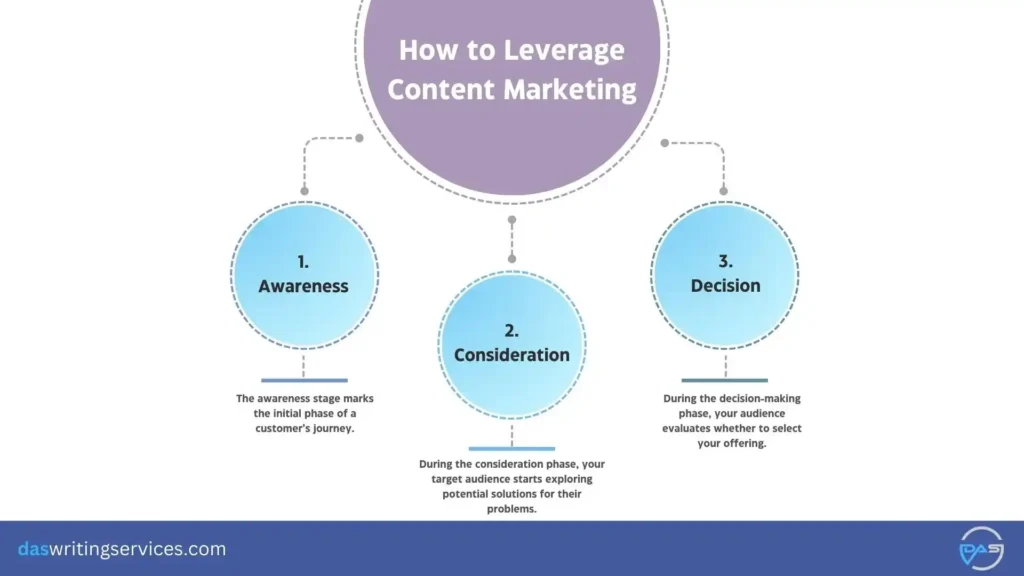
Any effective content marketing strategy must consider the three phases of content marketing:
1. Awareness
The awareness stage marks the initial phase of a customer’s journey. During this period, individuals recognize a challenge or concern they are facing. Content marketing efforts at this stage should prioritize addressing the needs and difficulties of potential customers, steering clear of excessive promotion of specific products or solutions.
Effective content formats for this stage include blog posts that tackle frequently asked questions, educational how-to videos, and comprehensive ebooks that provide valuable insights.
2. Consideration
During the consideration phase, your target audience starts exploring potential solutions for their problems. At this stage, businesses can start including promotional elements in their content marketing materials. However, businesses must continue providing valuable content.
Infographics and practical how-to articles are often used for this phase of content marketing.
3. Decision
During the decision-making phase, your audience evaluates whether to select your offering. At this point, your content marketing strategy should focus more on sales-oriented messaging.
Effective content types include comparison charts, testimonials from customers, product demonstration videos, and comprehensive product guides. Additionally, businesses can utilize retargeted advertising to re-engage potential customers who may have previously shown interest but did not convert.
Read More: Top 8 Content Marketing Goals for Success in 2025
Step by Step Guide to Content Marketing?
1. Know Your Audience
Who are you creating your content for?
You need to answer this question to run a compelling campaign. To streamline the content marketing process, you need to do customer segmentation.
Customer segmentation is the process under which customers are divided into groups based on characteristics such as demographics, behaviours, interests, problems, etc. It helps in creating a “buyer persona” which you can target in your content marketing efforts.
Customer personas play a crucial role in enabling businesses to gain insights into their clientele and pinpoint the content that will effectively engage various segments. By leveraging these personas, companies can enhance their communication strategies, foster trust, and attract new customers.
2. Understand What Information They Need
At this stage, you need to pinpoint the essential information required to make your customers find your product, brand, or service valuable.
Begin by analyzing the challenges and concerns of your target audience. This will provide insights into their priorities and preferences. Subsequently, your content marketing approach should focus on addressing frequently asked questions and offering solutions to their issues.
When your content effectively addresses a problem, it increases the likelihood of engaging your audience.
3. Decide How to Deliver the Information
After identifying your customers and their needs, it’s essential to provide content through the most effective channels for your target demographic. For instance, if your customer profile analysis indicates that your ideal clients frequently use Facebook, it’s wise to focus your content efforts on that platform. On the other hand, if you are targeting a professional audience, you can concentrate on platforms like LinkedIn.
After identifying where your audience is most active online, you need to place your content in front of them. This enhances the likelihood of them encountering your content and interacting with your brand.
4. Define Objectives and KPIs
Content marketing can yield great results, but determining its impact can be challenging. To gain insights into content performance, companies should define specific key performance indicators (KPIs).
The selection of these KPIs should align with your business objectives. For instance, some organizations may focus on metrics related to audience engagement, such as the number of views and comments, while others prioritize conversion rates.
Ultimately, it’s crucial to establish KPIs that are both measurable and attainable for your organization.
5. Set a Schedule and Budget
Your business needs to publish content regularly to draw in a steady stream of visitors and search engine bots. Establishing a content calendar can facilitate this process, but setting achievable goals is important. Starting with one blog post or video each week is a practical approach to maintaining consistency without overwhelming yourself.
Content marketing is often considered a cost-effective strategy, but it does come with a certain cost. Businesses need to allocate a budget for their content marketing efforts. This budget should encompass costs related to hiring professionals, purchasing content creation tools, and managing paid advertising campaigns.
It’s important to recognize that content marketers with greater experience and expertise typically command higher fees. However, lower prices often come with trade-offs in quality. Be cautious about opting for the cheapest option without evaluating the level of skill and experience offered.
6. Implement SEO Practices
You have to implement SEO techniques to ensure that your content is ranked high on the search engine results page. It includes targeting the right keywords and optimising your website for mobile usage. You can also test your website on Google PageSpeed Insights.
7. Analyze and Measure Results
Evaluating and assessing your performance allows you to identify your strong and weak points. It helps you double down on your strengths and eliminate your weaknesses. You can discuss your findings with your team and adapt your strategies accordingly.
Why Storytelling is Important in Content Marketing?
Human beings have a complex psychology, and content marketing seeks to use it to a brand’s advantage. Storytelling has been an important part of human evolution, and it is still important today.
If you tell a good story to your audience, they will remember it and positively associate it with your brand.
Your story can be tailored to align with your brand’s unique objectives and requirements. Maintaining a consistent voice is essential when sharing your narrative. Ultimately, consumers are drawn to your story and seek an emotional connection with it.
Difference Between Content Marketing and Content Strategy
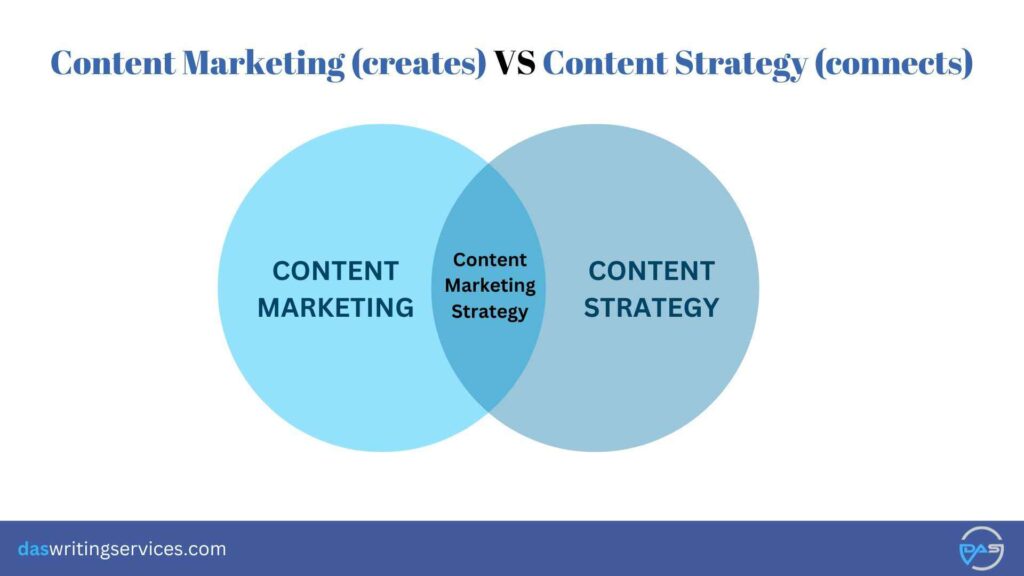
It’s common to mix content marketing with content strategy, but they serve different purposes.
Think of content marketing as a broad concept which is part of a larger whole. Examples include blogs, promotional campaigns, and visual content.
In contrast, a content strategy is about the total picture. It includes all the elements of content marketing and how they can be combined so that the potential customer passes through the marketing funnel, and ultimately makes a purchase. Thus, content strategy is a cross-platform framework unifying all your content marketing efforts.
Content Marketing Examples
Here are some noteworthy examples of content marketing:
1. Semrush
Semrush is a SaaS company which helps businesses with their search engine optimization, pay-per-click, and social media content. Semrush is not only well-renowned for the quality of its services, but it has also positioned itself as a thought leader via the quality of its content marketing.
Semrush’s blogs are some of the best sources to learn about SEO, branding, and content marketing. Its blogs have earned it a lot of positive reputation and authority in the industry.
2. Cristiano Ronaldo

Cristiano Ronaldo is one of the most famous people on the planet. He boasts 645 million followers on Instagram and 170 million followers on Facebook.
Recently, Ronaldo entered YouTube with a bang. His channel, UR . Cristiano, garnered a million subscribers within 90 minutes and boasts 71.5 million subscribers at the time of writing. A recent example of Ronaldo’s content marketing is his collaboration with the most followed YouTuber, MrBeast. Here’s the 1st video featuring the 2:
3. Reebok
Reebok has established itself as a brand dedicated to fitness by utilizing a combination of celebrity partnerships, engaging social media initiatives, and community-driven events.
In Reebok’s “Live With Fire” campaign launched in 2013, you can see the likes of John Abraham, MS Dhoni, and Nargis Fakhri. Here’s the video:
4. LG
Establishing a psychological connection with your audience is a pillar of content marketing. Here’s how LG did so to sell its new line of HDTVs.
LG played a clever prank targeting job applicants to promote its latest HD television series. To execute this prank, LG Chile set up a fake office environment featuring an 82-inch Ultra HD TV in place of a traditional window. They cleverly disguised the TV to display a realistic cityscape, creating the illusion of a genuine outdoor view.
As candidates arrived for their interviews, the scene took a dramatic turn when the video shifted to depict a meteor crashing towards the city. This shocking visual, combined with realistic sound effects and a sudden power outage, left the applicants in a state of panic as they believed they were in imminent danger. Eventually, the LG team revealed that it was all part of an elaborate joke.
The prank quickly gained traction online, amassing millions of views and sparking discussions about its authenticity, as some speculated that the participants were actors. Take a look at their advertisement:
5. Spotify Wrapped
Spotify Wrapped is an annual feature that allows users to reflect on their listening habits over the past year. This service compiles data on the music and podcasts users have engaged with, presenting it in a visually appealing format. Users receive insights into their most listened-to artists, genres, and songs, all of which are conveniently organized into a playlist.
Spotify Wrapped can be shared on social media. The influence of Spotify Wrapped extends beyond digital platforms, as people also discuss their playlists and music choices in person.
As a result, Spotify benefits from substantial free advertising. The organic visibility generated by Wrapped is impressive, leading to significant increases in app downloads each December.
Top 6 Content Marketing Tools for 2025
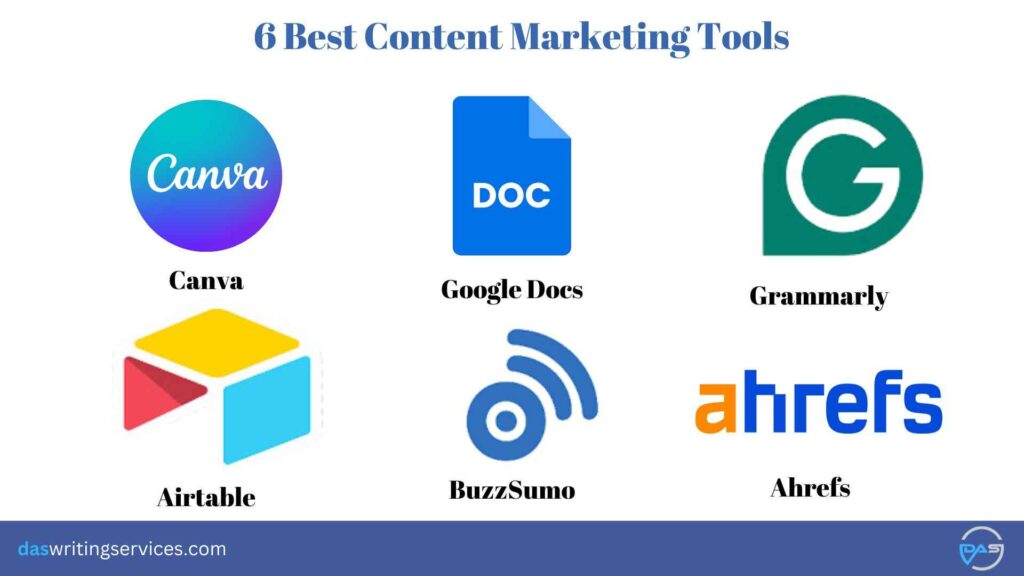
Top-notch tools can streamline the content marketing process. Here are the best content marketing tools you can use:
1. Canva
Canva is an online design tool which lets you create visually appealing content.
With its user-friendly drag-and-drop interface, Canva offers a diverse selection of templates that cater to various needs. You can use it to create posters, social media posts, and videos. Canva is compatible with desktops as well as iOS and Android platforms. Here’s a YouTube video where Canva describes itself:
2. Google Docs
Google Docs is an online word processor which is easy to use and is free. You can collaborate on documents with team members so that the whole content creation process is effortless.
3. Grammarly
Grammarly is a tool which checks grammatical errors in your content. You can download the online plugin and also use their website to evaluate your text. It can also make suggestion to make your writing more powerful.
4. Airtable
Airtable excels at managing extensive data sets while maintaining organization throughout the lifecycle of your project. Additionally, it offers features such as tools for tracking campaigns, editorial calendars, and interfaces for managing influencers, among other functionalities.
5. BuzzSumo
BuzzSumo has established itself as a leading tool for content marketing. Currently, numerous businesses leverage BuzzSumo to produce outstanding content, track their brand presence and industry trends, and identify potential growth avenues.
6. Ahrefs
Ahrefs is a SaaS firm that specializes in developing SEO tools and providing free educational resources for content marketing.
Ahrefs simplifies the process of keyword research, providing a reliable foundation for launching any marketing initiative. Additionally, it excels in monitoring of keyword positions, competitor keyword strategies, and traffic statistics.
Importance of ROI in Content Marketing
Return on Investment (ROI) is a crucial metric that should be evaluated across all marketing initiatives.
ROI serves as a clear and concise way to assess the effectiveness of your investments. To determine your ROI, subtract your total expenses from your total earnings, then divide that figure by your total expenses. This calculation is invaluable for setting and tracking your marketing efforts.
To conclude, content marketing is a long-term game. You have to carefully evaluate your goals and your target audience to decide your strategy. Along with the quality of the content, you need to consider factors such as the channels of distribution, the timing of your delivery, and the tools you will use for creating the content.
Know More: Top 19 Content Marketing Agencies in India in 2025
Frequently Asked Questions
1. What is content marketing?
Content marketing focuses on creating and distributing valuable, relevant content to attract and engage a specific audience. Its ultimate aim is to increase profits.
2. Why is content marketing important?
It helps build trust and authority with potential customers, enhances brand visibility, and fosters meaningful relationships by addressing customer needs and interests.
3. What types of content can I create?
Popular formats include blog posts, videos, infographics, podcasts, e-books, and social media posts. The choice of content should align with the preferences of your target audience.
4. How do I measure the success of my content marketing efforts?
Success can be gauged through metrics such as website traffic, lead generation, conversion rates, and social media interactions.

Subhodip Das is the founder and CEO of Das Writing Services Pvt. Ltd. He has an experience of 12 years in the field of Digital Marketing and specialises in Content Writing and Marketing Strategies. He has worked with well-established organisations and startups helping them achieve increased Search Engine Rank visibility. If you want to grow your business online, you can reach out to him here.


