Businesses are continually seeking new, innovative ways to enhance their online presence and boost revenue in this tech-savvy world. The fields of marketing have experienced substantial change, with performance marketing and digital marketing leading this digital revolution.
While both strategies have the same overarching objective of improving a brand’s digital footprint, their underlying techniques and results differ.
In this blog, we will delve into the key differences between performance marketing and digital marketing, highlighting the fundamental distinctions between these two marketing approaches. Understanding these differences will help you to make more informed decisions, which will eventually enhance your performance in the competitive internet market.
What is Performance Marketing?
Performance marketing is a results-focused digital marketing approach where brands pay only when a specific action happens. This could be a click, lead, sale, or app install. Unlike traditional marketing that prioritises visibility, performance marketing is built around clear outcomes and measurable returns.
This model matters because nearly 25% of marketing budgets are wasted on activities that do not drive results. Even intent data is unreliable, with only 26% of intent signals converting into real opportunities. Performance marketing uses channels like paid search, affiliate marketing, social media ads, email campaigns, and retail media networks to reduce this gap.
Affiliate marketing is expected to cross USD 20 billion in 2026. Social commerce is projected to reach 908.5 billion dollars by 2026, with 58% of shoppers buying after discovering products on social platforms.
What is Digital Marketing?
Digital marketing is the practice of promoting brands, products, or services through digital channels such as websites, search engines, social media, email, and mobile apps. It helps businesses reach the right audience at the right time using data and technology.
Today, digital marketing relies heavily on insights from user behaviour. Marketers use this data to create targeted and personalised campaigns that drive engagement and sales. AI plays a major role, with 88% of marketers using it daily to speed up content creation and improve results. Video is another powerful driver that delivers higher conversions and faster revenue growth for brands that use it consistently. Here are the top 15 digital marketing tips for beginners.
Search behaviour is also changing, as voice and AI-driven search continue to grow. At the same time, first-party data has become essential, with most digital publishers and e-commerce brands relying on it to boost performance and return on investment.
Unable to decide where to start? Contact our company, Das Writing Services, where we offer a full-fledged content strategy. Contact us at business@daswritingservices.com for a free site audit.
What are the Differences Between Performance Marketing Vs. Digital Marketing?
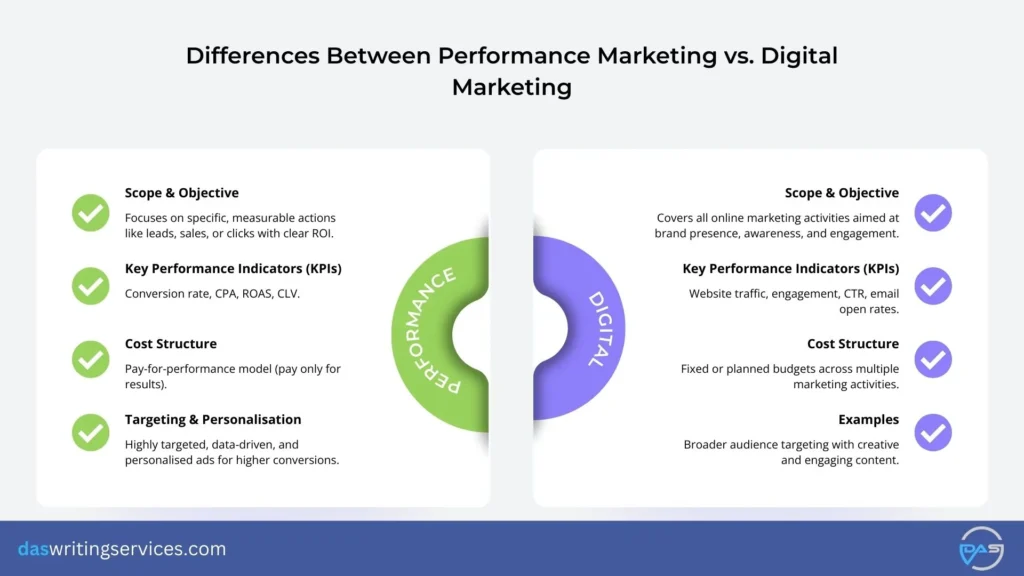
Performance marketing is narrower in scope and is driven by measurable actions such as clicks, leads, or sales. Digital marketing has a broader objective, and it focuses on long-term brand growth and engagement through channels such as email, content, video, and SEO.
Here are the key differences you should know:
| Point of Dissimilarity | Performance Marketing | Digital Marketing |
| Scope and Objective | It is a part of digital marketing that focuses on specific performance-based actions. Achieving measurable outcomes and a healthy return on investment (ROI) is the main goal. | Includes all marketing efforts performed using digital channels and technologies. The main objectives are to have a solid online presence, improve brand recognition, and interact with the target market. |
| Key Performance Indicators or KPIs | It depends on verifiable KPIs that are closely related to the goals of the campaign. Conversion rates, cost per acquisition (CPA), return on ad spends (ROAS), and customer lifetime values (CLV) are some of these indicators. | Measures success through various KPIs, such as website traffic, social media engagement, email open rates, and click-through rates (CTR). |
| Cost Structure | Uses pay-for-performance business strategy where advertisers only get paid when a specific conversion, like a click, lead submission, or sale, takes place. | Businesses allocate a defined budget for a variety of marketing activities, such as running social media advertising, creating content, or maintaining websites. |
| Targeting and Personalisation | The key components are exact targeting and customised message.Tailored advertisements are broadcasted to raise the possibility of conversions. Performance marketers may improve ads in real time for greater results thanks to this data-driven strategy. | Digital marketers may concentrate on increasing brand recognition among a variety of audiences and may utilise engaging and unique content to draw people in. |
| Campaign Optimisation | Performance marketers may quickly identify underperforming campaign components and make the required adjustments to increase performance. | Digital marketing campaigns are optimised based on overall marketing objectives and strategies.Changes and modifications may take longer to implement due to in-depth research and close collaborations. |
What are the Advantages of Performance Marketing?
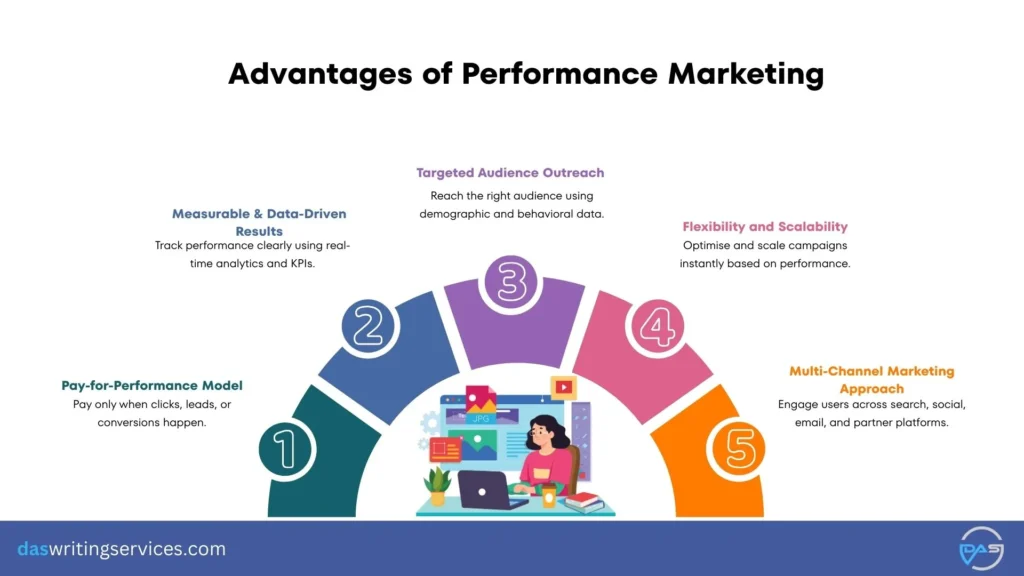
Performance marketing is a results-driven approach that lets businesses pay only for measurable actions, control costs, and scale quickly using data.
It delivers high ROI through channels like email, video, and affiliates, while AI-powered targeting improves precision.
In 2025-2026, faster optimisation, real-time tracking, and cross-platform reach make it a strong competitive advantage for modern, growth-focused digital businesses worldwide today globally.
1. Pay for Performance
Unlike traditional advertising, where advertisers pay upfront with no guarantee of results, performance marketing follows a pay-for-performance model. Advertisers only pay when specific actions such as clicks, leads or conversions are achieved. This ensures that marketing budgets are used effectively and return on investment is optimised.
2. Measurable Results
Performance marketing relies on data-driven metrics and analytics to accurately measure the success of campaigns. Therefore, advertisers can track and analyse key performance indicators and gain valuable insights into the effectiveness of their strategies. This data-driven approach helps with continuous improvement and better decision-making.
3. Targeted Audience Outreach
With access to rich audience data, advertisers can use performance marketing to accurately target their ideal customers. Thus, now, you can tailor your ads as per the demographics, interests or behaviours, to increase relevance and the likelihood of conversions.
4. Flexibility and Scalability
Performance marketing campaigns can be easily adjusted and scaled based on real-time performance data. Advertisers can optimise their strategies to capitalise on successful elements and quickly move away from underperforming elements to ensure maximum impact throughout the campaign.
5. The Diverse Use of Channels
This marketing leverages a variety of digital channels, including search engines, social media, email, partner platforms and more. This multi-channel approach increases brand visibility and engagement, reaching audiences across multiple touchpoints and devices.
Das Writing Services ensured guaranteed measurable ROI within 3-6 months after hiring our content services. Consult your requirements with us to get the best strategy. Contact now!
How to Measure Performance in Performance Marketing?
In performance marketing, the success of advertising campaigns is measured by certain KPIs that reflect the desired actions or results. These metrics provide valuable insights into the effectiveness and efficiency of marketing efforts. Some common KPIs used to measure performance marketing are:
1. Click-Through Rate (CTR)
CTR measures the percentage of users who click on an ad’s link compared to the total number of impressions. A higher CTR indicates that the ad is well-received by the target audience.
Across channels, average email CTR stands at around 2.44%, while top organic Google results can capture up to 39.8% of clicks. However, high CTR alone is not enough, as only about 26% of clicks convert into qualified leads or customers.
2. Conversion Rate
The conversion rate calculates the percentage of visitors who perform the desired action, e.g. make a purchase, fill out a form or ask for a free sample. It directly reflects the effectiveness of the campaign in achieving the desired results.
Global e-commerce conversion rates typically range between 2.3 and 3.4%. Campaigns using video perform better, with conversion rates reaching around 4.8%, and landing pages with video showing up to 86% higher conversions.
3. Cost Per Acquisition (CPA)
The CPA calculates the average cost of acquiring a customer or lead. It helps advertisers understand the cost-effectiveness of their campaigns and which channels or strategies are most efficient.
4. Customer Lifetime Value (CLV)
CLV assesses the total value that a customer brings to a company throughout their business relationship. By using this, you can understand the long-term profitability of customer acquisition efforts.
In addition, product videos can reduce return rates by 25% to 35% which improves long-term profitability.
5. Engagement Metrics
These include metrics such as time spent on a page, bounce rate and social media engagement, which provide insight into user engagement and interaction with content.
Affiliate marketing shows variable returns ranging from 20% – 70% depending on the model, and social commerce continues to grow as a high-potential ROAS channel.
What are the Key Advantages of Digital Marketing?
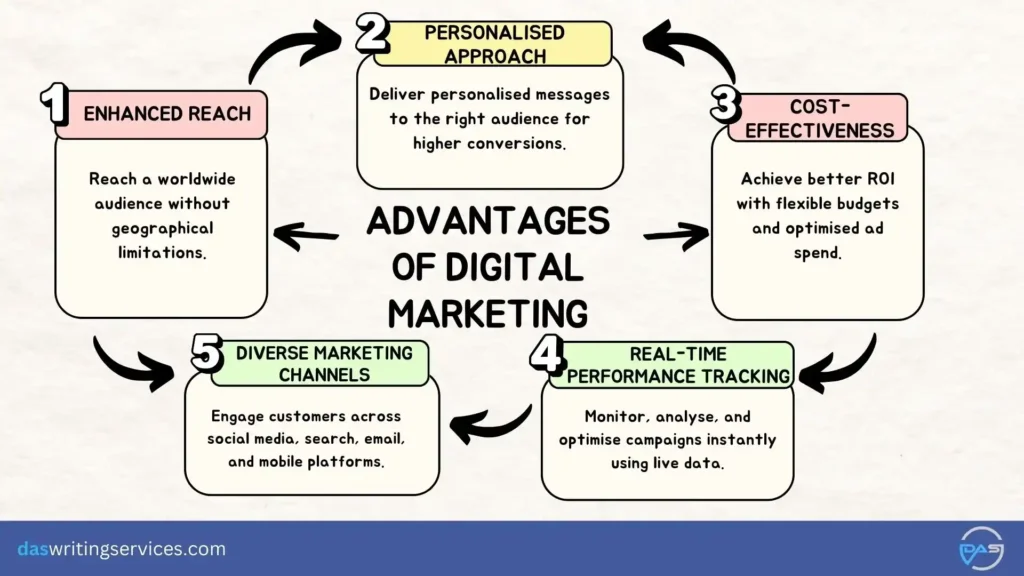
Digital marketing offers a variety of benefits that have revolutionised the way businesses promote their products and services nowadays. Here are five top benefits of digital marketing:
1. Enhanced Reach and Global Presence
Digital marketing breaks down geographical barriers and allows businesses to reach a global audience. Since the internet is everywhere, businesses can connect with potential customers from different parts of the world and exponentially increase their market reach.
By writing unique and relevant content, you can literally reach anywhere in the world through digital marketing. On average, performance marketing delivers nearly USD 15 in return for every dollar spent, though marketers must account for the fact that only about 26% of intent signals convert reliably.
2. Targeted and Personalised Approach
Digital marketing enables precise targeting of an audience based on demographics, interests, online behaviour and past interactions. This targeted approach makes sure that marketing efforts focus on the most relevant potential customers. It increases the likelihood of conversions and customer retention.
Channels like email deliver a USD 36 – USD 45 ROI per dollar, video marketing reports 87% positive ROI, and affiliate marketing alone reached an 11.99 billion dollar market in 2025.
3. Cost-Effectiveness
Compared to traditional marketing methods, digital marketing is generally more budget-friendly. Businesses can choose from different digital channels with flexible pricing options, optimise their advertising spend and achieve a better return on investment.
Today, 92% of ecommerce brands use AI-powered personalisation, and personalised CTAs drive up to 202% higher conversions.
4. Real-Time Performance Tracking
Digital marketing provides real-time data and analytics, allowing marketers to monitor the performance of their campaigns instantly. This data-driven approach allows for quick adjustments and optimisations and ensures that the marketers continuously make improvements for maximum impact.
5. Diverse Marketing Channels
Digital marketing offers a plethora of channels to reach target audiences, including social media platforms, search engines, email marketing, content marketing and mobile apps. This diversity helps businesses to engage with customers on multiple platforms. It improves brand visibility and customer engagement. Here are some free tips on how to create a digital marketing strategy for your brand.
How to Measure Performance in Digital Marketing?
In digital marketing, performance measurement involves tracking and analysing various key performance indicators (KPIs) such as website traffic, conversion rates, CTR, CPC, etc. These helps to evaluate the effectiveness of marketing strategies. Some important KPIs used to measure performance in digital marketing are:
1. Website Traffic
Tracking the number of visitors to your website on Google Analytics and its sources (organic search, social media, paid advertising, etc.) helps measure the success of marketing efforts in driving traffic.
Organic search alone drives around 53.3% of e-commerce traffic, and top search results capture nearly 75% of all clicks, highlighting the importance of SEO performance.
2. Conversion Rate
The percentage of website visitors who take a desired action, such as making a purchase or filling out a form, measures the effectiveness of the campaign in converting visitors into customers or prospects.
3. Click-Through Rate (CTR)
CTR measures the percentage of clicks on an ad compared to the number of impressions, indicating how relevant and appealing the ad is to the target audience.
4. Return on Investment (ROI)
ROI calculates the revenue generated compared to the cost of the marketing campaign. A positive ROI means a profitable campaign.
5. Cost Per Conversion (CPC) or Cost Per Lead (CPL)
These key figures indicate the average cost of obtaining a conversion or a lead and help to assess the cost efficiency of a campaign.
6. Social Media Engagement
Key figures such as likes, shares, comments and followers on social media platforms reflect the engagement of the target group and the visibility of the brand.
Around 58% of shoppers purchase after discovering products on social platforms, and Facebook Shops alone sees over 250 million monthly users.
Performance Marketing Vs. Digital Marketing: Which Should You Choose?
Performance marketing and digital marketing work best when you understand what each one is designed to achieve. Performance marketing focuses on quick, measurable actions like clicks, leads, or sales.
Digital marketing takes a broader view and helps build brand awareness, trust, and long-term customer relationships through content, SEO, and social media.
If your goal is fast and trackable results, performance marketing is a strong choice. It is ideal for short-term campaigns, product launches, and promotions where you want a clear return on spend.
Digital marketing is better suited for businesses that want to grow visibility and credibility over time.
Most brands succeed by combining both. The right balance often depends on the industry. E-commerce brands usually spend 60%-70% on performance marketing, driven by fast-growing social commerce and affiliate channels, with video delivering much higher conversions.
B2B SaaS companies lean more toward digital marketing, as longer buying cycles make SEO and content more effective over time. Consumer brands focus heavily on digital marketing because video and thought leadership drive faster revenue and stronger trust.
Professional services tend to split budgets evenly, using content to build authority and performance ads to generate leads.
In the end, the best strategy aligns with your goals, audience, and budget, using performance for speed and digital marketing for sustainable growth.
Check out some free tips on online content marketing strategies for your business.
Final Takeaway
We have found the distinctive features of these two powerful tactics in this analysis of performance marketing vs. digital marketing. Digital marketing’s adaptability and wide-ranging reach enable it to produce captivating brand experiences; on the other hand, performance marketing’s data-driven precision has demonstrated success in producing quantifiable results.
The achievement of unmatched success depends on achieving the ideal balance between these strategies as digital ecosystems continue to change. Marketing professionals can stay flexible and competitive in the market by adopting innovation and a proper balance.
Frequently Asked Questions
1. Performance marketing vs digital marketing: which marketing approach is better for small businesses?
For small businesses with limited budgets, a well-planned Performance Marketing strategy can be advantageous. It allows them to focus on specific actions that lead to conversions or sales, ensuring efficient use of resources and maximising the return on investment.
2. Is there a specific industry where one approach outperforms the other?
This may change based on the type of industry. Performance Marketing tends to excel in industries with clear conversion goals, such as e-commerce and lead generation. Digital Marketing is more versatile and adaptable across a wide range of industries, including service-oriented businesses and brand-driven sectors.
3. Can I use Performance Marketing for branding purposes?
While Performance Marketing primarily focuses on achieving measurable outcomes, you can also leverage it for branding. By using targeted ads and compelling messaging, Performance Marketing campaigns can increase brand visibility and recognition, which will contribute to overall brand-building efforts.
4. How do these marketing strategies adapt to changes in consumer behaviour?
Both are flexible strategies and can adapt to changes in consumer behaviour. Performance Marketing relies on real-time data analysis to identify shifts in consumer preferences and optimise campaigns accordingly.
5. Between performance marketing vs digital marketing, which approach is more suitable for businesses with a global target audience?
Both of these are adaptable for a global target audience. Performance Marketing allows precise targeting based on user behaviour and demographics, making it effective for reaching specific segments across different regions. Meanwhile, Digital Marketing tactics like multilingual content, localised social media, and region-specific SEO can help businesses connect with diverse audiences on a broader scale.Looking for the best content marketing services at an affordable price? Contact Das Writing Services, where we offer high-quality articles, blogs, website and service page content within your budget. Contact us now!

Subhodip Das is the founder and CEO of Das Writing Services Pvt. Ltd. He has an experience of 12 years in the field of Digital Marketing and specialises in Content Writing and Marketing Strategies. He has worked with well-established organisations and startups helping them achieve increased Search Engine Rank visibility. If you want to grow your business online, you can reach out to him here.
Leave a comment
All comments
prewarmed smtp server
I found the section on leveraging customer feedback in emails very useful.
Arghish Das
This is a really helpful post! It's great to see the difference between performance marketing and digital marketing. Thanks for sharing!