
Get Your Website Content Audit

 Add as preferred on Google →
Funnel lead generation is the process of attracting potential customers, nurturing their interest, and guiding them towards becoming paying customers through a structured journey. Businesses that use a well-defined funnel consistently generate better-quality leads and achieve higher conversion rates.
Understanding how a lead generation funnel works helps you create predictable growth instead of relying on one-off campaigns. This guide explains every stage of funnel lead generation, why it matters, and how you can build a funnel that consistently delivers results.
What is Funnel Lead Generation?
Funnel lead generation is the process of moving potential customers through different stages of awareness until they become qualified leads and eventually paying customers. Rather than expecting visitors to purchase immediately, the funnel gradually builds trust by delivering relevant information and personalised experiences.
A typical lead funnel begins when a prospect discovers your business through channels such as search engines, social media, or paid advertisements. After that, they interact with valuable content, download resources, subscribe to newsletters, or request a demo before making a purchasing decision.
Think of it as a journey rather than a one-time interaction. At each stage, prospects have different questions and expectations. Your role is to provide the right information at the right time.
Businesses that invest in quality content research can better understand customer pain points and create content that naturally moves prospects through every stage of the funnel.
What are the 3 Key Stages of a Lead Generation Funnel?
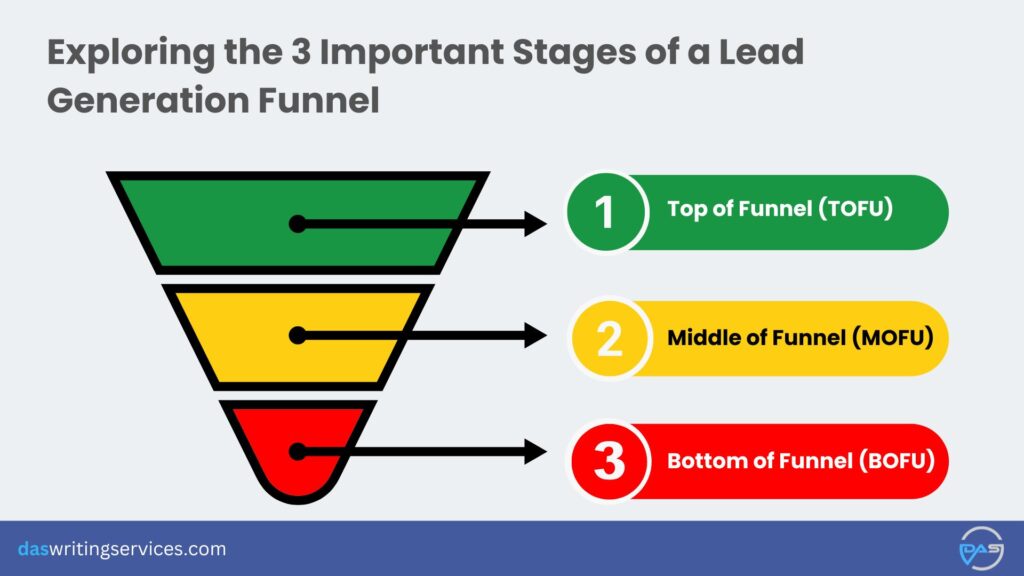
Every lead generation funnel consists of three major stages, which include awareness, consideration, and conversion. Each stage serves a unique purpose and requires different content, messaging, and marketing strategies. Here is a detailed understanding:
- Top of Funnel (TOFU)
The Top of the Funnel is where potential customers first discover your business. At this point, they may not even realise they need your product or service. Instead, they are looking for answers, educational resources, or useful insights. The primary objective here is to attract the right audience rather than sell immediately.
Here are some examples of common TOFU content:
- Educational blog posts
- SEO-optimised website content
- Social media posts
- Videos and infographics
- Podcasts
The goal at this stage is to build credibility and encourage visitors to take their first meaningful action.
- Middle of Funnel (MOFU)
Once prospects know your business exists, they enter the consideration stage. Here, they actively compare solutions and evaluate different providers before making a decision. The objective now shifts from attracting attention to building trust.
This is where personalised communication becomes important. Businesses should demonstrate expertise and showcase real value through educational content.
Here are some examples of common MOFU content:
- Case studies
- Webinars
- Customer testimonials
- Whitepapers
This stage is particularly important in a B2B lead generation funnel, where purchase decisions often involve multiple stakeholders and longer buying cycles.
- Bottom of Funnel (BOFU)
The Bottom of the Funnel is where prospects are ready to make a purchase. They have already researched their options and now need confidence that your business is the right choice. The focus here is on reducing friction and making the buying decision as simple as possible for your audience.
Here are some examples of common BOFU content:
- Product demonstrations
- Free trials
- Pricing pages
- One-to-one consultations
A well-planned funnel lead generation strategy ensures every stage supports the next. It creates a predictable system for attracting, nurturing, and converting prospects into loyal customers.
What is the Importance of Funnel Lead Generation?
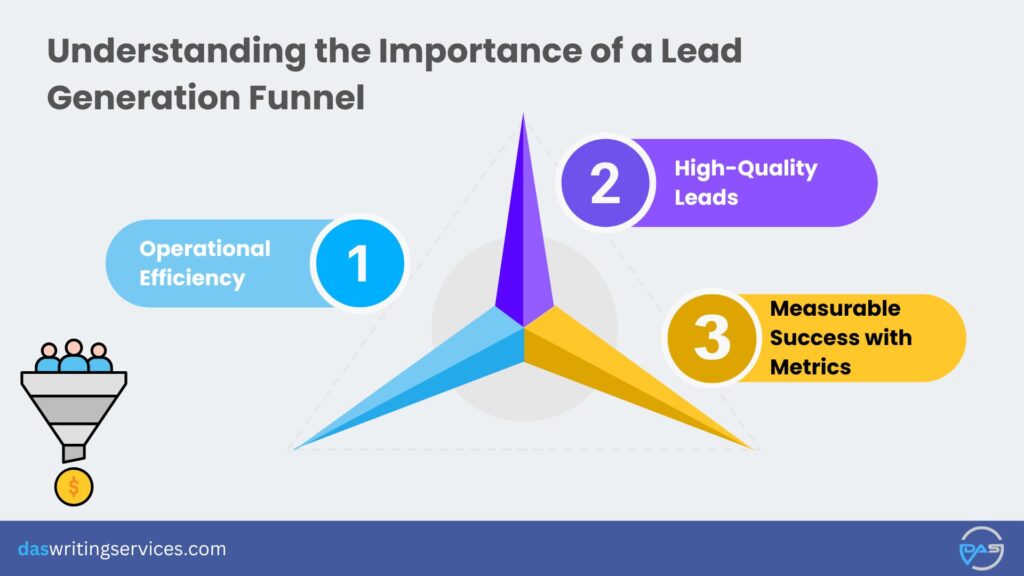
Funnel lead generation is important because it creates a structured path that turns strangers into qualified prospects and loyal customers.
A well-designed funnel also enables marketing and sales teams to work more efficiently. Here is a detailed overview of why lead generation funnel strategy is important for businesses:
- Operational Efficiency
An organised funnel eliminates guesswork from your marketing efforts. Every stage has a defined objective, which makes it easier to understand what content, campaigns, and channels contribute to conversions.
- High-Quality Leads
Instead of collecting thousands of contacts with little buying intent, a structured funnel qualifies prospects before they reach your sales team. Visitors who engage with multiple touchpoints are typically much more likely to convert.
- Measurable Success with Metrics
A major benefit of a structured funnel is that you can measure every stage. Instead of relying on assumptions, businesses can analyse data to identify where prospects enter, where they leave, and which campaigns generate the best results.
How to Build an Effective Lead Generation Funnel?
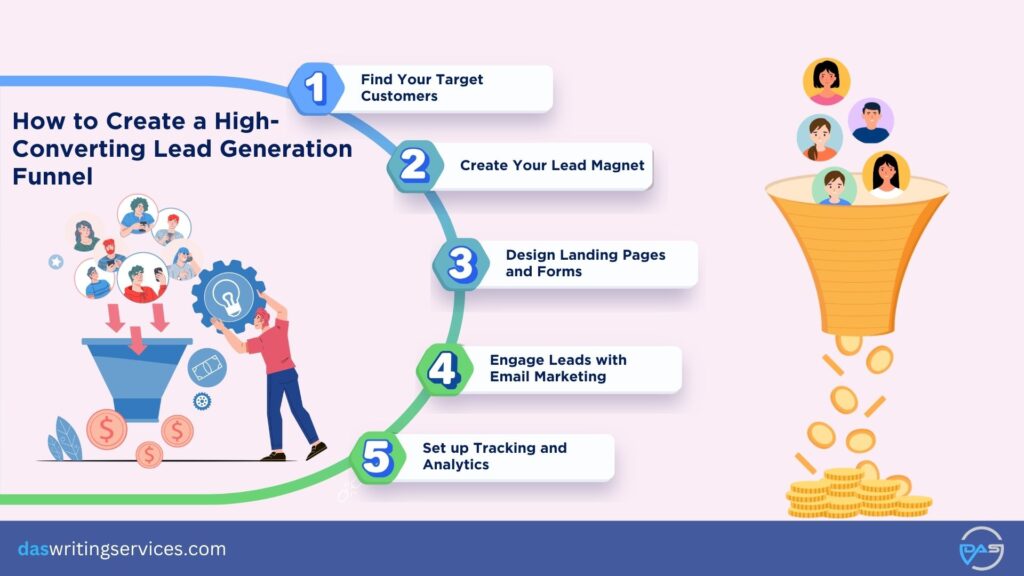
Building an effective lead generation funnel starts with understanding your audience and creating valuable experiences that guide them towards conversion.
Every stage should remove friction, answer customer questions, and encourage prospects to take the next step. Here is a step-by-step guide to executing an effective lead generation funnel for your business:
- Find Your Target Customers
The foundation of every successful funnel begins with knowing your ideal customers. Before creating campaigns or content, identify your audience’s demographics, interests, pain points, purchasing behaviour, and preferred communication channels. This helps you create messaging that resonates with their specific needs.
Businesses should also target long-tail search queries, such as how to build a funnel lead generation strategy, to attract users with stronger purchase intent. The better you understand your audience, the easier it becomes to move them through each stage of the funnel.
- Create Your Lead Magnet
Once you have attracted visitors, the next step is to offer something valuable in exchange for their contact information. A lead magnet should solve a specific problem, provide immediate value, and demonstrate your expertise. Resources such as eBooks, templates, webinars, industry reports, and free tools encourage visitors to engage with your business.
The most effective lead magnets closely align with your products or services. A relevant lead magnet not only increases conversions but also improves the quality of the leads entering your funnel lead generation process.
- Design Landing Pages and Forms
Landing pages play a critical role in converting visitors into leads. A well-designed landing page clearly explains the value of your offer, removes unnecessary distractions, and encourages visitors to complete one specific action. Strong headlines, persuasive copy, social proof, and a clear call-to-action all contribute to better conversion rates.
Lead capture forms should remain simple, especially during the awareness stage. Asking only for essential information, such as a name and email address, reduces friction and encourages more visitors to complete the form.
- Engage Leads with Email Marketing
Most prospects require multiple interactions before they are ready to make a purchasing decision. It makes email marketing one of the most valuable nurturing channels. Sharing educational articles, customer success stories, product updates, and personalised recommendations helps maintain engagement while gradually building trust.
If you are looking to strengthen your email campaigns, blogs, and landing pages, Das Writing Services can create conversion-focused content that supports every stage of your customer journey while maintaining a consistent brand voice.
- Set up Tracking and Analytics
Monitoring user behaviour helps businesses understand where prospects enter the funnel, which pages generate the highest conversions, and where potential customers lose interest. Analytics tools and marketing automation software provide valuable insights that support ongoing optimisation.
Regularly reviewing metrics such as conversion rates, customer acquisition costs, and lead quality enables businesses to make informed improvements. Many organisations also collaborate with the top content writers in India to create data-driven content that attracts qualified traffic and strengthens their sales funnel lead generation strategy over time.
What are the Common Mistakes You Must Avoid in Funnel Lead Generation?
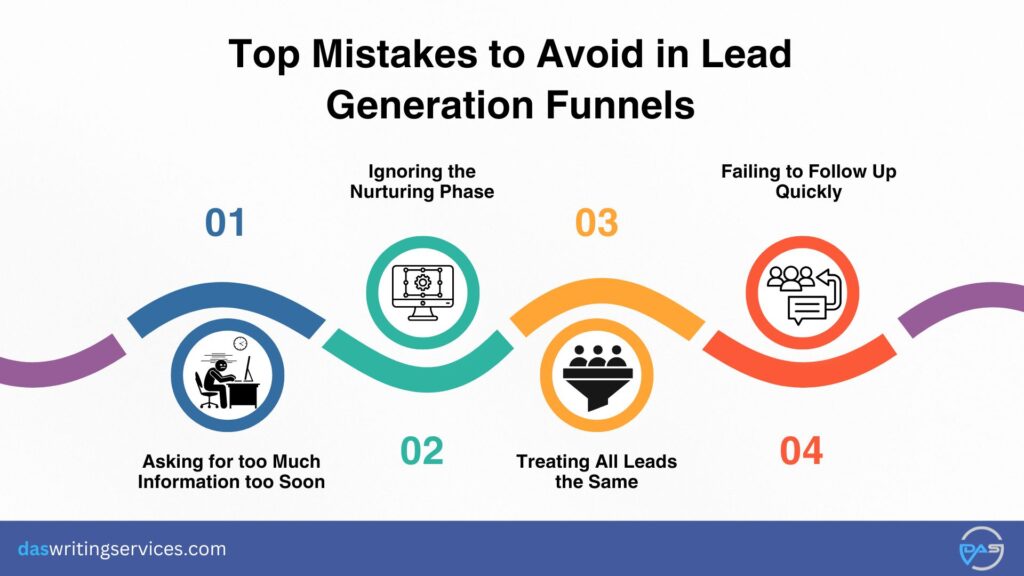
Many businesses struggle with funnel lead generation because they focus solely on acquiring leads instead of nurturing and converting them. According to HubSpot, nearly 30% of marketers say generating leads is one of their top challenges in 2026.
Even a well-designed funnel can underperform if common mistakes create friction throughout the customer journey. Avoiding the following mistakes will help you generate better-quality leads and improve overall conversion rates:
- Asking for too Much Information too Soon
One of the quickest ways to lose potential customers is by making them complete lengthy forms. At the awareness stage, prospects are simply exploring their options. Requesting too many details can discourage them from taking the next step.
Instead, keep forms simple by asking only for essential information. Remember, the objective of funnel lead generation is to start a relationship, not gather every possible detail during the first interaction.
- Ignoring the Nurturing Phase
Many businesses assume that capturing a lead automatically results in a sale. In reality, most prospects need multiple interactions before they are ready to make a purchasing decision.
Without consistent follow-up, potential customers may forget your brand or choose a competitor that remains visible throughout their buying journey.
Creating valuable, audience-focused content requires both strategic planning and expert execution. Partnering with Das Writing Services allows businesses to publish informative, conversion-focused content that keeps prospects engaged throughout every stage of the buying journey.
- Treating All Leads the Same
Not every lead has the same needs, buying intent, or level of readiness. Some visitors may be discovering your brand for the first time, while others are actively comparing vendors before making a purchase.
Sending identical emails or presenting the same offers to every lead often results in lower engagement and missed conversion opportunities. Personalised messaging creates more relevant customer experiences and improves the effectiveness of your funnel lead generation strategy.
- Failing to Follow Up Quickly
When someone requests a demo, downloads a resource, or submits an enquiry, they are actively interested in finding a solution. Delayed responses can reduce that interest and increase the likelihood of them engaging with a competitor instead.
Automated workflows, CRM systems, and email sequences can help ensure every enquiry receives a timely response. A successful funnel lead generation process does not end when a lead enters the funnel. It depends on maintaining momentum until the prospect is confident enough to make a purchasing decision.
Conclusion
Funnel lead generation is a strategic process that attracts the right audience, builds trust through valuable content, nurtures relationships, and converts qualified prospects into loyal customers.
By understanding each stage of the funnel, creating relevant website content, optimising landing pages, nurturing leads through personalised communication, and continuously monitoring performance, businesses can build a scalable system for long-term growth.
Frequently Asked Questions
- How is a lead generation funnel different from a sales funnel?
A lead generation funnel focuses on attracting and nurturing potential customers until they become qualified leads. On the other hand, a sales funnel begins once those qualified leads enter the sales process and guides them towards making a purchase.
- Do B2B funnels need different content than B2C?
Yes. B2B buyers usually require more detailed, educational content such as case studies, whitepapers, webinars, and industry reports because purchasing decisions involve multiple stakeholders and longer sales cycles.
- How many lead generation funnels should I run at once?
The ideal number depends on your products, services, and target audiences. Many businesses create separate funnels for different customer segments to deliver more personalised experiences and improve conversion rates.

Subhodip Das is the founder and CEO of Das Writing Services Pvt. Ltd. He has an experience of 12 years in the field of Digital Marketing and specialises in Content Writing and Marketing Strategies. He has worked with well-established organisations and startups helping them achieve increased Search Engine Rank visibility. If you want to grow your business online, you can reach out to him here.


