Ever wondered why leading SaaS companies such as HubSpot, Zoho, and Canva have such an extensive content repository? For them it is the primary driver of engagement, consumer trust, and conversions.
Creating a SaaS content marketing strategy that is highly relevant to the demands of B2B buyers has been a tried and tested method to scaling into a global brand. According to Google, the majority of consumers, including 69% of tech buyers, research products on digital channels before making a purchase.
Creating SaaS content not only nurtures these prospects but also bridges knowledge gap among users. This blog unpacks 9 effective SaaS content marketing strategies to boost your growth.
What is Saas Content Marketing?
Software as a Service (SaaS) companies can employ a SaaS content strategy to both acquire and retain their target clients. If done effectively, B2B SaaS companies may naturally attract clients without spending money on promotional campaigns.
Let us take the example of Zoho to understand B2B SaaS content marketing better.
Zoho’s SaaS content marketing strategy includes posting relevant and consistent content catered to a specific audience using a variety of channels such as blogs, social media, and email marketing. The primary goal is to attract, engage, and retain users throughout the buying experience.
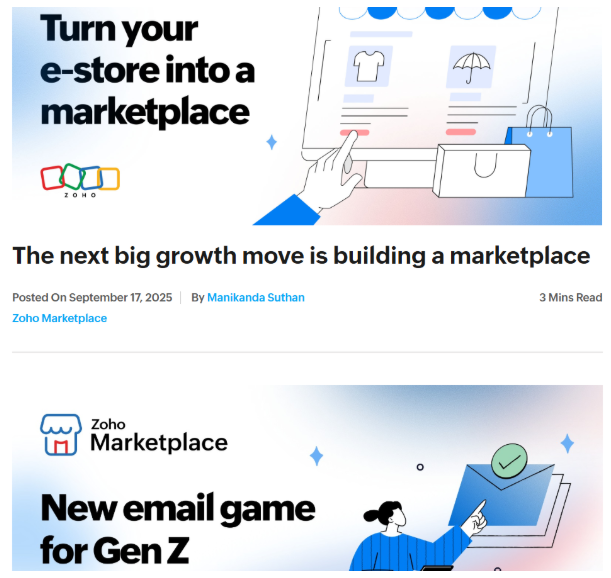
The above picture shows the blog section of Zoho’s official website. It acts as a primary centre, with postings covering a wide range of business, technology, and Zoho product updates.
It also posts by providing advice and strategies for company development, marketing, sales, and personnel management.
Why Content Marketing Matters for SaaS?
As discussed earlier, a powerful SaaS content marketing helps to build trust, attract the target audience, and reminds them of the product’s value propositions. However, there are more reasons why you should opt for a B2B SaaS content strategy.
B2B transactions frequently involve clients from different industries, each with its own set of priorities. Content marketing enables SaaS companies address the diverse needs of the respective industry.
Moreover, SaaS consumers spend most of their time researching their problem and assessing tools. If your blog posts assist people along the road, you are more likely to gain their trust. According to SaaS Partners, 9 out of 10 SaaS companies prefer blog posts to promote their offerings.
Sharing unique thoughts or useful content establishes your SaaS brand as one to trust. This is especially critical when marketing something new.
For example, Canva’s SaaS content marketing approach is based on the Jobs-to-Be-Done framework. This makes design available to everyone through a freemium model and unique product features.
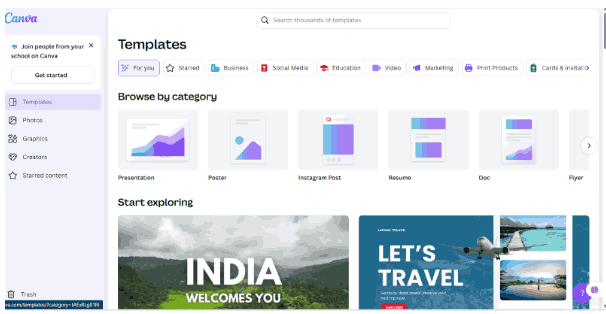
Their strategy involves users becoming brand advocates by creating and sharing designs with built-in watermarks on free templates, which results in free advertising.
Lastly, content marketing addresses frequent queries and eliminates uncertainty. This allows sales to focus on closing deals.
Creating a Powerful Saas Content Marketing Strategy: 9 Effective Ways
Now that you have an idea about what is content marketing for SaaS companies, you can have a look at the top 9 effective ways to create a powerful SaaS content marketing strategy:
1. Optimize Content around your Audiences’ Pains
Remember, you produce SaaS content for real individuals. You must think about what particular tasks they complete each day, and what problems they face on a regular basis. You may know these by reading sales notes and conducting research in relevant areas.
For instance, Semrush has recently created statistics-driven blog content to address a common concern prospects ask during sales calls: ‘Can AI Content Rank on Google?’
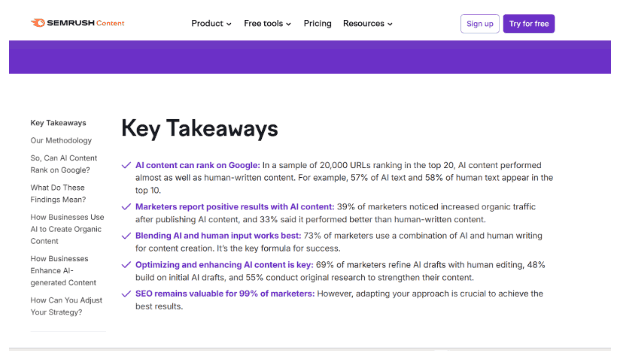
It has been proven that AI content can rank equally well as human-written content, if it is done correctly. This has helped Semrush overcome a significant purchasing barrier to their AI enabled content solutions.
This content marketing technique also met the conversion objectives of Semrush despite not having a promotional expense.
2. Building a Solid Foundation of Your Services
Before you start planning for your next content, your firm must have suitable product pages and lead-generating forms on its website. You must understand exactly how your solution solves consumer problems. As a result, your content can help support this narrative.
For instance, the academy courses offered by Hubspot build a solid foundation on their services of customer relationship management.
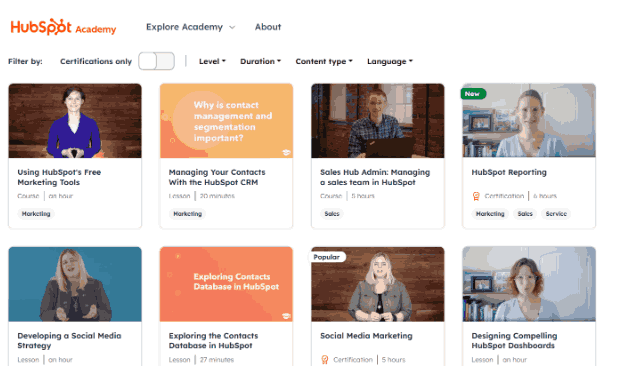
HubSpot Academy’s professional certification programmes have been spotted significantly, with over 250,000 qualified professionals by early 2025. This demonstrates a great enrolment and engagement in its free courses.
Moreover, a user-friendly and engaging website enables visitors to locate what they are looking for, comprehend your products, remember your brand, and convert.
3. Select Relevant Topics and Keywords
Keyword research is one of the basic but crucial strategies for SaaS content writing to create the foundation of your content marketing plan, particularly if your SaaS company’s focus is on maximizing organic search visibility.
You can use Ahrefs or Semrush as the keyword research tool, although there are many more excellent platforms available. Ahrefs shows a wide range of keyword recommendations collected directly from Google.
According to Ahrefs, Google Ads Keyword Planner overestimates keyword search volumes approximately 55% of the time, while being relatively accurate around 45% of the time.
Regardless of the platform you choose, you need something that can help you locate themes that are relevant to your audience.
4. Use Your Data
Creating an effective SaaS content marketing strategy requires sharing your insights with your audience and peers in the industry. Authority and originality is a valuable currency to succeed in content marketing.
Try to create corporate leadership reports, host data, and publish content that engages and proves helpful for B2B audiences.
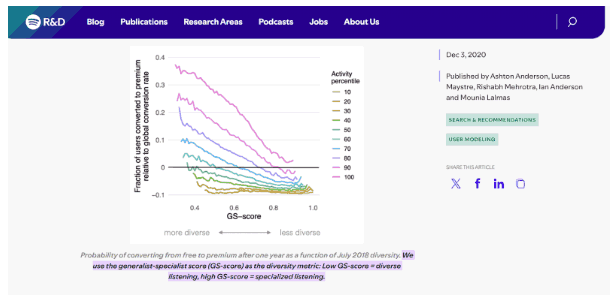
The above infographic shows that Spotify routinely provides information from its massive user data. This data-driven content is easily shared and underlines Spotify’s leadership in music analytics.
Hence, find the right mix and leverage both quantitative and qualitative user data to create meaningful and informative content.
5. Developing a Conversion First Strategy
A common mistake most of the B2B SaaS companies make is that they fail to categorise their topics as per their content marketing goals.
Content strategy is more than just choosing keywords that are related to the target demographics. Rather it is also about optimizing the high-intent pages for conversion.
Try to place CTAs strategically across the relevant pages to capture the contact details of your audience which may very well become your prospective buyer.
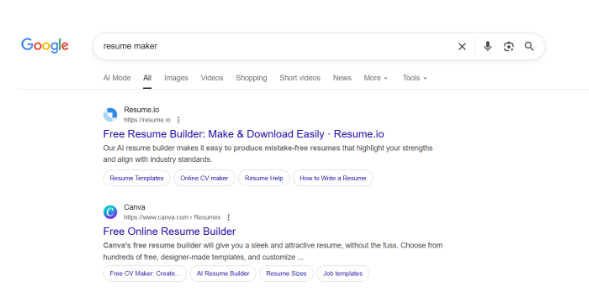
For instance, Canva ranks for keywords such as ‘resume maker’. This is not just a traffic-attracting keyword; it targets people with purchase intent who want to test Canva’s design tools.
6. Create Scalable Content Campaigns
Clear and concise marketing approaches help SaaS brands to increase content creation without burning out their staff or missing deadlines. Since your publication volume grows, effective content operations keep things organized.
That is why you should make simple and scalable content operations. For instance, the Notion Community team has engaged several contractors to assist in testing and scaling influencer marketing.
The objective was to locate inventors from many fields, including education, technology, entrepreneurship, and productivity. These creators might discuss the scope of Notion’s application cases.
Connect with our SaaS experts today to get fully managed scalable content solutions for your enterprise
7. Converting Freemium Users into Paid Users
Freemium consumers are drawn to the software because of its free features. This is typically beneficial, especially for SaaS companies that want more consumers to utilize their SaaS services.
However, it rapidly becomes an issue when you are unable to convert enough of those people into paying clients. According to Crunch Marketing, freemium conversion rates range from 1% to 10%. Although, anything above 2% is considered an excellent conversion rate.
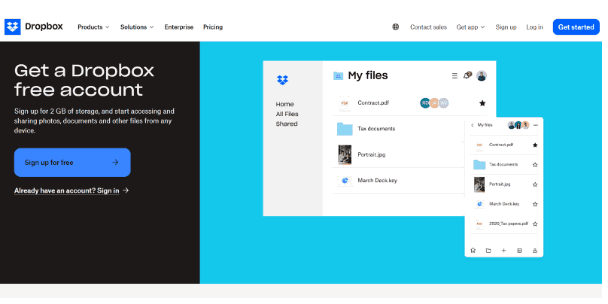
Freemium has been effective as a business model for the SaaS company Dropbox. The simplest and most apparent tip is to avoid making your freemium plan overly comprehensive.
8. Maintain Organic Integration
Using an effective SaaS content marketing strategy, you can differentiate yourself by demonstrating how your solution fits into real-world use cases.
This approach addresses a genuine issue and organically incorporates your product as part of the solution.
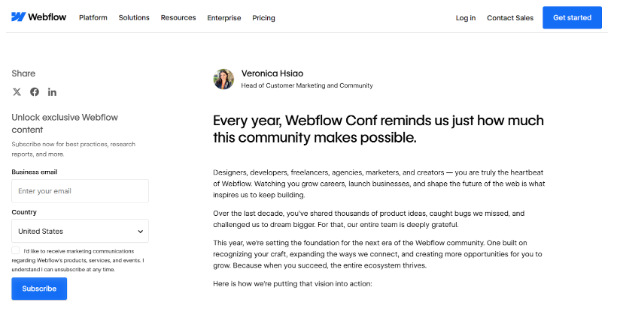
For example, the writing of Webflow’s blogs relates product features to real-world workflows, such as scaling design systems or analyzing website performance. This allows readers to see the technology in action without feeling marketed to.
Consider addressing real-life difficulties rather than creating generic how-to guides or analyzing product-related enquiries during sales calls.
9. Addressing a Specific Painpoint
Answering search intents only will not attract a large audience. As a SaaS content marketer, you must focus on the problem and pain points that your solution addresses.
When you tailor your content marketing strategy to a problem, you may reach a larger audience while remaining relevant to potential consumers.
Try to make these articles 20% about your SaaS product in terms of assisting in the solution of that problem, and 80% information that they can utilize without your SaaS product.

Grammarly’s blog covers typical writing challenges like grammar errors and tone issues, while demonstrating how it solves them. This problem-solving technique inspires trust.
Benefits of Crafting SaaS Content Marketing Strategies
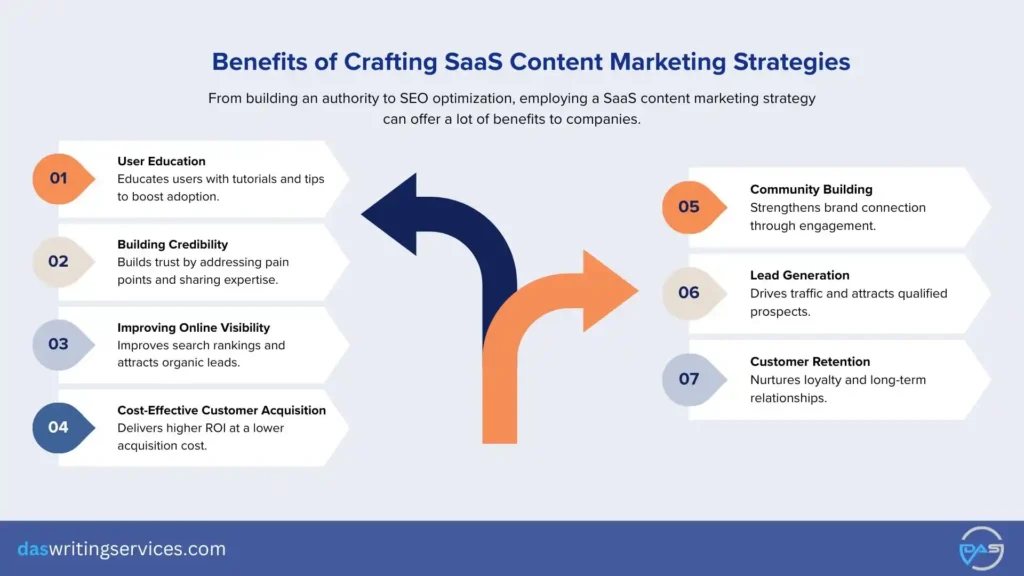
From building an authority to SEO optimization, employing a SaaS content marketing strategy can offer a lot of benefits to companies. Below are some of the benefits:
1. User Education
Employing content-led SaaS marketing strategies enables learning for the audience. With these strategies, you can offer tutorials, tips, and tools to help users get the most out of your product. This method promotes user adoption and product stickiness.
2. Building Credibility
Producing quality content increases the credibility of a SaaS company and enhances brand positioning. SaaS companies may create trust with prospects and existing customers by addressing industry pain points. These include responding to frequent questions and providing pro tips.
3. Improving Online Visibility
Creating quality content increases your ranking 2x in search engines. It is beneficial for SaaS companies to capture organic leads, particularly when customers seek solutions for specific pain points that the program addresses.
4. Cost-Effective Customer Acquisition
Content marketing frequently outperforms traditional advertising strategies in terms of return on investment (ROI). SaaS companies may attract potential clients more effectively and affordably to achieve their content marketing goals. This can be achieved by generating interactive content that answers their requirements.
5. Community Building
By creating engaging SaaS content, you can help consumers feel more connected to your brand. Producing user-generated content and insights can help you align your marketing goals with consumer needs.
6. Lead Generation
Engaging content also hooks prospective clients. With such SaaS content, you may generate free traffic to your website or social media sites that people want to read.
7. Customer Retention
While gathering new clients, keeping existing ones is more beneficial in the long term. Creating engaging SaaS content, you can take care of these relationships with trust and respect. This can benefit your organisation in the long run.
How to Distribute Your SaaS Content?
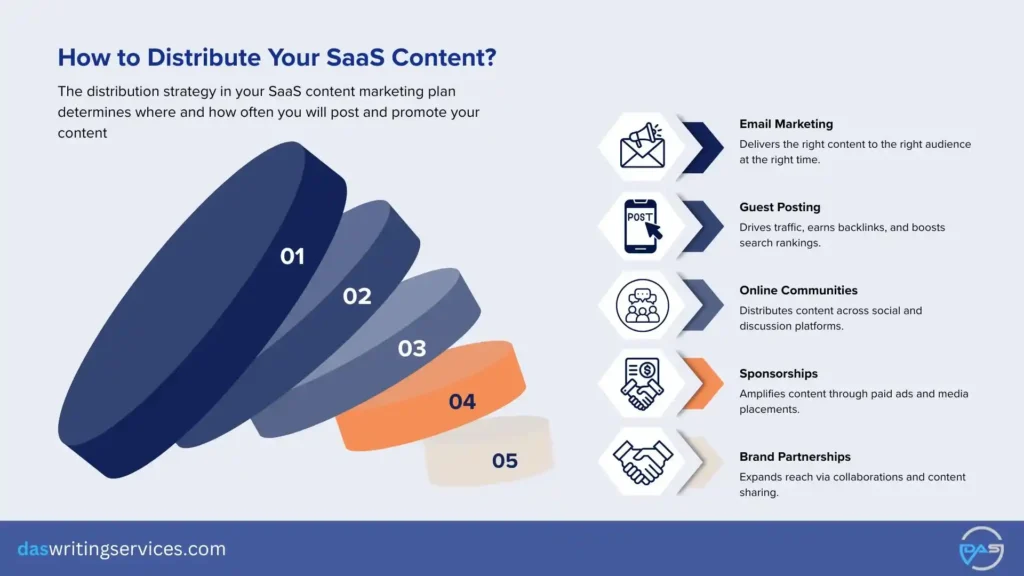
The distribution strategy in your SaaS content marketing plan determines where and how often you will post and promote your content because there is a huge difference between content writing vs content marketing. Your approach should answer questions like where you will publish your on-site content, and whether it will be indexed on your blog, in a reference guide, or elsewhere.
Here are some of the channels you can use to distribute your content:
1. Email Marketing
With an experienced email or lifecycle marketer on your team, you may use your content lifecycle diagram to deliver your current website content to the appropriate individuals at the right time.
2. Guest Posting
Guest posting is one of the most effective distribution strategies that can significantly increase traffic to your website. It also provides backlinks to help you improve your domain authority and rank better in search engines.
3. Online Communities
Posting in online communities like Facebook, Instagram, Reddit, and other platforms is an excellent method to distribute your SaaS content.
4. Sponsorships
If you have a high budget, you may boost content on Meta platforms like Facebook, buy clicks on Google, run advertisements, or purchase sponsorship placements from media businesses.
5. Brand Partnerships
You can also opt for brand partnerships with other brands in your sector. This includes guest blogging, sharing each other’s SaaS content on social media, newsletter collaborations, and more.
Challenges of SaaS Content Marketing
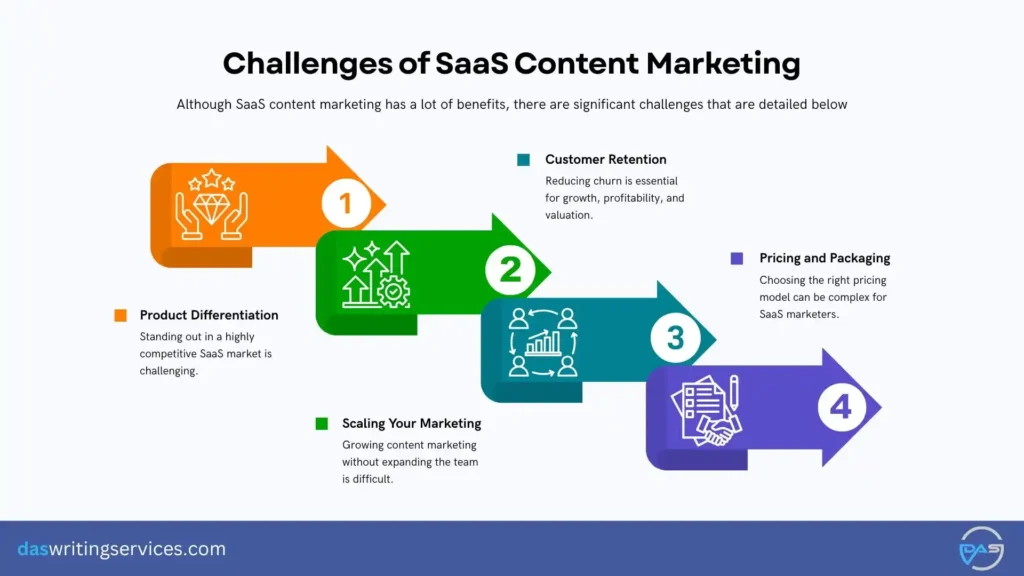
Although SaaS content marketing has a lot of benefits, there are significant challenges that are detailed below:
1. Product Differentiation
With each companies using more than 10 SaaS tools on average, there is an increased demand for SaaS products. However, with so many options in each sector, the SaaS business is very competitive, and standing out from the crowd with your product is not always easy.
2. Scaling Your Marketing
Scaling your content marketing activities is a frequent challenge for expanding SaaS operations. As your company grows, you must ensure that your marketing plan expands alongside it. Sometimes the objective is to do this without considerably increasing the workforce.
3. Customer Retention
Customer retention is a significant concern in SaaS marketing teams. Try to reduce your turnover rate to ensure company development and profitability. It also increases your valuation, which can help you secure capital.
4. Pricing and Packaging
Knowing how much to charge for your products can be a major challenge. Marketers often confuse which pricing model they should adopt or whether it is cost or value-based. The ideal strategy to overcome this challenge is to compare the various SaaS pricing structures and choose which one best corresponds with your goals.
Moreover, implementing the aforementioned SaaS content marketing approaches can help you overcome these challenges.
Takeaway
SaaS content marketing differentiates, fosters trust, and engages. Its adaptability enables it to remain relevant and responsive to the evolving SaaS market.
However, evaluating content’s potential and efficiently distributing it can help you reach your marketing goals. Every piece of content provides an opportunity to promote your business, interact with your target audience, and drive growth.
FAQs on SaaS Content Marketing
1. How to measure SaaS content marketing?
You can measure your SaaS content marketing with a lot of metrics. Some of them are organic traffic, click-through-rate, bounce rate, and SERP ranking.
2. What is SaaS content writing?
SaaS content writing entails developing content to promote and sell SaaS products. These include website content, blog articles, email newsletters, eBooks, case studies, and product descriptions.
3. How to write SaaS content?
You can write SaaS content by implementing some practices. These are practising regular writing, building user experience awareness, knowing respective SaaS products, using simple language, and studying copywriting examples.

Subhodip Das is the founder and CEO of Das Writing Services Pvt. Ltd. He has an experience of 12 years in the field of Digital Marketing and specialises in Content Writing and Marketing Strategies. He has worked with well-established organisations and startups helping them achieve increased Search Engine Rank visibility. If you want to grow your business online, you can reach out to him here.
Leave a comment