
Get Your Website Content Audit

 Add as preferred on Google →
What if everything you knew about getting discovered online just became irrelevant overnight? For the past 20 years, SEO was the rulebook to ranking and reaching the right kind of audience. Keywords, backlinks, rankings – you did it right; Google rewarded you with traffic and conversions.
Then AI came in, and suddenly you’re hearing this buzz phrase, ‘SEO is dead’ – and it might not just be clickbait anymore. Now, customers aren’t just typing keywords into search bars. They’re asking full questions to Meta AI, ChatGPT and Perplexity. These answer engines don’t show 10 blue links, but provide one crisp answer – yours, or your competitor’s.
It’s a complete rewrite via answer engines, AI summaries and intent graphs deciding who gets discovered and who doesn’t. Explore what possibly led to the death of SEO and how the current scene for discovery online works. Also, let’s establish once and for all – is SEO really dead or just evolving?
How Have Answer Engines & AI Changed the Game for Online Brand Visibility?
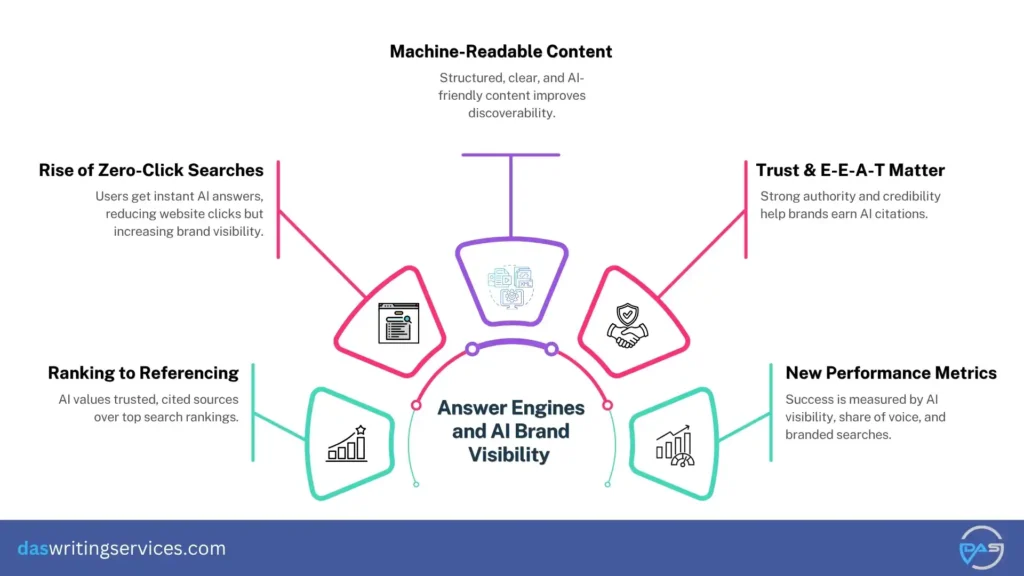
AI and answer engines have majorly shifted the scene for brand visibility. From getting clicks on a list of links to earning trusted citations within AI-generated responses, discoverability rules now look different.
This has prompted a measurable change from traditional SEO tactics to Generative Engine Optimisation (GEO)/Answer Engine Optimisation (AEO) strategies.
Here’s how the focus has moved beyond SEO, onto prioritising ranking on AI answer engines:
- Ranking to Referencing
Traditionally, search results that would result in visibility were all about claiming the #1 spot on page one of SERP. Today, search journeys often end even without a click.
AI synthesises answers from several sources. This means your goal is to be the authoritative source/trusted brand that AI cites in its response. If an AI engine is unable to recognise your brand in its ‘decision set’, you may even stay entirely invisible regardless of content marketing.
This emphasises the need for quality content that establishes authority over respective subjects. We, at Das Writing Services, host a dedicated team of in-house writers who produce highly structured and quotable content across various niches. AI models prioritise content that answers search queries directly.
If you’re looking to provide true value through content, backed by real-world expertise, we’re just a call away!
- Zero-Click Searches are Common Now
Users in 2026 are increasingly relying on chatbots like ChatGPT, Perplexity, or Gemini. AI Overviews in Google is also bypassing traditional research phases. These give direct, quotable answers to people who are looking for quick information.
In fact, according to Ahrefs, “AI Overviews are associated with a 58% lower average click-through rate for the top-ranking organic page.”
While there has been a drastic reduction in click-through rates (CTR) to websites, it doesn’t mean that visibility has dropped as well. Instead, brands frequently see a hike in unlinked brand mentions/direct, branded searches as audiences follow up with AI’s recommendations.
- Machine Readability & Structuring
AI engines don’t read/browse websites as humans do, but completely rely on raw HTML, structured formats and clear entity associations.
Brands need to gear up and optimise for immediate information extraction by incorporating question-and-answer formatted headings and short, answer-capsulated paragraphs directly answering user queries.
Wondering how to maintain such AI optimisation-friendly guidelines in your content? Choose Das Writing Services for audience-centric content, optimised for both traditional search and modern AI-driven engines.
We’ll take charge of the technicalities if you’re struggling with them, guaranteeing results over time.
- Trust, Authority, and E-E-A-T Still Take Priority
AI models are programmed to avoid ‘guesswork’ by prioritising verifiable/authoritative sources. The AI-generated answers choose citations favouring brands with a strong, consistent and reliable digital presence.
This allows the generated answers to maintain consistent information across third-party directories and profiles. These are typically foolproof sources for publishing original statistics/quotes.
- A Different Look at Analytics
Keyword rankings and click volume are traditionally critical performance indicators. However, they are becoming less reliable now.
Instead, brands are now measuring success by tracking ‘share of voice’ in LLM responses and monitoring branded organic searches (on Google Search Console).
What is the Role of Intent Graphs in 2026?
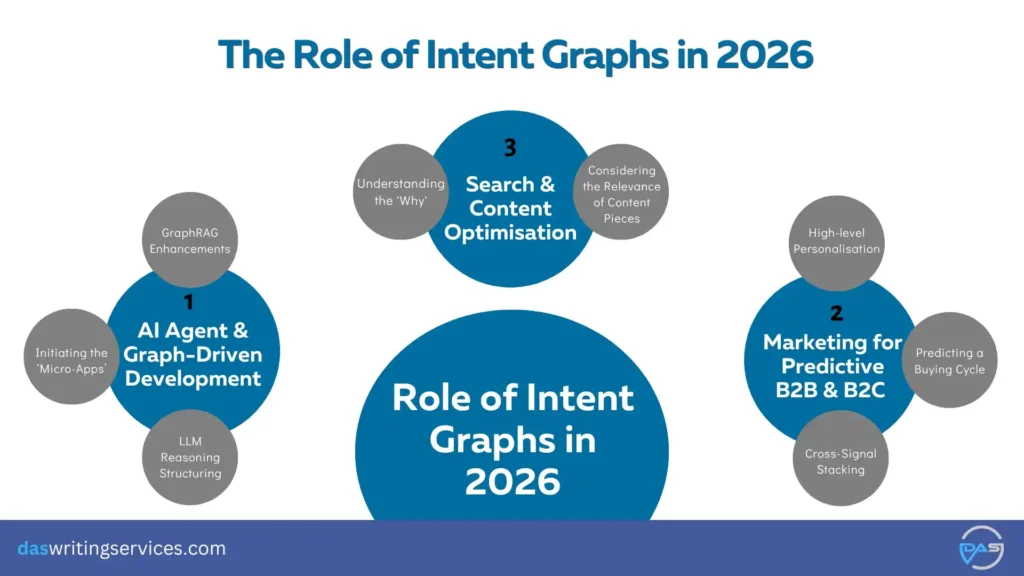
In 2026, intent graphs act as dynamic maps which track potation individual requirements. They are different from static keywords and data points.
While traditional knowledge graphs display what entities are, intent graphs infer why users/autonomous agents are doing what they do. They highlight why users are taking action, tracing goals, dependencies and future-friendly actions.
Here’s how intent graphs in 2026 serve their purpose:
- AI Agent & Graph-Driven Development
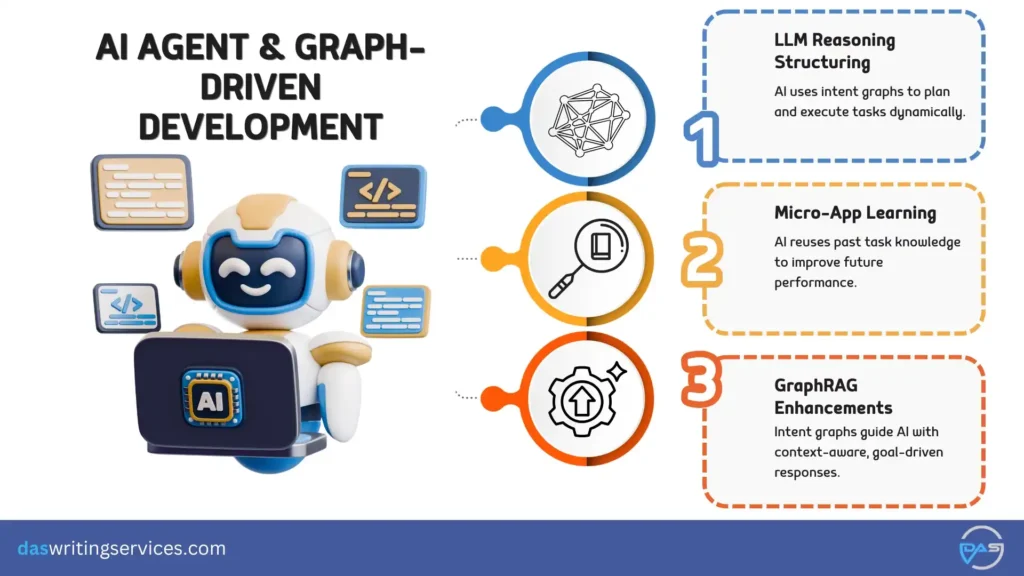
In AI development, intent graphs fill the gap between human-initiated instructions and execution. Here’s how they function:
- LLM Reasoning Structuring: Before, there was a rigid emphasis on step-by-step procedures. Now, AI agents use LLM reasoning structuring to navigate intent graphs and determine what tasks demand attention with more scope for dynamic action-taking.
- Initiating the ‘Micro-Apps’: Previous task decisions, attempts and outcomes are logged into the graph under ‘skill files’. When such tasks arise again later in the future, the agent draws from the already-existing encoded knowledge without having to start from the beginning.
- GraphRAG Enhancements: Conversational and Retrieval-Augmented Generation (RAG) systems implement intent transition paths. These are built in reference to historical dialogue, with the aim of mapping the optimal route to the goal of a user.
- Marketing for Predictive B2B & B2C
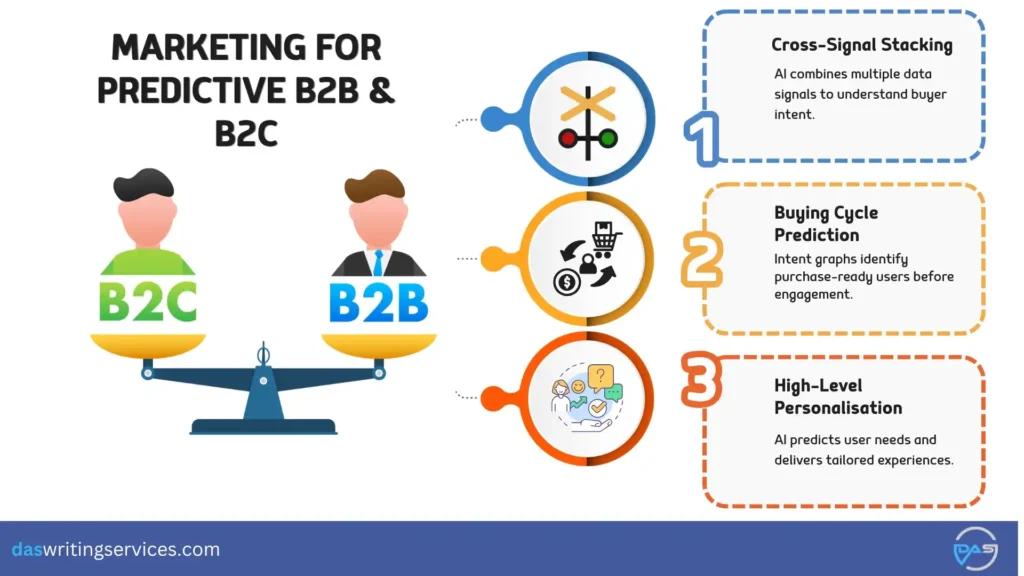
Tracking cookies/single-dimension identities are now phasing out; intent graphs are instead building a multidimensional, nuanced picture of buyers/accounts.
- Cross-Signal Stacking: These processes the live contextual signals, content sentiment that could possibly inspire future behaviour and engagement from previously run campaigns.
- Predicting a Buying Cycle: Updated and advanced platforms combine competitor movements, macro-economic trends and browsing signals from stakeholders to flag accounts. These accounts were entering a buying phase before direct engagement even took place.
- High-level Personalisation: This allows digital storefronts/marketplaces to move up from the standard search recommendations to anticipating the next possible step in an individual’s purchasing timeline.
- Search & Content Optimisation
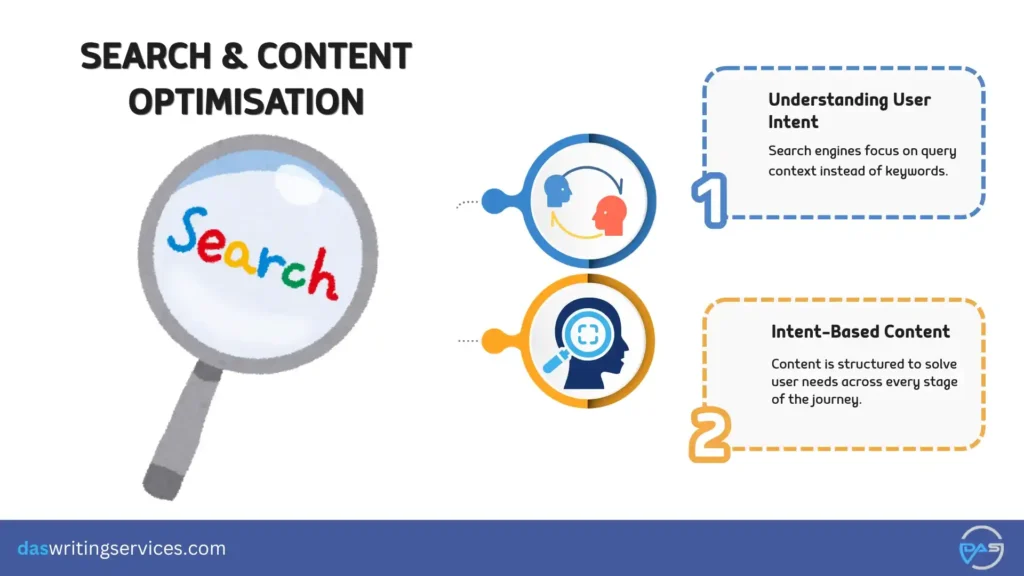
Zero-click searches and AI Overviews are currently dominating discovery. Search strategies have turned to intent/context rather than traditional keyword tracking. Here’s what’s necessary as the next step:
- Understanding the ‘Why’: Search engines now use dynamic intent graph embedding to make sense of the intent of the user. They essentially translate plain English queries to have them serve as contextual responses.
- Considering the Relevance of Content Pieces: Businesses trace out their content architecture as per the intent graphs. Thus, they can ensure that they answer the explicit problem a user is looking to solve. It’s achieved by capturing valuable micro-moments as the research journey continues.
With all of that said, we can recognise that there is some truth to the matter when they say ‘SEO is dead’. But is it entirely the case, though? Not really; so, let’s understand why.
How Has SEO Evolved in 2026?
SEO has indeed evolved, going from simplified keyword matching to ‘Search Everywhere Optimisation’. It now majorly focuses on AI-driven discovery.
SEO is not just chasing traditional ‘blue links’ on the first page of SERP. Modern SEO prioritises visibility across Generative AI answers, conversational chat-bots, and specialised platforms like Reddit and YouTube.
Ever wondered how transactional keywords have continued to stay extremely relevant in 2026? Search queries signal a user’s intent to make a purchase/complete a specific action (for example, buy, hire or subscribe), which is responsible for direct ROI.
Optimising for these terms is crucial as they target the bottom-of-the-funnel traffic, capturing users who are ready to convert. Searches for product categories necessitate the need for fool-proof SEO-optimisation to boost the chances of concerned brands showing up as ‘recommendations’.
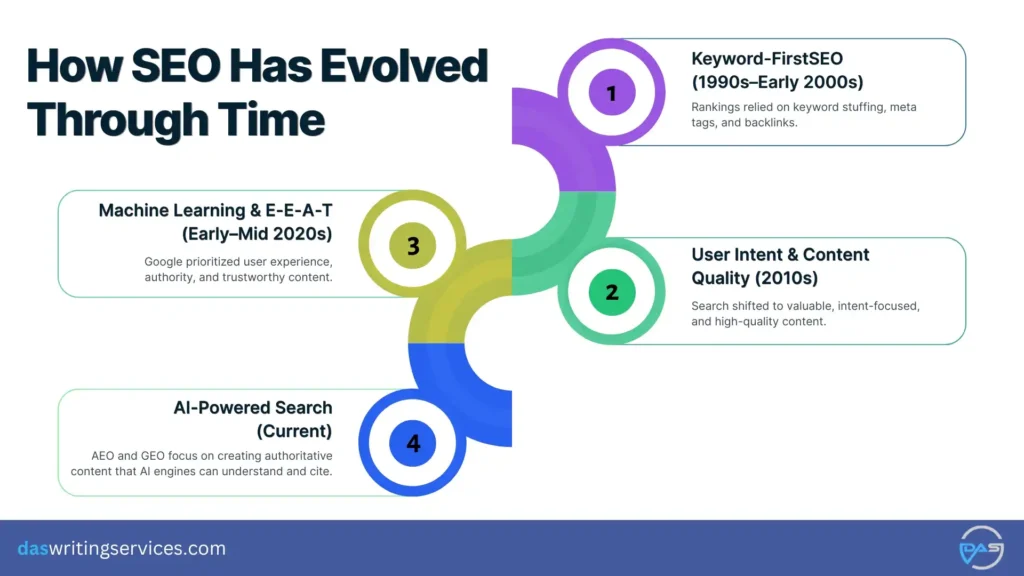
Here’s a brief overview of how SEO has evolved through time:
- Keyword Stuffing & Usage of Meta Tags (1990s – Early 2000s)
The sole strategy was to heavily rely on cramming pages with keywords, manipulating Meta tags and buying backlinks. Search logic matched up with basic string-matching. Whoever repeated a key phrase or a word the most usually ranked first on the SERP.
- Prioritising User Intent & Quality of Content (2010s)
With notable updates like Google Panda and Hummingbird, there has been a shift in the focus to semantic SEO search. It prioritises understanding the meaning/context of a query instead of only the isolated keywords.
The search logic aligned with the phrase, ‘content is king.’ Bettering user experience (UX), publishing authoritative information and optimising page speed were the baselines to abide by.
- Machine Learning & Dependable Experience (Early – Mid 2020s)
Machine learning algorithms started to analyse how users interact with the published content. Google introduced E-E-A-T (Experience, Expertise, Authoritativeness, and Trustworthiness) to filter out generic, low-quality information pieces.
With retrieval-based logic, Natural Language Processing (NLP) lets engines grasp onto and tackle complex questions with ease.
- Generative AI & Conversational Search (Current Scenario)
The modern content era requires optimising for AEO (Answer Engine Optimisation) and GEO (Generative Engine Optimisation). It’s more about getting one’s brand recognised and cited within AI-generated summaries across Google Gemini, ChatGPT, Perplexity, etc.
The search logic aligns with intelligent contextual extraction. Users prefer the conversational tone of interaction, looking to quickly seek contextualised answers at once.
At Das Writing Services, we adopt a hybrid approach combining the foundational rules of traditional SEO with the authoritative, context-driven demands of modern AEO and GEO. Modern search necessitates establishing holistic, intent-first content.
Therefore, our in-house writers create readable content for humans while structurally optimising for AI.
Final Word
Yes, you’ll probably still keep hearing about how ‘SEO is dead’ – whereas it’s simply shedding its old skin. It’s true that keywords and backlinks alone won’t get you discovered anymore. When answer engines pull everything the users need to know from intent graphs, you have to inevitably level up your content to stay relevant.
Now get rewarded for clarity, authority and reliable, quick answers to real questions. Brands that adapt will dominate the conversation even inside of AI results. Those that don’t may disappear, even if they rank #1 on page one.
Are you ready to stay discoverable in the era of AI? We, at Das Writing Services, help brands create content that search engines trust to cite. From traditional SEO-optimised, intent-driven blogs to AEO-optimised pages, our in-house writers make sure you show up where it counts.
So, don’t get replaced by those AI summaries; become the source it quotes. Book a content audit today, and let’s rewrite your brand’s visibility together!
Frequently Asked Questions
Even if there’s some truth to the controversial statement about SEO being dead, it does not paint the complete picture. Traditional SEO is fading, but searches are evolving into Answer Engine Optimisation. Keywords matter – but clarity, authority, and direct answers take priority. Google/AI tools reward content that solves intent, instead of just matching phrases.
Yes, but backlinks help with AI discoverability indirectly. AI models are trained as per credible sources. High-authority backlinks signal your brand’s trustworthiness. These make AI more likely to cite you. Quality now beats quantity in 2026.
The key is to structure your content for machines as well as humans. So, answer questions directly in the first 2 lines after formulating the subheadings in question format. Make sure to use clear headings, lists and easily digestible information. Also, build topical authority with interlinked content.
Keywords are essentially what people type into the search bar. Intent graphs account for ‘why’ they’re searching for it. AI draws information from such graphs to understand the context, predict follow-up questions and set real goals. Optimising for intent towers over stuffing keywords in 2026, offering more scope and ease of quick research.
SEO optimises the content for ranking high on search engines. AEO, on the other hand, optimises for citations on answer engines. It focuses on being clear and quotable with its answer, not just becoming the #1 ranking link on SERP.

Subhodip Das is the founder and CEO of Das Writing Services Pvt. Ltd. He has an experience of 12 years in the field of Digital Marketing and specialises in Content Writing and Marketing Strategies. He has worked with well-established organisations and startups helping them achieve increased Search Engine Rank visibility. If you want to grow your business online, you can reach out to him here.


