Content writing involves creating narrative driven blogs & website content that inform and educate users. Copywriting, on the contrary, is all about creating short, direct and persuasive marketing copies or captions that encourages users to convert or take an action.
To the uninitiated, writing is just writing. But both copy and content writing serve different purposes in marketing and knowing about the two help marketers take strategic user oriented decisions.
This blog relates the differences between copywriting and content writing that set them apart and which one is effective at which stage.
Looking for engaging content that converts? Click below to get a free sample today!

Copywriting vs Content Writing: The Comparison at a Glance
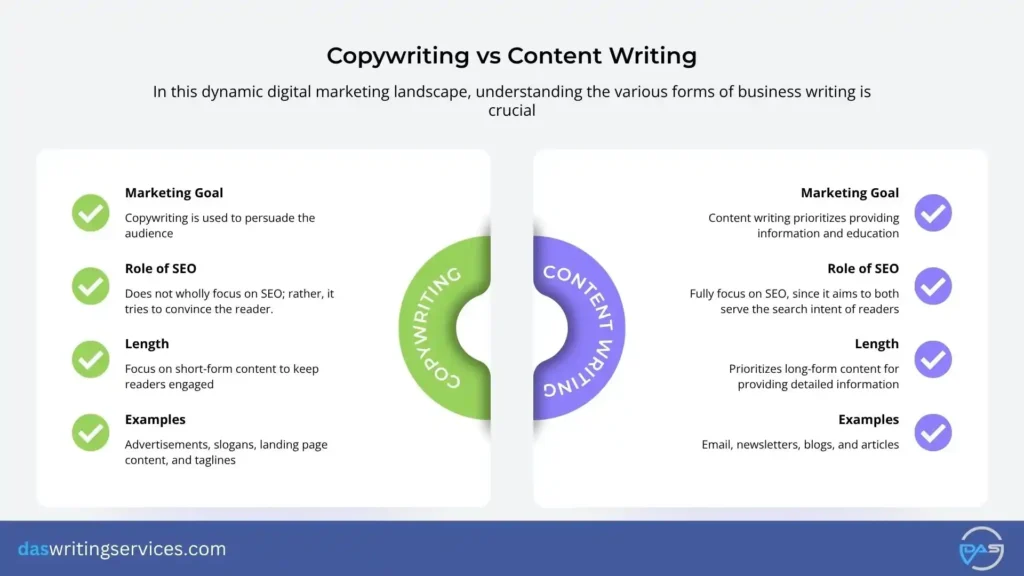
In this dynamic digital marketing landscape, understanding the various forms of business writing is crucial. The table below highlights the differences between copywriting and content writing:
| Aspect | Copywriting | Content Writing |
| Marketing Goal | Copywriting is used to persuade the audience or take action to purchase any product. | Content writing prioritizes providing information and education about specific products or services to the readers. |
| Role of SEO | Does not wholly focus on SEO; rather, it tries to convince the reader. | Fully focus on SEO, since it aims to both serve the search intent of readers and ensure a higher rank on search engines. |
| Length | Focus on short-form content to keep readers engaged | Prioritizes long-form content for providing detailed information on a business offering or answering a question |
| Examples | Advertisements, slogans, landing page content, and taglines | Email, newsletters, blogs, and articles |
What is Copywriting?
A copy or ad copy is generally a written piece that convinces the audience to take an action. In simple words, a copy is just like a text that persuades them to purchase or sign up for a newsletter or product.
Compared to other writing types, the format of copywriting is short and aims for a quick response from the audience. For this purpose, copywriting ends with a call to action to make readers take action.
Pay-per-click (PPC) advertisements, product descriptions, and website content are some common examples of a copy.
What is Content?
Writing or creating content is all about informing and/or entertaining your audience to keep them engaged. Instead of trying to sell, content writing is used to establish credibility and build a brand reputation in the industry.
Content writing can create brand awareness among prospective audiences who may benefit from the product or services. With content writing conversion or sales is an eventuality, not an immediate performance indicator.
Read Related Blog: Examples of Content Writing
9 Differences Between Copywriting and Content Writing
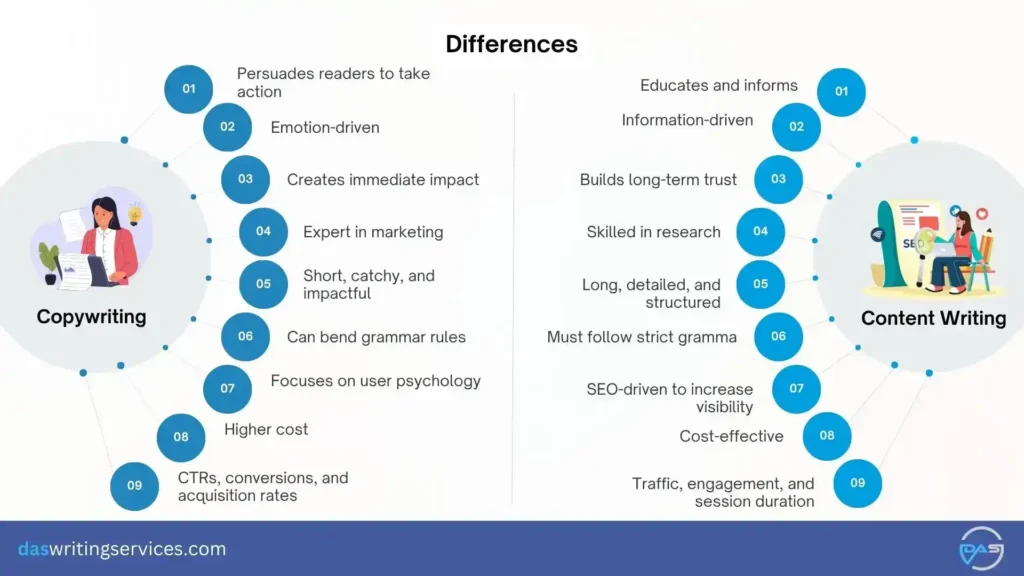
Writing creative copy is useful to drive conversions, while content writing allows brands to gain more organic traffic to their website. Here are the nine important aspects that set these two types of writing apart:
1. Writing intent
It is quite normal that different types of writing have a distinct intent.
While creating captivating copies, you must prioritize positive reinforcement to sell your products. Each communication has to be optimized with outcome driven objective.
In copywriting, you must be mindful about customer emotions, motivating their decisions, and providing values that inspire audiences to take action.
On the other hand, content writing is all about focusing on adding value for the audience as much as you can. While writing content, you should focus less on driving action for sales and put more emphasis on content clarity.
Know More: How to Create Engaging Content for SEO?
2. Use of Emotions
Being able to evoke strong emotions allows readers to engage and identify with your communications. It helps a brand create a lasting impact among the target audience.
Although all writings must influence readers emotions to engage them, copywriters put more emphasis on emotion to drive desired actions. Copywriters use a curated choice of sensory and persuasive words, which influences them to make a purchase.
You only have three to four words to emotionally attach to your writing in CTA implementation.
However, content writing is a straightforward approach since its purpose is to inform and educate readers rather than drive more sales. The use of direct language must be prioritized in content writing to gain the audience’s trust rather than using trigger words.
3. Impact on Readers
The impact of writing on readers is one of the major differences between copywriting and content writing.
Copywriters influence people to take immediate action to purchase a product or avail a service. Copywriting directs readers to sign up for newsletters, download an application, or buy products or services.
On the other hand, content writing makes audiences engaged and connected in the long term. The main goal behind making a content plan is to establish trust with the readers about the brand.
Always try to ask yourself whether you are providing something valuable compared to what others are not. Content writing is all about helping others to know things with your writing skills.
4. Writing Skills
The difference between copywriter and content writer sets both types of writing apart. The reason is that a copywriter and a content writer have expertise in distinct types of writing.
Copywriters must have expertise in marketing and sales, and the human psychology to drive actions.
Conversely, content writers must be able to conduct efficient research and have subject matter expertise to offer genuine value to the readers.
Writing for email campaigns, ad copy, SEO copy, billboards, and video scripts are some common skills that a copywriter usually has.
Content writers must have expertise in writing articles, white papers, blog posts, podcast scripts, and magazines.
Read Related Blog: Top 9 Content Writers in India in 2025
5. Length
Copywriting includes writing short-form copies to attract readers or audiences. A copywriter has to write slogans and social media ad copy, in which grabbing readers’ attention in a short period is crucial.
Look at the above infographic by Sony India. This ad copy has used fewer than 10 words to attract readers to its latest camera.
On the other hand, content is written in a long format, including an introduction, body, and conclusion. Since it has a longer life than copies and can be found on a website’s blog section, the ideal writing length is 2100 to 2400 words.
However, different types of content writing have different writing lengths.
6. Grammar
While highlighting the differences between copywriting and content writing, it is imperative to talk about grammar.
Grammar is more important in content writing compared to writing a copy. Copywriters make adjustments to grammatical rules most of the time to attract readers.
The above copy by Adidas is short and crisp and is not grammatically correct. However, this incomplete sentence is appropriate for highlighting a slogan, which is also aligned with the company’s brand goals.
Content writing includes grammatically correct sentences and adheres to the Associated Press (AP) Stylebook. Grammatically correct content is essential for increasing credibility among customers.
7. SEO
Content writing implement SEO optimization practices to get a higher rank in the Google Search Engine Results Page (SERP). This drives audiences to a website page to find information.
Copywriting, on the contrary, focuses more on user behaviour and psychology to drive user actions. SEO is not a necessity in copywriting since it predominantly uses paid channels.
8. Cost
Although it depends on the brands and content marketing agencies, cost is a major factor that sets them apart.
Copywriting tends to be more expensive since it uses paid channels to reach the prospective users. With an immediate ROI focused strategy, the upfront cost of a copywriting campaign tends to be significantly higher than content writing.
Comparatively content writing offers long-term engagement and the upfront cost is significantly lower than copywriting camapigns in terms of ROI.
Looking for content that both engages and converts? Reach out to our experts below

9. Measure of Success
The success of both content writing and copywriting is measured using different metrics.
You can gauge the success of a copy with the help of metrics like customer CTR, acquisition rate and conversion rate. This helps you to track how effective the copy was in attracting users and driving conversions.
It is quite easy to measure the success of a copy since it elicits short-term results.
On the other hand website bounce rate, impressions, clicks, session time are the other key performance indicators (KPIs) of content writing. These KPIs are useful to measure how well your content fosters customer engagement.
What Should You Choose Between Copywriting and Content Writing?
As you have gone through the differences between copywriting and content writing, it entirely depends on you to choose between them.
If you want to engage people with your brand and want them to purchase your products, you must hire a copywriter. You must choose copywriting to fulfill the requirements for writing for a landing page or PPC ad copy.
On the other hand, if you want to provide information about your products and services with comprehensive research, then content writing will be perfect for you.
Content writers help you to write blog posts, email newsletters, and ebooks.
Takeaway
Copywriting and content are based on writing, ultimately. Both types of writing helps in improving brand awareness and generating sales.
However, these nine differences between copywriting and content writing help you to consider which one to choose.
The factors like cost, SEO, grammar, length, mindset, and the use of emotions are some of the crucial factors that set them apart.
Finally, hiring a copywriter or a content writer entirely depends on your task requirements.
Frequently Asked Questions on the Differences Between Copywriting and Content Writing
1. Is copywriting the same as content writing?
No, copywriting and content writing are two distinct forms of writing. Copywriters focus on short-form write-ups that influence readers to take action. However, a content writer long-form content with a major focus on SEO.
2. Can a copywriter be a content writer?
A copywriter can be a content writer, but both professions are different. It depends on which type of writing the writer is considering.
3. Is copywriting a freelance job?
You can take copywriting as a freelance job and be in charge of your own business. You can establish a rate of offering this service and advertise it to build a client base.
4. Copywriting or content writing – which is more useful to get sales?
To get immediate sales, copywriting is your best shot. You can use copies in Google ads and PPC campaigns across social media.
5. Who should use content writing?
If you want to create a strong brand and drive sustainable user engagement to your website, content writing can be a good choice. It tends to be slow in producing results, but you get compounding growth over time.

Rohit Majumdar, a professional SEO content writer with a specialisation in Digital Marketing and Finance, is working at Das Writing Services. In his SEO content writing career, he has worked for different clients offering products and services like insurance, FDs, brokerage, and digital marketing. Following his passion, he also contributes to our blog, exchanging valuable ideas. You can also contact him on LinkedIn for any queries.


Leave a comment