Generative AI tools like ChatGPT and Perplexity usually creates an article in 1/4th of time than the time humans need. Obviously, there is no doubt that generative AI is more efficient – saving both cost and time when it comes content creation.
But on the other hand, there is another side of the story. NP Digital’s survey notes, for each minute spent on writing, human content attracts 4.10 users while AI generated content generates 3.25 users.
So, the big question still remains important, which one should you choose? Well, your content marketing goals are essential to determine which one you should use. Long story short – for long term campaigns and sustainable results, go for human writers. Conversely, if you are looking for quick captions then AI can be the way for you.
But if sustainable and consistent performance is your goal then reach out to us now

What is AI Content Writing?
On the question of AI or humans, let us cover the basics first. AI content writing is the process of generating blogs, and articles – virtually anything and everything using generative AI tools like OpenAI’s ChatGPT and Google’s Gemini.
They are known as natural language processing (NLP) models that understand and reproduce language like humans do. So, when you give it a prompt like “create a blog that plans a 5 day tour itinerary to Thailand” – it can create an entire blog for you.
We can see, in spite of using a very basic and generic prompt – ChatGPT can produce a considerable amount of text which reads just like any human written blog.
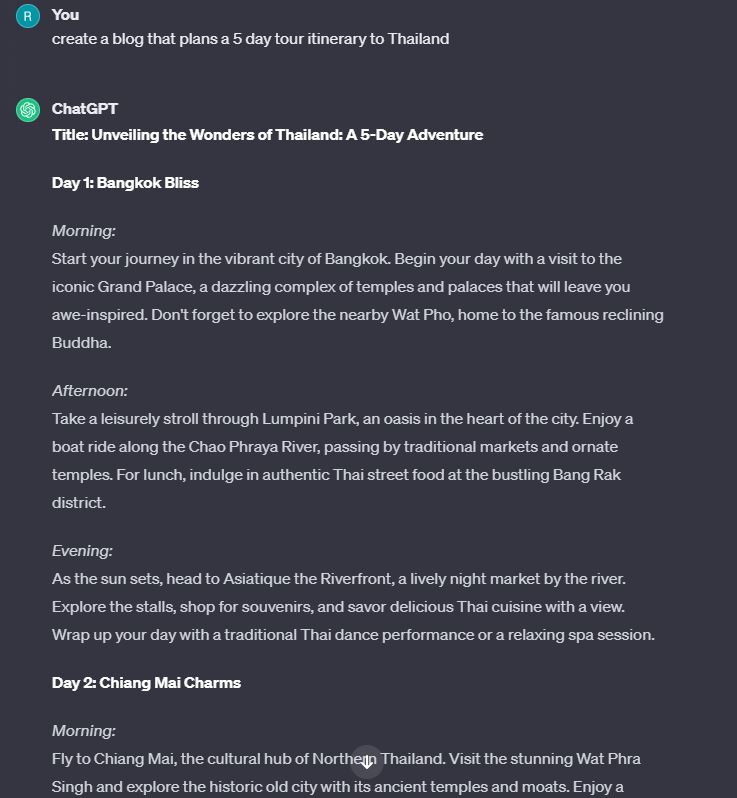
Here are a few observations we can make on ChatGPT’s content generation capacity:
- ChatGPT is versatile in its scope to create content on any topic.
- It can generate grammatically accurate texts that just read like human-written blogs do.
- The model is able to follow simple instructions for customising, we asked the GPT model to create a 5 day tour itinerary and it did exactly the same.
How is AI Content Different from Human Content?
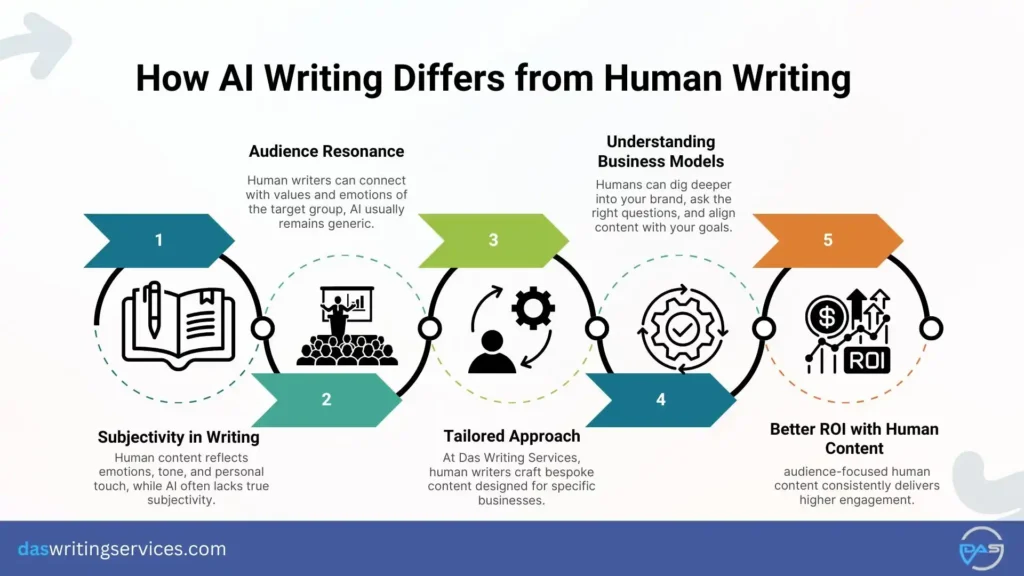
The fundamental difference between AI and human written content is subjectivity. In the case of human written content, we can be subjective with tone and choice of words – it can better address a target group to resonate with their emotions and values.
For instance, at Das Writing Services, our unique value proposition is tailored original content that are designed to speak directly to the audience. This is the reason why we can be a bit nosy about your business model and target audience when you reach out to us. By asking all those questions, we strive to create bespoke content that resonates with your audience and generates better ROI for content marketing.

Generative AI, on the other hand, writes for everyone by default. Unless specified, it produces generic information that is meant for all.
Since generative AI models are usually trained on LLM-based neural transformer models, they rely on a vector database to process unstructured information which sometimes compromises logic and rationality.
Also Read:
- How AI Content Detectors Work?
- Guide to Outsourcing Content Writing
- Complete Guide on Content Optimization
Despite their ability to be lucid and creative, chatbots like ChatGPT and Gemini fail to replicate critical thinking. For instance, if all SERP results are wrong about particular information –the information retrieved by AI bots also tend to be incorrect.
Irrespective of the drawbacks of LLM-based chatbots, they continue to evolve and are being relied on by many.
Especially its ability to create a large amount of content that is both grammatically accurate and coherent, that too within a minute is simply astonishing.
That is why it is quite safe to assume that when time is of the essence, using AI technology to generate content might be the best way to go.
Pros & Cons of AI-Generated Content
It is pretty evident that AI-generated content has its own share of merits and demerits. While such chatbots are no match for human intelligence and sensibility, they can outshine humans in their ability to create content faster than anything else.
| Pros of AI-Generated Content | Cons of AI-Generated Content |
| Quickest in creating new content | The quality of information is doubtful |
| Saves both time and money | Needs professional prompt engineers to generate the right content |
| Can generate content for diverse genres and industry | Inferior content personalization for diverse target groups |
| Anybody can generate content with AI | SEO content optimization with AI is poor |
At the same time, reliability becomes a huge concern for content created with artificial intelligence. The cases of AI hallucinations are infamous where the chatbots create erroneous data and information trying to pass it as authentic.
So, if authenticity of information is a concern for you, unless you are trying to generate a solely creative content, generative AI content must be taken with a pinch of salt.
Pros & Cons of Human Written Content
When pitted against AI, content written by professional SEO content writers can produce verifiable and precise information that is trustworthy. However, the downside of precision is the unavailability of good writers and the inability of a single writer to write content in multiple industries and genres.
Also, coming across high-quality content writers who correctly understand your requirements can be tiresome.
| Pros of Human Written Content | Cons of Human Written Content |
| Better audience engagement | Time-consuming process |
| In-depth knowledge of the topic | Comparatively expensive |
| Better with SEO optimization | Needs multiple interventions to maintain uniform quality |
| Ensures accurate information distribution | Mostly unable to produce large volumes of content quickly |
Further, Google continues to emphasise on the importance of quality as a ranking factor. It is more evident than ever, getting AI to write your content can be actually harmful if you want to rank on the SERP.
Read Related Blogs:
- Will AI Replace Content Writers
- Differences Between Content Writing Agency Vs Freelancer
- Ultimate Guide For SEO Writers
AI Content Creation vs Human Content Creation
Having taken into account the pros and cons of both human and AI-generated content; let us finally pit them against each other to see which one deserves the best of our attention.
| Human Written Content | AI Generated Content |
| Original and authentic information | Provided information is only as good as the data available on the internet (or the data it was trained on) |
| Better understanding of context and target audience | Better at creating content faster |
| Helpful to drive and retain organic traffic | Useful to cater to urgent content requirements |
| Can produce SEO-optimized content for better search engine performance | Search engine performance is not optimal without human intervention |
| Can write brand-specific tailored content | AI is inefficient for organic content marketing |
While AI-generated content proves useful when trying to fill out generic web pages like Privacy Policy and Terms and Conditions, outsourcing your content marketing plans to AI alone is hardly a sensible choice.
A good rule of thumb is if you are planning to generate brand awareness or earn revenue from content, be aware of the limitations of AI. A shortcut and cost-saving measure now may invite penalties and strikes that hamper your website’s performance in the long run.
AI vs Humans Content Creation: Final Verdict
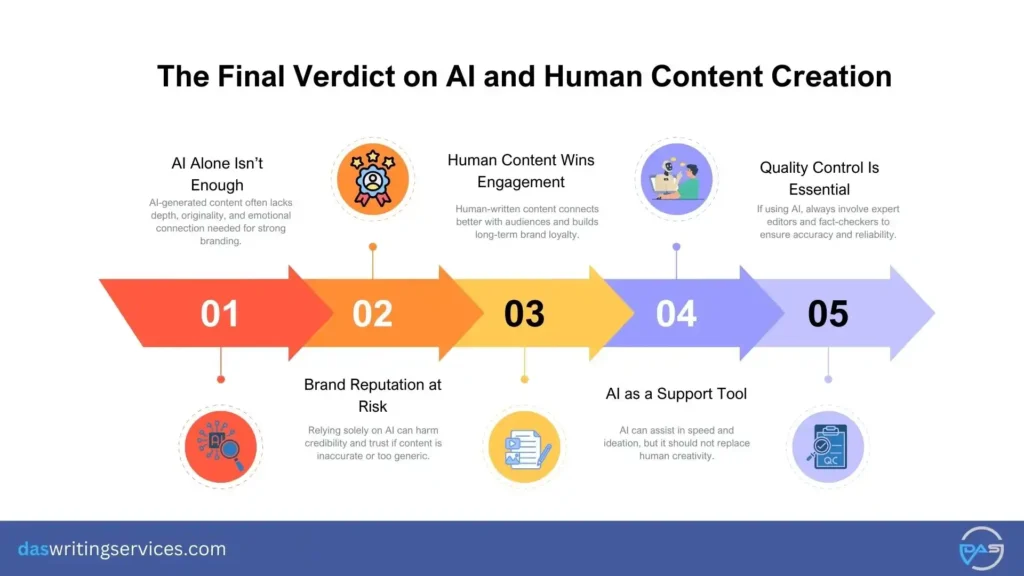
So, as we are almost at the end game now, it is time to take a stand on the AI vs human written content debate. When it comes to content marketing, using AI-generated content is hardly a sensible choice if you want to increase your brand reputation and create an audience through it.
Still, if you want to leverage AI in content marketing, having a good editor and a fact and quality-checking specialist is a must to prevent any unforeseen debacles.
Bonus Section: AI Content Creation Tools in 2025
If you are actually trying to go with AI content tools, there are quite a few in the market. Yet, each of the tools has its strengths and weaknesses. Refer to the chart below to find out which one can support your cause.
| Tools | Specializations | Drawback |
| ChatGPT | Versatile; Useful at brainstorming ideas, Creating outlines. Asks follow up questions | Calculations, Data Interpretation, Logical Analyses |
| Perplexity | Good at offering research insights; Fact finding and source backed answers | Results can lack freshness, poor quality content creation |
| Claude | Multi-format content repurposing, document editing | Creates mechanical writing, plagiarism risk |
| Deep Seek | Good for Data Interpretation; handles a large amount of data to create reports and visualisations | Struggles with creative drafting and gauging content depth |
| Gemini | Integrates seamlessly with Google’s Workflow apps | Produces bland and rehashed content from SERP results |
| Grok | Good for creative/imaginative writing – especially suitable for engaging copies. | Not ideal for business or professional communications |
FAQs
1. Is AI more effective than humans?
In terms of efficiency, yes: AI can be super-efficient for data-driven repetitive tasks. However, matching human intelligence and experience is difficult for AI.
2. Can ChatGPT replace creative writing?
ChatGPT has already become famous for creative writing like stories and poems. While it is capable of producing creative works alongside humans, the chances of AI completely replacing creative writers are less because of its inability to recreate human originality.
3. Is AI more efficient than humans?
Definitely, when the question comes down to efficiency and productivity, the capacity of generative AI is unprecedented. AI chatbots like ChatGPT and Bard can consistently follow prompts tirelessly. The same kind of efficiency is impossible for humans.
4. Will AI replace copywriting?
AI tools can produce copies in bulk. However, it cannot imitate human creativity and insights which create conversion-worthy website copies.
5. Will AI replace human writers? GenerativeAI (artificial intelligence) is very good at replicating human-like language creation. However, its mechanical and formula driven writing style can quickly become monotonous. They do not read as well as human writing and get reduced user engagement. If informing and fostering genuine connections are your motivation behind content creation – then AI should never replace human creativity.

Ritish Dutta is a seasoned Content Developer with over 7 years of experience in the industry. Currently, at Das Writing Services, he writes SEO-optimized content that caters to our diverse clientele. Ritish utilizes his critical insights and experience to talk about digital marketing, SEO content writing, content strategy, and AI.


Leave a comment
All comments
M~a gii thiu binance
Your article helped me a lot, is there any more related content? Thanks!
kosmik
Your article helped me a lot, Thanks for sharing us.
kosmik
This post is so interactive and informative. keep update more information.
devops-training-in-hyderabad