The user search pattern took a turn with the introduction of Generative AI to the public as businesses looked for how to rank on AI search or AI Overviews. With more and more industries adopted it and businesses rolled out AI features, trends show increasing adoption of AI in daily searches.
As of 2025, ChatGPT caters to only 0.25% of the search traffic share compared to Google SERP – which, by the way, has also seen significant changes after the introduction of AI features.
AI powered SERP features are on the rise and along with it – the rise of zero click searches.
Ranking on the first page is rarely enough as few are scrolling past the encyclopedic AI Overviews. So, the desired position is no longer snippet or SERP #1 rank but citations and brand mentions on AI Overview and AI Mode.
In this guide, we have compiled a few trends, tips and best practices of AI search patterns. Something you can follow to increase your visibility across the platforms.
If you are looking for AEO and SEO optimized content – just click below!

What are the Difference between Traditional SEO and AI SEO?
While terms like AEO and GEO are quite the hype of the town, under the garb of AI search optimization – we are still doing SEO. But the objective has changed.
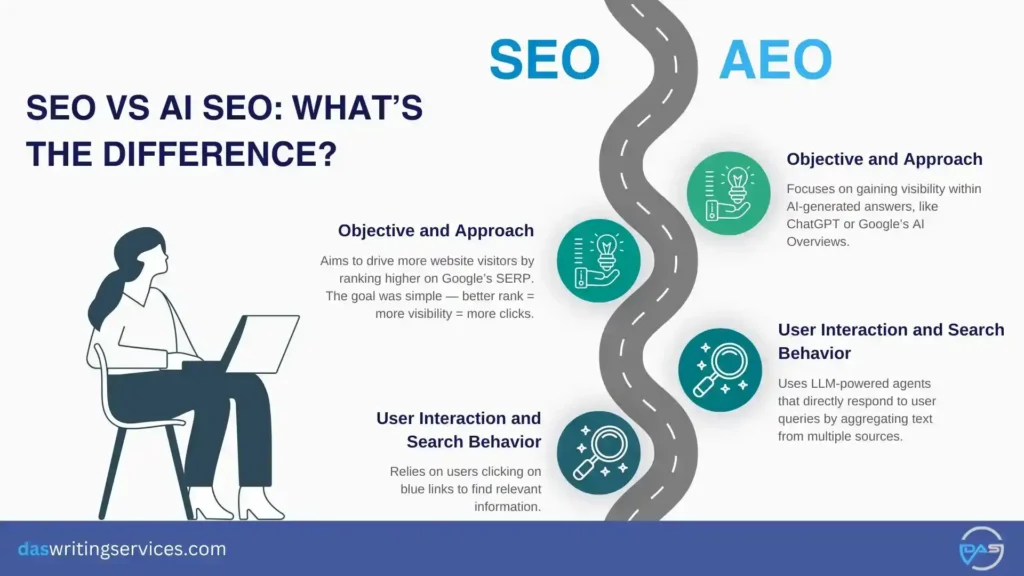
If we may still recall (it seems decades since we talked about ranks), traditional SEO focused on driving more website visitors by ranking higher on the SERP. The equation was simple, better rank = more visibility; as a result, more clicks and increased website traffic.
Also Read: How AI is Reshaping Content Marketing?
Google’s advanced AI enabled features has removed users’ need to click on the blue link to find relevant information. Rather LLM powered agents allowed it to directly respond to queries by aggregating texts from multiple sources to create an all-encompassing response.
AI SEO or AEO tries to do the same but by securing citations or mentions on the answer engines and link cards.
What are the AI Search Ranking Factors in 2025?
The following are some of the areas that websites must pay attention to, if AI visibility is a concern. We tested some odd 50+ websites and noticed a few recurrent trends that can be identified as AI search ranking factors.
1. E-E-A-T Importance in AI Search
E-E-A-T is no longer a Google recommendation but appears to be of vital importance for AI features. Note, for this query ‘demat account close’ AI Overview cites websites like Bajaj Finserv, HDFC Mutual Funds and CDSL.
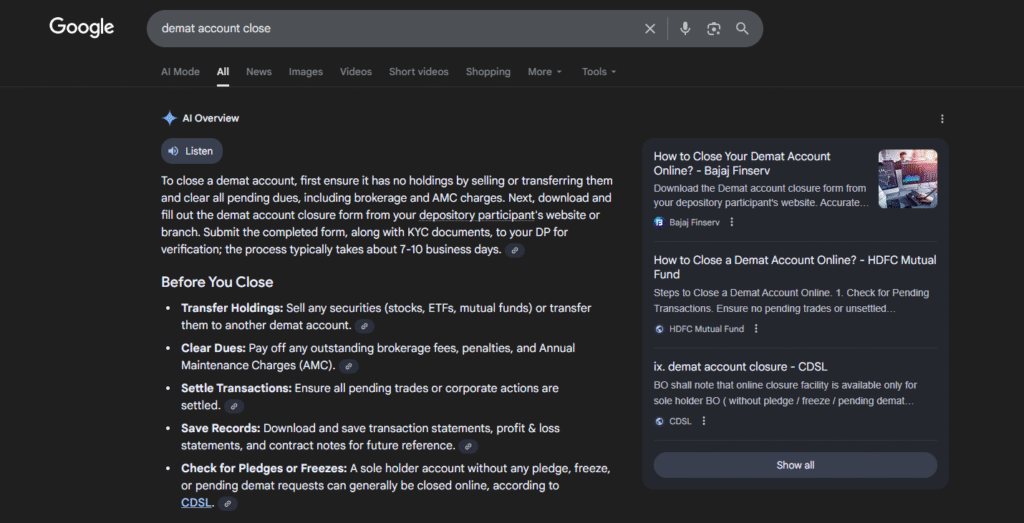
While CDSL is a Govt. registered depository that electronically holds securities (aka dematerialization), HDFC Mutual Fund is an AMC and Bajaj Finserv an NBFC which offers financial services. Hence the citations and mentions are actively related to relevant fields that offer associated services.
2. Using Long Tail Keywords for Search
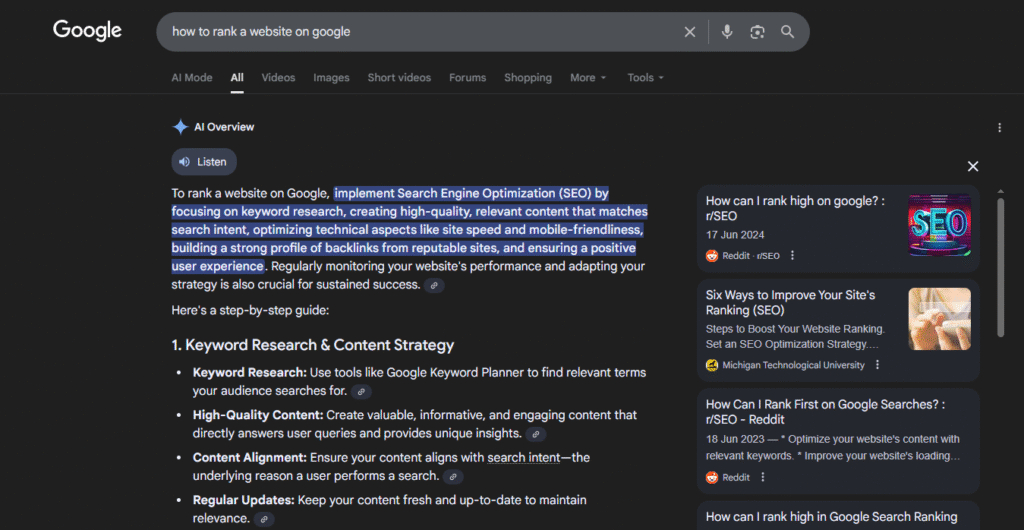
With the various SERP features introduced by Google – the search engine transitioned from catering to keywords to trying to decode the underlying meaning aka search intent. Since RankBrain improved semantic search, question based answers dominated the SERP. The trend continues even in the AI search era as more than 91% of all Google search is typically from long tail keywords and these tend to trigger AI Overviews the most. So, to rank on AI search – question answer based content optimization seems a must.
3. Create Answer-first Content
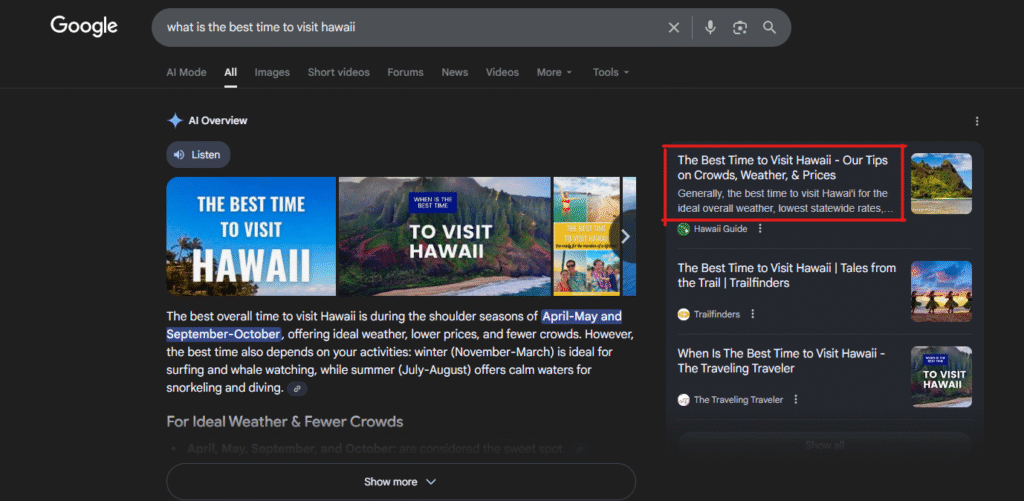
Check out the snap above. Instead of the response, we will be focusing on the link card – the first site checks out the E-E-A-T signals. The domain name itself communicates their authority on Hawaii. But that is not all. Clicking on the link card directly brings up a question and answer segment on the website.
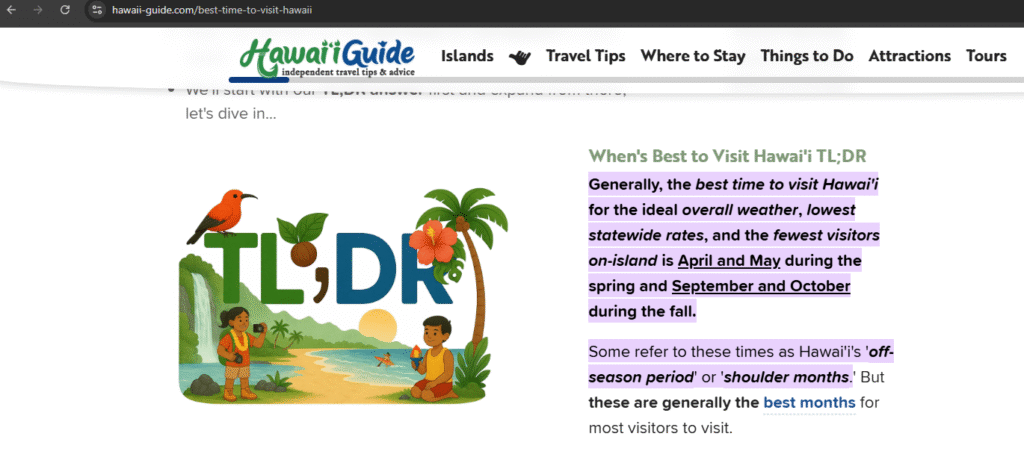
So, the principle of getting visibility on SERP Features and AI Overview does not appear to be too different. Create question answer based content without beating around the bush and you may crack the code to rank on AI search.
4. Optimize for Conversational Queries
Over the last few years, voice search and AI search has become quite prevalent among majority of the internet users. As a result it is estimated that 1 in 5 search queries are “chat style” natural, conversational query.
These queries are not only increasing in terms of search trends, they also indicate higher buying intent. Reason why optimizing for zero volume keywords has been a SEO practice for some time now. With AEO and optimizing for AI search, the need for long tail human-like subheads and pointers are even more essential.
5. Optimize Site Speed and Schema
Maintaining structured data is another vital factor that works positively to rank on AI search. Again, this is nothing new because Google has been emphasizing the importance of optimizing site speed and using structured data which allow easy retrieval.
Consider it this way, using product schema on your eCommerce page explicitly tells the crawlers that we are dealing with a product. When not mentioned, it is left to guesswork. Making it easier for crawlers definitely gives you an edge to get featured on AI search.
6. Maintain Brand Credibility
One thing that is definitely common among sites ranking on AI searches is the domination of brands. On an average, AI overview and AI mode cite 6+ brands associated with a particular search intent.
So, if you are still not focusing enough on growing your brand value in the market, may be this could be wake up call.
7. Optimize for Query Fan Out
LLMs like ChatGPT, AI mode and AI Overview typically follows a query fan out framework where each search query triggers numerous additional specific queries. By retrieving and combining individual responses from multiple sources, the AI generated write-up ends up creating enriched response.
As webmasters, creating all round content is the upcoming content optimization trend for AI search. If a page is able to answer multiple sub-queries, it highlights topical authority and comprehensive information – thereby increasing likelihood of being cited in AI based searches.
11 Tips to Follow for AI Search Visibility
There is no denying, powerful AI models like Perplexity, ChatGPT and Gemini are essentially hijacking almost all of the ToFU traffic and clicks. While the competition has intensified –industry leaders now have greater opportunity.
At Das Writing Services, we follow some of the tried and tested methods that compounds and gives way to sustainable visibility on AI searches.
As AI filters generic clutter of the SERP, legitimate sites and thought leaders are more likely to maintain consistent visibility.
1. Write Comprehensive Blogs
Rather than writing around keywords, shift your focus on gaining topical authority. Generally 1500+ words of content pieces perform well on both SERP and AI searches.
As informational queries make up 36.4% of Google search and 52.2% ChatGPT prompts, visibility against these AI-dependent search queries gives more strength to your brand.
Of course, visibility i.e. citations for informational queries will create more conversion-ready clicks. Since AI searches are primarily siphoning off ToFU (Top of the Funnel) traffic, this is the opportunity to maintain organic positions.
2. Include LSIs and NLPs
The LLM powered AI searches typically rely on vector databases to recognize the search intent of a query. Maintaining natural flow of writing with the relevant semantic words and phrases makes your content in-depth.
Additionally, it helps you drive visibility across diverse string of queries and help you rank on AI searches.
3. Create Internal Links
Internal links used to be essential for user navigation. In the AI searches, internal links make it easier for AI agents to find related pages – which in turn help retrieve related pages for a comprehensive response.
4. Update Content Frequently
Freshness of your content will increase your potential visibility across all the relevant platforms. It keeps the website dwell time towards the upper side and allow quick navigation.
Refreshing your statistics and analogies periodically should help you get continued value from outdated content making sure they maintain visibility.
5. Use Contextually Relevant Visuals
While many use visuals just for decoration– having relevant and descriptive visual can do wonders to your on page engagement. It has another positive impact as well. Many times AI Overviews retrieve images from one page and information from another.
So if you are optimizing both your texts and visuals, you will have 2x the chances of visibility across AI overviews, AI mode, SERP features and so on.
6. Optimize the Trust Signals
Using Top-Level Domain (TLD) is among the many ways of tweaking your website to communicate credibility and establish trust signals. Optimizing for users and AI agents are not too different.
Just like credibility signals make a user stick longer, the same recipe is the key to get AI positions across the web.
7. Find Keyword Opportunities
Google still dominates the organic search landscape. Monitor which type of queries in your niche are triggering an AI overview on Google to find what kind of content you need to optimize.
As AI typically shows up for Top of the Funnel queries, this is what you typically need to optimize. Source your headings from People Also Ask and Related Searches section.
Also Read: How to Use Branded Keywords for SEO?
8. Use Meta Data Correctly
Your title and description are the first touch point for both users and AI agents skimming through contents online. By using targeted keywords you can get visibility across the target group. Besides, you can optimize give value signals in the title and description.
Make sure to include schema and structured data to get rich snippet and better information retrieval by AI agents.
9. Maintain Content Architecture
A logical content structure helps AI agents crawl pages and extract relevant sections as per the requirement. With an intuitive layout containing bullets, lists, and subhead distributions – you make a content skimmable for the users.
Additionally, silos of content with pillar and cluster pages help in overall visibility and increase in authority in the industry.
10. Optimize for SERP Features
The introduction of AI overviews does not make SERP Features obsolete. Rather pages that already get visibility in SERP Features tend to perform well for AI overview as well.
So, if you are selling a product make sure you have a product schema available in the pages. If you are not already targeting long tail queries and question based headers, then this is the high time to revive your visibility online.
11. Track Mentions
Brand mentions as well as branded keywords continue get more and more leverage in AI powered searches. An ahrefs study finds, branded web mentions, search volume, and anchors have a strong correlation (0.664 on a scale between 0.00 and 0.8) with visibility on AI Overview.
For the time being, you will have to track mentions and rank on AI search manually. Search for queries in your genre to find if you are driving mentions or citations.
Examples of AI Search Optimization
By following the optimization tips above, a business can maintain visibility across multiple AI overview and AI mode. The following are some of the clients who are dominating the AI positions with our AEO optimized content.
PL Capital
As a legacy Asset Management Company (AMC) in India, PL Capital avails our AI & SEO optimized MoFU and BoFU content. With an objective to maintain their organic visibility across multiple touchpoints, we executed a tailored strategy. The following are the examples of much coveted citations in AI mode and AI overview of Google.
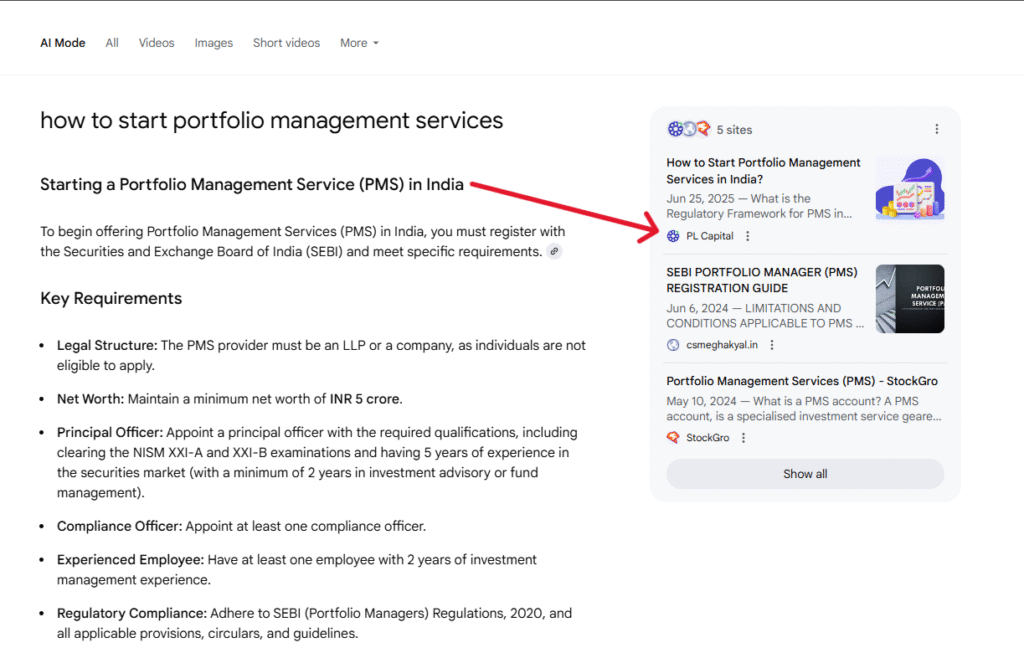
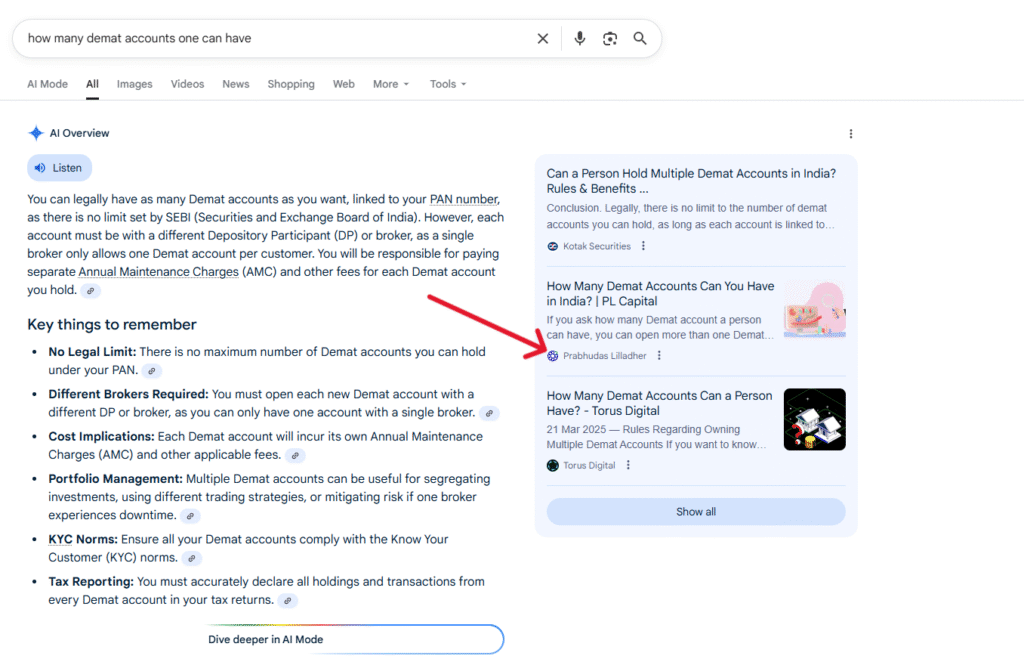
While the above position is vital for PL Capital’s brand visibility, the AI Overview snap below positions the brand against a commercial intent query:
Stable Money
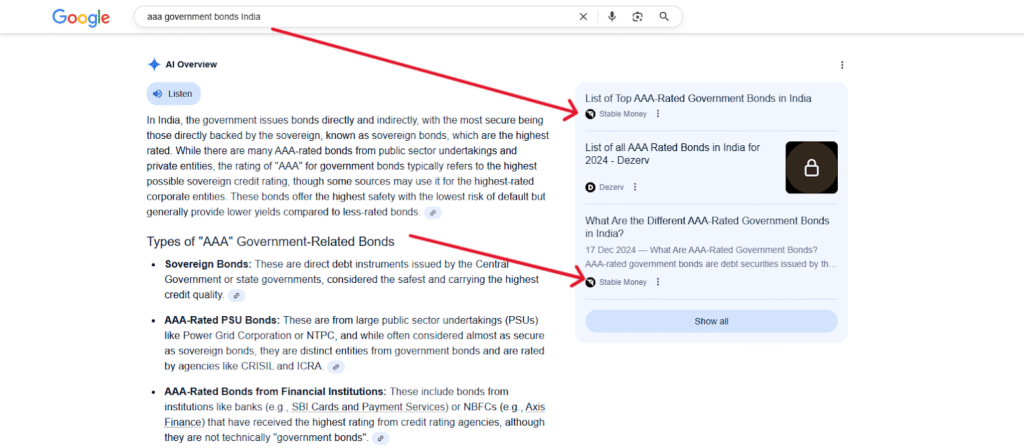
The investment specialists, Stable Money uses our AEO and SEO optimized content that maintains their organic visibility in spite of the changing trends.
With consistent and sustainable content optimization practices, Stable Money continues to drive visibility in vital keywords. In this case, AI overview is working in the client’s favor where they are getting better visibility across the board.

How to Measure AI Search Performance
With SERP clicks taking a sizeable hit, zero click searches are dominating user search behavior. To survive in this AI powered search environment, SEOs must redefine the KPIs of organic search performance. To track a rank on AI search and its performance, we may use the following parameters.
1. Citation Frequency
It is all about measuring how frequently you are being featured on AI mode or AI overview. They may not directly influence traffic or attract clicks all the time, but being cited more often helps enhance your brand visibility and brand recall value in the market.
You may refer to Semrush’s AI toolkit where you can track how often you are being cited.
2. User Engagement
Driving just clicks are not enough in the age of AI. If you are actively performing SEO or AEO in your website, one decisive metric is how engaged your audience is with your content. For this, you don’t need any expensive tools.
Just head over to Google Analytics and there you can easily track the average session time per page. A session time of > 1.5 minutes is usually good enough – suggesting engaged users. However, it does depend on industry and target audience, so the actuals may vary depending on your site.
Know More: How to Create Engaging Content?
3. AI Referral Traffic
If you are doing everything right, then a sizeable amount of your inbound traffic will come from AI citations. The good news is, by making some tweaks you can seamlessly track it on Analytics.
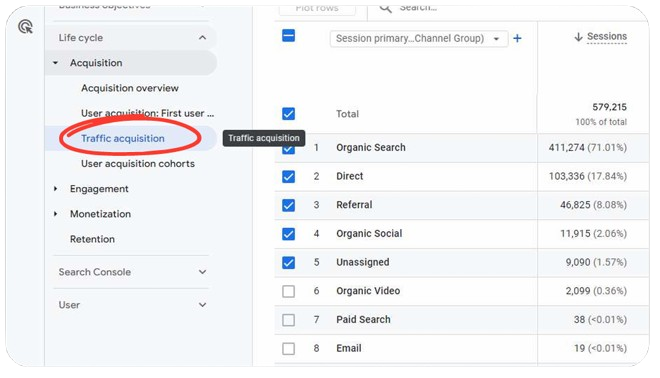
You can create a custom channel group in GA4 to isolate the AI search traffic from the organic and referral traffic. By building a regex filter for AI traffic, you can seamlessly track how often you are ranking on AI search.
4. PAA appearances
By optimizing a content for answer first search queries, you also increase the chances of being featured in the People Also Ask section and secure rank on AI searches. Use Semrush to track your page positions and there you can seamlessly track the performance of the URLs across all the SERP Features.
5. Brand Mentions in AI answers
One of the most cherished features of AI is the brand mentions. Being directly mentioned by ChatGPT and or AI Mode is a clear indicator of authority and credibility. It is of little wonder then if marketers are actively vying for this position. You can use Semrush to track your brand mentions across the internet.
While there is no specific tool yet that lets you track brand mentions in AI searches, you can check it manually for the time being. Start with the desired keywords and targeted search queries to track in-text brand mentions.
Future-Proofing AI Search Trends for 2025 and Ahead
With all the emerging AI search trends, we can notice a significant shift in the established practices and KPIs of content marketing. So, if you want to maintain organic visibility by ranking on AI searches, you have to tweak your marketing campaigns as per the following:
1. Impressions are Not Equal to Clicks
While impressions across all websites have increased, the CTR has dropped significantly across all the industries. Primarily for informational queries, clicks are at an all-time low. Going forward, zero click searches will continue to dominate the search landscape. Alongside, SEOs must reconsider the utility of CTR as a vital performance indicator
2. Driving website traffic without brand will be difficult
As mentioned before, sites that have good brand reputation are enjoying the first row seat in the AI transition. Especially since the LLM tools frequently cite forums like Reddit and Github – maintaining a cohesive presence across both on-page and external channels will be key to get momentum in AI searches.
3. E-E-A-T & YMYL are non-negotiable
While AI Overviews are presently coming up for some odd 20 per cent Google searches, it is only expected to grow in the coming days. To make sure that one is not losing out on key citation opportunities, webmasters and SEOs must work on their trust signals to vouch for the credibility of the content and secure rank on AI search.

Ritish Dutta is a seasoned Content Developer with over 7 years of experience in the industry. Currently, at Das Writing Services, he writes SEO-optimized content that caters to our diverse clientele. Ritish utilizes his critical insights and experience to talk about digital marketing, SEO content writing, content strategy, and AI.

Leave a comment