Lately, the financial and fintech industry is getting very competitive in India. Yet, traditional marketing strategies often prove ineffective to capture the attention or trust of informed, cautious, and research-driven audience.
That is where content marketing proves beneficial for many fintech companies. With content marketing, both emerging companies as well as legacy AMCs are educating clients, and build long-term relationships with both old and new prospects.
Recent data shows that 91% of financial marketers now use content marketing, yet only 29% find their efforts highly effective, highlighting room for smarter, more targeted strategies.
Add an infographic (pie chart) of the above data here
The idea is to create practical, easy-to-understand resources, such as guides, articles, and videos. As they are meant to help your users, it create a strong connection with your target audience.
By focusing on authenticity, education, and relevance, financial institutions can enhance trustworthiness, attract qualified leads, and achieve sustainable growth in a competitive marketplace. Let’s understand more about content marketing for financial institutions.
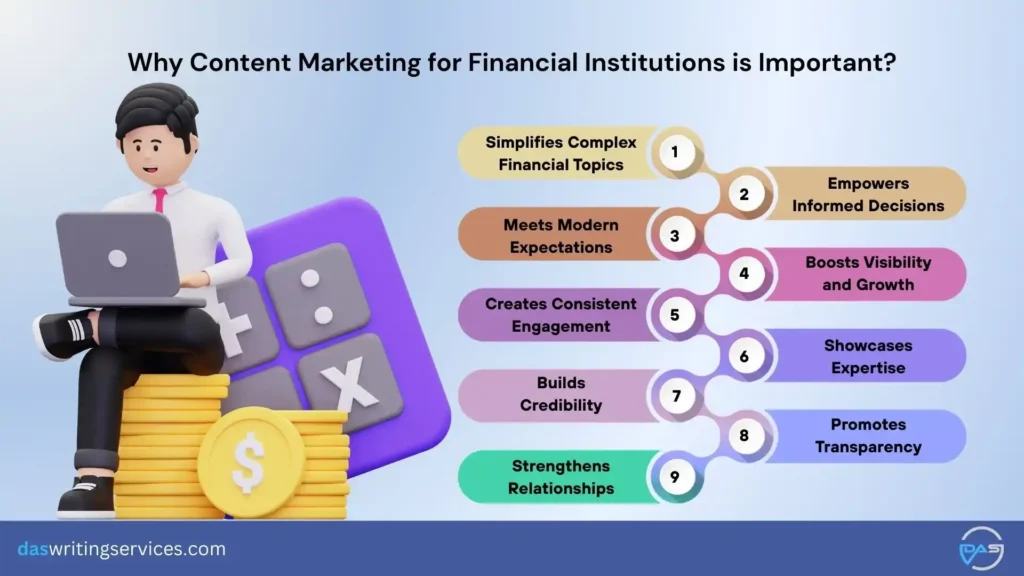
Why Content Marketing for Financial Institutions is Important?
Audiences spend an average of 1 minute and 51 seconds engaging with financial services content, with a 70% average engagement rate and 52% finish rate. Hence,
- Simplifies Complex Financial Topics: Content marketing agencies help explain complicated concepts like shares, bonds, mutual funds, insurance, etc., in simple, relatable terms.
- Empowers Informed Decisions: Educational content gives customers the confidence to choose financial products and instruments that truly fit their goals and needs.
- Meets Modern Expectations: Nowadays, customers research online across multiple platforms. If your organisation shares useful, transparent information, it will attract more attention and trust.
- Boosts Visibility and Growth: Quality content improves SEO and GEO, generates organic traffic, supports lead generation, brand awareness, and customer loyalty.
- Creates Consistent Engagement: By providing helpful insights across multiple channels, a financial organisation stay connected with customers throughout their financial journey.
- Showcases Expertise: Regular, well-researched articles and insights prove the institution’s depth of knowledge and reliability.
- Builds Credibility: Consistent, valuable content marketing positions the organisation as a trusted thought leader.
- Promotes Transparency: Clear explanations reduce confusion around complex financial processes and help customers feel informed and secure.
- Strengthens Relationships: Honest, educational communication with unique content fosters confidence and lasting trust between the customer and the brand.
Ready to transform your financial institution’s online presence? Contact Das Writing Services to build trust and boost engagement with expert content tailored for your clients.

Key Strategies for Content Marketing for Financial Institutions
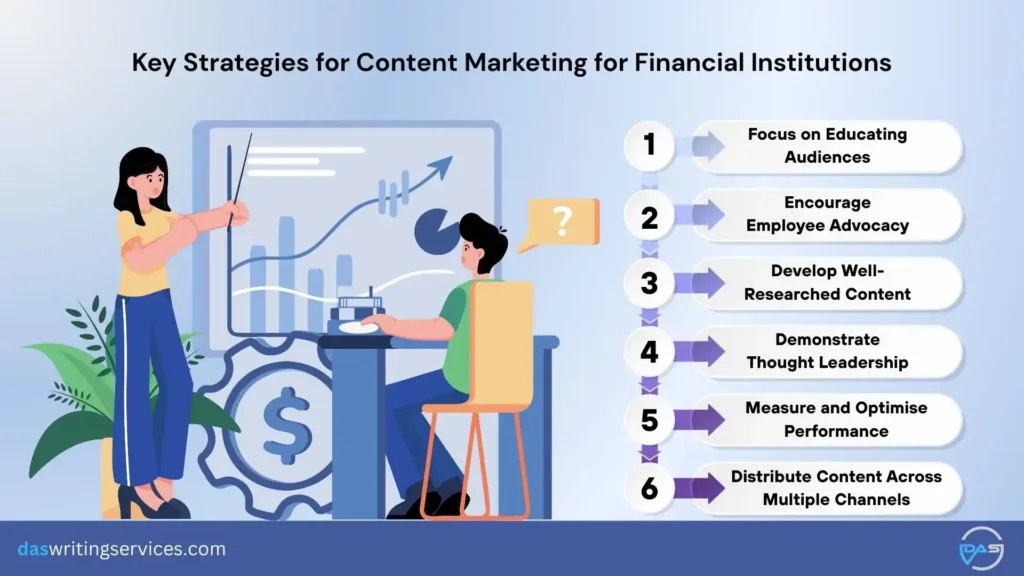
Instead of pushing products, when a brand focuses on helping customers understand financial topics and feel confident about their knowledge, it forms long term association between the business and their audience. Here are the key strategies:
- Focus on Educating Audiences
You should simplify complex financial topics with easy-to-understand FAQs, blogs, and explainer videos. Educational content helps customers make confident decisions and see your platform as a trustworthy guide.
- Encourage Employee Advocacy
Your employees can be powerful brand ambassadors. Encourage them to share company content on their own social media platforms. People trust information shared by peers more than paid ads, which boosts reach and authenticity.
- Develop Well-Researched Content
Back your content with original data, cite authoritative sources, and present insights clearly. Credibility in finance depends on consistency and reputation. Include success stories and client testimonials to provide social proof and reinforce reliability.
Read Related Blog: Why Content Research is Vital to Create Effective Content?
- Demonstrate Thought Leadership
Position your brand as an expert voice by publishing insights on trends, policy updates, and financial forecasts. Thoughtful, data-driven articles and reports attract professionals seeking informed perspectives. By outsourcing content writing to a reputed vendor, you can develop authority without having to spend a lot of time.
- Measure and Optimise Performance
You can track essential metrics such as engagement rates, conversions, and website traffic to evaluate your content’s impact and measure your content marketing ROI. Use these insights to refine your strategy, focus on top-performing formats, and continuously improve results.
- Distribute Content Across Multiple Channels
You have to maximise reach by sharing content across your website, blog, email newsletters, and social media platforms. You may use automation tools to plan and track your PR distributions across third-party platforms and maintain consistency. A multichannel approach ensures your message reaches audiences at the right time and place.
Read Related Blog: Top 8 Content Marketing Goals
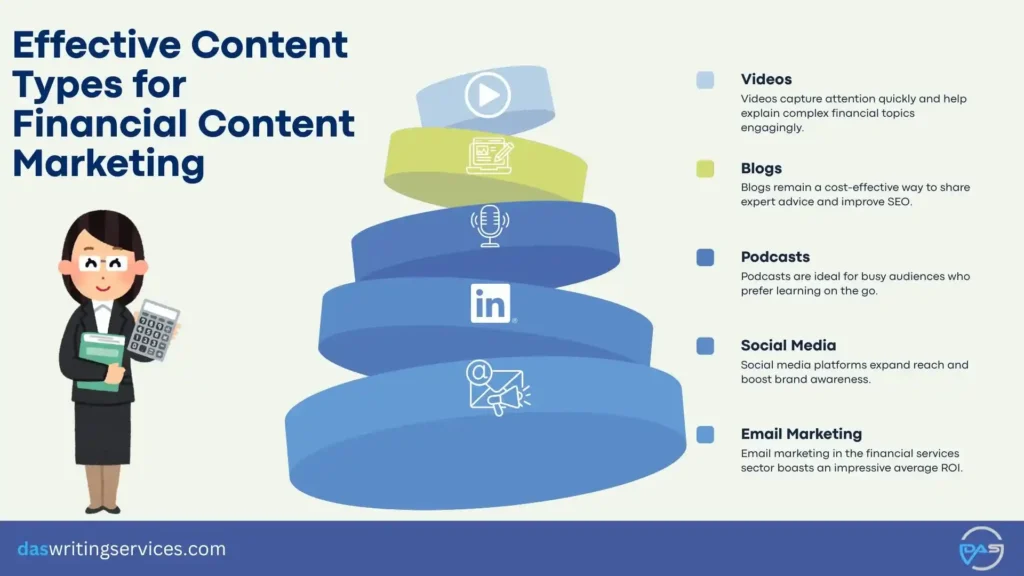
Effective Content Types for Financial Content Marketing
1. Videos
Videos capture attention quickly and help explain complex financial topics engagingly. They boost search rankings, drive more website traffic, and improve conversion rates. In 2025, 49% of marketers leverage videos, with short-form videos yielding the highest ROI at 21%.
Although production can be costly and time-consuming, well-made videos build trust, educate audiences, and deliver lasting engagement over time.
2. Blogs
Blogs remain a cost-effective way to share expert advice and improve SEO. They educate readers, attract organic traffic, and establish authority.
Yet, maintaining quality and consistency can be challenging, and text-heavy content may seem less engaging than visual formats like videos or infographics.
3. Podcasts
Podcasts are ideal for busy audiences who prefer learning on the go. They help financial brands share insights, educate listeners, and subtly promote services.
However, they require effort, consistency, and creativity to stand out in a crowded market and build a loyal listener base.
4. Social Media
Social media platforms expand reach and boost brand awareness through direct engagement. They are ideal for sharing updates, videos, and short financial tips.
However, strict compliance regulations and potential negative comments mean institutions must monitor content carefully and maintain professionalism across all interactions.
5. Email Marketing
Email marketing in the financial services sector boasts an impressive average ROI of 3600-3800%, surpassing nearly all other marketing channels. In fintech, the average email open rate is 34%, with conversion rates averaging 21%.
When done right, it builds loyalty and drives conversions. The key is delivering valuable, relevant content that feels helpful and not spammy in an already crowded inboxes.
Common Challenges in Content Marketing for Financial Institutions
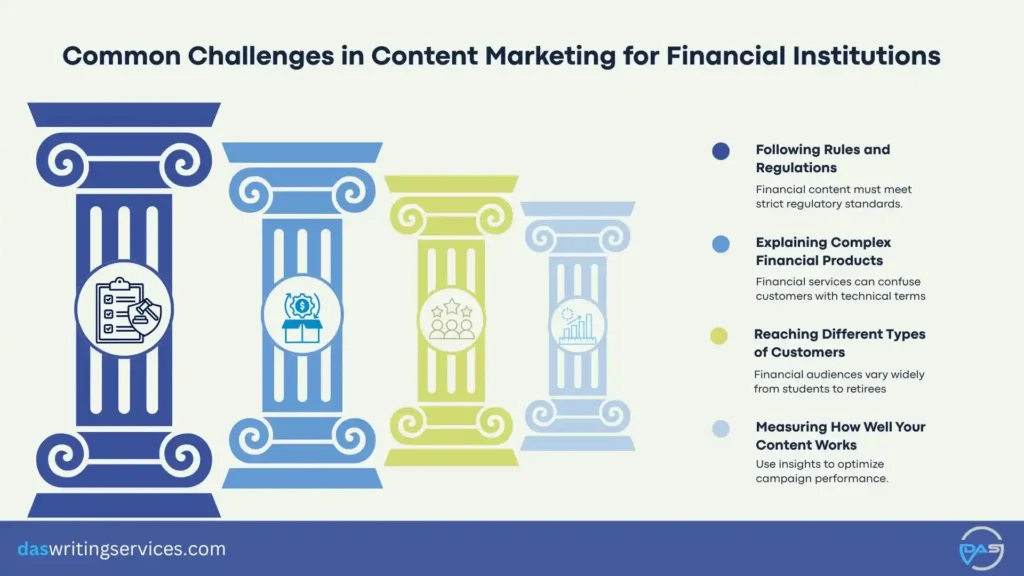
- Following Rules and Regulations
Financial content must meet strict regulatory standards set by institutions like SEBI and RBI. Non-compliance can lead to heavy fines or reputational damage.
Since these rules are prone to revisions, stay updated and involve your compliance team in every review. Therefore, you need trained and experienced content writers who understand compliance or have an experience with working with SMEs.
- Explaining Complex Financial Products
Financial services can confuse customers with technical terms and jargon. Simplify your messaging by explaining products in clear, understandable language.
Create content that answers real customer questions about loans, insurance, or taxes. Train in-house writers or collaborate with professional content writing agencies to make complex topics easy to understand.
- Reaching Different Types of Customers
Financial audiences vary widely from students to retirees, each with unique goals. A single message rarely fits all. Segment your audience by age, income, or life stage and tailor your content to each group’s needs.
Use research and data to personalise communication to ensure it resonates across languages, cultures, and financial priorities.
- Measuring How Well Your Content Works
Financial decisions often take time, so results are not immediate. Track performance using key metrics like website visits, lead conversions, and engagement rates.
According to a report by Forbes, 92% of marketers view content as a valuable long-term business asset for driving ROI, while 89% say content marketing outperforms traditional marketing approaches.
You can use analytics tools to study user behaviour and feedback surveys to gauge satisfaction. Measuring the entire customer journey helps identify which content drives trust, interest, and long-term results.
Read Related Blog: Content Marketing for Startups
How to Get Started With Us for Content Marketing for Financial Institutions?
To hire SEO content marketing services from Das Writing Services for your financial institution, you can simply contact our team at business@daswritingservices.com. You just need to share your requirements and the budget. Then, we will work together to create a strategic content plan with educational blogs, articles, etc. that build trust and address financial challenges.
Our team has a proven record of producing high-quality, informative and helpful content marketing strategies for financial institutions. We help them attract new audiences and create a strong brand connection with clear messaging. By tracking performance through SERP ranking, impressions and clicks, we make sure you receive consistent ROI through organic marketing.
Click below to check out the esteemed clients that benefit from our finance content writing services.

Frequently Asked Questions
The 4 P’s of content marketing for financial institutions are: Product (the financial services offered), Price (the cost of these services), Place (where and how they are provided), and Promotion (the marketing strategies used to attract customers).
The five primary content marketing goals are to raise brand awareness, generate leads, educate customers, boost engagement, and increase conversions. These goals help businesses to create focused content strategies to achieve clear, measurable results.
To build an effective content marketing strategy, set clear goals, understand your audience, review existing content, choose suitable content types, plan your approach, establish a creation process, and regularly measure performance to track success and improve future efforts.
Content marketing has four main types: written (blogs, articles), audio (podcasts), video (YouTube, reels, ads), and image-based (infographics, social posts).
Content marketing involves creating and sharing valuable, engaging content to attract, inform, and retain a specific audience. The goal is to build brand awareness, customer loyalty, and encourage profitable actions over time.

Subhodip Das is the founder and CEO of Das Writing Services Pvt. Ltd. He has an experience of 12 years in the field of Digital Marketing and specialises in Content Writing and Marketing Strategies. He has worked with well-established organisations and startups helping them achieve increased Search Engine Rank visibility. If you want to grow your business online, you can reach out to him here.


Leave a comment