In our time, AI has pretty much redefined how search engine optimization typically works. Instead of looking for maximum number of keywords, AI in SEO has helped search engines understand the intent and context of a search query – producing more accurate and helpful search results to users.
Today we are discussing how artificial intelligence is shaping search engine optimization and what you can do about it to stay ahead of the competition. So, the initial part of the blog will try to explain how AI models are involved in SEO.
Subsequently, the blog will further elaborate a few tools and trends that may come in handy in optimizing your strategy for AI visibility in SEO.
How AI Driven Search Works in SEO?
When you enter a prompt or query on a search engine, the underlying IR (information retrieval) machine learning algorithms scan inverted and vector indexes for semantically relevant information. Once the relevant information is identified, the RAG models extract the data to create context while LLMs generate responses for the query based on the context.
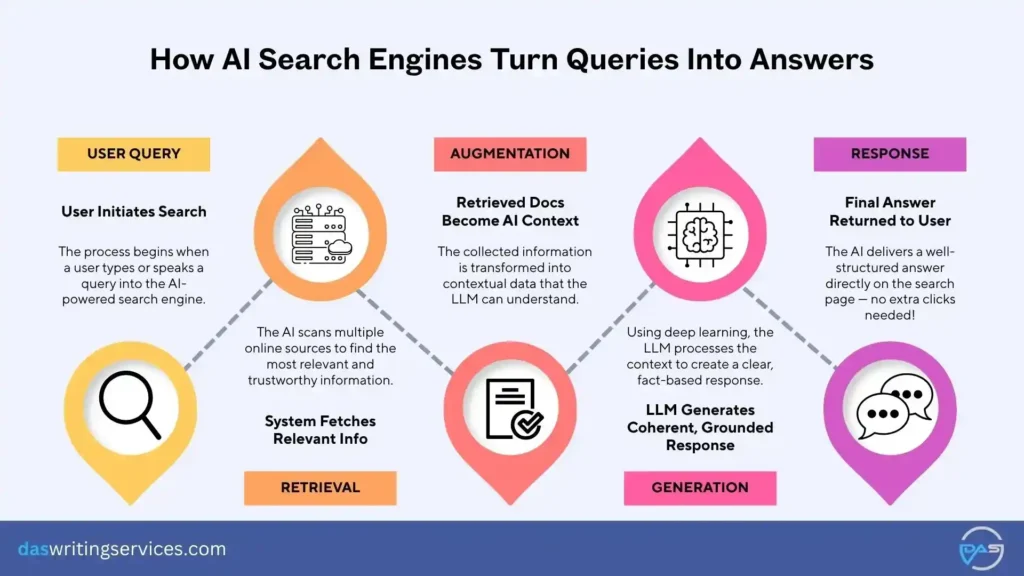
AI based RAG (Retrieval Augmented Generation) models like AI Overview and Co Pilot may have come now to users. But the foundation of AI search was laid back in 2015 with machine learning algorithms like RankBrain, BERT and MUM which helped Google shift from keywords to understanding intent of search queries.
Recently the MUVERA algorithm has further taken it to the next level where the involvement of multiple vector databases has made information retrieval more accurate and nuanced. Hence the efficiency of models like GPT5 or Google’s AI Mode that combines the power of LLMs with data points accessed from multiple vector databases.

How Search Engines Use AI/LLMs in 2025
Over the past year, zero click searches have increased by 2.8% in the US and 2.5% in the UK. Meanwhile more than 70% of mobile searches do not lead to any clicks. Users are finding relevant information on the SERP itself and leaving from there.
It is pretty evident that introduction of RAG models like AI Overview and AI Mode are responsible behind this shift, where IR (information retrieval) systems source the information from credible websites and forums, and LLMs optimize it as per the user query. With this framework, let us try to understand how AI powered search engines choose the right sources of information. And what you can do to secure citations in AI search results.
1. Direct answer generation
Instead of directing the user to relevant websites and pages that discuss the searched query, search engines can now extract the information against the query. As a result, users find most of their queries answered on the SERP home page itself, doing away with the need to visit a dedicated page.
2. Recognise the user search intent
Rather than matching the keywords, AI algorithms like neural matching and BERT recognise the context and intent behind a search. They can recognise the meaning of even long tail question based queries – thanks to NLP. So if you are searching with informational search intent, AI overview appears.
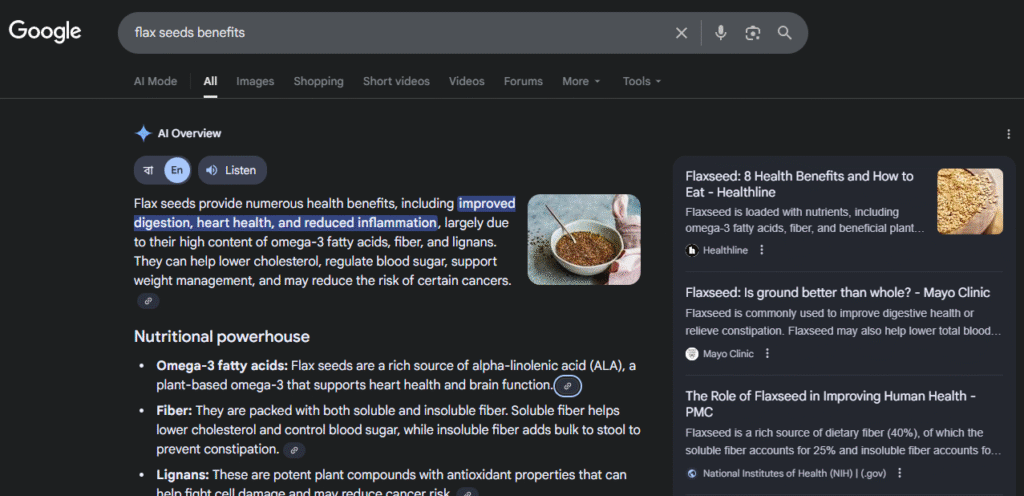
It scrapes information from relevant high authority sources such as healthline, NIH and Mayo Clinic in the above snippet. Following the retrieval, LLMs create the AI Overviews optimized for the particular search query.
3. Semantic search
If you have noticed, both AI Overview and AI Mode tends to offer all-round comprehensive responses, often going beyond the immediate search query.
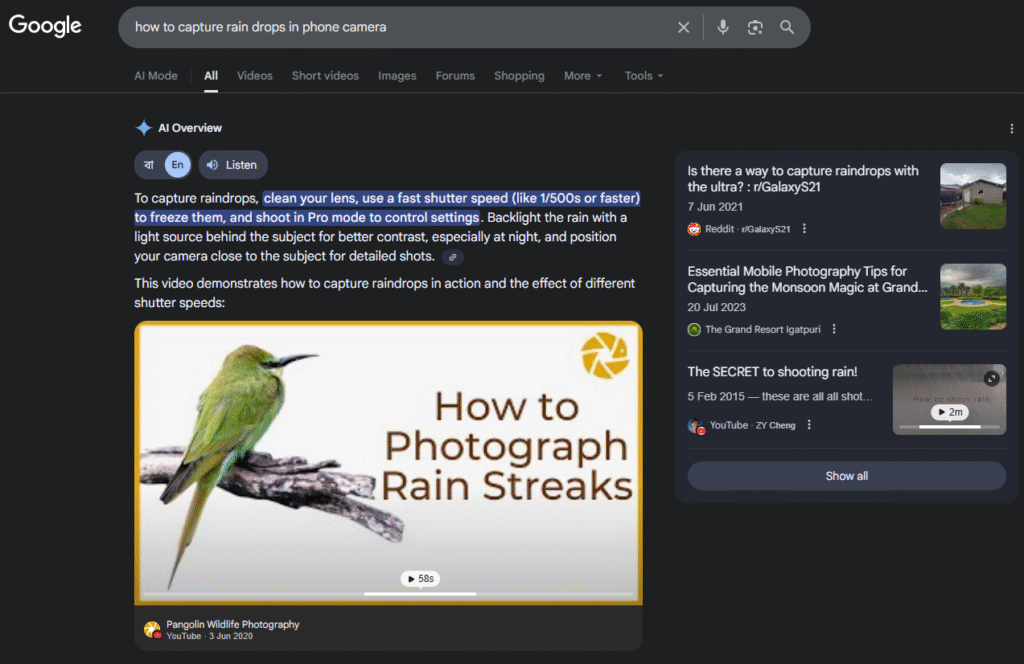
For instance, the above query triggered an AI Overview which cites information from 3 sources primarily. The first being a subreddit related to a similar topic of the search query. While two other sources refer to YouTube tutorials on photography, the RAG model of AI Overview fans out the search query into subsidiary queries – indexing and extracting information from associated pages like the second citation on Mobile photography tips.
4. Personalization – based on context
The introduction of LLM powered AI search witnessed drastic increase in the time users spend on the SERP. Thanks to context based personalization in responses, user engagement has increased by 2.5x. Personalizing based on factors like location, search history and user preferences and behaviour – AI responses are getting more and more fine-tuned for the user.
5. Continued Learning
Google’s AIO or AI based search models like ChatGPT and Perplexity continue to upgrade its infrastructure and databases to offer updated and relevant information. Most of these tools have an ingrained memory where the user’s inputs and preferences are remembered to generate custom responses.
Also Read: How to Optimize Content for AI Visibility?
Essential Tools & Platforms for AI SEO
As AI search trends keep growing in SEO, professionals must learn to optimize for AI SEO. As a marketer in 2025 looking to drive AI visibility and performance, you can use the following tools to optimize your pages for AI visibility and keep a track of the same.
Semrush
Semrush’s AI SEO Toolkit allows marketers to track a brand’s visibility in AI generated answers across platforms. Since measuring the AI visibility of a brand is a rigorous and hectic process to be done manually, this toolkit can automate the KPI tracking process without daily supervision.
Profound
Profound reveals how your brand is cited by generative AIs. It tracks metrics like citation frequency, sentiment, and prompt volumes across platforms like ChatGPT, Gemini, and Perplexity—making it possible to turn AI-driven insights into optimized content briefs. The tool also helps you find the gaps in your pages and suggest ways to optimize them.
Surfer SEO
Surfer SEO gives you a data-backed roadmap to optimize content via on-page signals. It scans hundreds of ranking pages to suggest content structure, keyword usage, and semantics. It also comes with a built-in content editor that grades your writing in real time by scanning for keywords, semantics and readability of the content.
Neuron Writer
With algorithms having evolved for Natural Language Processing (NLP), this tool helps you identify the naturally occurring semantic phrases and words recurrent across the top ranking pages on the SERP. It gives you a pretty decent idea as to what are the subtopics you need to address to create a helpful content.
Otterly.ai
Identified as an AI search monitoring solution, Otter.ai helps marketers track the visibility and performance across all major AI search platforms like Perplexity, Gemini, ChatGPT and AI Overview. The tool efficiently tracks the existing citations while also providing the high-intent prompts for which you may optimize your pages for greater visibility.
Challenges of AI in SEO
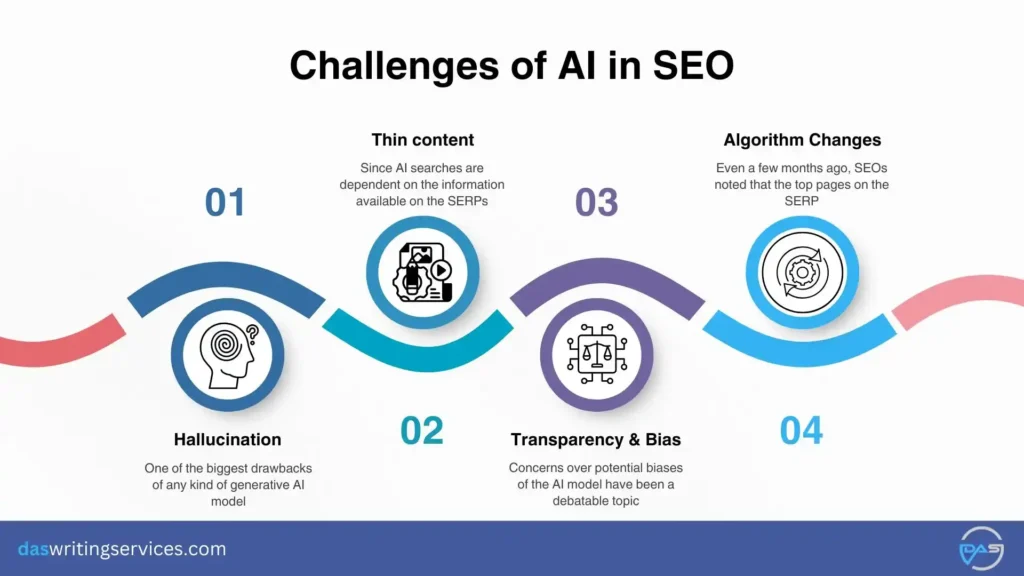
While AI in SEO has made information retrieval more effective and virtually easier, there are definitely some drawbacks when AI comes to replace traditional search results.
1. Hallucination
One of the biggest drawbacks of any kind of generative AI model is the tendency to create random information. The phenomenon is called AI hallucinations where the model generates random references and quotes and passes them as legitimate.
2. Thin content
Since AI searches are dependent on the information available on the SERPs, the responses will be as good as information available. So, if most of the ranking pages or sources contain generic descriptions, the AI search responses also tend to mimic the same.
Read Related Blog: What Is Unique Content and How to Create It
3. Transparency & Bias
Concerns over potential biases of the AI model have been a debatable topic since the inception of artificial intelligence and machine learning. The underlying reason is straightforward – while AI models are supposed to be objective, they are trained on data sets which are seen to have underlying biases.
So, the models tend to replicate the same biases found in the data sets in their responses. Additionally, the inconsistency in AI citations put up a big question on transparency. While a predisposed bias towards western information sources are quite rampant, the models often cite low authority third party websites.
4. Algorithm Changes
Even a few months ago, SEOs noted that the top pages on the SERP essentially are appearing as citations on AI Overview. However, the same is no longer the situation, nowadays even if the search query remains same, the citations keep changing every time you hit refresh on the SERP.
The frequent algorithm changes are one of the classic reasons why search engine ranks remain volatile. The same issue also impacts AI in SEO as visibility on AI answers remains fleeting and volatile.
How to Measure KPIs of AI SEO?
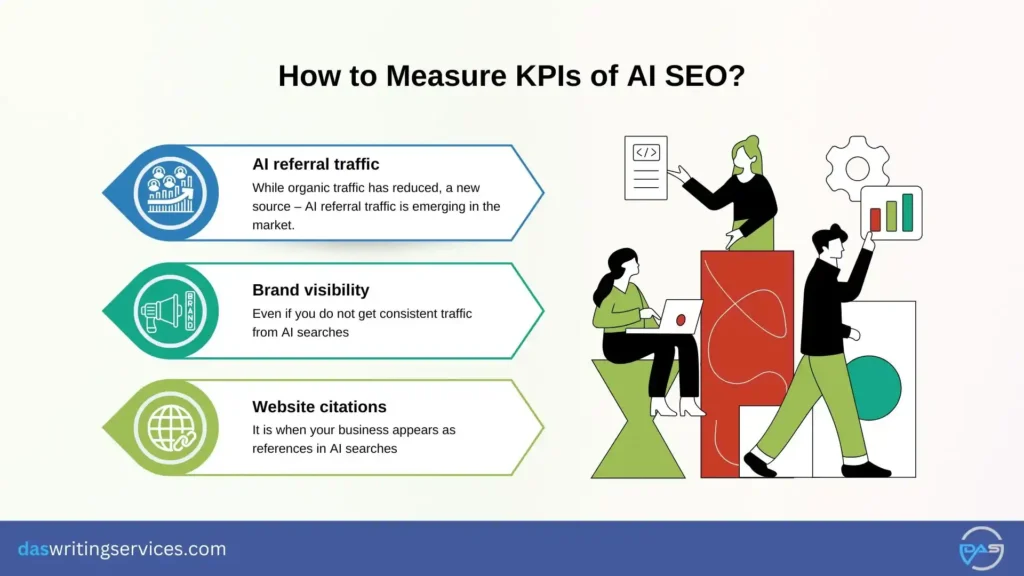
While traditional SEO KPIs seems to struggle with reduced clicks and overall reduction in CTR, AI search trends are taking off thanks to efficiency and convenience of the models.
1. AI referral traffic
While organic traffic has reduced, a new source – AI referral traffic is emerging in the market. While the AI referral’s percentage share is very low, it promises to only increase with time. Also, marketers consider AI referrals to be better quality prospect due to their familiarity with latest industry technology.
2. Brand visibility
Even if you do not get consistent traffic from AI searches, brand mentions in AI responses are vital assets in the growth journey of a brand. By securing mentions against high intent prompts, businesses can drive higher brand recall.
Know More: Top 17 Types of Branding with Examples
3. Website citations
It is when your business appears as references in AI searches. Apart from helping the user navigate to your website, citations in AI responses establish you as an authoritative entity and signals trustworthiness to the users.
Trending Strategies in AI in SEO
1. Multi-channel optimization
Since IR (information retrieval) systems crawl virtually the entire web, managing your overall online reputation is essential. Naturally then, maintaining uniform messaging across multiple channels help you feature a robust brand identity to the user.
2. Agentic AI
Incorporation of agentic and autonomous AI can further streamline the workflow of SEO professionals. With frameworks like AutoGPT, LangChain etc. marketing professionals can entrust objective based tasks to multi agent powered models. This automates workflow allowing AI agents to execute tasks by itself.
Takeaway
With all the innovations in AI, the SEO industry is noticing an overall shift. AI searches have made it easier for users to find necessary information without having to scan multiple SERP results to find relevant source of information. But for many marketers, the AI shift means coming at pace with the current requirements of the industry – to upgrade content strategy and distribution to stay relevant in organic searches.
FAQs
1. What AI can help with SEO?
AI helps with SEO by automating tasks like keyword research, competitor analysis, technical SEO audits and performance tracking.
2. Is AI good or bad for SEO?
Essentially, AI is neither good nor bad for SEO. AI is a tool which, when used mindfully, can automate repetitive tasks of SEOs and increase productivity.
3. How to use AI for local SEO?
AI can be used in local SEO to optimize content for hyper-local audience, optimize Google Business Profile and automate data updates.
4. Does Google allow AI content for SEO?
Google maintains that appropriate use of AI and automation is not against the Google’s guidelines. However, it emphasizes that those willing to secure visibility in Google Search must focus on E-E-A-T and produce original information designed to help users.
5. How to rank #1 in ChatGPT results AI SEO strategy?
Creating answer first content around conversational queries are one of the ways to optimize content for ChatGPT. Additionally, a strong brand identity tends to work well for businesses looking citations and mentions in ChatGPT.

Ritish Dutta is a seasoned Content Developer with over 7 years of experience in the industry. Currently, at Das Writing Services, he writes SEO-optimized content that caters to our diverse clientele. Ritish utilizes his critical insights and experience to talk about digital marketing, SEO content writing, content strategy, and AI.
Leave a comment
All comments
Arghish Das
This is a really helpful article! It's great to learn about how AI can help with SEO. What are the downsides of relying too much on AI for SEO? Thanks for sharing your knowledge!