
Creating content without structure is like building a house without a blueprint. It is possible, but never sustainable in the long-term. Pillar content solves that problem by offering a clear, strategic framework that supports all related content on your site. It also helps scale your content campaigns without threats of keyword cannibalization.
A well-built pillar page becomes the central resource of a topic cluster, helping you claim authority, improve your SEO performance, and give search engines a clear trajectory to discover and understand how content are related to each other on you site.
For visitors, pillar pages give a clear pathway to explore related topics without any confusion. So, keep reading to learn all about pillar content to create your own content strategy.
Want to get a custom content strategy tailored to your business needs? Click below

What is Pillar Content and Why Does It Matter for SEO?
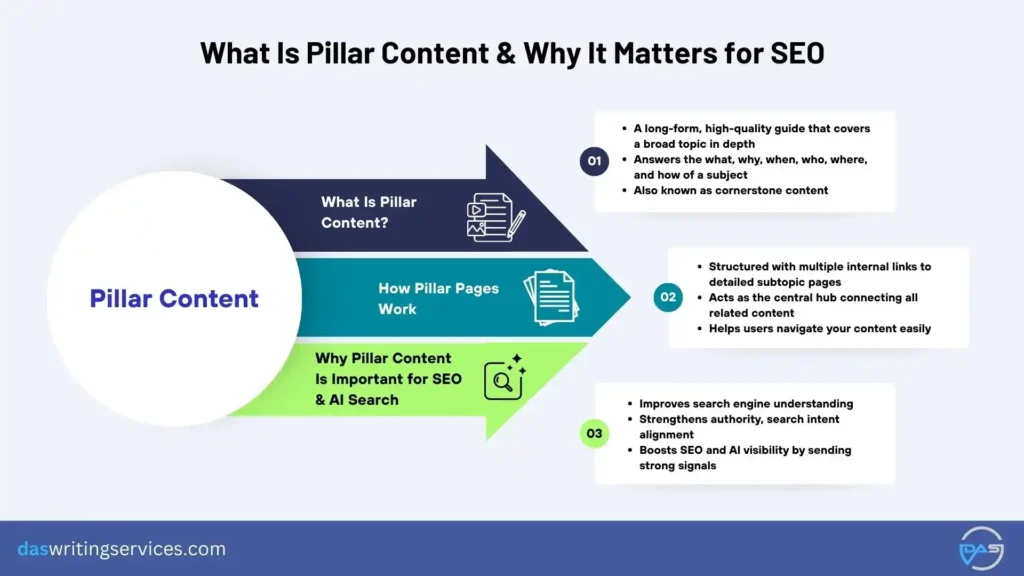
Pillar content is an extensive, high-quality content asset offering a broad topic overview. It acts as an ultimate guide that addresses what, why, when, who, where, and how of a subject.
A pillar page is typically long-form and structured, linking out to associated topics or pages that explore each subtopic in detail.
Search engine crawlers prefer this structure because it organizes the content on your site more efficiently and helps understand the connection between one page to another. When search engine and AI search crawlers navigate your content pillar, they find clear internal links connecting related content pieces, sending a strong signal to search engines that your site offers comprehensive coverage on a topic.
This approach is also known as cornerstone content, and it helps you become an authority on the topic while improving your SEO and AI visibility through stronger interconnections, clear search intent alignment, and better keyword relevance.
How Does a Pillar Page Work Within a Topic Cluster?
A pillar page and the cluster pages work like a hub and spokes. The pillar page covers a broad topic, while each cluster content page explores a specific subtopic, linking back to the pillar.
This structure ensures your content aligns with search engine results pages expectations, organizes your related content, and makes it easier for both bots and humans to navigate through your website’s sections.
The internal link network helps search engines understand the relationship between pages on your site, promoting higher rankings for competitive keywords.
From an SEO standpoint, topic cluster models help consolidate authority. When multiple pages link back to the pillar, they amplify its strength, pushing the entire cluster’s performance upward. As users click into subtopics and return back to the pillar page, bounce rate naturally reduces due to deeper engagement.
What Types of Pillar Content Should You Create?
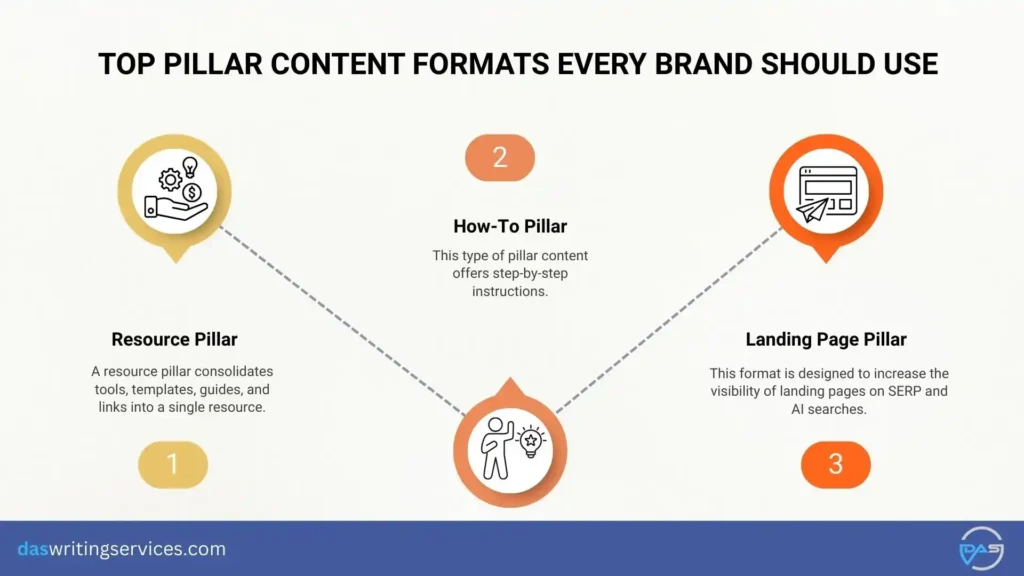
There are several types of pillar content structures depending on your objectives, audience, and industry. Selecting the right structure influences how pillar pages help your website rank. The following are widely used pillar+cluster models by businesses.
1. Resource Pillar
A resource pillar consolidates tools, templates, guides, and links into a single resource. It is helpful for audiences needing quick, organized access.
2. How-To Pillar
This type of pillar content offers step-by-step instructions, ideal when your audience seeks actionable solutions. It is a powerful piece of content for building trust.
3. Landing Page Pillar
Often used to generate leads from content marketing, this format is designed to increase the visibility of landing pages on SERP and AI searches. They capture organic traffic and drive conversions.
All types of content above can become part of a structured content pillar plan, ensuring your content is relevant, comprehensive, and important to your business.
What are the Steps to Create a Pillar Page for Your Website?

Here is a streamlined approach to create a pillar page that ensures your content could rank higher:
Step 1: Identify a Broad Topic
Choose a core subject aligned with your content marketing strategy and audience expectations. It would typically target a short tail and convertible intent keyword. Perform thorough competitor research to list down related semantics and pointers you would need to cover in the pillar content.
Step 2: Map Subtopics
Conduct keyword research and isolate content ideas that address the full breadth of the topic. You can choose long-tail keywords in this case. Browse forums and PAA section on the SERP to find out what related searches people are performing. These become cluster pages that go in-depth on a particular subtopic related to your pillar content.
Step 3: Build Inverted Content Silos
The idea is to explore specific details about your pillar pages in the cluster content. Design your structure so that topic clusters link back to the pillar. This way you can create content silos to cover each theme or broad topics. Your pillar content will be at the head of the silo – creating context for all the subtopics.
Step 4: Write the Comprehensive Pillar Page
Ensure it covers all aspects of the topic, integrates subtopics, and provides an overview. Place CTAs and lead magnets strategically across the page to capture the user details efficiently. Make sure that your lead magnets indicate value and the narrative of the content naturally leads the user to it.
Step 5: Add Internal Linking
Cluster pages link back to the pillar page to reinforce its topical authority, while the pillar page links out to relevant cluster pages to provide structured navigation and context. This interconnected structure boosts search engine results visibility. Additionally, users also find it more convenient to move from a page to related pages that go in-depth on a particular subtopic.
Step 6: Publish and Promote
Share your content across website and social media platforms and track performance. Try to maintain a content calendar that keeps your publications regular and predictable. Publishing all content at one go might invite a bulk content abuse penalty from Google.
How Do Topic Clusters and Pillar Pages Help Your SEO?
Pillar content helps search engines understand context, relevance, and hierarchy. When pillar pages act as centralized hubs, they guide search engines to navigate your site more efficiently.
This structure improves your ability to earn organic traffic, especially when you want to rank for competitive keywords. A well-developed topic cluster builds a strong information architecture that reinforces relevance and authority signals.
Additionally, pillar pages can help maintain coherence across pages on your site, signaling that your content is comprehensive and interconnected. As a result, you strengthen your ability to improve your SEO and enhance visibility across search engine results pages.
5 Advantages of Using Pillar Content in Your Content Strategy
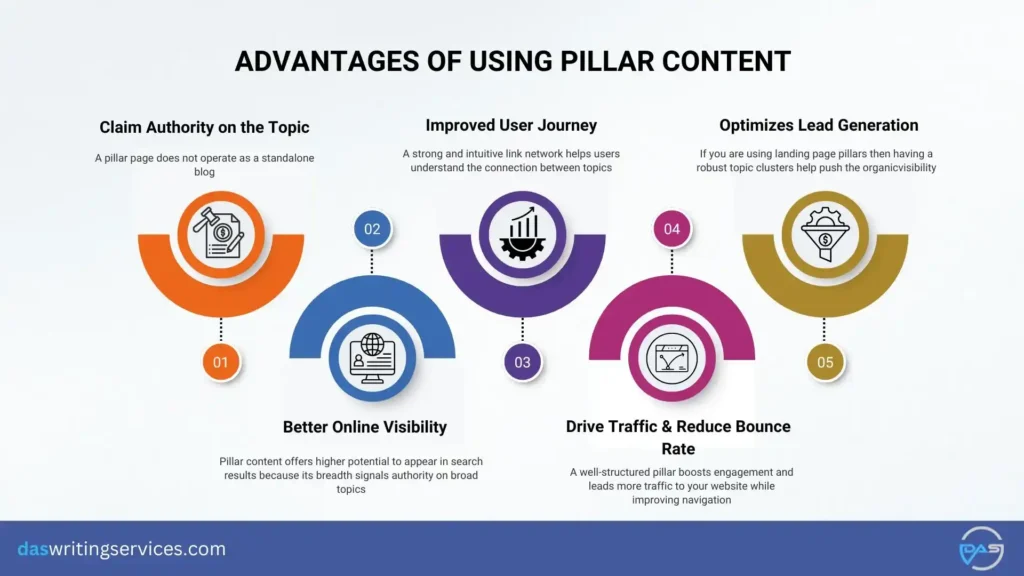
1. Claim Authority on the Topic
A pillar page does not operate as a standalone blog. Since the pillar content links to related topics and vice versa – it shows clear connection between topics. By creating content silos on topics and subtopics, you claim topical authority on a particular subject.
By offering a complete overview, you establish yourself as an expert and create solid content that users trust.
2. Better Online Visibility
Pillar content offers higher potential to appear in search results because its breadth signals authority on broad topics. With a comprehensive plan, it can boost your performance across SERP and help you rank in AI searches across the internet.
3. Improved User Journey
A strong and intuitive link network helps users understand the connection between topics. They find helpful content without navigating endlessly, ensuring your content aligns with search intent.
4. Drive Traffic & Reduce Bounce Rate
A well-structured pillar boosts engagement and leads more traffic to your website while improving navigation. Interconnected topics encourage navigation to related pages. This makes users stick around for longer duration and the average bounce rate of your website decreases.
5. Optimizes Lead Generation
If you are using landing page pillars then having a robust topic clusters help push the organic visibility and AI citation frequency of the commercial intent pages. Ultimately, this ensures consistent traffic inflow from various touchpoints which increases organic lead generation.
How to Ensure Your Content Pillar Stays Relevant Over Time?
To keep your content pillar updated, ensure your content is relevant to current trends and search intent. For that, schedule quarterly reviews to include new data, new tools, and evolving helpful content guidelines. Update your pillar content and clusters as your industry and market practices evolve.
Maintain a content calendar and ensure your strategy can also adapt to new opportunities. This approach keeps your content fresh, provides long-term value, and nurtures ongoing traffic to your site.
When was the last time you audited your website content strategy? Get minimum 20% performance growths with our complimentary content auditing service.
What Makes a Successful Pillar Content Structure?
A successful pillar content piece combines structure, depth, and clarity. It must feature:
- A comprehensive pillar page
- Clear internal link pathways
- Strong keyword integration
- High-quality content aligned with search intent
- Logical hierarchy between the page and the cluster pages
Make content practical, actionable, and easy to navigate. This makes sure that your site is easier for both users and crawlers to explore, resulting in ranking higher in search.
Examples to Inspire Your Next Pillar Content Project
Here are pillar page examples to inspire your next content silo:
1. Ultimate Guide Pillars
For a pillar content on “The Ultimate Guide to SEO Tools”, the cluster pages would look something like this: best keyword research tools (free+paid), technical SEO tools to fix broken links, analytics and reporting tools and how to use them.
2. Resource Pillars
Let us consider the following topic “All-In-One Marketing Templates and Frameworks” as the pillar page in a content silo. This pillar content may branch out to create cluster pages on the following topics, social media marketing, content marketing, PPC, influencer marketing etc.
3. Cluster-Heavy Pillars
“Content Marketing: Explained” is a broad pillar content topic which includes myriad subtopics that can be explained with linked clusters like Content Planning, Editorial Calendar, Measuring Performance. Due to extensive subtopics, one can create a 3 tier content silo to efficiently cluster content.
Tips to Create Effective Pillar Content
1. Identify Your Commercial Goals
Like any other marketing channels, pillar content marketing must have definitive purposes. Whether it is to rank higher for a difficult keyword, drive more traffic from a specific user cohort or to establish thought leadership – articulating your content marketing goals guides you to develop an appropriate content plan that works for you.
2. Take Advantage of Technical SEO and Structured Data
One common pitfall of scaling content production is the risk of duplication. Since you create content across related topics, the chances of duplication or keyword cannibalization is higher.
Avoid this by using Rel=canonical tag on your pillar pages to indicate it as the primary page in the theme. You can also use schema to categorize your page, this can enhance your website’s visibility on AI driven search.
3. Plan a Deliberate Linking Strategy
If you have a considerable repository of content, it will be tempting to link to every second page on your website. Nevertheless, there has to be a clean and planned network of links between your pages.
It is advisable to create your complete content plan first and sticking with it. This should help you keep a tab on the link flow.
4. Begin with a Content Audit
If you already have a published website, performing a content audit is mandatory. And you have to do it before launching theme based content silos for marketing. A content audit gives you a clear idea as to how existing pages are thematically tied to each other.
Once grouped together, you can refresh or remove these pages to create your pillar + cluster content silos.
5. Use Self-explanatory Anchor Texts
When creating a content cluster, choose the right anchor text to hyperlink your pillar content. Make sure that your anchor texts clearly suggest what the user might get from the linked page.
For instance, “click here” and “as per a survey” are generic and vague anchor texts. For precision, “NITI Aayog’s 2024-25 report” or “click to download the case study” are precise and direct anchors that help users and web crawlers identify the purpose of a hyperlink.
How to Track the Performance of your Pillar Content Marketing?
Like any other marketing campaign, the usefulness of pillar content marketing strategy is only discernable if you are able to track its performance. The following are a few ways you can track your content performance.
- Track AI citations on informational pillar pages
- Use tag manager to track conversions from landing pages
- Look out for improvement in average session time
- A reduced bounce rate is a good sign that the navigation is engaging users
- Look for improvement in average position on GSC over last 3-6 months
Key Takeaways
For SEO crawlers and AI bots, a pillar & cluster content model chalks out clear content architecture that suggests comprehensive coverage and highlight topical authority. As with any form of organic marketing, the results may not be too quick. Yet, consistent performance drives momentum over time that brings sustainable results.
However, if you want to measure ongoing performance in 2-3 months – focus on engagement metrics like bounce rate and session time. They are the early indicators that your marketing strategy is working.

Ritish Dutta is a seasoned Content Developer with over 7 years of experience in the industry. Currently, at Das Writing Services, he writes SEO-optimized content that caters to our diverse clientele. Ritish utilizes his critical insights and experience to talk about digital marketing, SEO content writing, content strategy, and AI.


Leave a comment