By now, content creation is no longer an innovation. Almost 82% marketers across the globe actively invest in content marketing – making it a popular choice to engage users. With the many benefits of blogging, content is used by B2B enterprises as well as consumer facing brands planning a sustainable growth.
However, a content here and a social media post there can hardly produce any noticeable shift in engagement. Especially when you want to grow your operations and target wider user groups, scaling your content production is must to acquire new website users.
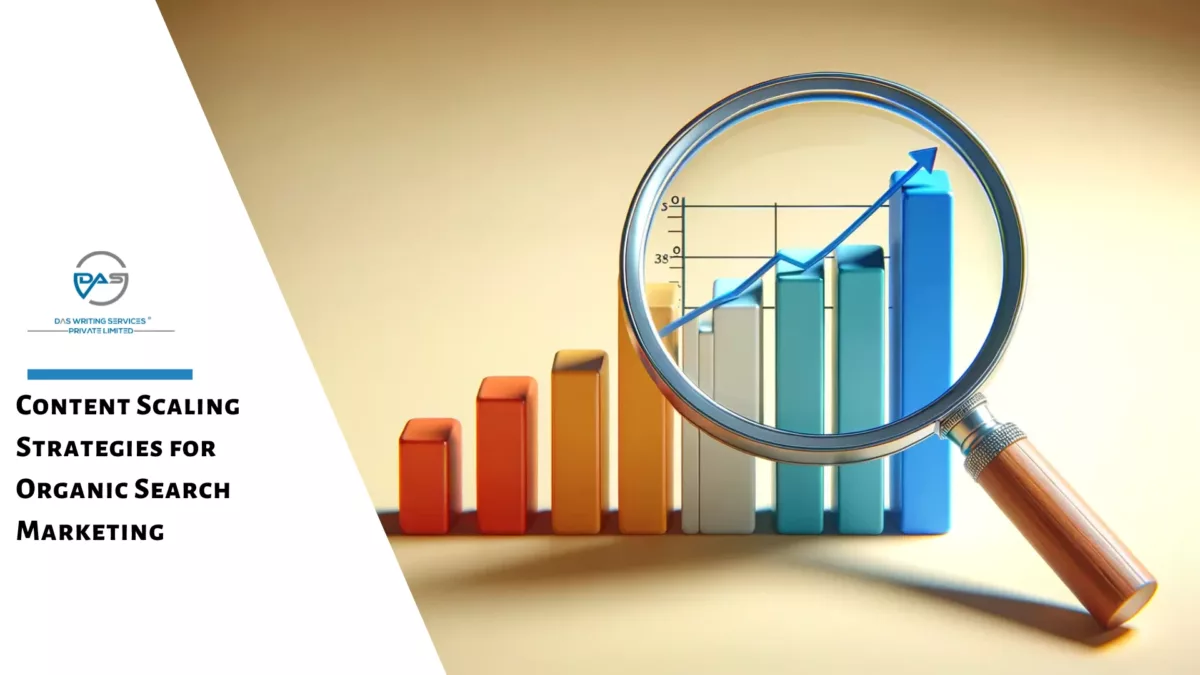
Content scaling is a systematic approach to increase your content production across multiple verticals and channels. By optimizing workflow for high volume production, scaled content marketing draws new website visitors, builds brand reputation and increases organic visibility across the web.
If you are thinking about scaling your content production, you have landed at the right spot! We are the content specialists offering tailored solutions to some of the popular names in India and abroad.

Why Content Scaling is Essential for Businesses in 2025?
Up to 80% of businesses who create content notice little to no ROI. While the rest 20% generates returns exceeding 500%. Do you know why? Because, these 80% tend to create content erratically without outlining the goals for content marketing.
When you produce and distribute content regularly across multiple channels, you get the following advantages.
1. Increases Organic Reach
Consistent publication of fresh, relevant, and high-quality content is one of the main driving forces of organic visibility and SEO success. This is due to the fact that search engines prefer websites that get updated frequently with high-quality content.
The algorithms interpret this as the site’s authority, helpfulness, and relevancy. With content scaling you are able to add a greater volume of high-quality content, which will also help you cast a wider net, enabling you to answer a larger amount of search queries.
2. Drive Higher Conversion Rates
If you want to convert your website visitors to customers or clients, scaled content can play a pivotal role in making that possible. Good quality content engage visitors, encourages them to stick around longer. This ends up increasing the average user session time.
It is a widely established fact that websites that get more than 3 minutes worth of session time has an higher conversion rates. Well-optimized content also strengthens the touch points to acquire more MQLs (Marketing Qualified Leads).
Depending on the stage of the client’s journey and the business your content can include prompt actions for availing free trials, newsletter sign-ups, sample products, or direct purchases.
3. Increase Brand Awareness
The more your brand is associated with a solution or recognised by your customers the better its awareness within a particular industry. However, in digital marketing, brand awareness has a slightly different meaning, especially looking through the SEO lens. Brands attract more attention when they appear more frequently in the SERP for a specific subject.
The customers or the searchers understand that the company is authoritative in that subject and most probably can answer their query. Therefore, getting more recognition in the market is directly proportional to the number of content you are able to rank.
Scale your content today with tailored enterprise grade solutions!

9 Content Scaling Tips for Businesses in 2025
Depending on your line of business, content scaling can be a definitive strategy to catapult your business to limelight. Following these steps can help you make the most out of it.
1. Create Buyers Personas for Each Stage of the Funnel
Content scaling is all about identifying and reaching the target audience the way you want. Gaining an understanding of what makes your target audience tick can be easier if you develop marketing or buyer personas for users in each stage.
Also Read: What is Content Marketing Funnel?
Leverage data and analytics to fine-tune your personas. This will make sure you are efficiently communicating for users across multiple touch points.
2. Create a Content Plan
The next step would be to invest some time into creating a well-structured content plan. During content production, it will act as a roadmap. Among many other functions, it outlines your content goals, types, and distribution channels.
A plan helps you keep your content production, publication and business objectives in remunerative alignment as in that way every piece of content serves the target audience and your purpose.
3. Design an Organised Content Calendar
An organised content calendar allows you to constructively manage your content production. Your content calendar should work as an intricate project management system that does not let anything fall through the cracks by listing every step and tracking development. You can do this using tools like Google Sheets, Monday.com, and Notion.
4. Reposition Existing Content
A content that performs well in Google may be repurposed on LikedIn to engage users with meaningful tips. Therefore, you can save a lot of time (by avoiding crafting content from scratch) by repurposing old content. Adapting the format or the messaging may be all it will take for those to be ready to be appealing to new audiences again.
To help you with this process refer to your buyer personas. To attract these soon-to-be customers try tweaking the overall angle of the content, its heading, and keywords.
5. Choose Scalable Topics
Refer back to your personas again and keep their inclinations in mind when you start to plan the topics or themes. By creating a silo structure with pillar and cluster pages, you can increase visibility as well as domain authority in the market.
For example, if you offer home décor accessories, you can create pillar pages around comprehensive home renovation and have the cluster pages elaborate on particular aesthetic trends of renovation.
6. Have Detailed Briefs for Each Post
This is especially important if your organization has an elaborate hierarchy or if you are planning to outsource your content requirements.
Content strategists and SEOs should make these briefs that will include crucial information like target audience, search intent, post type, primary and secondary keywords, and specific notes on content differentiation and angles.
To ensure clarity you may also include a detailed outline of the content, however, it is optional. You can also have ChatGPT suggest LSIs and semantic keywords to drive competitive advantage. Having detailed briefs ensures quality, consistency, and deliberate alignment across all content.
7. Create a Style Guide
To make the content scaling process even more efficient, you can implement the use of style guides. Whether you are using an internal or external team of content creators, style guides make sure that your messaging is consistent and always on-brand. A proper style guide should have guidelines for brand-specific terminology, voice, tone, and formatting.
Moreover, include clear guidelines for engaging each group of your target audience. If you do want to focus on a specific group of people, ensure that the appeal is not too broad. Otherwise, you may fail to resonate with your target segment.
8. Offer Resources & Support for E-E-A-T
Making sure that your content is credible is always the first step in any content planning. With the increasing competition E.E.A.T. (Experience, Expertise, Authoritativeness, Trustworthiness) is not an option but a requirement.
If you cannot find domain experts, one other way is to find skilled writers and connect them with SMEs. Whether internal or external, all you need to do is connect writers with SMEs to make sure that the content has real-world experience. It takes care of the content’s authority which greatly contributes to its performance.
9. Keep Improving and Refining
Finally, you should ensure that you keep refining and improving your content creation process. Your content needs to be an ever-evolving product, therefore, you have to find areas for improvement.
Keep the information and data points updated as per requirements. Generally, updating your evergreen content once a year is good enough. You can choose which ones to update by regularly reviewing SEO rankings, traffic, and similar performance metrics.
Common Content Scaling Mistakes to Avoid
Even when amping up content production, many startups fail to see noticeable difference in their traffic. While there can be some technical factors like lack of website trust signals, most businesses end up committing some or all of the following mistakes.
1. Unplanned distribution
Content distribution has to be deliberate and regular across multiple channels. Publishing blogs randomly may give you some initial traction, but it is not sustainable to grow your brand. Make sure you have a strategic schedule of updating or publishing your content. Predictability always favours well with algorithms!
2. Copying competitor’s strategy
This one is pretty tempting. All of us take inspirations from the competitors. But blindly copying the competitor is rarely a good idea. Remember, each business has different agendas. Trying to capitalise on the competitor’s keywords and positions may end up diluting your unique brand position.
3. Not updating the content regularly
We cannot stress on this enough. 95% of marketers who report no significant gains from content, acknowledge that they create content but fail it update regularly. Scaling content is not only about increasing the publication of new content but it is also about maintaining regular updates.
4. Using AI to mass produce content
It is almost too tempting to not delegate the bulk content production on generative AI tools. But please don’t. Using AI especially to scale your content can have serious repercussions. Especially with Google’s guidelines on scaled content abuse – you will immediately attract a penalty that can derail your complete marketing campaign.
5. Ignoring off-page
When a business uses content marketing, on-page is invariably the go-to option for most. However, your campaign cannot survive on on-page posting alone. Make sure that you are distributing the content across multiple digital marketing channels to enhance all-round visibility and communicate credibility.
How to Measure the Success of Your Content Scaling?
Now that you have learned how to scale content you should also know how to measure the success of your scaled content. Without that, you cannot work for further refinement and achieve your goals.
Here are some of the crucial aspects of measuring success:
1. Set Clear Objectives and Benchmarks
Before you jump in to measure content scaling success it is essential to establish clear objectives and measurable goals for your content strategy. Whether it is website traffic, engagement metrics, lead generation, or conversion, having measurable and specific goals will help you tremendously with your measuring and analysis process.
2. Track Key Performance Indicators (KPIs)
You will only be able to measure the success of your content creation efforts if you identify the right KPIs for your business. In content marketing common KPIs are engagement metrics such as social shares, comments, bounce rate, time on page, etc., website traffic, conversion rate, and client retention. By regularly tracking these metrics you can make data-driven decisions.
For example, let us suppose that your goal is to increase website traffic. You can track metrics such as referral traffic from social media platforms. Organic search traffic, and the number of backlinks your posts are generating. By regularly monitoring these KPIs you can identify strengths and weaknesses in your strategy and act accordingly.
3. Conduct A/B Testing
A/B testing allows you to understand what resonates better with your audience by comparing the performance of distinct versions of your content. You can create multiple variations of your content and test them simultaneously so gather data on elements that are more successful in achieving the outcome you desire.
4. Use Content Analytics Tools
You should leverage content analytics tools to successfully measure the performance of your content scaling. You can track and examine your content success more effectively as these tools can offer you valuable insights and data you can work on.
Platforms like Google Analytics, HubSpot, Semrush, ahrefs, BuzzSumo, etc. can offer you details on metrics such as audience demographics, page views, click-through rates, and much more.
Takeaway
Incorporating these organic content scaling strategies will empower your business to consistently produce high-quality content, enhance your SEO efforts, and drive greater brand visibility. By streamlining your processes and aligning your team with your scaling objective and goals, you can achieve sustained growth, higher conversions, and increased revenue.
Frequently Asked Questions
On-page time, bounce rate, scroll depth, CTR, conversion rate – these are some of the metrics you can use to determine if your writers are performing effectively.
You can conduct feedback and surveys to let the audience offer their impressions directly. Additionally, you can use established practices like content audit, A/B testing and competitor analysis to understand how your content fares against the crowd.

Subhodip Das is the founder and CEO of Das Writing Services Pvt. Ltd. He has an experience of 12 years in the field of Digital Marketing and specialises in Content Writing and Marketing Strategies. He has worked with well-established organisations and startups helping them achieve increased Search Engine Rank visibility. If you want to grow your business online, you can reach out to him here.
Leave a comment
All comments
Arghish Das
Great article! It's really helpful for anyone who wants to learn about content scaling. I especially liked the parts about creating a content plan and repurposing old content.