
Get Free Content Sample

 Add as preferred on Google →
Marketing is a key driver that helps plan, supports development, and finally promotes a brand along with its product and services. It is in the nature of marketing to establish communication with the audience to understand their pain points and help the company produce relevant solutions.
For example, when Netflix noticed viewers skipping traditional cable TV, they developed original content like Stranger Things to meet the evolving entertainment needs of their audience.
To truly understand how businesses operate today, it is important to discuss the nature and scope of marketing in detail. The marketing nature and scope explain how marketing connects consumer needs with business strategies. At the same time, the nature and scope of marketing management highlight how companies organise marketing activities to achieve long-term growth.
In fact, understanding the marketing management nature and scope helps organisations design effective marketing strategies, manage resources efficiently, and reach the right customers at the right time.Being one of India’s best content writing agencies, we at Das Writing Services helped hundreds of brands to prepare and execute their marketing plans. In this blog, we are covering the complete nature and scope of the marketing division in current businesses.
What is Marketing?
Marketing is to recognise customer needs and pain points and find the best ways to meet those expectations and desires through strategic innovation. Marketing is about performing the necessary research to guide product development, eventually using multiple channels like ads, content marketing, social media, etc., to position the product to the target audience.
For instance, flat feet are a common concern among many young people. The insole specialists, Frido, introduced arch-support insoles for Indian consumers and marketed them as a solution to pain and discomfort caused by flat feet.
Another instance is Ola Electric in India, which identified the demand for eco-friendly transportation. Their marketing campaigns highlighted cost savings, environmental benefits, and modern lifestyle appeal, driving adoption among urban commuters.
In the digital era, insightful content like this blog ranks #1 on Google SERPs by solving real queries. Das Writing Services specialises in this. We crafted SEO-optimised blogs for a Kolkata fintech client and lifted their SERP position from page 3 to #1 in 3.5 months, and they got 5x leads.
Did you know? In marketing, companies are now using AI to complete the work faster.
A survey by SurveyMonkey shows that 88% of marketers use AI in their daily work. Among them, 93% use AI to create content faster, 81% use it to find insights more quickly, and 90% rely on it to make faster campaign decisions.
Wait! If you are looking for contemporary marketing solutions for today’s business, reach out to Das Writing Services Pvt. Ltd. and learn how we can support you with modern marketing strategies.
What is the Nature of Marketing?
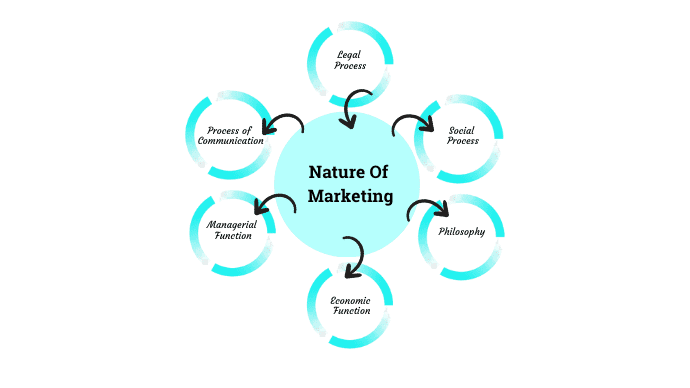
When businesses discuss the nature and scope of marketing, they often explore how marketing functions as both a strategic and operational activity. The marketing nature and scope, therefore, include communication, planning, analysis, and relationship building with consumers. It includes the following elements –
1. It is a Process of Communication
Marketing is the process of communicating with consumers and stakeholders with the objective of maintaining customer relationships, managing stakeholder expectations and driving more business. It also directs the flow of services and products to the end-user.
For Example, Nike uses social media campaigns to communicate both product benefits and brand philosophy, engaging customers emotionally while providing relevant updates on new launches.
2. Marketing is a Managerial Function
The particular marketing approach of an organisation is influenced by the management policy. It is the management policy that dictates the kind of marketing campaigns to run and sets the brand’s communication style.
For instance, Coca-Cola’s “Share a Coke” campaign reflected a managerial strategy to personalise consumer experience. It boosts sales through consumer engagement.
3. Marketing is a Social Process
Marketing to the end consumer plays a vital social role. Through different marketing channels, the consumer is introduced to a desirable standard of living. To create an optimised marketing strategy, you must be informed about the consumer’s changing needs and expenditure patterns.
4. Marketing is a Philosophy
It is the key guiding principle that defines the communication and organisational policy of a company. As a policy, marketing requires you to establish ground rules on the messaging and the brand’s overall ideology.
Tesla’s marketing philosophy revolves around sustainability and innovation, which shapes all their communication and product launches. You must ask yourself questions like – what kind of experience do I want to deliver with my product or service? Whose aspirations am I serving? How will my business ease the pain points of my consumer? And what kind of role will my product/service play in the life of the consumers?
5. Marketing is a Legal Process
In its essence, marketing is an elaborate legal process through which the ownership of a product is transferred to the consumer. It is the way an enterprise discovers and identifies the needs of the market and transforms them into marketable products and services.
6. It is an Economic Function
Marketing, at its roots, is an economic function. Through different marketing strategies, the consumer is encouraged to take economic action. This action is transactional in nature and underpins the availing or procuring of a product/service in exchange for money.
7. Objectives: Consumer Satisfaction & Profit Making
After all, marketing is an objective-driven action that requires a methodical approach. The ultimate goal of marketing is to satisfy consumer needs and expectations and, by this means, generate profit for an organisation.
What are the Scopes of Marketing?
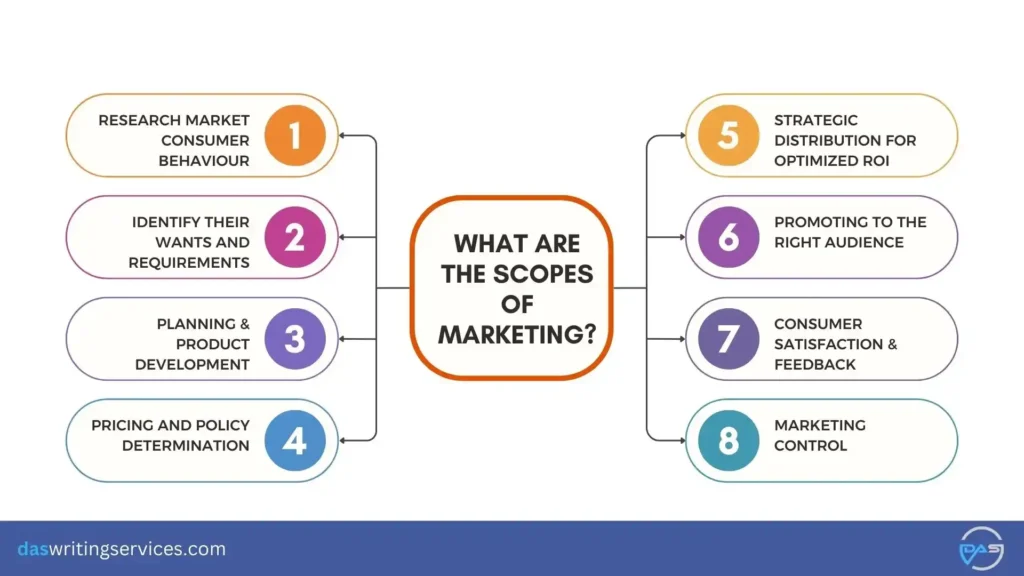
The scope of marketing involves both science and art which requires a dynamic approach to solve real-world problems and crises in society. In modern business, the marketing department uses key strategies to guide a product from conceptualisation, development, and execution to promotion and distribution.
1. Research Market Consumer Behaviour
The first and foremost role of marketing professionals is to be familiar with the expectations and expenditure patterns of the consumer in general. A thorough understanding of what they like to purchase.
For this, Spotify uses listening habits to recommend personalised playlists, directly reflecting user preferences to increase engagement and subscription revenue.
Such market research helps determine the time and strategy behind your product launches. It lies in the nature of marketing management to gauge who could be your true consumers and strategise as per their behaviour.
2. Identify Their Wants and Requirements
To ensure a streamlined product launch and satisfy the user demand, marketers first need to identify the pain points of the audience. For instance, Amazon Prime’s personalised recommendations and targeted email campaigns increase purchase likelihood by aligning with individual user preferences. Studies on arXiv suggest that effective personalised marketing strategies can increase business revenue by up to 40%.
3. Planning & Product Development
In this phase, the idea of the product is conceptualised. Inputs from the marketing team allow the production team to create user-centric products that can address real-world challenges. With the ideation of the product done, it lies in the scope of marketing channels to determine the correct marketing strategy that addresses the consumer demands and desires.
4. Pricing and Policy Determination
Marketing professionals may leverage various factors in the product development cycle to identify the correct pricing. It takes into consideration existing competition in the market and the expenditure pattern of the target audience. The strategy should help marketers determine attractive packaging and prices that encourage buyers.
5. Strategic Distribution for Optimised ROI
Identifying the proper distribution channel for the product is vital to optimise your ROI. Your marketing team must have solid data about the targeted demography and which marketing channels are useful to get desired outcomes without spending a lot on customer acquisition. To ensure maximised sales, the distribution line must ensure wider target group outreach at the minimum cost.
6. Promoting to the Right Audience
In this step, marketers can use a mix of online and offline marketing channels to promote the product or service. Digital platforms now dominate promotional strategies. Digital advertising is expected to make up about 73.2% of global ad revenue in 2025, according to the WPP Media Advertising Forecast 2025.
7. Consumer Satisfaction & Feedback
Every product or service is created and distributed in the market with the end goal of satisfying the user’s demand or making their life easier. Therefore, after market distribution, it is essential to get feedback from the clients on how the product is being received. Depending on the kind of response, a future iteration of the same product or service can be improved to target the maximum number of potential customers.
8. Marketing Control
It falls to the marketing department to ensure that the strategies implemented are able to produce the desired amount of results. After the product distribution and launch, marketers perform an in-depth audit to determine the utility of the approach and optimise it accordingly.
What is the Essential Purpose of Marketing?
The modern role of marketing goes way beyond the simple promotions of a product and/or service. It is an influential tool that helps in establishing and fostering long-term relationships with clients and the entire target group at large.
According to Machine Learning Marketing Statistics 2025 by Amra & Elma, AI-driven marketing campaigns can increase conversion rates by about 14% and reduce customer acquisition costs by up to 52%.
In this way, the purpose of marketing operations can be categorised into the following –
1. Recognising the needs and expectations of the consumer
Understanding the pulse of the market lies at the core of your marketing operations. It includes identifying the pain points of the consumer and coming up with innovative solutions that address the problems of the consumer.
For example, PepsiCo monitors changing snack preferences, launching products like Baked Lays to meet health-conscious demand.
2. Develop products and services that contribute value to the end-user
The second phase of the marketing operation requires you to translate raw data and subjective preferences into quantifiable user-oriented products and services. The primary goal in this phase is to conceptualise a product that users can instantly identify with and are encouraged to interact with.
3. Effectively communicate with the audience to increase profitability
Now this is the final and most vital purpose of a marketing operation – the promotion. Once the product or service is ideated, it requires an elaborate marketing plan to create awareness among the target group. It may be through targeted ads, local SEO, or social media marketing campaigns – marketers need to choose the ideal tool that may provide streamlined results against the campaign.
For example, if you are selling comic book merchandise that targets teens and young adults, social media and influencer marketing may be the more ROI-driven choice out there.
What is the Key Importance of Marketing?
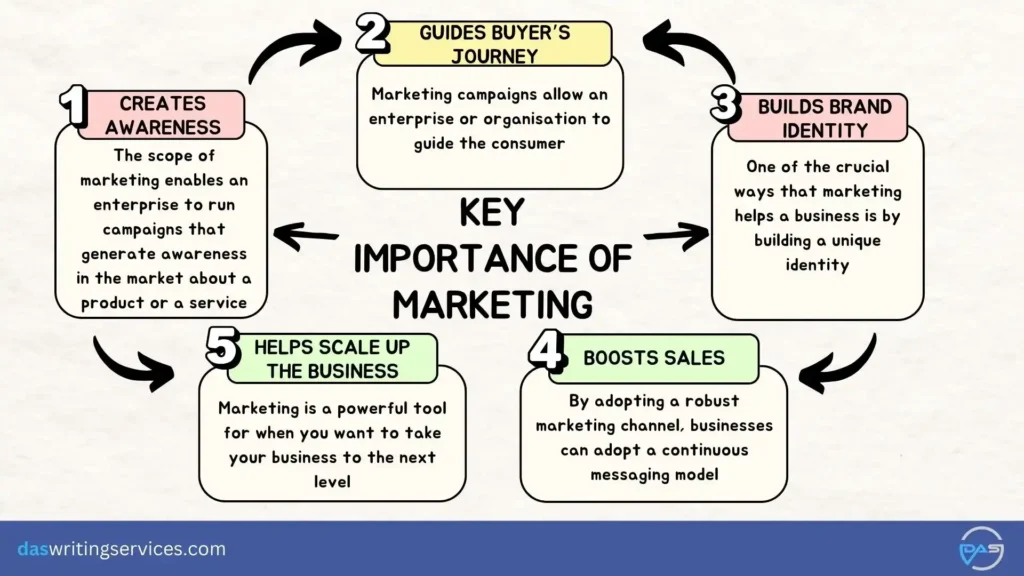
Marketing is directed at consumer satisfaction. In its natural form, marketing operations fulfil the needs of the market to help an enterprise earn profits and boost its sales. Here is a thorough breakdown of the various significances of marketing:
1. Creates Awareness
The scope of marketing enables an enterprise to run campaigns that generate awareness in the market about a product or a service. This is also the preliminary step of marketing and helps lay the groundwork during product launch.
2. Guides Buyer’s Journey
Marketing campaigns allow an enterprise or organisation to guide the consumer, offering knowledge and the relevant guidance that ultimately leads to purchase.
Let us take 3D printers as an example.When a company sells 3D printers, it may produce customised web blogs, articles and videos that educate and inform people. Different genres of web-based content work as marketing tools that illustrate the benefits of 3D printers and create the necessary knowledge crucial to operate one.
3. Builds Brand Identity
One of the crucial ways that marketing helps a business is by building a unique identity. It takes creativity of thought and expression to crack an exclusive message that works for your company.
So, it falls upon the marketing department to conjure up a distinctive message that fosters better communication between the company and the target audience. And thereby establishing a brand identity that creates a unique position among the competition.
4. Boosts Sales
By adopting a robust marketing channel, businesses can adopt a continuous messaging model. It may include targeted advertisements or Search Engine Marketing (SEM) to get maximum visibility to the target group of audience. And thereby increase the sales of your products.
5. Helps Scale Up the Business
Marketing is a powerful tool when you want to take your business to the next level. Whether you are targeting a new demographic of audience or trying to offer a variety of services, let your existing reputation guide your new journey.
It reduces the obstacles of capturing a new market or penetrating a segment different from your core products and services. Thus, utilising marketing tools effectively can help you avert multiple roadblocks to a flourishing business.
What are the Different Types of Marketing?
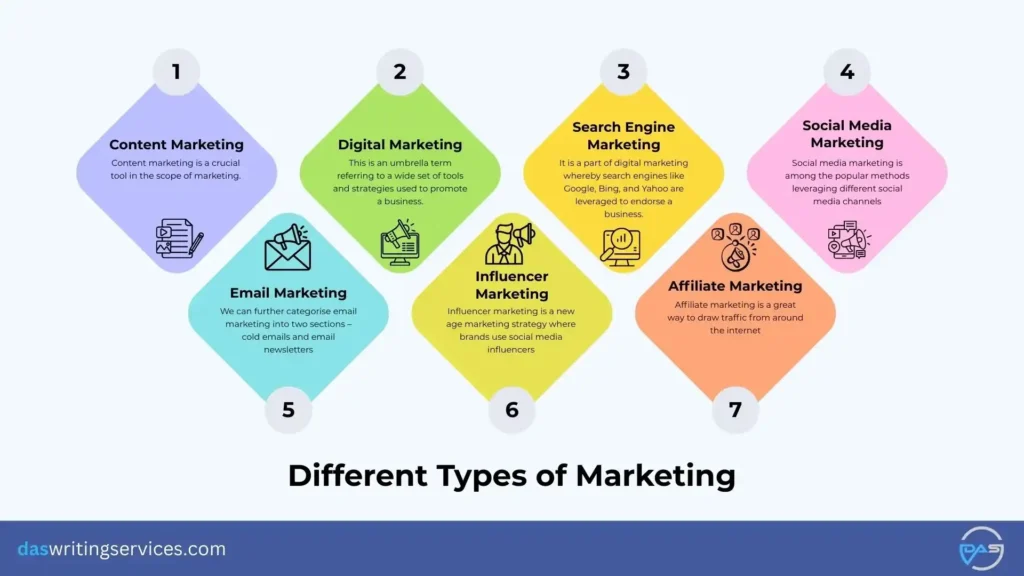
In this digital age, marketing has gone through a severe transition to introduce several new strategies. According to the AI Trends Statistics Report 2025 by TwinStrata, about 75.7% of digital marketers use AI tools for advertising, analytics, and content creation.
This helps target consumers in different phases of their buying journey along the marketing funnel. Some of the prevalent marketing methods include –
1. Content Marketing
Content marketing is a crucial tool in the scope of marketing. It helps an enterprise target consumers across the spectrum by promoting useful content in search engines and AI searches. Mostly, such content would contain thorough information about a product or service and help middle-of-the-funnel users to make an informed decision.
By the way, we, at Das Writing Services, are the content marketing specialists. Get in touch to know more!
2. Digital Marketing
This is an umbrella term referring to a wide set of tools and strategies used to promote a business. Digital marketing includes PPC (pay-per-click), targeted ads, sponsored links and a variety of other methods to connect with the audience and influence their buying patterns.
3. Search Engine Marketing
It is a part of digital marketing whereby search engines like Google, Bing, and Yahoo are leveraged to endorse a business. Marketers strive to target intent-specific keywords with Search Engine Optimised content that ranks high on the SERP and draws an increased amount of traffic to the website. Around 86% of SEO professionals now use AI-powered tools for keyword research and optimisation.
4. Social Media Marketing
Social media marketing is among the popular methods leveraging different social media channels like Facebook, Instagram, Snapchat, TikTok and X (formerly Twitter) to recommend a product or service. It may include sponsored posts, videos or micro content like Reels to create awareness about a product and draw a relevant audience to the website.
5. Email Marketing
We can further categorise email marketing into two sections – cold emails and email newsletters. While newsletters are a prevalent practice to grow enthusiasm and awareness among the dormant audience, cold email can be good to draw relevant traffic to your website. Needless to say, newsletter audiences are more likely to convert than cold email recipients.
6. Influencer Marketing
Influencer marketing is a new-age marketing strategy where brands use social media influencers and their established audience base to reach a potential target group. It mainly relies on the influencer’s audience and brand image to create a reputation for a new product. It is mainly useful for new products or brands to create a niche audience base and kick-start their marketing campaign.
7. Affiliate Marketing
Affiliate marketing is a great way to draw traffic from around the internet. This is also a potent tool for SEO, as affiliate marketing helps to get backlinks from relevant websites with higher domain authority and helps send trust signals to your site.
What are the 4P’s of Marketing?
As discussed already beforehand, marketing is not only about promoting a new product or service. By establishing communication between consumers and enterprises, marketing plays a crucial social role in bridging the gap between businesses and the market. The 4 principles of marketing define its crucial role –
- Product: the actual commodity. It considers the usage of the product and how it may affect the pain points of the audience.
- Price: How much will the company charge for the offering? It determines the target group of the product.
- Place: It identifies where the product will be sold. In a physical store or online store.
- Promotion: Finally, here the approach for promoting the product is determined by the company.
The scope of marketing a product depends on these four pillars that go on to identify the correct approach.
What is the Difference Between Marketing and Sales?
While marketing is a set of practices with multiple tools and strategies used to streamline the promotional operation, sales is a single, objective-driven practice. In this way, let us elaborate on how marketing is different from sales:
| Marketing | Sales |
| It is a systematic strategy to promote a product or service and establish communication with the audience. | It is a straightforward transaction where the buyer receives a product or service in exchange for money. |
| It is extensive in approach and relies on predicting the trends and requirements of the market. | It is only concerned about closing a sale, i.e. performing a transaction. |
| Marketing is entrusted to create new demands in the market. | Sales are expected to fulfil the demands of the market. |
| The target is broad and focuses on a particular group. | Target is small, and it focuses on only one person or an organisation at a time. |
| It requires creative as well as critical problem-solving skills | Salespeople need good communication skills and persuasive capacity. |
What is the Difference Between Marketing and Advertising?
Although in layman’s terms, marketing and advertising these two terms are interchangeable, they are naturally separate and serve quite different but associated functions. Let us have a look at how marketing is different from advertising:
| Topic | Marketing | Advertising |
| Approach | Identifies customer needs and determines the strategy to meet the needs. | It involves continuous communication through marketing channels to promote a product or service. |
| Focus | Strengthening customer relationships. | Encouraging users to complete a transaction. |
| Scope | It is long-lasting and can promote a brand as a whole. | The duration is shorter and usually promotes a single product or service. |
What are the Future Trends in Marketing?
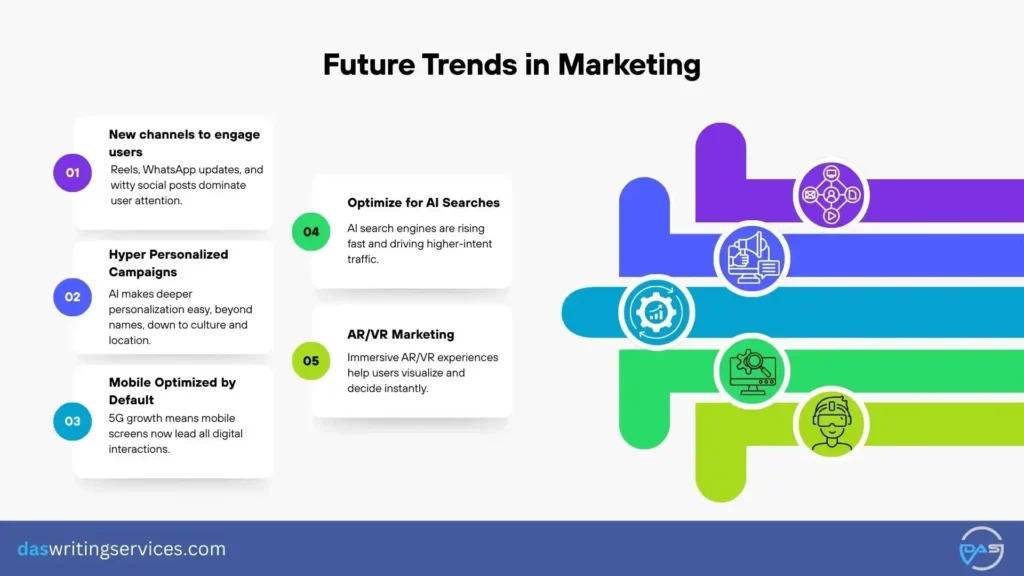
According to the SalesGroup AI Marketing Statistics Report 2025, the global AI-driven marketing industry reached about $47.32 billion in 2025. It is expected to grow quickly over the next decade. These are some key future trends you can observe in marketing in the near future:
1. New channels to engage users
Once novel marketing channels like reel format ads and WhatsApp marketing are used by every second business. And an unspoken law in marketing is that whichever channel has more promotional communication, users tend to ignore that. So if you are an established brand targeting a saturated industry, exploring new channels gives a fresh new appeal to the brand.
Check out the above image, Zapier and other popular brands are using humorous captions and remarks across their own and peers’ social handles. Instead of mechanical professional communications, the personalised remarks help foster better engagement with the target audience.
2. Hyper Personalised Campaigns
Thanks to automation and AI, creating personalised marketing communications has never been easier. It is no longer about mentioning the first name to draw attention. A 2025 survey by XtendedView found that more than 85% of marketers use AI tools for content creation and campaign personalisation. Personalising as per location, local customs, and festivities are some of the emerging future trends that marketers need to look out for.
3. Mobile Optimized by Default
5G is no longer an isolated futuristic model. By 2030, the number of 5G users is expected to surpass 6 billion active users. With superfast mobile data connections, mobile devices are already the dominant device for most consumers. Hence, optimising predominantly for mobile users only should be the norm for quite a few industries like fast fashion and FMCG.
4. Optimise for AI Searches
Research suggests that while AI searches are still marginal across LLM-based RAG models, the user shares are rising. Google still dominates organic search, but AI searches have higher purchase intent and enhance brand reputation. Optimising content for all-around visibility is the need of the hour to make your brand noticeable and inspire credibility.
5. AR/VR Marketing
While virtual reality and augmented reality are yet to see mass market adoption, both these infrastructures cater to niche audience groups. Optimising content for AR & VR can help marketers drive precision marketing communications. For instance, the real estate and interior decoration industry can benefit immensely from AR/VR integrated campaigns, which let the user visualise and produce enhanced immersion and hence conversion.
Takeaway
Having all said, you should have a comprehensive understanding of the scope of marketing in the digital age. Since marketing strategies rely on industry practices, it always remains a dynamic strategy that requires revisions with time to stay relevant. You can read more about future-proof marketing trends in our blog on metaverse marketing strategies.

Ritish Dutta is a seasoned Content Developer with over 7 years of experience in the industry. Currently, at Das Writing Services, he writes SEO-optimized content that caters to our diverse clientele. Ritish utilizes his critical insights and experience to talk about digital marketing, SEO content writing, content strategy, and AI.


All Comments
اخرین اخبار سامانه یکپارچه خودرو وارداتی
bookmarked!!, I really like your website!
Mike Bamusi
Good book
бнанс реферальний код
Can you be more specific about the content of your article? After reading it, I still have some doubts. Hope you can help me.